The agriculture industry is experiencing a major change as technology is allowing agriculture owners to produce more food, using less resources. One of the biggest breakthroughs is the IoT Polyhouse Monitoring System, which is modernizing the controlled environment agriculture (CEA). Polyhouse crops are grown in a protective structure that uses environmental controls, like a greenhouse, to protect crops from pests and other environmental factors while allowing the farmer to manage the climate.
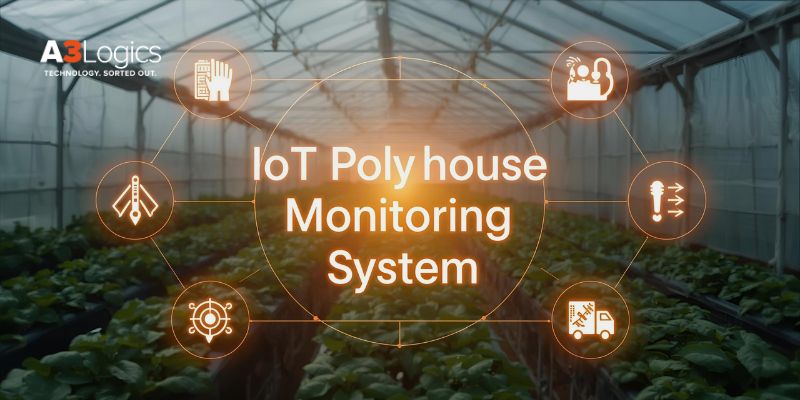
When an IoT Polyhouse Monitoring System with smart sensors connected to cloud infrastructure is used, growers achieve precision control. It enables real-time monitoring and automation of farming, ensuring plants grow healthy with minimal waste for better crop productivity. Farmers gain transparency to make informed decisions that optimize resources and improve sustainability.
Applying this system in agriculture demonstrates how technology modernizes farming practices effectively. Various agriculture owners have successfully implemented IoT Polyhouse Monitoring Systems to maximize yields and enhance efficiency.
IoT Polyhouse Monitoring System for Agriculture: An Overview
An IoT Polyhouse Monitoring System for Agriculture is a digital-enabled system that interconnects sensors and actuators to Cloud platforms, to monitor, control and automate environmental parameters inside the polyhouse.
It is important to note that an IoT Polyhouse Monitoring System revolutionizes a farmer’s ability to monitor and control, via smartphone or computer, the critical aspects of the environment within a polyhouse vs normal greenhouse monitoring including temperature, humidity, light, soil conditions, etc.
Recent reports indicate that the market for IoT in agriculture, including polyhouse monitoring, is reaching $30 Billion across the globe by 2030. This estimated reach demonstrates the growing value of smart automation in food production and for agricultural owners.
How Does an IoT Polyhouse Monitoring System Work?
At the heart of any IoT Polyhouse Monitoring System are smart sensors and controllers, created especially for an agricultural environment. The sensors measure data on a variety of parameters including temperature, humidity, soil moisture, and light intensity. The data obtained is sent via communication interfaces (Wi-Fi, LoRaWAN or Zigbee) to a central cloud platform where it is stored and analyzed.
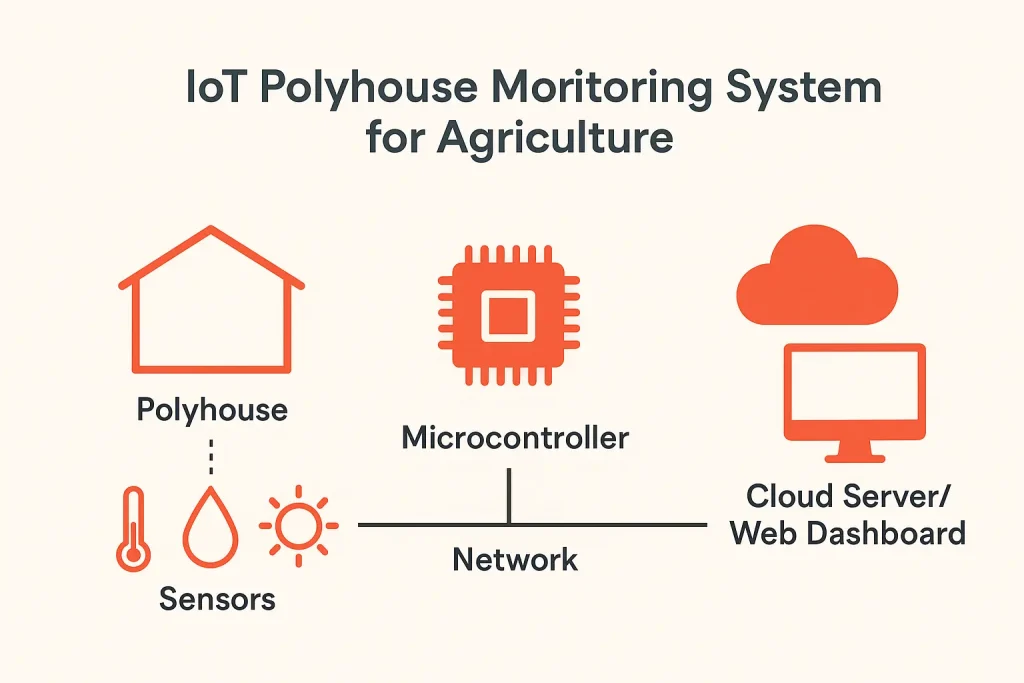
The farmer/ grower can visualize this data on mobile dashboards and receive alerts in real time should anything be outside normal range. In many applications the system is able to take an action automatically (e.g. point source ventilation, foggers or irrigation) if the conditions exceed pre-determined boundaries. In most cases, the closed-loop feedback system maintains optimal environmental conditions, resulting in few manual interventions.
The Tangible Benefits of an IoT Polyhouse Monitoring System
There are many measurable benefits to Farming with an IoT Polyhouse Monitoring System:
1. Maximize Yield & Enhance Crop Quality
Advanced monitoring and automation create constantly ideal growing environments, nutrition schedules, and pest control. Plants go through less stress events leading to higher yields, and a higher quality of production. There are improvements to 30% productivity gains based on IoT enabled polyhouse solutions.
2. Dramatically Reduce Resource Usage
IoT for Polyhouse Monitoring enables optimal scheduling and distribution of water, fertilizers, and electrical allotments. Automated irrigation and fertigation quantity that is restricted on data from surrounding conditions such as soil moisture, and weather events, ensuring garden waste is reduced to near nil. Effective management of the growing environment can save up to fifty percent on water usage with close savings on energy costs.
3. Mitigates Risk and Prevents Crop Loss
The early warning system of an IoT Polyhouse Monitoring System will allow farmers to recognize and act on threats to their crop such as pest outbreaks, disease, and mechanical failures quickly. Automation will help ensure that critical life-supporting conditions for polyhouses such as heat and humidity are not reliant on our needing to be present, thus preventing failures caused by human oversight or absence.
4. Unprecedented Operational Efficiencies
By automating labor-intensive tasks like climate management, watering, and nutrient dosing, these systems reduce manual workload significantly. Moreover, they lower fixed costs associated with employment while improving operational efficiency. As a result, operators of large polyhouses can manage environmental and irrigation factors remotely.
Consequently, this capability allows them to scale production without drastically increasing fixed overhead expenses.
5. Decision – building Data for Smarter Agronomy
Data is continuously captured for analytic learning and improved decision-making in crop planning, disease forecasting, and maintenance scheduling. Data driven decisions mean farmers can rely on what the data indicates resulting in maximizing the quality of every level of resource that could mean the performance of the crop as a high value resource.
Key Components of IoT-Based Polyhouse Automation
Developing a comprehensive IoT Polyhouse Monitoring System project is reliant upon a number of technological building blocks:
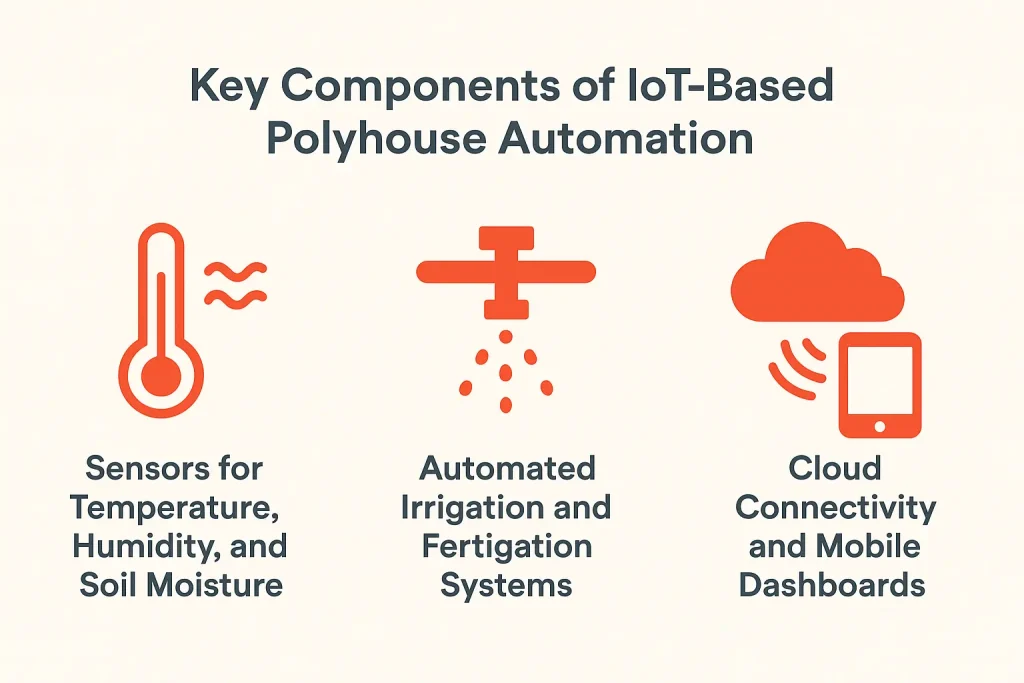
1. Sensors for Temperature, Humidity, and Soil Moisture
A comprehensive IoT Polyhouse Monitoring System must include a variety of technological building blocks. The DHT11 sensors provide reliability for temperature and humidity measurements. They also indicate when plants incur heat stress or mold. The YL69 soil moisture sensor will monitor soil moisture so that the system can perform smart irrigation. The information from these sensors construct IoT for Agriculture Monitoring.
2. Automated Irrigation and Fertigation Systems
In association with actuators and solenoid valves, an automated irrigation and fertigation system, simply controls water and nutrients. The system will adjust volume and timing to plants’ needs continuously and in real-time, and we know precision is important in getting it right—no more, no less
3. Cloud Connectivity & Dashboards
The most modern systems will save data in the cloud and ensure the data is always safe, and available anywhere. Easy-to-use mobile and web dashboards will allow farmers to monitor their environment and control their devices.
Use Cases of IoT Polyhouse Monitoring Systems for Agriculture
The implementation of an IoT Polyhouse Monitoring System for Agriculture is bringing exciting possibilities across the following areas:
1. Climate Control and Environmental Monitoring
Automated use of rolling shutters, foggers, and ventilation based on sensor data are all used to maintain ideal temperatures and humidity, even for the most sensitive crops within the polyhouse.
2. Smart Irrigation and Water Management
Soil, weather, and irrigation sensors can communicate with irrigation controllers to apply the `right amount of water` for every crop while avoiding over-application of water. Automated scheduling eliminates the problem of when to irrigate and prevents over-irrigation, ultimately ensuring that the `right amount of water` is applied, conserving water, and preventing root-borne diseases.
3. Nutrient and Fertigation Control
Automated fertigation units can communicate with sensors that monitor nutrient levels and the crop schedule to accurately dose and deliver liquid fertilizer, ultimately resulting in robust and healthy crop growth curves.
4. Pest and Disease Monitoring
IoT sensors that monitor the worked environment can be implemented to signal deviations that may be conducive to the onset of pests and diseases, like excessive humidity and temperature changes. Automated dispensing of pesticides and sending alerts regarding environmental signals is useful for `prevention` and managing issues early when outbreaks occur.
5. Remote Monitoring and Farm Management
Farmers and others are able to remotely track their crops’ growing process and to verify operations through mobile apps from any location, typically with real-time updates that can also be adjusted for climate controls or instantly notified when conditions are outside parameters. This is highly valuable for managing multiple sites or large operations.
Step-by-Step Implementation Guide for IoT Polyhouse Monitoring Systems
1. Conduct Feasibility Study
Evaluate your farm’s present scenario, crop growth plans, resources available, interaction with your critical crops in terms of size, local climate, and problem areas. Set targets regarding effectiveness, quality, or sustainability.
2. Select IoT Hardware
Additively,-order one of the reliable sources of ruggedized sensors and controllers that met your polyhouse’s. Temperature, humidity, soil moisture, CO₂, and light are common parameters to select.
3. Install Automation Tools
Install actuators i.e., valves for irrigation, any climate controlled equipment, fertigation pumps. Ensure any automation fits with the chosen sensors and central controllers.
4. Connect with Cloud Platforms
Set up gateways and either choose an IoT platform (AWS, Azure, custom) and secure the connection to the platform. Connect your dashboards for real-time use of data in both accessing data and controlling systems.
5. Train Employees
Teach farm people to use the system, navigate their app, maintain their use of IoT systems, and troubleshoot in emergency situations to maximize uptime and return on investment.
6. Maintenance is Key
Should maintain each system regularly, i.e. check to see if sensors are calibrated appropriately, actuators function as intended, and connectivity is stable…look for wear and replace if required. You may have to update firmware and replace batteries over time, or if sensors stop functioning altogether, you will at least know when required to replace or repair as part of your planned maintenance.
Implementation Cost of IoT Polyhouse Monitoring Systems in 2025
The cost of an IoT Polyhouse Monitoring System Development project can vary widely based on capacity and the extent of the level of automation:
- Basic Setup: $2,000–$5,000 (sensors and a dashboard for 500–1,000sq ft)
- Full Automation: $8,000–$25,000+ (large farms, advanced analytics, multi-device integration)
As with any system, there is a range of ongoing costs associated with subscriptions to the platform, replacing sensors, conducting periodic maintenance, etc. While the initial cost might be high, the payback consists of lower losses against crop failures, labor savings, and increased yields.
Challenges in Implementing IoT-Based Polyhouse Monitoring Systems
1. Data Security & Privacy
Because IoT Polyhouse Monitoring Systems handle sensitive sensor and crop data, strong cybersecurity frameworks will be essential. Among the threats these systems face are risks of hacking or even breaches of data that can compromise yield schedules or insight into proprietary methods on a farm.
These systems will incorporate a number of different features to protect this valuable information and establish compliance with data and privacy, including encryption, secure authentication, and frequent security audits, which will instill confidence in farmers and protect their remote activities.
2. Compatibility
Many farms have installed infrastructure that was not built with the intention of integrating with IoT for Polyhouse Monitoring System devices. Bringing these systems into interaction often requires custom bridges, retrofit older hardware, or significant investment in interface modules, which can hinder the integration of the new and often require hours and hours of expert time in fashioning the integration and ceasing significant outlays on hybrid technologies.
3. Reliability
Consistent operation is essential for Polyhouse IoT. A faulty sensor or actuator due to power outages, connectivity issues, or software bugs will result in a disconnect between the environmental control and the Polyhouse. Even a small lapse in operating a sensor or actuator could have catastrophic consequences like watering, overheating, or unknown stress to the crop.
It is prudent to incorporate redundancy, failovers, and real time monitoring to avoid or manage those risks in the system and to avoid risking crops that may be sensitive in their growth stage.
4. Skill & Adoption Barriers
While developing a Polyhouse IoT Monitoring System and ultimately experiencing success, there is an expectation that users of the system will embrace a digital interface and some automated routine. Farmers, and staff, who have been compliant in the nature of their manual task, may require extensive training to conduct dashboards, interpret analytics, and diagnose problems within the environment.
Some resistance to these new tools may delay a return on investment, therefore it is helpful to develop a change management strategy with ongoing support to help with the widespread adoption of the system.
5. Maintenance
A Polyhouse is a harsh environment for devices, it exposes them to a large amount of humidity, dust, fertilizers, and constantly changing temperature levels; this unique environment may reduce the accuracy of a sensor or inactivate an actuator. To maintain the prescribed accuracy of the devices, the operation team will be required to implement regular calibrating schedules, repair or fix damaged equipment in a timely manner, and be compliant with any consistent maintenance requirements to keep stresses to the wearable and all components of the IoT for Polyhouse Monitoring System.
Latest Trends in Smart Agriculture and Polyhouse IoT
1. AI & Data Analytics
With machine learning and IoT sensors combined, farmers gain richer insights, predict pests, and forecast crop yields. They can also adjust environmental controls in real time to improve crop health and efficiency. This trend empowers farmers to make proactive, data-driven decisions that are actionable and timely. As a result, resource waste is reduced while productivity increases across the smart agriculture ecosystem.
2. Blockchain Traceability
By recording vital farm data like environment and crop interventions on blockchain, producers ensure transparent and tamper-proof traceability. This process improves food safety and enables premium pricing opportunities in competitive export markets. It also strengthens trust between farmers, suppliers, regulators, and consumers.
3. Edge Computing
Alongside blockchain traceability, performance analytics processing locally on local controllers reduces response times, and less reliance on uninterrupted internet connections. For example, edge devices monitoring the polyhouse environmental conditions (temperatures, humidity), providing immediate corrective actions, and storing data during connectivity blackouts adds value to making the IoT Polyhouse Monitoring System for Farming more robust and efficient.
4. Energy-efficient Hod Cloud Designs
Solar-powered IoT devices and low-power wireless protocols (like LoRaWAN, or Zigbee) reduce operating costs and reduce carbon emissions for sustainable farming. Sustainability with automation supports critical polyhouse functions in areas of unreliable electric grids and supports the Green economy goals within Governments and Climate Change.
5. Integrating Drones and Robotics
Drones provide aerial mapping with cameras and sensors, disease scouting, and targeted spray applications. Polyhouse robotics provide effective automation for pollination, and harvesting with IoT sensors bringing immediate synchronized interventions across the polyhouse floor and space for faster and more accurate operations. A new frontier of highly efficient, autonomous agriculture/crop management is upon us!
Why Partner with A3Logics for IoT Polyhouse Monitoring System Development?
A3Logics is a best-of-breed IOT Development Company, with a focus on smart agriculture. They are experts in IoT for Polyhouse Monitoring Systems, cloud platforms, and user-friendly dashboards. They take a comprehensive end-to-end approach that is customer-specific and customer-sized. With recent advances in smart agriculture, A3Logics has a proven approach for quick deployment, ongoing support, and integration of the cloud into your existing operations.
With brand new IOT for Agriculture assessment technology, predictive analytics, and increased data security, A3Logics not only helps their customers deliver more yield but also mitigates the operational headaches associated with security issues.
Conclusion
The IoT Polyhouse Monitoring System is a fundamental building block for sustainable and profitable agriculture. Farmers are now using data, automation, and insight from the cloud to address productivity by reducing waste and making better informed choices, while preparing their farms to face the challenges underpinning modern agriculture. As the demand for high-quality produce increases, and climate unpredictability becomes a more common occurrence, smart agriculture taking advantage of IoT brings solutions to small farmers and commercial producers alike.