
Optical Character Recognition (OCR) converts various types of text within various kinds of documents, including- PDFs, photos, invoices, scanned images, and more, into machine-readable formats. With businesses juggling a large number of documents, there is a growing need for advanced measures such as AI-powered OCR software as compared to traditional OCR methods.
In this post, we’ll have a look at how AI optical character recognition solutions can enhance business workflow and how they work.
Why is AI integration a game-changer in document analysis?
By using AI for document analysis, businesses can process thousands of documents quickly. This also includes analyzing batches of documents with complex information without getting tired and eventually making better decisions every time. Another benefit of AI OCR technology is that it doesn’t just process documents; but it also learns from them. AI-OCR software can also help businesses automate routine, time-consuming tasks such as data categorization and cleaning.
Market adoption and industry relevance
AI-powered OCR is relevant across industries. It enables accurate and fast extraction of text from documents, forms, and images. It caters to industries such as – logistics, healthcare, finance, and others by automating data entry.
- Intelligent Document Processing that centers on AI OCR to grow from $2.4 billion to $10.5 billion by 2028 (a 35% annual growth rate).
- Google’s Vision OCR leveraged deep learning and correctly extracted about 98% of text from a mixed set of printed and handwritten documents.
- In 2024, more than 45% of OCR software updates included machine learning upgrades for better contextual recognition and language detection.
What is AI-Powered OCR?
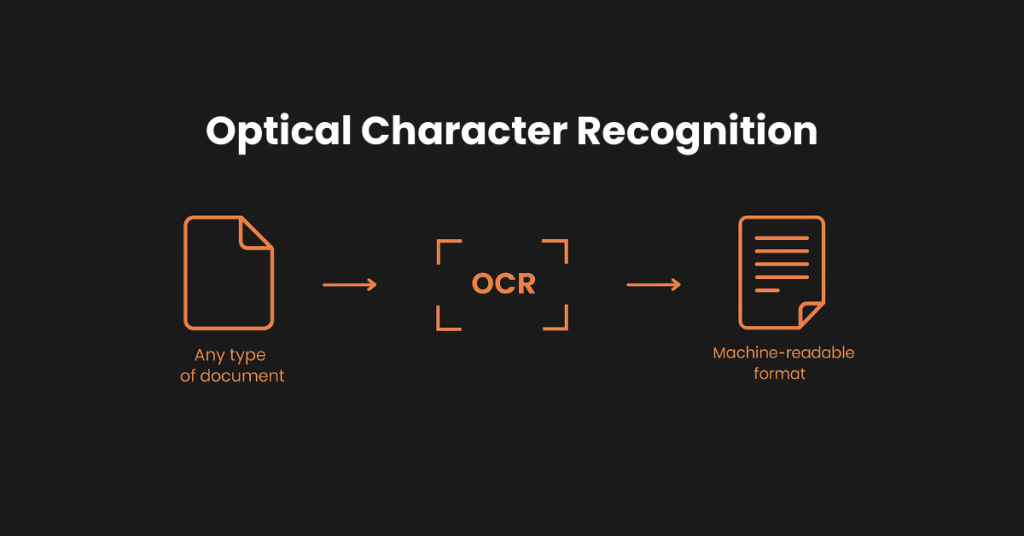
1. How is AI-powered OCR Different from Traditional OCR?
Traditional OCR uses algorithms based on rules to identify text in documents. It functions best with structured data, or information that is clearly formatted and organized. It works best with structured data because structured data is consistent with layouts and formats and as such the scope of errors is less.
AI-powered OCR on the other hand, is backed with AI; It uses ML and deep learning algorithms, and natural language processing (NLP) to understand text. It continuously learns from the data, and can handle various fonts, complex data with multiple formats. IT improves over time and accurately extract data even from inconsistent documents.
2. Real-world applications across industries
| Industry | Use Cases Showing Application of AI-powered OCR |
| Finance | Data extraction from invoicesVerifying KYC documentsProcessing a batch of cheques Loan application automationFraud detection |
| Healthcare | Digitizing patient recordsAnalyzing prescriptions for personal treatment Processing insurance claimsInterpreting lab reports |
| Retail | Scanning receipts Product label recognition Digitizing the inventory list Scanning price tags |
| Logistics | Shipping label reading Digitizing the bill of lading Barcode recognition Delivery proof scanning Customer form automation |
| Government | ID card scanning Passport data extraction Tax form processing Land record digitization Legal document indexing |
How Does AI-Powered OCR Work?
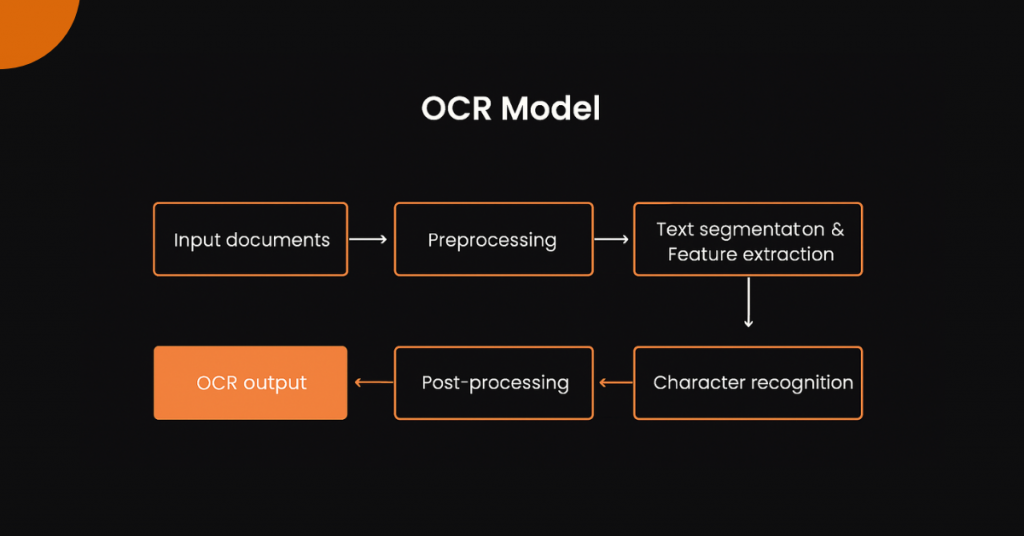
Step-by-step process:
1. Image Acquisition
A scanner is used to first scan the document. Once the document is imported, the OCR technology reads it. It converts the text into binary data. Then it uses computer vision to analyze documents that have elements of shapes, color, and texture. It identifies areas that include text and extracts structured data by recognizing characters, understanding layout, and interpreting context for accurate data capture.
2. Preprocessing
The AI OCR software processes the document or image to optimize its readability and quality. It removes noise and adjusts contrast, apart from deskewing the image by rotating it. All in all, it makes the image clear and well-defined.
3. Text Segmentation
Text segmentation in AI OCR software involves breaking content into characters, lines, and words to allow for further recognition. The whole processed text is cut into phrases, words, and characters. This step helps the OCR system understand the structure of the text. During this process; the software takes the scanned text and breaks it down into readable units. This makes it easier for AI to process each part of the text.
4. Feature Extraction
The AI-powered OCR software extracts important features from the text for further processing. The software focuses on features like shape of the text, texture, and other properties. By doing this; it identifies structures and patterns to understand context in an image. It adapts to variations, and converts images to text.
5. Character Recognition
The AI-OCR software uses ML and AI algorithms for analyzing the document. These algorithms are trained on large datasets. Using these technologies – the algorithms learn the relationships between corresponding characters. This enables the software to identify the textual content within the image.
6. Post-Processing
In the post-processing stage; AI/ML models are used to correct misrecognized words. To do that, it performs tasks such as spell-checking, context-based verification, and error correction to remove any errors.
How AI-Powered OCR is Transforming Document Processing & Analysis?
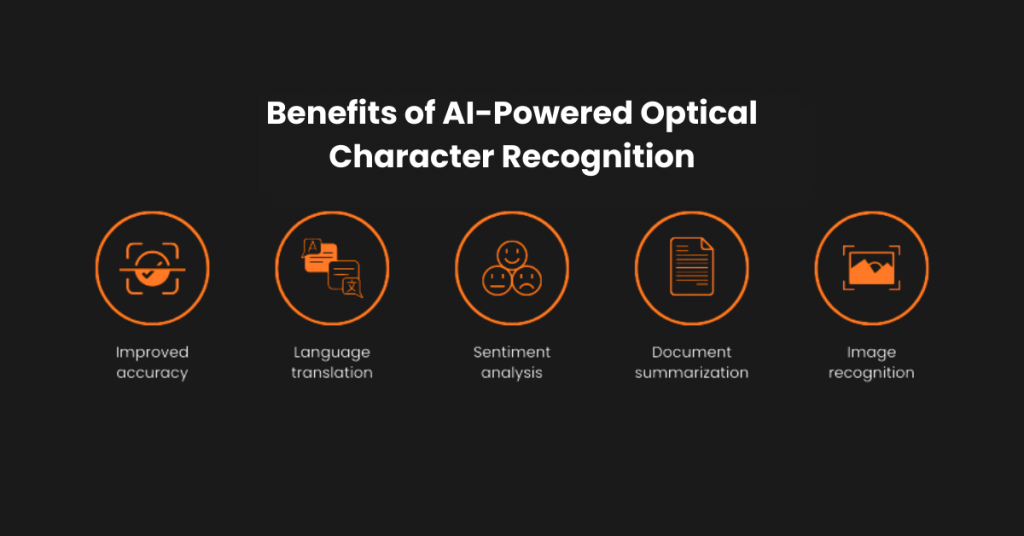
1. Improved Accuracy and Efficiency
AI-powered OCR software uses advanced ML and deep learning algorithms that are equipped for character recognition. By learning from massive training data sets, they can adapt to various fonts, styles, and languages, resulting in more accurate data extraction.
2. Language Translation
AI-enabled OCR software can translate text in scanned documents into various languages. One of the best aspects of this software is that it can pick up minute cultural nuances and idiomatic expressions. As such, they can provide a wholesome translation.
3. Sentiment Analysis
As compared to traditional feedback systems, OCR software that use deep learning technologies analyze text data, categorize it into positive, negative, and neutral sentiments, and extract important information. Using this information, they can make better data–driven decisions.
4. Document Summarization
AI-enabled OCR systems can summarise key points by skimming through large data volumes. To achieve this – they utilize natural language processing, machine learning, and deep learning technologies. The tools can offer personalized summaries and remove redundancies in text data.
5. Image & Pattern Recognition
When it comes to handling documents such as IDs, invoices, contracts, and forms, mere text detection capabilities won’t suffice. AI-powered OCR tools are capable of detecting images, people, objects, and other elements. They can detect and identify text and objects in images, identify faces, and categorise the captured data into various categories for easier analysis.

Business Benefits of AI-Powered OCR
1. Intelligent Automation & workflow optimization
One of the benefits of AI OCR is how it optimizes workflow, and it performs intelligent automation. Businesses can turn to AI OCR software development, and get a system developed with the help of which they can eliminate long and tedious data entry tasks of analyzing documents manually that are prone to errors.
2. Improved Data Security and compliance support
Improved data security is a key benefit of AI OCR. Here’s how: using AI OCR technology, businesses can transform their paper documents into digital formats that are safer to handle and store. Most AI optical character recognition software come with cloud storage options that guarantee robust security for sensitive documents.
3. Reduced Operational Costs
If, as a business, you wish to reduce operational costs, AI OCR software development can be a wise move. By integrating AI based OCR tools into their operations, organizations can automate manual data entry, which can later lead to costly human errors. Not just error reduction; AI in document processing can free up labor for more critical and strategic tasks.
4. Faster Turnaround & Improved Efficiency
AI in document processing can help analyze, organize, and process documents faster. It reduces manual intervention i.e. AI eliminates the need to enter data or manually validate it. This, in turn, leads to faster turnaround and improved efficiency.
5. Enhanced Customer Experience
With AI OCR software development, you can create solutions that accelerate processes such as document processing and identity verification, thereby reducing wait times. AI-based OCR systems improve customer satisfaction through accurate data handling, and efficient operations. Because of which they are able to resolve queries faster. They have the ability to personalize services based on insights from digital documents.
Limitations of Current AI-Enabled OCR Software
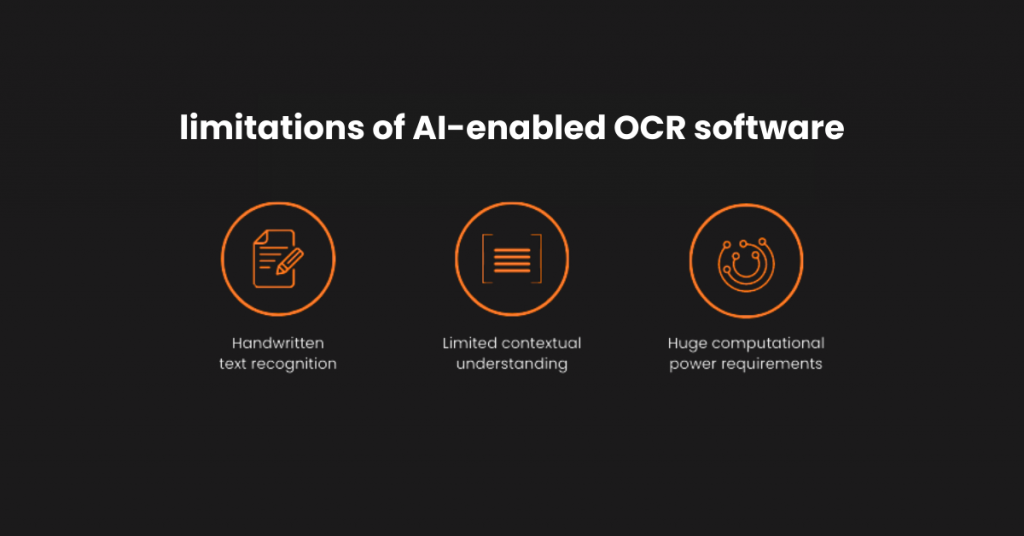
1. Difficulty with Handwritten Text Recognition
Although AI-powered OCR technology has advanced significantly, it still faces challenges in accurately understanding handwritten text, and it is still learning how to comprehend context. That’s because the handwritten text varies in clarity and style; making it difficult for a system to recognize it.
2. Limited Contextual Understanding of extracted content
AI OCR software still struggles with complex semantic analysis. It may or may not be able to comprehend the full context of a document. This holds true for those documents that contain complex speech patterns.
3. High Computational Power Requirements
Most AI-powered optical character recognition technologies run on advanced technologies such as ML, NLP, and deep learning. This implies that a high level of computing power is required to process them. Running AI OCR software can thus, be a challenge to small businesses who may be short on budget and who can’t afford to assemble powerful computers.
4. Dependence on Training Data Quality
The performance of AI OCR depends on the diversity and quality of the training data. The training data should include accurate fonts, styles, orientations, and image conditions so that the model can learn patterns and recognize text accurately. If the training data is biased, the OCR output will be unreliable.
5. Challenges in Complex Layout Handling (tables, forms, mixed media)
Even though the existing AI OCR technologies are advanced, AI in document processing can still make errors when handling layouts with complex elements, such as tables or those without clear borders or those with multi-column formats. This drawback can result in data extraction, which can be detrimental for enterprises that expect accurate results.
6. Limited Language and Font Support
When faced with historical documents, common scripts, and diverse typefaces, AI optical character recognition may face limited font and language support challenges. Non-standard and older fonts and complex scripts can be difficult for OCR to recognize and segment. Similarly, a lack of sufficient linguistic data for certain languages can make it challenging for AI to pick up context.
7. Black Box Nature – lack of interpretability in decision-making
If an AI-OCR operates as a “black box,” it can be challenging to understand the decision-making process of the AI or diagnose the problem, per se. It”s internal process will be hidden and not easily explainable. It might become difficult to understand how it makes decisions or why it has made a decision.
Generative AI in OCR Systems
1. Methodology
GenAI OCR systems leverage advanced generative models – to analyze and interpret text. Unlike traditional AI systems; Gen OCR systems don’t just rely on character recognition; instead, they go beyond that to understand context.
2. Adaptability
Unlike traditional AI-OCR tools that require retraining with new data, GenAI OCR utilizes advanced algorithms; These have the capability to continuously learn and adapt. They can understand new patterns and correct errors more intelligently without requiring continuous training.
3. Efficiency
Thanks to its Gen AI capabilities, AI-OCR offers intelligent document processing. It can handle a lot of scanned documents quickly because it doesn’t depend on fixed rules or instructions. All while understanding the context of these documents. Eventually, this leads to streamlining of workflows. AI based OCR can recognize and interpret a wide variety of fonts, complex layouts and handwriting styles.

Final Thoughts
As has been established in the post, OCR technology is no longer confined to simple text recognition. With AI, OCR can now understand context, extract data intelligently, and even analyze documents like a human. The future of OCR technology looks even brighter with developments in machine learning, enabling more accurate and real-time processing across multiple formats and languages.
This evolution is transforming industries, from healthcare to finance, making data extraction faster, smarter, and easier.
Why Choose A3Logics for AI-Powered OCR Development?

1. Expertise in AI/ML-driven solutions
As a leading company providing AI development services, we offer a wide range of AI solutions, including the smooth integration of custom AI applications into your workflows. With our machine learning solutions, you can leverage extensive algorithms, AI-driven models, and data analytics to grow your business.
2. Proven track record in enterprise automation
We have a proven track record in developing enterprise AI solutions. We offer full-cycle development, right from brainstorming to launch. And help enterprises implement AI in ways that can enhance productivity and efficiency. With our solutions, you can automate repetitive tasks. This way you can reduce the workload on your support teams. Our solutions can seamlessly connect with existing enterprise systems such as CRMs, ERPs, ITSM, and others.
3. Customized OCR systems for business-specific needs
We offer OCR systems; that help you with your business operations. We combine OCR with computer vision to convert text and images into useful insights. With our OCR service, you can automate tasks like facial recognition, document digitization, and defect detection across industries like manufacturing, retail, healthcare, and logistics.
4. End-to-end implementation and support
From ideation to post-launch, we provide end-to-end support and maintenance services. Our goal is to maintain optimized, secure, and up-to-date solutions. For this – we roll out regular updates and offer proactive and prompt solutions, ensuring that your AI systems perform at their peak all the time.