
Large Vision Models (LVMs) and their variants, Large Vision Language Models, are emerging quickly in the landscape of artificial intelligence. As data and computers continue to grow, large computer vision models are overcoming the restrictions of traditional methods and enabling new applications from automated diagnostics to reactive robot control and content generation. This guide is meant to help frame the world of LVMs, describe the main aspects and applications in use in the real world, overview the rise of large vision language models, and the challenges that they bring.
What are Large Vision Models in Artificial Intelligence?
Large Vision Models are advanced AI systems capable of understanding images, videos, and in some instances, multimodal data consisting of image and text. The architectures of LVMs use deep neural networks with 100 M, even a billion plus parameters, to learn from enormous data sets the complex spatial and semantic information that such data can provide. Additionally, LVM and similar comprehensive architectures process, segment, and reason about images without the use of hand-crafted features, which has enabled them to outperform other applications in breadth of knowledge and generalization.
In 2024, researchers reported that leading large vision models outperformed CNN-based tools on the majority of industry benchmarks and are being adopted very quickly for real-world multimodal applications.
Large Vision Language Models illustrate a powerful blend of visual and textual comprehension, generating systems that can caption images, answer questions pertinent to visual content, and even elaborate on or create new visual invitations to prompts in natural language. These models have set a new bar for integrated AI, and by 2026, it’s expected that their prolific development will double within enterprises.
Large Vision Language Models: Key Statistics
Large Vision Language Models, which are a type of LVMs that combine text and vision, have exploded in popularity and impact.
- Over 100 open-source Large Vision Language Models were released from 2023 to 2025, with benchmark dimensions exceeding many billion parameters (per model).
- Accuracy on multimodal reasoning tasks — such as responding to inquiries about complex scenes — grew from 60% capability with early models to over 85% accuracy with the latest LVMs.
- Among enterprise survey respondents in the financial services sector, 80% of respondents plan to deploy large vision language models for document automation and compliance within the next three years.
- The worldwide market for large vision models LVM in media and entertainment is anticipated to reach $1.2 billion by 2026 at a growth rate of over 30% per year.
- Large Vision Language Models are routinely fine-tuned with combinations of synthetic and real world datasets, enabling developments in AR/VR, robotics, and content filtering.
Key Industry Statistics
- The number of published research papers on large computer vision models has increased more than 60% per year from 2022 to 2025, expressing unprecedented academic and commercial interest.
- Most of the Fortune 500 companies are piloting or planning to stand up LVM Large Vision Model platforms to enable applications like defect detection, diagnostics, or automation processes.
- Large vision language models appeared in 40% of advanced imaging products in the healthcare and life sciences industries.
- VC investment in Large Computer Vision Models technology hit over $5 billion USD in 2024 alone.
How Do Large Vision Models Work? Step-by-Step Explanation
To discern the components that make the Temporal Large Vision Models so potent, we need to illustrate their architecture and workflow. Here’s how most Large Vision Models function step-by-step:
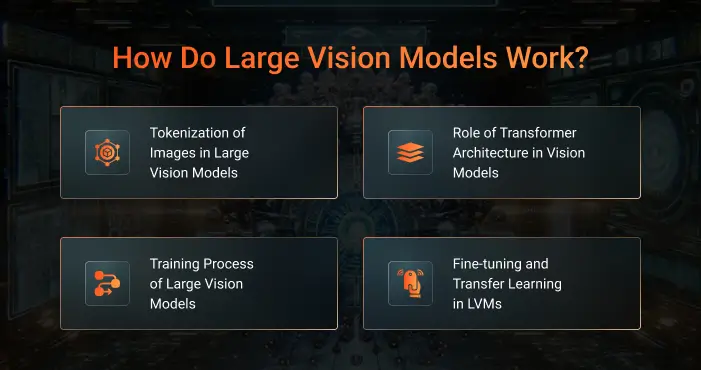
1. Tokenization of Images in Large Vision Models
Images are broken down into smaller pieces (often called “patches” or “tokens”) much the same way linguistic models tokenize words or phrases of text before processing them. These patches of image are embedded along into high-dimensional vectors and retain spatial context and representations to analysis later on.
2. Role of Transformer Architecture in Vision Models
The majority of Large Vision Models are underpinned by transformer architecture, a deep-learning model developed to process natural language. Vision transformers (ViTs) and alternatives use self-attention to weigh the relationships among patches in the image, allowing the model to develop context and a holistic understanding of scenes. Prototype models also use transformer architecture as a basis for many Large Vision Language Models for cross-modal analysis.
3. Training Process of Large Vision Models
LVMs have a wide range of training modalities depending on whether supervised, self-supervised, or using synthetic data is leveraged. This training is supplemented with backpropagation to minimize task specific loss functions tied to the specific computer vision task the LVM is learning (e.g., object-detection, image-level captioning). When performing this training, there will likely be tens of millions, or even up to hundreds of millions of images and related datasets that have been used in training LVMs.
4. Fine-tuning and Transfer Learning LVMs
Once pretrained, LVMs efficiently solve domain-specific tasks. Moreover, fine-tuning occurs by training parameter subsets with task-specific data. This approach improves performance while reducing training costs. In addition, transfer learning plays a crucial role in sensitive fields like healthcare or autonomous driving. Since these fields often lack abundant labeled data, LVMs enable efficient adaptation and ensure better outcomes with minimal resources.
Key Features of LVM Large Vision Models
LVMs have a similar base of functional and technical features:
1. Large-Scale Architecture and Training
LVMs are neural networks containing millions or billions of parameters. Moreover, they train on massive, diverse global datasets. In addition, they detect low-level features directly from raw pixels across multiple domains. Furthermore, they capture global spatial patterns to improve accuracy and adaptability. Consequently, they advance computer vision capabilities at an unprecedented scale.
2. Generalizability and Adaptability
Unlike previous computer vision models, LVM large vision model architectures are generalizable and adaptable to new or unseen data. They exhibit few‐ short learning capabilities, meaning they can adapt to new tasks with minimal additional labeled datasets, and they can be beneficial across use cases in industry.
3. Transformer Architectures
The shift from CNNs to transformer-based models enhances modeling of long-range spatial dependencies. Furthermore, these models capture multi-scale features more effectively. In addition, they support cross-modal reasoning, enabling advanced vision and text integration. Consequently, Large Vision Language Models deliver stronger performance and broader applications across diverse domains.
4. Multimodality
Modern LVMs and Large Vision Language Models operate across modalities—they model images, video, text, and structured data. They can answer questions, generate captions, and produce additional media from visual prompts.
5. Generative Models
Most state-of-the-art Large Computer Vision Models actively train as generative models, and they not only create original synthetic images but also generate complex scenes. Moreover, they seamlessly complete images that users have only partially observed, making the process more efficient and dynamic.
In this manner, they facilitate applications ranging from media and entertainment to design and augmented reality.

Large Vision Models vs Traditional Computer Vision Techniques
The advantages of LVM Large Vision Model combinations over traditional techniques for computer vision tools, especially convolutional neural networks (CNNs), is quite apparent. Below shows how they differ:
| Aspect | Large Vision Models LVM | Traditional CNN-Based Models |
| Architecture | Transformer-based, multi-scale, multimodal | Convolutional neural networks |
| Data Requirements | Huge, diverse, multimodal datasets | Moderate, typically static |
| Generalization | High, effective in few-shot tasks | Good, less effective for transfer |
| Multimodality | Native text, image, and video handling | Primarily image-focused |
| Use Cases | Complex, generalizable tasks | Single-purpose, domain-specific |
| Interpretability | Less transparent, complex | More interpretable feature maps |
| Computation Cost | High, requires advanced hardware | Moderate to low |
| Scalability | Highly scalable across tasks and industries | Limited scalability |
Top Use Cases of Large Vision Models (LVM) Across Industries
LVMs and Large Vision Language Models are actively transforming the way businesses operate, advancing how scientists conduct research, and reshaping how people manage their daily lives. Furthermore, they drive innovation by making processes smarter, faster, and more efficient across multiple domains.
1. Applications of Large Vision Models in Healthcare
LVM (Large Vision Model) tools allow radiologists to make faster, and more accurate assessments of X-rays, MRIs, and CT scans at an unprecedented scale. More reliable radiology diagnoses lead to improved patient outcomes. Decision support systems embedding LVMs use visual and textual input to support treatment, flag anomalies, and predict patient outcomes. LVMs can find tumors at greater sensitivity than human experts can in some modalities. In addition, LVMs support telemedicine and optimize workflows for medical personnel.
2. How Large Vision Models Are Used in Autonomous Vehicles?
Largely Computer Vision Models help self-driving cars and drones detect pedestrians, bikers, and vehicles to make real-time decisions related to safety. LVMs also interpret road signs, lights, and changing conditions to promote navigation through unpredictable territory. LVMs can also provide an “explanation” of their decisions with engineers being able to verify what led to the model’s decisions to ensure compliance with regulations as well as debugging or other verification processes. This “explainability” is essential to scaling the next generation of autonomous systems.
3. Retail and E-commerce Applications of Large Vision Models
Retailers are using Large Vision Language Models to improve visual search, product recommendations, and dynamic cataloging. LVMs find and identify products as shown in user-generated content, personalize shopping recommendations, and enable users to virtually try on their fashion and accessories. Visual recognition helps manage inventory and improves customer experiences – leading to increased sales, customer loyalty, and operational.
4. Large Vision Models in Security and Surveillance Systems
In security and smart city applications, Large Vision Models (LVM) analyze live video streams around threats, unauthorized persons, crowd sizes, or unusual behavior—allowing for high-speed action in automation. LVMs in law enforcement or traffic management can support scaling facial recognition processes, crowd analytics, and incident detection, enhancing resource planning and public safety outcomes.
5. Applications of Large Vision Models in Robotics and Industry 4.0
Robots and industrial automation systems use LVM Large Vision Model platforms as product inspection on assembly lines, to facilitate packing and shipping, and for visual inventory tracking. Within the context of Industry 4.0, LVMs drive factory automation by creating sorting, defect detection, and self-learning robotic vision systems.
With LVM’s combined with Graph Convolutional Neural Network (GCNN), our ability to reach even more sophisticated, relationship-based reasoning for use in manufacturing or supply chain is possible.
6. Large Vision Model in Media & Entertainment
Media and entertainment companies are applying Large Vision Language Models for applications like automatic editing, content creation, tagging, and moderation. LVMs drive deepfake detection, video up-scaling, simulated game character animation, and real-time effects creation, leading to faster production cycles, new forms of creative engagement, and safer online communities through automated content filtering.
Benefits of Large Vision Language Models for Businesses
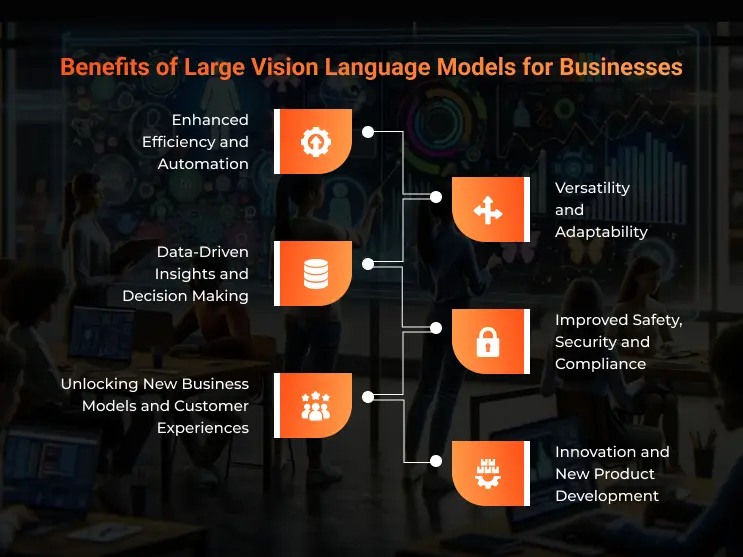
Improved Efficiency and Automation
Large Vision Models (LVMs) now automate complex visual tasks that previously required large teams of people to handle manually. Moreover, they streamline workflows and make these processes faster, more accurate, and highly scalable. LVMs reduce costs and enable around-the-clock work–in banking, health care, or logistics.
Evidence Based Recommendations and Decision-Making
Large Vision models, with their high analytic capabilities, review qualitative customer patterns, products defects from manufacturers, or monitor public safety trends, delivering evidence-based recommendations to business leaders.
New Business Models and Customer Experiences
LVMs have merged and analyzed text, voice and visuals into sites or places that use AR to bring immersive experiences, include virtual assistants to deliver services on demand, or deliver personalized content at scale in real-time.
Flexibility and Responsiveness
LVMs and LCMs (Large Computer Vision Models) use the adaptability and rapid responsiveness without re-learning to perform new tasks or use new data, by incorporating other models to enhance operations.
Enhanced Safety, Security or Compliance
From alerts in workplaces to comply with rules and regulations in manufacturing, or self driving, large vision models transform companies’ current operations into compliant, secure environments.
New Product Creation or Innovation
Companies have used LVM’s large vision model solutions as a mode for next-generation product design, market scan for future launch, and/or trend identification, enhancing innovation and staying ahead of competitors.
Challenges and Limitations of Large Vision Models
High Computational Costs
Training and deploying LVMs large vision models requires expensive access to high-end GPUs, a lot of memory, and energy capacity. For smaller companies, these costs may be too steep without working with a dedicated Computer Vision Solutions company or using a managed cloud company.
Data Bias and Ethics
LVM large vision model products learn from vast datasets. If these datasets contain biased, or unrepresentative data points then the model may perpetuate or magnify the unfairness inherent in the original data set, e.g. medical or security uses.
Privacy Concerns
Using LVMs for surveillance, face identification, or other sensitive use cases raises privacy concerns. The responsible use of LVMs is understanding the trade-off between innovation and the ethical conventions, regulations and consumer expectations about compliance, adherence, and ethics- especially in areas where there are strict data privacy laws.
Future of LVM (Large Vision Models) in Artificial Intelligence
1. Multimodal AI
Advances will increasingly combine multimedia and sensor data with visual, text, and audio data to generate Large Vision Language Models that will facilitate the development of highly contextual, human-like AI agents across multiple domains.
2. Ethical AI and Explainability
The field will see more attention devoted to model transparency, “explainable AI”, and financing diverse datasets to reduce bias – essential in the deployment of safer and more ethical AI.
3. Generalization and Foundation Models
As LVMs will function as “foundation models” similar to what GPT-4 accomplishes with language they will allow for fast adaptation to different domains, be effective with few-shot learning, and versatile across tasks and industries.
4. Advancements in Video and 3D Vision
There are efforts to develop new AI architectures to process videos, 3D shapes, and spatiotemporal data (where time is an influential factor) will unlock next-gen applications in gaming, robotics, and all things metaverse.
5. Generative AI and Synthetic Data
As generative AI models become stronger, LVMs will not only be able to read and interpret information, but create information, too. LVMs will be able to synthesize images, video, and multimodal inputs not only for the sake of simulation and training purposes but also for use in the fields of creative and conception.

Why Choose A3Logics for Large Computer Vision Models Development?
A3Logics is a leader in large computer vision models comprising deep knowledge in transformer models, foundation models, and the latest advances in AI research. It has a strong record of delivering Enterprise Scale Large Vision Models LVM – and deploying LLM’s Large Vision Language Models at scale.
A3Logics provides tailor-made Computer Vision services and end-to-end AI Development Services. For organizations ready to take advantage of large computer vision models, A3Logics brings unmatched expertise from consultation to deployment, support, and compliance.
By utilizing the latest developments in Graph Convolutional Neural Network (GCNN) models, transfer learning, and the latest integration of multiple modalities of data, the LVM Large Vision Model is efficient, flexible, and designed to address specific industry needs.
When moments count and visions, languages, and data need to merge in real-time, the right paired partner will accelerate time-to-value and drive innovation.
Final Thoughts
Large Vision Models, Large Computer Vision Models, and Large Vision Language Models (LVMs) now stand at the forefront of innovation in the $250 billion AI industry, the LVM’s are transforming industries from health care to entertainment, logistics to security. Their transformer architecture with transformative capacity, imitative multimodality, and unparalleled generalization offer pathways to automate, create smarter decisions, and provide unique customer experiences.
While they bring challenges, computation costs, bias, and privacy, those challenges create avenues for safe, efficient, and exploitable capitalization on market leadership. Working with specialized providers, and strong expertise in Large Language Model Development, and responsibly leveraging the LVM’s technologies will enable enterprises to both prudently and responsibly engage with these transformative tools.