When you’re in the driver’s seat, bad roads or weather are not the biggest factor for accidents; it is human error. Whether it be from fatigue, distraction, or impairment, the human element is the silent, deadly factor, killing thousands every day. The World Health Organization estimates that over 1.19 million individuals die in road accidents every year, and millions more are injured each year.
Here is where the Driver Monitoring System (DMS) takes over. Once a seldom seen safety feature, it now stands as the first line of defense against avoidable accidents. Not only through detecting but also through real-time intervention, DMS technology is changing the way of the automobile industry for the better.
The Internet of Things (IoT) and artificial intelligence (AI) breakthroughs have allowed the evolution of Driver Monitoring Systems that are now moving from passive recorders to proactive safety agents. These systems have machine vision, biometric data, real-time IoT connectivity and other things so that they can predict and prevent accidents before they even happen. Moreover, for fleet managers, logistics leaders, and automotive manufacturers, DMS moved from being a regulatory requirement to a strategic necessity.
In this blog, we will understand how AI and IoT are remodeling driver monitoring systems. It covers core functions, key technologies, market trends, industry applications, and more.
What is a Driver Monitoring System?
A Driver Monitoring System is an in-vehicle technology to assess the driver’s state, behavior, and attention in real-time. These systems traditionally were based on cameras and simple algorithms as they couldn’t find any better solutions for drowsiness or distraction detection. The rapid expansion of AI-driven computer vision and IoT connectivity helps them in integrating with and expanding vehicle safety ecosystems.
Driver Monitoring Systems use inputs like eye movement, facial expressions, head position, and physiological data, which are then processed through AI models to identify risk states. When a risk condition is identified, the system can respond with any number of mitigative actions, from alerts to automated safety mechanisms.
Driver Monitoring System Market Statistics
The driver monitoring market has witnessed incredible growth owing to the regulatory push and widespread adoption in commercial vehicles. A report published by Grand View Research confirms that the global DMS market size is expected to reach around $8 billion by 2033.
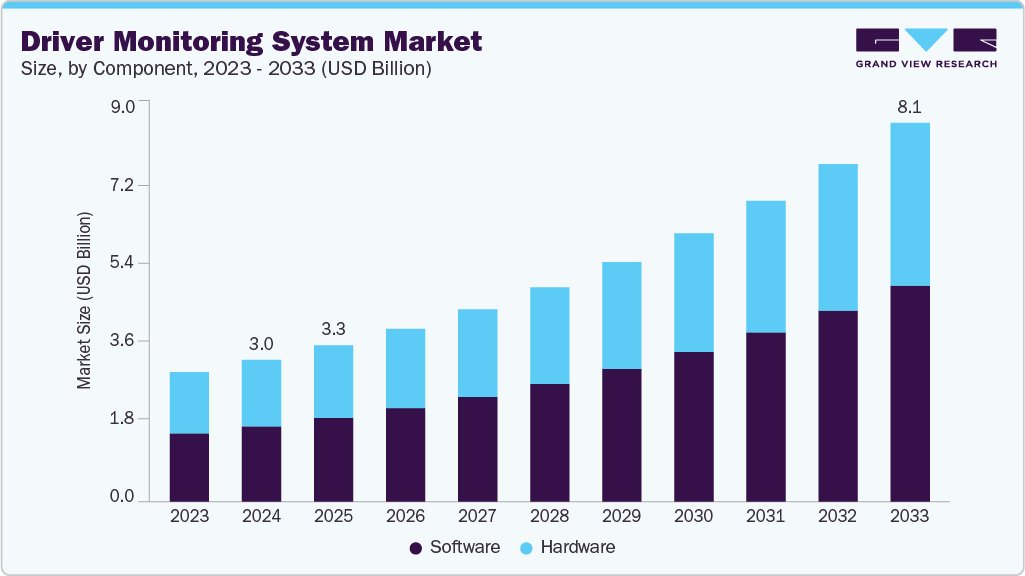
The main reasons for this boom are:
- Euro NCAP and NHTSA regulations require new vehicles to have distracted driving detection (Driver Fatigue and Distraction).
- The introduction of Level 2+ and Level 3 autonomous systems where driver attention is still necessary.
- The quick move of commercial fleets seeking a cut in accident-related costs.
The fleet management industry represents about 40% of the market share and the fleets are aware of the dual advantages of a safe environment and improved efficiency.
Why is Driver Behavior Monitoring Crucial for Autonomous Vehicle Development?
Autonomous vehicles will bring safer roads, but until fully realizable Level 5 autonomy is achieved, human drivers will still represent a valuable safety backstop.
A driver behavior monitoring system (DMS) can ensure the driver is engaged, demonstrates competency, and can take over control of the vehicle if required. Without a DMS, AV safety runs the risk of inattentive or sleepy distracted driving.
In addition, behavior monitoring data can provide generative information for AI modeling and training for AV vehicles, while providing researchers with rich contextual data to better understand how humans drive. By accounting for DMS reporting when developing AV ecosystems with OEMs, we can close the enhanced safety gap created by operational technology.
The Role of Artificial Intelligence in Driver Monitoring Systems Explained
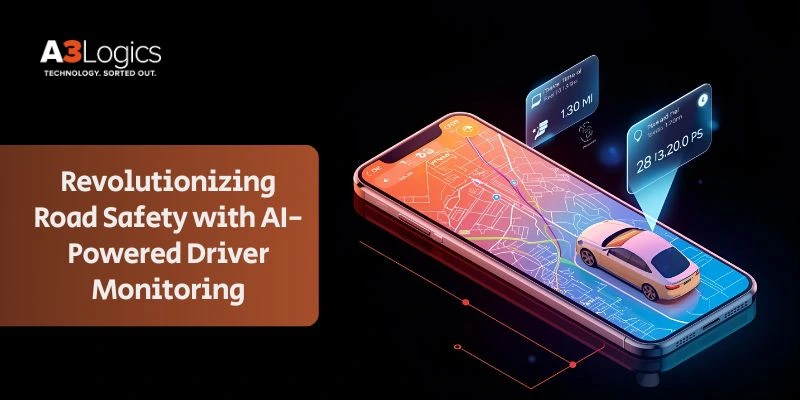
Artificial intelligence has the greatest transforming hand in limiting human errors. Driver monitoring systems have thus changed from their reliance on fixed rankings and rule-based warnings into current devices using adaptive AI models. These are models that acquire new knowledge from real-time data due to driver behavior. The combination of real-time and historical sensor data enables the correct identification of fatigue, distraction, or impairment conditions, including harsh driving at night or heavy traffic in the city.
This dynamic intelligence enables the system to act proactively by issuing the right interventions at the right time to significantly reduce accident risks.
Core Functions of AI in Driver Monitoring
a. Drowsiness and Fatigue Detection
Driving while tired is dangerous. The driving performance deteriorates, which can even lead to several short “microsleeps” while the driver is behind the wheel. To stop this, AI-based systems look for various signs of fatigue, using cues from the driver’s body and behavior.
- Eye Movements: Computer vision monitors how often people blink, the rate of closed eyes, and fixations. Increases in microsleeps, or extended amount of time with eyes closed, indicate upcoming fatigue.
- Head Position: AI models detect head nodding, tilting, or drooping, all signs of the early stages of micro-drowsiness.
- Yawning: Facial-recognition algorithms detect yawning frequency. Yawning is another symptom of driver fatigue.
b. Distraction Monitoring
AI plays a significant role in accident detection, as it has become increasingly prevalent in the world of smartphones. One of the major reasons distraction monitoring focuses on is whether the driver is primarily devoted to the road or not. The AI-monitoring notes the signs of lost concentration through behavioral cues:
- Phone Use: Object detection models may identify the driver holding or looking at a phone.
- Looking Away: The tracker can also detect if you are looking completely off the road.
- Eating and Drinking: It also detects your gestures from multitasking which can be risky.
c. Behavioral Analysis
In addition to discrete actions, AI also performs behavioral analysis as a whole by making interrelations between driver posture, facial micro-expressions, and response times. This allows alerts to be more personalized.
Key AI Technologies Powering DMS
1. Machine Learning (ML) and Deep Learning (DL)
ML and DL algorithms are the statistical basis for driver-state classification in a Driver Monitoring System (DMS). Supervised, learned models are trained from millions of hours of labeled driving data and apply classification to generalize various patterns of driver fatigue, distraction, or impairment. DL architectures like Recurrent Neural Networks (RNN) are used for learning time-based or temporal structures of driver behavior.
2. Convolutional Neural Networks (CNNs)
CNNs play a big role in image-based feature extraction. In a Driver Monitor System deployment, CNNs extract facial landmarks, recognize yawning, and understand the complexities of lighting conditions inside a vehicle.
3. Sensor Fusion
Modern DMS systems utilize sensor fusion by combining data streams from multi-sensor sources like infrared cameras, accelerometers, steering torque sensors, and heart rate monitors. DMS solutions that employ sensor fusion benefit from the fusion algorithms that combine staged data and make more reliable detections. In each instance of detection, DMS solutions reduce false-positive and false negatives.
4. Computer Vision
Computer vision systems are now sophisticated enough to perform on-device computing (often referred to as “edge computing”) so that monitoring can occur in real-time with minimal latency. These are resilient to environmental issues, such as not being able to pick up on poor lighting, the wearing of sunglasses, or obstructed views.
How IoT Devices Transform Traditional Driver Monitoring into Smart Systems
1. From Isolated Data to a Connected Ecosystem
DMS data was traditionally confined to the vehicle. IoT, by its functionality, connects these standalone devices to a safety network, which is in turn connected to cloud platforms, fleet dashboards, and emergency responders for real-time communications.
2. Enabling Real-Time, Predictive Insights
Driver Monitoring System uploads raw telemetry data to cloud hardware and allows predictive insights refinement. For instance, fatigue patterns, observed in a fleet of drivers, can be used to reschedule shifts thereby lowering systemic risk.
3. Enhancing Fleet Management and Safety
For fleet owners, the IOT for Fleet Management will give connected dashboards that integrated driver state observations with vehicle telematics. This integration improves safety compliance, routing efficiencies, and insurance risk profiling.
4. Biometric and Environmental Context
An IoT device can capture biometric information like heart rate variability as well as environmental context like cabin temperature and CO2 levels. There are multiple layers of context that contribute to AI-based driver state evaluations.
5. Seamless Integration with AI
IoT is the backbone of data for which continuous learning is possible. The training of AI models is done when the edge devices are streamed with annotated driving data. With the feedback loop operationally closed, the driver systems evolve in response to the changes in driver behavior.
Key Driver Monitoring System Features You Should Know
1. Driver State Monitoring (The Primary Focus)
a. Drowsiness & Fatigue Detection
Driver Monitoring System utilizes gaze-tracking, head pose estimation, and yawning recognition all of which are aimed at detecting the early signs of fatigue and in turn anxiety micro-sleeps.
b. Distraction Detection
AI algorithms track behaviors (like texting, eating, or interacting with devices, etc.) and thus prevent distractions and accidents.
c. Impairment & Identity Recognition
Facial analysis and biometric authentication are used to allow authorized drivers to drive the car and they also alert if an impairment has taken place.
2. Driving Behavior Monitoring
a. Event Triggering
Advanced sensors identify events of harsh braking, lane departure, and aggressive acceleration, and immediate interventions of safety are initiated.
b. Scoring & Analytics
Performance and safety scores based on the system code help fleets market drivers for training and insurance.
3. Safety Intervention & Alerts
a. Real-Time Audible & Visual Warnings
Instant in cabin notifications act as an alarm whenever the driver violates safety and give the option to redress the matter as fast as possible.
b. Haptic Alerts
Things such as steering wheel vibrators and seat shakers alert the drowsy drivers to focus on the road.
c. Pre-Arming Safety Systems
Driver Monitoring System, when it is sure of the condition of the driver being extremely fatigued, can pre-arm the critical safety features like airbags and collision mitigation systems.
d. Emergency Response
Automated emergency call (eCall) is a feature that is triggered by the failure of the driver to react thus informing the first responders who will attend the accident.
4. Connectivity & Integration Features (The IoT Aspect)
a. Real-Time GPS Tracking
The modern Driver Monitoring Systems are GPS integrated to track where the vehicle has been, where it is going, and how fast it is driving. The combination of this driver state monitoring with GPS allows for a more complex risk analysis. For instance, relating fatigue levels to high accident rate road conditions.
b. Telematics Integration
Integrating DMS with present telematics platforms provides a 360-degree view of safety, compliance, and operational information. Fleet Managers achieve total visibility on fleet health with one dashboard that includes vehicle diagnostics, as well as driver awareness indicators.
c. Cloud Reporting & Dashboards
Cloud usage in IoT automates fleet reporting which summarizes driver scores, fatigue and distractions. It automates cloud dashboards with real-time escalation of alerts, allowing for expedited intervention by supervisors.
d. Over-the-Air (OTA) Updates
Creating and maintaining driver monitor systems requires over-the-air (OTA) updates as AI models improve. The cloud-to-vehicle update process allows manufacturers and an Automotive Software Development Company to transmit new algorithms or compliance configurations without having to recall any vehicle.
e. V2X Capability
The implementation of Vehicle-to-Everything (V2X) communication allows proactive risk management. For example, when a vehicle in the vicinity alerts to lane erratic driving due to distracted driving, surrounding vehicles can adjust trajectories to avoid the incident.
5. Security & Compliance Features
a. Video Telematics
Video telematics with AI will provide irrefutable evidence in the case of a crash or disputed work contracts. Keeping drivers accountable for safe work is indeed important but so is ensuring the due diligence of your insurance and regulatory obligations with a view to not being liable.
b. Driver Authentication
The biometric token used ensures that only authorized personnel are permitted to drive commercial vehicles. The Driver Monitoring System in Trucks has modules for Identity recognition that combat unauthorized access and theft, while also helping to maintain fleet contracts.
c. Hours of Service (HOS) Compliance
The U.S. has Federal Motor Carrier Safety Administration (FMCSA) regulations that mandate strict driving limits. The electronic logging devices (ELDs) that come with automated hours of service compliance contribute to reducing paperwork and audits, while preventing fatigue-related accidents.
Top Benefits of Implementing a Driver Behavior Monitoring System in Fleet Management
1. Dramatically Enhanced Safety (The Primary Benefit)
The main benefit of the Driver Behavior Monitoring System is being able to actively prevent accidents caused by drivers. Signs of fatigue, distraction, or poor driving habits are quickly detected and processed. Thus, the driver returns to his correct behavior before the accident occurred.
2. Lower Fuel Consumption
In this case, the system also helps to cut the fuel spending significantly as it restrains the habits that waste fuel. Acceleration and speed control are examples of the faults discovered by the system. Further encouraging the drivers to operate their vehicles more smoothly.
3. Reduced Maintenance and Repair Costs
Being able to detect issues and discourage poor driving events reduces repair costs. For instance, preventing harsh braking helps in the longevity of brake systems, resulting in cheaper overall maintenance expenses.
4. Route Optimization
Using GPS and DMS together is possible when it comes to dynamic routing. You can adjust drivers’ fatigue, traffic, and environmental hazards all in one setting for faster routes and greater delivery reliability.
5. Increased Operational Efficiency
The integration of DMS data within fleet management systems allows businesses to have a common view of their operations ranging from safety, fuel, routes, and compliance. These efficiencies directly increase profit margins in high-volume logistics operations.
6. Personalized Training
The driver performance scoring provides an evidence-based training program. Training doesn’t focus on general courses. Instead, specific weaknesses are addressed, which improves the quality in the long term driving.
7. Electronic Logging Device (ELD) Integration
DMS and ELD systems provide a compliance-ready infrastructure that quickly addresses any Hours of Service (HOS) issues automatically which reduces both your administrative burden and risks associated with audits.
8. Securing Cargo and Assets
Cargo security is primarily dependent upon driver authentication with IoT-enabled geofencing. Fleet managers not only receive real-time alerts when unauthorized drivers operate the vehicle but also when the vehicle deviates from the designated route.
9. Reduced Carbon Footprint
A Driver Monitoring System promotes CO2 emission reduction with energy-efficient driving behaviors that support global sustainability efforts. Large fleets who implemented such Driver Monitoring Systems have seen documented emission reductions in the area of 10-15%.
10. Driver Empowerment and Retention
The modern systems accept drivers as professionals who want to put their best foot forward and be recognized. The schemes aim to provide better job satisfaction and reduce turnover in the industry.
Types of Driver Monitoring Systems Powered by AI and IoT
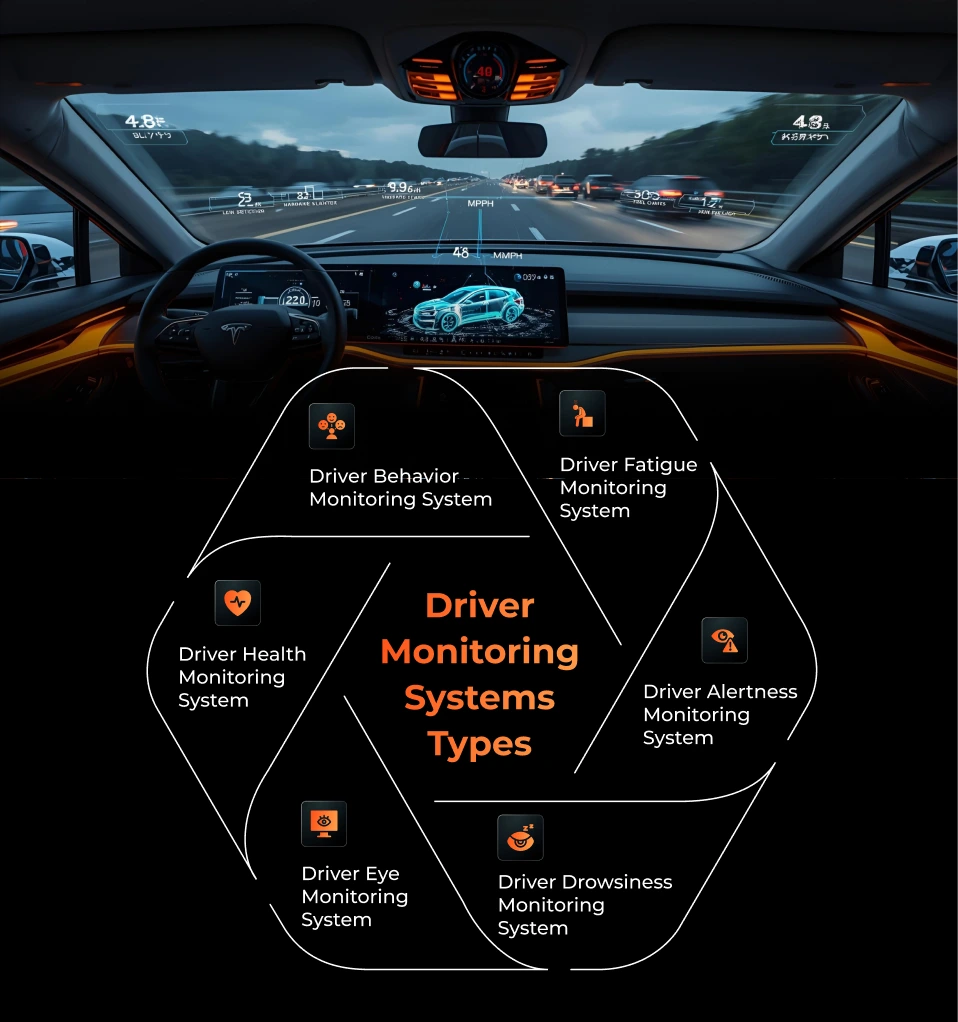
1. Driver Behavior Monitoring System
This type of system focuses on behavior risk such as hard braking, speeding, and unsafe lane changes. It creates real-time alerts and historical analytics for the respective driver.
2. Driver Fatigue Monitoring System
It’s the most frequently used type of system that is geared to help with drowsiness and micro-sleep detection. It is often required by the law for trucking fleets that have fatigue risk as their top safety issue.
3. Driver Alertness Monitoring System
This type of system attempts to keep track of the driver’s alertness through gaze and posture cues that are essential for partially-autonomous vehicles, where the driver is needed to re-engage constantly.
4. Driver Drowsiness Monitoring System
This is a kind of fatigue monitoring system that focuses on the preliminary symptoms of drowsiness before it affects critically. This is especially useful for ride-hailing drivers who work long hours continuously.
5. Driver Eye Monitoring System
The detection of eye pupil dilation, blink frequency, and gaze direction in this technology is made possible by using high-resolution infrared cameras and CNN-based computer vision.
6. Driver Health Monitoring System
IoT wearables continue to be the primary sources of input, while health-related impairments are intervened proactively. They go beyond behavior to monitor vital signs like heart rate, stress levels, and blood oxygen levels.
Top Industries Benefiting from Modern Driver Monitoring Systems
1. Logistics and Transportation
Long-haul fleets are the major adopters of the driver monitoring systems. Monitoring System in Trucks, here, additionally minimizes accident costs, enhances insurance conditions, and provides FMCSA compliance. The IoT-enabled dashboard is now also being programmed to optimize fleet routes as well as maintenance cycles.
2. Ride-Hailing Companies
Companies such as Uber and Lyft are more frequently integrating Driver Monitor System features to protect their passengers and also provide the drivers with professional standards. AI is used to ensure safe driving through distraction detection in urban environments.
3. Public Transport Operators
Bus fleets are now the major beneficiaries of AI-powered distraction and fatigue detection that helps to cut down on catastrophic accidents. Besides, driver certification is ensured by means of biometric identification for the effective operation of public transportation.
4. Construction and Mining Fleets
Heavy-duty off-road vehicles are a type of vehicle that needs special monitoring. IoT-enabled fatigue detection systems help to mitigate accidents in areas where operators may make multimillion-dollar mistakes.
5. Emergency Services
The fatigue detection becomes very critical in the case of ambulances, fire trucks, and police vehicles. High stress and long working hours are core reasons for fatigue. The integration with DMS ensures not only the safety of the operators but also the capability for rapid response.
Future Trends in AI and IoT for Driver Monitoring Systems in 2025 and Beyond
1. AI Dashcams
Next-gen AI dashcams are shifting from passive devices to active participants in driving safety. All-new AI dashcams now have the ability to run active models in a manner where they can detect driver inattention, distractions, fatigue, increasingly dangerous roadways, and more.
2. Wearable IoT Devices
The convergence of in-cabin sensors and wearable IoT devices represents a major level of development. Smart watches and biometric patches capture heart rate, stress markers, and blood oxygen levels, supplementing in-cabin computer vision. This hybrid model allows an exhaustive health and safety profile, particularly for long-haul commercial drivers.
3. Predictive Accident Prevention Models
AI models are being trained with historical data from millions of hours of driving to predict the likely probability of an accident before the risk occurs. And these predictions will help fleet managers proactively schedule breaks, manage driving workloads or re-assign drivers based on their early indication of fatigue.
4. Integration with Autonomous Vehicle Ecosystems
As semi-autonomous cars receive wide acceptance, the Driver Monitoring System in Cars and trucks will connect actively with Edge Computing in Autonomous Vehicles. In this way, the vehicle’s AI-based decisions, along with the driver’s attentiveness, contribute to a scenario of safe and seamless handover.
5. Blockchain-based Secure Data Sharing
The problems of data security and privacy are weighty. Consequently, the creation of the blockchain-based data sharing frameworks was emerging, making it possible for fleets and the regulators to send and receive driver data securely while ensuring the anonymity of their users.

A3Logics: Expertise at the Intersection of AI, IoT and Fleet Management
A3Logics is a well-established IOT Development Company, with over 20 years of experience bringing digital transformation solutions to clients around the globe.
Possesses deep experience with AI for automotive applications. We deliver solutions that are intelligent and fit your business. As a seasoned Automotive Software Development Company, we create scalable solutions that incorporate Driver Monitoring Systems with telematics, predictive analytics, and fleet management systems.
Key capabilities include:
- Custom Driver Monitoring System deployments tailored for logistics, mining, and ride-hailing industries.
- Seamless DMS Integration with existing ERP, compliance, and telematics platforms.
- Deployment of edge AI models to support Machine Learning in Automotive Industry use cases.
- Long-term support for fleets through OTA updates, dashboards, and cross-platform interoperability.
By combining AI, IoT, and enterprise-grade software development, A3Logics enables organizations to reduce accidents, optimize fuel efficiency, and achieve regulatory compliance at scale.
Final Thoughts
Driver safety has remained a long-standing pillar of automotive development for years. What has changed is the access to the tools. AI-powered models and IoT-enabled connectivity have changed driver monitoring from reactive to proactive safety models. Regardless of deployment area i.e. in logistics fleets, ride-hailing applications, or autonomous vehicle ecosystems, Driver Monitoring Systems are becoming indispensable.
Smart business leaders understand that the future of mobility depends on AI Development Services that make driver monitoring more intelligent and reliable. Investing in smart technologies demonstrates a clear ROI in the areas of safety, compliance, efficiency, and sustainability.
Don’t wait for the future of mobility to arrive! Take the driver’s seat and lead the direction.
Connect with A3Logics today!