
The global digital asset sector is booming: the cryptocurrency exchange software market is forecasted to exceed 19 billion U.S. dollars in 2025, and, currently, more than 500 million people globally own cryptocurrency. Crypto trading volume is surging as platforms conduct hundreds of billions of dollars in trades each month while institutional and retail investors search for new avenues within decentralized finance (DeFi) and ease of management of digital currencies.

This momentum has highlighted the challenges and opportunities created by the demand for robust, secure, and scalable exchange platforms. Cryptocurrency exchange software development empowers startups and enterprises to innovate, compete, and thrive within the global digital currency ecosystem.
How Has It Evolved?
Cryptocurrency exchange software development is not just coding; rather, it blends economic literacy, regulatory awareness, user-focused design, and advanced technologies. Due to rising cyber threats and stricter regulations, firms with foresight, flexibility, and trusted partners will successfully lead.
Whether building from scratch, using white-label solutions, or scaling products, success requires process knowledge, strong security, and compliance.
What Is Cryptocurrency Exchange Software Development?
Essentially, Cryptocurrency Exchange Software Development involves designing, building, and deploying secure digital marketplaces, enabling users to safely buy, sell, and exchange cryptocurrencies.
These digital marketplaces consist of trading engines, order books, multi-currency wallets, user management systems, payment gateways, intuitive dashboards, and sophisticated risk controls to provide a smooth customer experience.
Top Cryptocurrency Exchange Software Development Services make sure that exchanges adhere to strict know-your-customer (KYC) and anti-money laundering (AML) guidelines, protect user funds through cutting-edge wallet technology capabilities, and provide readily available, transparent real-time data analytics for traders and administrators alike.
Why Are Businesses Investing in Cryptocurrency Exchange Software Development in 2025?
- With a projected CAGR of greater than 14% in the next ten years, crypto trading platforms are a fast-growing fintech sector gaining traction amongst startups, banks, and tech giants who are seeking their piece of the fast emerging digital asset opportunity.
- Businesses are using Fintech Software Development to capitalize on intangible business factors such as scale, borderless operations, active market 24/7, instant settlements, etc. Additionally, there is a realization that there is yet another revenue stream by collecting fees for trading and listing tokens which has a high earning potential.
- As regulations clarify and user trust in digital assets grows, enterprises increasingly view launching robust mobile exchanges as essential for relevance, compliance, and competitiveness. Furthermore, by adopting secure, user-friendly platforms, businesses can effectively navigate financial disruption while staying ahead of market trends and customer expectations.
Types of Cryptocurrency Exchanges Startups and Enterprises Can Build
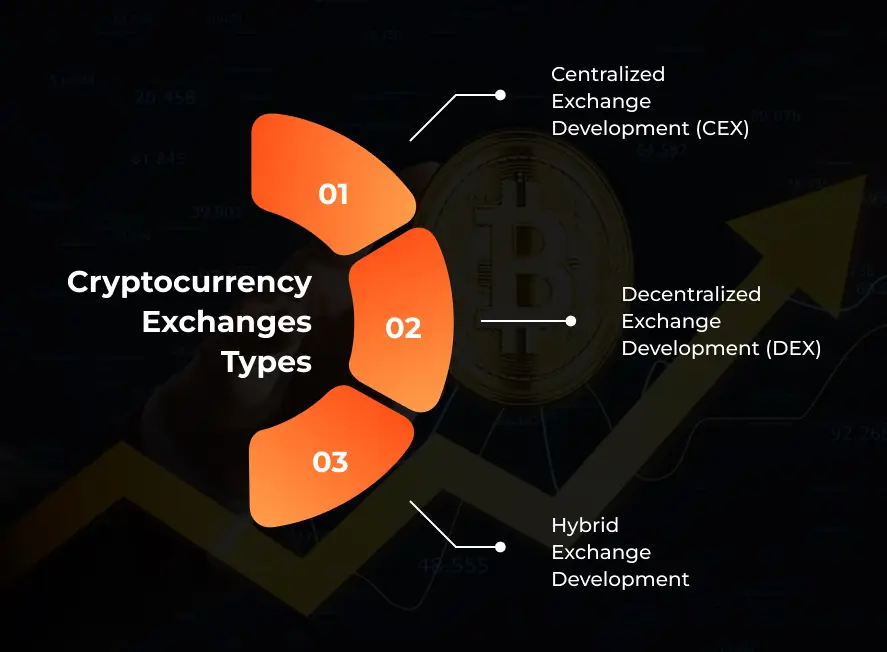
1. Centralized Exchange Development (CEX)
Centralized exchanges serve as intermediaries, safeguarding assets and facilitating trades through their proprietary engines; CEX solutions elevate fiat onramps, liquidity, and compliance to primary aspects.
Startups benefit from out-of-the-box security and user experiences which allow for rapid development cycles. Enterprises can leverage sophisticated analytics, API-based trading, and compliance infrastructure, and scale their solutions when appropriate.
2. Decentralized Exchange Development (DEX)
With the growing momentum of decentralized technologies, these decentralized exchanges primarily use smart contracts on the blockchain to allow peer-to-peer trading with no need for intermediaries, while users retain ultimate control of their assets. Transparency and privacy are key selling points of DEX implementations.
As Decentralized Crypto Exchanges, these platforms allow users to innovate in a permissionless manner by permitting any tokens to be listed, albeit with limited liquidity and KYC enforcement, which may provide challenges to both users and issuers.
3. Hybrid Exchange Development
Hybrid models offer the speed and liquidity of a centralized exchange while incorporating an increasing amount of decentralized functions or utilizing the trustless governance model of DEXs; giving users the best of both worlds.
Generally, hybrids offer centralized order books, while custodial functions are decentralized. Hybrids improve user choice, market resilience and available depth.
Step-by-Step Process of Cryptocurrency Exchange Software Development
1. Market Research and Feasibility Study
Successful projects start with a thorough review of current competitor platforms, understanding regulatory requirements, assessing risks, and understanding user requirements within selected target markets.
2. Choosing Exchange Type (CEX, DEX, Hybrid)
The next decision will be how it will be structured – centralized to expedite customer exchange or decentralized which provides delegation and self-sovereignty; or the best of both worlds to maximize the speed and efficiency of CEX and the trustless autonomy of DEX.
3. Choosing Tech Stack (Blockchain, Backend, Frontend, APIs)
Teams choose trusted blockchains including Ethereum, Solana, backend stacks including Node.js, Go, frontend frameworks including React, Vue, and robust API frameworks for trading, payment, and data feeds.
4. Designing for Traders’ UI/UX
Designing for UI/UX is vital; responsive dashboards, simple onboarding, intuitive navigation and real-time charts can help maintain sophisticated users and new users alike.
5. Integrating Wallets and Payment Processors
Integrating hot and cold wallets, fiat gateways, and trusted payment processors to streamline deposits, withdrawals, and cross-chain assets will help work to build user trust.
6. Implementing Security Features (2FA, SSL, Encryption)
Including security layers like Two-Factor Authentication (2FA), end-to-end encryption, DDoS protection, and withdrawal whitelists to tip the chart in favor of security.
7. Compliance and KYC/AML Features
Integrating KYC/AML is necessary for exchanges to help comply with global and local compliance requirements, as well as to protect the platform and users from fraud and illicit finance.
8. Testing (Security, Performance, Usability)
Before going live, exchanges and trading platforms must go through QA: penetration testing, stress testing, user acceptance testing, and performance simulacrum.
9. Go Live and Maintenance
Successful deployment, next comes the frenzy of early-stage deployment, immediate support, speeding up fixes and deploying updates, monitoring for threats, and initial releases of features and enhancements.
Must-Have Features in Cryptocurrency Exchange Software for Startups
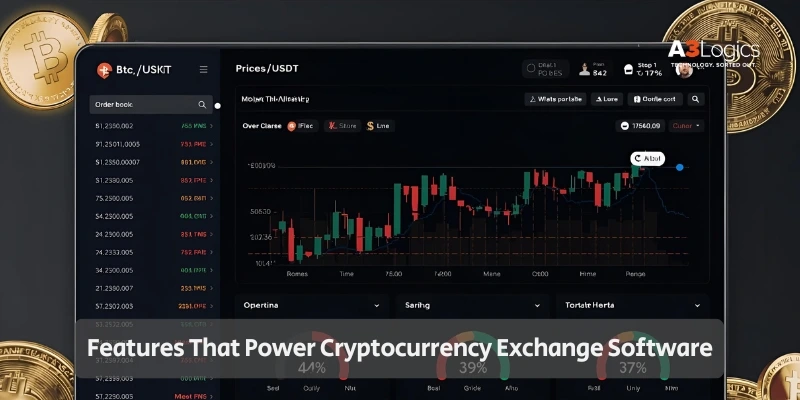
1. Multi-currency Wallet Integration
A highly secure wallet will allow them to access a wide range of assets, be it cryptocurrencies or stablecoins, with broad trading freedom .
2. Real-time Order Book & Trading Engine
The best order books and matching engines provide efficient latency, fair pricing, instant transaction settlement, and transparent trade histories, which are important for volume and liquidity.
3. Liquidity Management Tools
White labelled exchanges have native liquidity pools, aggregator modules, and external API integration options so that they can maintain deep, active order books from inception.
4. Secure KYC/AML Verification System
They will be forced to maintain automated document scanning for KYC as well as a proactive and reactive infrastructure for AML. This is a necessity to onboard clients and abide by regulations while establishing a level of trust and compliance.
5. User-Friendly Dashboards
Ideal for onboarding new users, dashboards with clear navigation, customizable widgets, and alerts, along with education topics are intriguing to all traders, casual or professional.
6. Multi-device Capabilities (Desktop, Mobile, Tablets)
Considerable cross device compatibility (web, mobile, tablets) is critical as more than 70% of crypto traders are using their smartphones to access exchanges now.

Enterprise-Grade Features in Cryptocurrency Exchange Development
i. Advanced Analytics and Reporting Dashboards
For enterprises, real-time and historic analytics, customized reporting, and data exports can provide adequate tools for best practices for business intelligence, audits and compliance management.
ii. API Trading Integration for Institutions
Open APIs, flexible FIX protocols, customizable endpoints allow institutions, market makers, and quants to integrate and optimize operations seamlessly.
iii. AI Fraud Detection and Risk Management
Exchanges can leverage an AI/ML approach to detect or even ensure suspicious activity is prevented, automating transaction monitoring, and reducing systemic risks before they negatively impact the exchanges.
iv. Cold and Hot Wallet Management
Enterprise platforms use cold storage techniques for the majority of their funds and hot wallets for tail liquidity, balancing security and experience for users.
v. High-frequency Trading Support
Moreover, low-latency APIs, co-location, and advanced matching engines collectively ensure faster execution speeds for market makers and algorithmic traders.
vi. Customizable User Permissions and Admin Controls
Exchange may apply granular role-based access, on a per-feature basis, alongside admin controls so the group can achieve rapid scale-up, securely and transparently.
How to Ensure Security in Cryptocurrency Exchange Platforms?
1. Two-Factor Authentication (2FA)
Require 2FA through SMS, email, or authentication applications for user accounts and administrator access.
2. Multi-Sig Wallets
Ensure that funds in hot and cold wallets require multiple approvals from multiple keys before any asset is withdrawn/transferred.
3. DDoS Protection
Employ advanced firewalls, rate limiting and bot-detection capabilities to guard the exchange from volumetric DDoS as well as targeted attacks.
4. Cold Wallet Storage for Funds
Most digital assets should be stored in offline cold wallets, as hot wallets are easier for attackers to breach and exploit. Additionally, securing assets this way significantly reduces risks, protecting investors and applications from potential hacks and vulnerabilities.
5. Regular Security Auditing and Penetration Testing
Arrange to undertake formal vulnerability assessments, perform source code reviews, red-team penetration testing, etc. to actively seek out and remediate any security gaps.
Cost Breakdown of Cryptocurrency Exchange Software Development in 2025
- Cryptocurrency Exchange Software Development typically costs between $30,000–$150,000 depending on complexity, compliance obligations, infrastructure, and custom functionalities.
- Centralized exchanges with simple features have a range starting around $35,000–$85,000; Decentralized Crypto Exchanges average $55,000–$115,000, while hybrid solutions often queue up toward $150,000 by having far greater architecture complexity.
- White-label solutions offer faster, lower-cost entry ($30,000–$60,000), while custom platforms provide scalability and bespoke features, albeit at higher costs.
Custom vs. White-Label Cryptocurrency Exchange Software Development: Which One to Choose?
- White Label Cryptocurrency Exchange Software Development allows for faster launch times, lower cost, and tested functions. They are a good option for a startup or MVP where time-to-market outweighs the value of something unique.
- Custom-built exchanges are valuable when branding is crucial, proprietary features matter, compliance is vital, and performance demands scalable growth. Furthermore, they not only empower established platforms but also enable aspiring businesses to innovate, differentiate, and remain competitive in the evolving crypto market.
The decision between the two is ultimately how you balance budget, market strategy and long-term vision of the platform.
Successful Examples of Cryptocurrency Exchange Development
1. Binance
Today, Binance is the world’s largest exchange by trading volume, proving how strong platform-building, innovation in security, and rapid scalability can create a lasting global leader.
2. Coinbase
A compliance-first mentality, excellent user experience, trusted access to fiat integrations—these core principles have made Coinbase the on-ramp for mainstream American crypto users.
3. Kraken

Founded in 2011, Kraken has built a multi-jurisdictional compliance. It is a high bar for security practices, modern API-based offerings, and meaningful uses. All of this have significantly attracted an institutional user base worldwide.
4. Uniswap

Uniswap is a leading decentralized exchange (DEX) that uses Ethereum smart contracts. It facilitates peer-to-peer trading, as well as the decentralized liquidity pools and automated market making.
5. dYdX
Focused on DeFi derivatives, dYdX uses a decentralized order book protocol to prove decentralized leverage and perpetual swaps are viable.
6. FTX
FTX has a powerful and customized matching engine as well as a superior cross-margin system. Even though the company is probably no more, its powerful terminals attracted a lot of advanced traders that looked there first.
7. Bitso
Bitso is the leading exchange across Latin America. It is a blockchain-first platform that facilitates remittances and cross-border payments in a bilingual user experience.
Why Should Enterprises Invest in Custom Cryptocurrency Exchange Development?
- Custom solutions provide unparalleled flexibility, compliance to specific organisations’ requirements, opportunities for differentiation in user experience, and unique proprietary features.
- The enterprises have direct control over product evolution, integration, and data governance that enhances credibility with regulators, and premium clients.
- An organisation can ensure scalability, performance and security by working with a dedicated Cryptocurrency Exchange Software Development Company at every stage.
The Future of Cryptocurrency Exchange Platforms: Trends to Watch in 2025 and Beyond
- In 2025, cross-chain trading, DeFi onramps, and layer-2 scaling will expand, driving providers to onboard assets and swaps.
- We expect regulators to tighten KYC/AML, harmonize rules, share intelligence, embed compliance in design, and still ensure privacy.
- AI-assisted analytics, risk management and customer service bots will become standard over a period. DeFi identity and smart contract-powered governance will change levels of trust and transparency.

What Makes A3Logics a Top Cryptocurrency Exchange Software Development Company?
A3Logics is focused on providing seamless, secure, and regulatory-compliant solutions. We can help you design your own solution from scratch as per your specific needs through white label cryptocurrency exchange software development.
Our Cryptocurrency Exchange Software Development Services include UI/UX and integration of multi-currency wallets in conjunction. Being a reliable Cryptocurrency Wallet Development Company, we assist you with advanced Trading Engine, and full compliance all the time.
A3Logics offers highly innovative Blockchain Development as per custom needs and requirements. We also have a proven expertise in Fintech software development services, enabling us to deliver progressive personalized support to all sectors.
Final Thought
Successfully adopting a secure, compliant crypto trading platform increasingly depends on experienced blockchain, finance, and cybersecurity partners.
Moreover, opting for white label cryptocurrency exchange software, leveraging Blockchain Development Services ensure seamless integration and regulatory adherence .
The experts will give both startups and established firms the environment needed to succeed in the environment filled with innovation.