Consider a scenario wherein you enter the emergency room with only a few vague symptoms. An intelligent system scans every part of your body and checks your past records against those of millions of patients. The system notifies the physician that you are at high risk of sepsis hours before traditional systems would catch it. This is the powerful, life-saving capability of the AI Clinical Decision Support System (AI-CDSS).
So what exactly makes this possible?
An AI-CDSS is a system that includes artificial intelligence, machine learning, and natural language processing. It provides clinicians with evidence-based insights, real-time alerts, and predictive analytics. All that in turn helps them improve the diagnostic accuracy.
The demand for these systems is rising. A study shows that diagnostic mistakes are the primary cause of the nearly 12 million people being wrongly diagnosed yearly in the USA. Studies also indicate that 30% of the mistakes committed by medical professionals not only endanger the patient’s health but also create the need for additional medical attention.
In addition to this, the sheer complexity of today’s healthcare setting has even the best practitioners struggling to handle the vast amount of available data. AI Decision Support Systems are solving this serious issue, standing out as one of the most impactful applications of AI in Healthcare.
In today’s blog, we will delve into the concept of AI-CDSS, including their operational details, characteristics that differentiate them, market perspectives, implementation methods, costs, and potential future developments. Let’s start!
What is an AI Clinical Decision Support System (AI-CDSS)?
AI-powered Clinical Decision Support Systems (CDSS) assist clinicians. They help them make better diagnostic and therapeutic decisions. Consequently, this technology helps most clinicians in a given scenario. These systems use machine learning algorithms and large datasets. It includes historical electronic health records (EHR), lab results, imaging data, and even genomic profiles. Contrary to the traditional systems, the use of machine learning algorithms by the AI-CDSS is self-adaptive since they are able to learn from the past to make context-specific recommendations.
To the user, this means that the system is able to recognize configurations, such as slight changes in lab values that show a risk of sepsis, or tell which medication adjustments based on patient-specific genomic data would be the best. Clinical Decision Support Systems (CDSS) primarily improve the accuracy of a clinician’s decisions. They do not aim to replace a clinician’s professional judgment. Instead, they provide information that ensures decisions are well-informed. Consequently, this leads to timely actions that align with the most recent evidence and guidelines.
Clinical Decision Support System (CDSS) Market Statistics
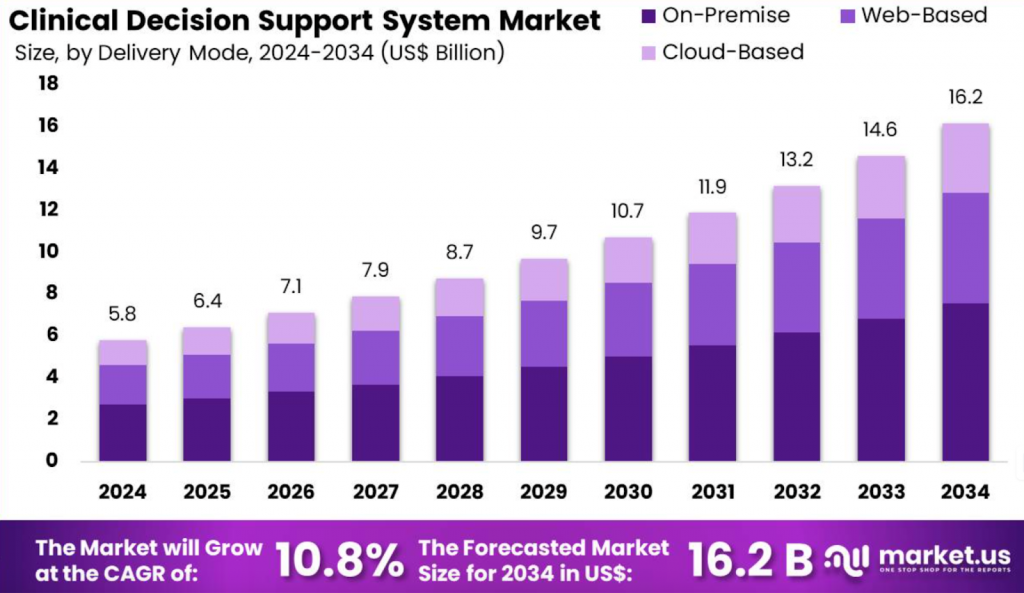
- The total Clinical Decision Support System (CDSS) market around the world is valued at USD 6.4 billion in 2025, and it is expected to be 16.2 billion by 2034, thus rising with a CAGR of 10.8%.
- Research published by Oxford University Press showed that the CPOE commercial system combined with CDSS in the ICUs resulted in a reduction of errors by 85% on medication prescriptions and also decreased the ICU mortality by 12%.
- A systematic review of 87 studies suggested that the implementation of a CDSS led to a 53% reduction in medication errors.
These statistics reveal that the adoption of CDSS is both urgent and on the move. For providers, the question has been replaced with whether they should implement Clinical Decision Support Software or not; they should focus on the speed and effectiveness of doing it to get value.
How does the AI Clinical Decision Support System Work?
AI Clinical Decision Support System is run through a multi-layer architecture that is established to process and analyze personal health care data streams:
Data Ingestion: Inputs are received from EHR/EMR systems, lab reports, diagnostic imaging, wearable devices, and genomic sequencing.
Preprocessing & Normalization: Data are cleaned, standardized, and mapped to guarantee the interoperability among the formats, for example, HL7 and FHIR.
AI/ML Engines: The machine learning models detect anomalies, generate predictive risk scores, and identify correlations across datasets. Clustering algorithms may identify patient subgroups with the comorbidities for example.
Clinical Knowledge Base: The medical guidelines are embedded (for example, those from WHO, CDC, and local standards) which state that the recommendations must be in line with accepted practices.
User Interface Layer: Clinicians get actionable recommendations, real-time alerts, or predictive insights within their workflow, usually through the EHR interface or mobile dashboards.
The leading systems now integrate natural language processing (NLP) to extract insights from unstructured physician notes, and some of them even employ reinforcement learning to permanently adjust based on clinician feedback.
Key Features of AI Clinical Decision Support Systems
1. Real-time Clinical Insights
Clinical Decision Support Systems in Healthcare present point-of-care guidance by emphasizing contraindications during order entry and proposing a differential diagnosis based on user’s symptoms and lab data.
2. Predictive Analytics for Diagnosis and Treatment
Predictive modeling studies historical data for estimation of future disease development and the adoption of early treatments. For example, prediction of readmission risks after surgery allocates preventive resources.
3. Drug Interaction Alerts and Medication Safety
Wrong medications lead to costs in healthcare worth over $20 billion every year in the US. AI-CDSS decreases the risk by notifying clinicians about the interaction between the drug and the patient’s comorbidities.
4. Integration with EHR and EMR Systems
The integration of systems, for example, Epic, Cerner, or Allscripts, along with EHR, is the best path for clinicians to act on any knowledge gained without causing workflow interruptions. The compliance with FHIR rules is of paramount importance for interoperability.
5. NLP-powered Clinical Note Analysis
Natural language processing is a mechanism for machines to process documents like unstructured notes, discharge summaries, or pathology reports and to identify poorly considered risk factors or comorbidities.
6. Genomics Integration
The progress of precision medicine has made it possible to incorporate the AI-CDSS with genomic sequencing. Through the analysis of genetic markers, these systems are capable of personalizing treatments to individual patient profiles.
7. AI Chatbots Integration
Chatbots are providing a major contribution to the enhancement of patient care by addressing issues of treatment plans and reminding patients to take their medicines.
8. Automated Compliance Monitoring
The complexities of compliance with HIPAA, CMS, and The Joint Commission are challenges for hospitals. AI-CDSS achieves compliance by an automated and continuous review of documents and alerts the staff of variations.
9. Personalized Treatment Recommendations
Integrating technology that processes multimodal data allows systems to present personalized treatment pathways. This ensures that therapists can tailor therapies to align with clinical guidelines. Subsequently, they can also customize them based on a patient’s specific conditions.
10. Multimodal Data Integration
The combination of data from images, wearables, labs, and genomics has a favorable effect on the accuracy of the data. For example, by integrating radiology with laboratory markers, early cancer detection models will be enhanced.
11. Adherence to Clinical Guidelines
AI engines are employing rule sets that are based on clinical guidelines, for example, cardiology standards like ACC/AHA. It is a great help in the reduction of variability in care.
Types of Clinical Decision Support Systems
1. Knowledge-Based CDSS
Implemented in a clinical environment through clinical guidelines, which form the basis for “if–then rules” and structured logic, these AI Clinical Decision Support Systems are prominent in functions such as drug–drug interaction alerts and allergy checks.
2. Non-Knowledge-Based CDSS
Compared to knowledge-based systems with preset rules, they are more machine learning and pattern recognition driven to gain insights from data. After they make the decision whether to use them or not, they can easily change as more and more data is introduced.
3. Diagnostic Decision Support Systems
Diagnostic decision support systems were designed to assist doctors in diagnosing various illnesses. They do this by analyzing images, looking at lab results, or grouping symptoms to give a list of potential diseases.
4. Therapeutic Decision Support Systems
These are the systems recommending treatment options and care plans that are especially useful in cancer, heart, and chronic illness management.
5. Administrative Decision Support Systems
Spending less time on clinical issues and concentrating on scheduling, staffing, and cost optimization, these systems help hospitals run the organization better.
6. Integrated CDSS
The integration of these systems into EHR and EMR makes them the best since they provide real-time, context-aware insights without disrupting clinicians’ workflows.
7. Stand-Alone CDSS
Specialties like outpatient or department clinics, which experience limited or lacking integration, are where stand-alone systems are utilized.
8. Patient-Oriented CDSS
Patient-oriented systems offer personalized advice to patients through applications or porters. They are the most popular tools in the management of chronic diseases and lifestyle coaching.
Implementing Clinical Decision Support Systems – Step-by-Step Approach
1. Needs Assessment and Goal Setting
Having clear objectives that can be measured, hospitals can consider implementing an efficient clinical decision support system such as cutting medication errors by 20% or improving compliance with national guidelines.
2. Data Collection, Preparation and Compliance
The role of authentic data in the project is very significant. These modes should clean, standardize, and map datasets from different sources (EHRs, labs, imaging) to reach the same state of quality. It is also worth noting that compliance with HIPAA, GDPR, and local laws is crucial, and the construction of data governance frameworks for security, interoperability, and auditability must proceed.
3. Technology Selection and Vendor Evaluation
Hospitals when selecting vendors should choose those who show scalability, integration with the existing EHR, and those that have shown good results in previous healthcare deployments. The total cost of ownership, integration complexity, and support models are some of the issues that should be taken into consideration. Avoiding vendor lock-in requires assessments to be conducted on the open standards like HL7 and FHIR to make this investment future-proof.
4. Pilot Testing and Phased Rollout
Pilot programs in specific departments, like ICUs and cardiology units, enable the hospitals to check whether the CDSS is operating well in real-life conditions and also to detect the problems with integration. The issues found are fixed before the technology is introduced to the rest of the hospital. A phased rollout is considerably less disruptive; it enables training of the clinician, and it builds trust in the system.
5. Training, Adoption and Change Management
The biggest obstacle is the clinician’s acceptance. Well-organized training sessions that are tailored to the users, and managers’ strong backing are the crop. When CDSS is likely to bring substantial decreases to the cognitive burdens and locations, resistance is no longer an issue.
Benefits of AI Clinical Decision Support Software
1. Reduces Diagnostic and Prescription Errors
AI Decision Support Systems not only provide real time diagnostic guidance, but also flag anomalies in lab results, imaging, and patient history. Drug interactions and allergies encountered in prescribing help prevent unwanted adverse drug reactions, which cost the healthcare system around $20 billion annually.
2. Improves Care Coordination Across Departments
Through the integration with the enterprise EHR systems, CDSS ensures the communication line of primary care, specialists, pharmacists, and nursing teams is secure and free of glitches. A case in point is when a cardiologist alters a therapy regimen, the AI Clinical Decision Support System consequently auto-corrects discharge instructions, pharmacy workflows, and follow-up reminders that govern the entire care process.
3. Enhances Patient Engagement with Personalized Care
AI-CDSS fully utilize multimodal patient data (genomics, imaging, wearable devices) to suggest lifestyle adjustments and form personalized care plans. The use of these customized methods not only increases patients’ compliance rates but also improves their satisfaction scores which in turn influences the HCAHPS (Hospital Consumer Assessment of Healthcare Providers and Systems) metrics used for reimbursement.
4. Saves Costs by Eliminating Redundancies
Duplicate imaging and unnecessary laboratory tests are one of the major sources of wasting money. By retrieving old findings and discovering redundancies, Clinical Decision Support Systems in Healthcare make the care pathways more efficient, which in turn results in lower direct and indirect costs.
5. Improves Hospital Reputation through Better Outcomes
Hospitals making use of the Clinical Decision Support System Development models are happy to report a significant level of improvement in both their CMS star ratings and the results of their accreditation process. Increased safety, efficiency, and patient satisfaction further strengthen the positive image and attract more clients to the provider in a market marked by a shift towards value.
AI Clinical Decision Support System (AI-CDSS) Applications
1. Disease Diagnosis and Detection
AI-CDSS offers a significant advantage for clinicians in detecting tricky diseases through the analysis of multiple clinical data and comprehensively illustrating the possible risks at the beginning. As one of the most powerful Healthcare Software Types, it assists in making quicker and more precise diagnostic decisions.
2. Predictive Analytics for Patient Risk
AI Decision Support Systems offer patients predictive risk scores who are likely to be re-admitted to the hospital, get complications, or suffer from disease progression. In this way, healthcare providers can take action before the issues arise and thus use resources more effectively.
3. Personalized Treatment Planning
AI CDSS customizes the treatment plans by taking in genomic data, biomarkers, and patient history. This process ensures the right patients get the right medications and therapies.
4. Medication Management and Safety
CDSS modules make sure the prescribed drugs are administered safely by assessing the comorbidities, lab results, and genetic factors which directly impact the metabolism of the drug. In pediatrics, this has played a crucial role in the adjustment of doses to prevent toxicity.
5. Clinical Workflow Optimization
Automated alerts, addressing the incomplete documentation, and offering the next steps are the main areas of focus for AI-driven Decision Support Systems for Clinicians. This lessens the administrative burden and improves the efficiency of care delivery.
6. Diagnostic Imaging Support
AI-powered Clinical Decision Support Systems (CDSS) help radiologists by highlighting anomalies in medical scans. Examples include X-rays, MRIs, and CT scans. Tools like Aidoc and Zebra Medical Vision are clinically validated. They seamlessly integrate with PACS systems. As a result, they support second-reader analysis. This aids in detecting conditions such as stroke and pulmonary embolism. Ultimately, this leads to reduced error rates.
7. Critical Care and ICU Monitoring
Clinical Decision Support Software is in a cycle of monitoring the patient’s vital life statistics, lab data, and ventilator settings in real-time. This enables the early detection of patient deterioration and the suggestion and support of interventions in intensive care based on real data.
8. Public Health and Population Management
In a macroscopic sense, the CDSS gives the public health agencies an opportunity to monitor epidemiological data of the disease. During the pandemic, AI Clinical Decision Support Systems have been utilized for surge case projection, ventilator supply optimization, and vaccination prioritization.
9. Telemedicine and Remote Patient Monitoring
In the rapidly expanding field of telehealth, clinicians are increasingly utilizing Clinical Decision Support Systems (CDSS) for remote care. For example, when monitoring chronic diseases like diabetes or hypertension, these systems analyze useful patient health data from wearables in real-time. Consequently, if a patient’s parameters exceed predetermined thresholds, the CDSS promptly triggers alerts, enabling clinicians to intervene proactively.
10. Clinical Research and Trials
AI-CDSS is the one that leads to accelerating clinical research by the automation of patient selection, the monitoring of trial safety, and the analysis of study outcomes. This streamlines clinical processes, enhances accuracy, and facilitates the faster development of medical innovations.
How Much Does It Cost To Develop a Custom CDSS?
The financial investment required depends on functionality, integration complexity, compliance requirements, and scalability goals. A recent industry analysis provides the following benchmarks:
- Basic decision support modules (drug interaction, allergy alerts) integrated into existing EHR: $250,000 – $500,000.
- Mid-tier AI-CDSS with predictive analytics, NLP integration, and EHR interoperability: $1 – $2.5 million.
- Enterprise-grade custom AI-driven Decision Support Systems for Clinicians with multimodal integration (genomics, imaging, wearables) and advanced compliance automation: $3 – $10 million.
Operational costs must also be factored:
- Annual licensing & maintenance: typically 15–20% of implementation costs.
- Cloud hosting & infrastructure: $100,000 – $500,000 annually for large-scale deployments.
- Training & change management: 5–10% of total project cost.
However, the return on investment can be quite significant. Accenture has shown that implementations of efficiency gains, reductions in errors, and optimized resource allocations would allow the U.S. healthcare system to save over $150 billion through the key clinical health AI applications by 2026.
Hospitals that are looking into their options often work with a Healthcare Software Development Company to do needs assessments, calculate TCO, and align budget forecasts with expected ROI.
The Future of AI in Clinical Decision Support Systems
1. AI + IoT Integration
The Internet of Things (IoT) has multiple applications in healthcare, from connected insulin pumps to continuous glucose monitoring. This, together with the AI Decision Support Systems, ensures that patients get alerts in real-time when their vitals go off baseline. Smart ICUs, for instance, apply IoT-enabled ventilators that are linked to predictive models for respiratory failure.
2. Blockchain-Powered Data Security
Data breaches in the medical sector grew, and HIPAA violations have been charged to the organizations leading to penalties of millions of dollars. The operation of CDSS based on blockchain enables the establishment of unchangeable audit trails, therefore, also ensuring compliance with HIPAA and GDPR. Hence, not only is sensitive EHR data secured but also trust is built between patients and regulators.
3. Explainable AI Models
The principal challenge to the acceptance of CDSS is the distrust clinicians feel regarding the “black box” algorithms. The solution is the introduction of explainable AI (XAI), which entails revealing the logic behind system recommendations.
4. Integration with Wearable Devices
Gadgets like smartwatches and biosensors serve as continuous monitors for heart rate, oxygen saturation, and mobility data. These inputs will be contextualized by AI Clinical Decision Support Systems which will further the possibility of preventive interventions such as early atrial fibrillation or fall risk prediction in older patients.
Why Build Your AI Clinical Decision Support Systems (AI – CDSS) With A3Logics?
A3Logics is the top player in this niche with almost 20 years of experience in healthcare software solutions. Here is what we offer:
- Custom Implementation: A3Logics specializes in custom software development services for healthcare facilities with unique clinical workflows, specialty care settings, and compliance frameworks.
- Regulatory Alignment: With expertise in HIPAA, GDPR, and FDA 21 CFR Part 11, A3Logics ensures compliance without sacrificing innovation.
- Scalable Architecture: We design CDSS platforms for modular scaling, from pilot implementations to enterprise rollouts across multi-hospital systems.
- Data Interoperability: Leveraging FHIR APIs and HL7 standards, A3Logics integrates seamlessly with leading EHR vendors such as Epic and Cerner.
- Innovation Focus: The company’s commitment to R&D in LLM in Healthcare and multimodal AI brings customers cutting-edge benefits from things like natural language insights from unstructured notes and predictive analytics from imaging datasets.
As a Healthcare Software Development Company, A3Logics has delivered AI-powered platforms across oncology, cardiology, and chronic disease management.
Conclusion
The success story of the AI Clinical Decision Support System is a notable restructuring of modern medical care. From risk prediction to automatic compliance surveillance, these systems have become the essential areas of operating all healthcare delivery settings from hospitals to clinics and remote telehealth providers.
The strategic decision comprises two parts: invest in Clinical Decision Support Software that is reliable today, and as a result, you will get the benefits of safety and efficiency. Additionally, you can start planning for the future by integrating next-generation features such as explainable AI, blockchain integration, and wearable-driven personalization.
By associating with trusted partners like A3Logics for AI Development Services, healthcare providers can confidently innovate and build scalable platforms.
Connect with us today!