
Managing claims can be a challenging task for both insurers and policyholders. With mountains of paperwork, manual data entry, document validation, cross-checking policy details, and adherence to compliance, it can be further difficult to process claims on time. AI-based Insurance claims management software can simplify this entire workflow by automating the entire claims process. In this post, we’ll discuss the revolutionary impact of AI in claims management.
We’ll discuss how you can create one such platform and what challenges you might have to deal with along the way.
> Why insurers are adopting AI?

Insurers are adopting AI in insurance claims; since it helps them work smarter and serve customers better. Insurance companies implementing AI-powered claims processing have experienced up to a 70% reduction in processing times.
It reduces the scope of errors while simultaneously facilitating faster claim processing and enhancing customer satisfaction. Claim adjusters, underwriters, actuaries, etc can use AI automation in insurance to process large volumes of claims and compress the claims lifecycle.
Last but not least, through AI-driven claims settlement, insurers can manage compliance and mitigate risks, two key concerns in this highly regulated industry.
What is Claims Management Software in Insurance?
An insurance claims management software is a digital platform that streamlines the claims processing process; It automates workflows and reduces manual efforts. With insurance claims automation, insurers can optimize communication among decision-makers by supporting every step of the claim process, including recording incident details, managing settlements, and processing documents.
The Market Landscape of AI in Insurance Claims
- Growth of AI in insurance technology
- The worldwide market size for claims processing software is expected to reach $73 billion by 2030.
- Global IT spending within the insurance industry is expected to reach $271 billion by 2025.
- 63% of insurers plan to fully digitize by 2025.
Traditional Claims Processing: Challenges & Limitations
> Time-consuming workflows
The time period to process an average claim can take a long time i.e. from days to weeks. That’s because traditional claims processing has time-consuming workflows. From patient registration and benefits verification to coding, and payment posting, each stage requires careful execution.
> Error-prone manual processes
Traditional claims processing relies on manual data entry. Since most processes are repetitive, unlike AI-powered claims management software, traditional claims processing systems lack standardization; Traditional claims processing systems do not follow uniform rules or procedures, which leads to inconsistencies and mistakes, especially, when complex forms and paper-based documents are involved.
> Inconsistent decisions
Unlike AI claims settlement, traditional claims assessment relies on human judgment, which may vary between individuals. Different claims processing individuals may interpret the same claim differently based on experience. This may lead to inconsistent decisions. Secondly, manual data entry, and document review can impact the overall accuracy of claim assessment and payouts.
> Limited scalability
Traditional claims processing is incapable of handling an increased volume of claims. Its capacity is constrained by heavy reliance on manual processes that further lead to bottlenecks, increased costs, and longer processing times.
> Poor document and data management
When you opt for insurance claims management software development, you intend to create a platform that helps in managing documents and data. In traditional claims processing, employees have to manually collect, verify, and store a large amount of paperwork across multiple systems. This opens possibilities for loss of data or inconsistencies. Furthermore, at the time of need, searching for past records or cross-checking information, too, can take a lot of time.
How AI Transforms Claims Processing?
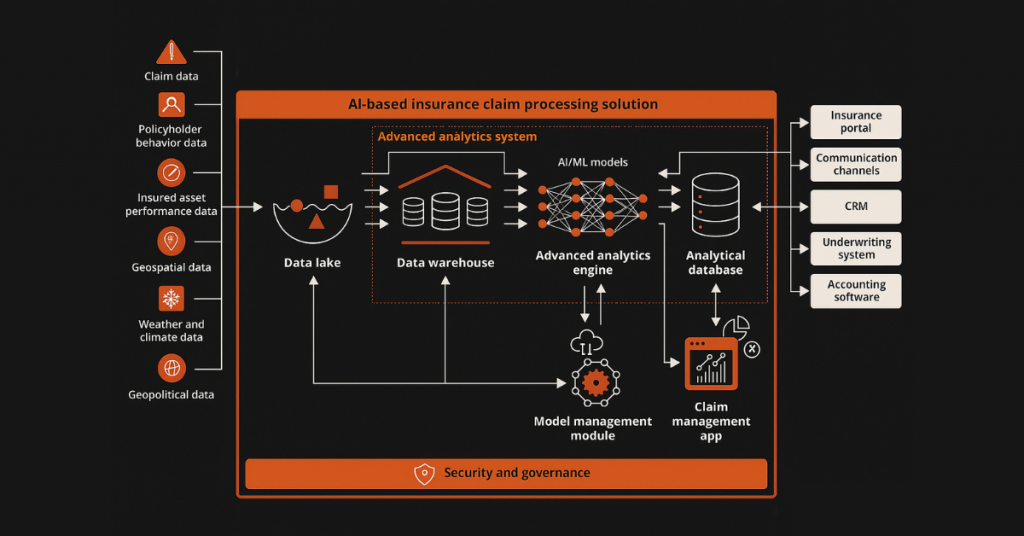
1. Digitization of input channels
Claims Management Software can transform traditional paperwork into a fully digital workflow; The platform captures data from multiple input channels – including scanned documents, emails, photos, and PDFs. Using advanced recognition technologies, a claims management software extracts relevant information from these documents, and further sorts the data it into digital records so that it becomes easier for insurers to process them.
2. OCR & NLP for smart data extraction
AI-Powered Claims Processing fuses OCR and NLP for smart data extraction. Let’s discuss this in brief; The OCR (Optical Character Recognition) technology scans images and converts the data into machine-readable text. The NLP (Natural Language Processing) analyzes the content using natural language and understands its meaning, structure, and context.
3. AI-based classification and triage of claims
An AI-based claims management software automates claim triage by categorizing cases based on factors like risk, complexity, and priority. Hence, the AI-powered triage system significantly reduces claim handling time and helps cut operational costs.
4. Automated verification with policy data
An AI insurance claims management software facilitates insurance claims automation. It uses machine learning algorithms to analyze data and cross-verify it against established patterns and historical data. It identifies anomalies and inconsistencies that may go unnoticed.
5. Fraud detection with pattern recognition & anomaly detection
AI fraud detection in Insurance applies machine learning algorithms to identify deviations from normal data patterns. Based on this; it flags potential fraudulent activities such as unusual locations, transaction amounts, and behaviors.
6. Decision-making automation with minimal human intervention
An insurance claims management software helps in decision making by automating repetitive steps; validating claim details, checking the policy coverage of various customers and calculating the right settlement amount. It reduces human intervention by following predefined rules. This doesn’t imply that it doesn’t involve humans. In case there’s a complex claim, the system routes it to a human reviewer. Together, this automation with minimal human intervention can cut operational costs and increase the speed of processing claims.
7. Predictive analytics for claims outcomes
Predictive analytics in insurance claims helps identify patterns and predict the outcome of new claims. It uses machine learning and statistical models to analyze historical data; insurers can forecast the severity of the claim, forecast claim likelihood, identify fraudulent claims, and streamline processing. We have covered the topic of data analytics in insurance in a separate post; discussing its impact.
Case Study – Transforming Claims with Intelligence: ClaimPro Corp’s Journey to Data-Driven Success
> Background
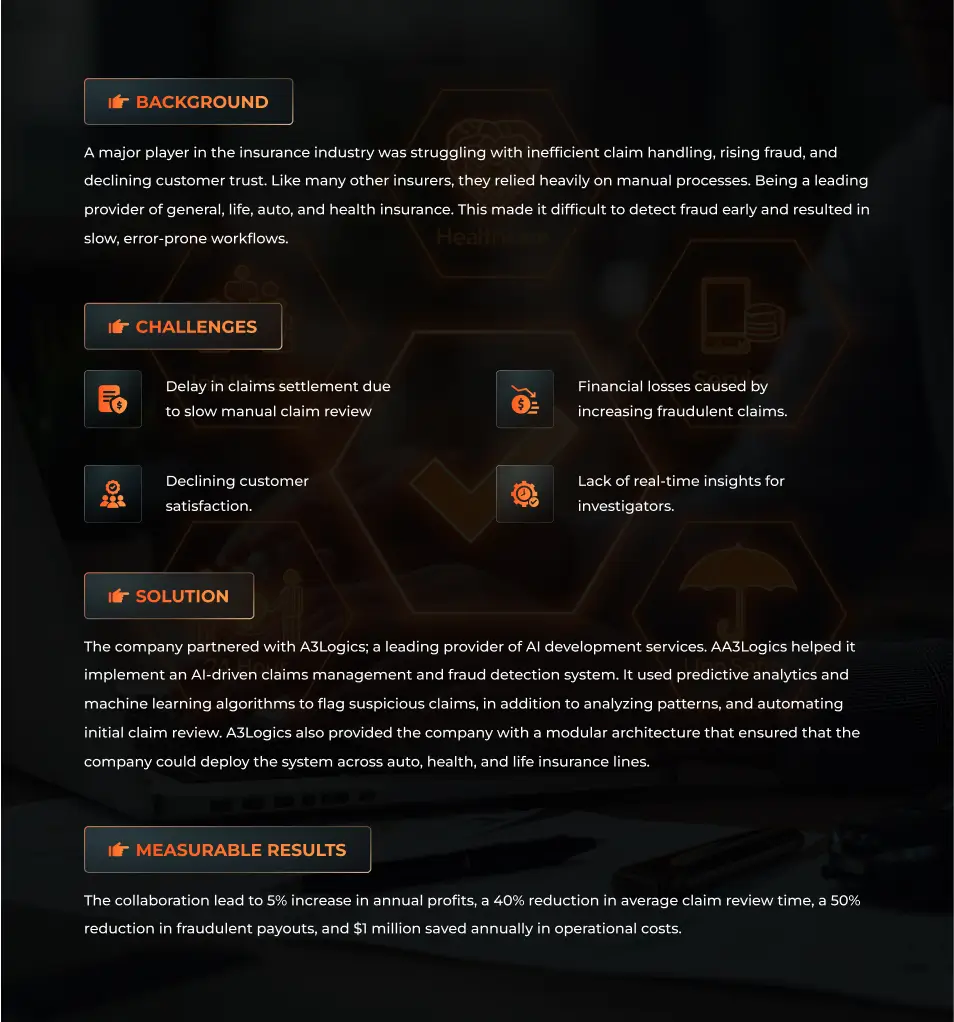
A major player in the insurance industry was struggling with inefficient claim handling, rising fraud, and declining customer trust. Like many other insurers, they relied heavily on manual processes. Being a leading provider of general, life, auto, and health insurance. This made it difficult to detect fraud early and resulted in slow, error-prone workflows.
> Challenges
- Delay in claims settlement due to slow manual claim review
- Financial losses caused by increasing fraudulent claims.
- Declining customer satisfaction.
- Lack of real-time insights for investigators.
> Solution
The company partnered with A3Logics; a leading provider of AI development services. AA3Logics helped it implement an AI-driven claims management and fraud detection system. It used predictive analytics and machine learning algorithms to flag suspicious claims, in addition to analyzing patterns, and automating initial claim review. A3Logics also provided the company with a modular architecture that ensured that the company could deploy the system across auto, health, and life insurance lines.
> Measurable results
The collaboration lead to 5% increase in annual profits, a 40% reduction in average claim review time, a 50% reduction in fraudulent payouts, and $1 million saved annually in operational costs.
> Conclusion
By using AI-driven claims management, the company was able to reduce fraud significantly. Not just that; it was able to build stronger customer trust, and make its operations more efficient. You can go through the detailed A3Logics insurance BI case study here to explore the complete journey.

Key Use Cases of AI in Claims Processing or Management
1. Document Processing & Data Extraction
With the help of an Insurance claims management software; you can build a system that fuses natural language processing with optical character recognition to extract relevant information from claim-related documents such as policy numbers, medical reports, incident information, and others. Such systems are capable of understanding various layouts and formats.
2. Claim Classification & Triage
Through insurance claims automation; AI algorithms automatically classify claims received based on factors such as complexity and urgency, claim type, fraud potential, and claim type; This triage ensures that claims are routed to the right processing channels. What’s even better is that simple claims are fast-tracked for automated processing, whereas complex ones are routed towards specialized teams.
3. Fraud Detection & Prevention
With AI fraud detection, insurance fraud patterns and unusual claim behaviors can be identified. AI systems in insurance can highlight errors in claim documents.
4. Automated Damage Assessment
AI for damage assessment is often used in insurance verticals such as auto and property insurance. With the help of advanced technologies such as computer vision, insurance companies can analyze videos of damage and photos to estimate repair costs based on visual evidence. They can also find out if the damage is new or an old one and create detailed reports.
5. AI-Powered Decision-Makin
AI-powered claim management software makes handling insurance claims easier; It can check if a policy covers the claim; confirm the details are correct, and figure out the right settlement amount. As a aresult, it can also approve payments automatically.
6. Customer Support & Communication (chatbots, self-service portals)
With AI claims management software, customers can get answers to their insurance-related queries. These systems are backed by conversational chatbots. Customers can get instant answers to common questions and track the progress of the claims in real-time. Another aspect of such platforms is that they offer self-service portals on which users can submit claims, upload documents, and check updates anytime they wish to.
7. Predictive Analytics for Reserving & Settlement
AI claims settlement studies past claim records to estimate future costs. It helps insurers decide how much money to keep aside, predicts the total claim expense, and suggests fair settlement amounts for quicker and more accurate payouts.

Architecture of AI-Powered Claims Processing Systems
> Data ingestion & digitization layer
The data ingestion layer of a claims management system collects claim information from; emails, web portals, scanned documents, and voice recordings. It then checks the data for accuracy, verifies customer and policy details, and extracts important information using tools like OCR and NLP.
> AI/ML models (OCR, NLP, fraud detection, predictive analytics)
The AI/ML models play an important role in the architecture of AI-powered claims processing systems and consists of multiple technologies such as OCR, NLP, predctive analytics, etc. The OCR model extracts text and data from multiple documents. The Natural Language Processing Layer helps analyze reports and customer communication using natural language. The fraud detection and predictive analytics layers prevent fraudulent claims by utilizing historical data to forecast future outcomes.
> Integration with insurance core systems
In insurance claims management software development, the integration layer facilitates communication between system components. It utilizes APIs to connect AI tools with core systems, such as billing and policy platforms.
The microservices architecture enables each function, such as document scanning and fraud detection, to run independently while still communicating with the rest. The event-driven pipelines allow the system to react instantly when something happens.
> Customer interaction layer (notifications, chatbots, portals)
The customer interaction layer is where customers connect with the claims system. It includes chatbots, notifications, and portals. AI chatbots help customers file claims step by step and give 24/7 support whenever they need assistance. The customer portals provide a platform where policyholders can access policy information and track claims. Through notifications, customers get updated information about their claim progress.
> Analytics & reporting
With the help of predictive analytics in insurance claims, AI models analyze vast amounts of historical data. It also identifies trends and detects anomalies such as fraud. Furthermore; this layer also helps generate reports highlighting possible bottlenecks and insights into the risk profiles of customers.

Benefits of AI-Driven Claims Management
1. Operational Benefits
- Faster claim processing
AI helps get rid of repetitive tasks such as data entry and document analysis. This further speeds up claims resolution and the time taken to process claims is reduced to days where earlier, in case of traditional claim processing, it would take up days.
- Cost efficiency & reduced overhead
AI reduces reliance on human resources; the human claim adjusters, underwriters, and other professionals can focus on more complex issues, allowing for better allocation of resources.
- Higher scalability
By handling a large volume of claims simultaneously without slowing down processing times; AI for damage assessment offers higher scalability.
- Greater accuracy & productivity
AI-powered claims automation improves accuracy by creating consistent workflows and minimizing human mistakes. It uses smart document processing, multiple AI tools, and automation to handle claims efficiently, making the process faster, more reliable, and easier for insurers to manage.
- Improved document & workflow management
Insurance claims automation automatically reads and pulls information from unorganized documents, reducing manual work. It also organizes incoming claims, sorts them by type or priority, and starts the right workflow, making the entire claims process faster and more efficient.
2. Customer Experience Benefits
- Faster resolutions (days vs. weeks)
AI-powered chatbots provide instant support by answering queries related to insurance and status updates 24/7.
- Real-time claim tracking & transparency
Stakeholders such as providers, policyholders, and others can stay updated on the status of their claims through automated platforms.
- Consistency in claim outcomes
AI-enabled rules and decision support tools standardize the process of claims. These systems analyze patterns in past claims outcomes and apply policy logic to route edge cases to human reviewers.
- 24/7 convenience & multi-channel access
AI-driven claims management provides 24/7 multi-channel access and convenience by enabling policyholders to interact with the platform anytime, anywhere. It lets customers submit and manage claims through websites, apps, chatbots, or emails.
- Personalized communication
By leveraging predictive analytics in insurance claims, AI enables insurers to offer personalized products and services tailored to customer needs and preferences.
3. Strategic Benefits
- Data-driven insights for decision-making
AI plays a pivotal role in claims management by collecting and structuring data across all claims. It also provides valuable insights for performance analysis, enabling informed decision-making.
- Enhanced fraud detection & risk management
AI Fraud Detection in Insurance analyzes historical fraud patterns and identifies suspicious relationships between parties. It flags inconsistencies in claim documentation.
- Competitive edge in customer service
When insurers exercise AI claims settlement, they respond quickly to customer queries. With the integration of AI, insurers can send instant notifications regarding claims progress and enable personalized interactions.
- Optimal resource allocation (humans focus on complex claims)
AI-based claims management software automates repetitive tasks and routes complex claims to human agents, thereby facilitating optimal resource allocation.
- Innovation in insurance products
AI opens up product innovation opportunities by using data insights gathered during the claims process to design smarter and more flexible insurance offerings.
4. Financial Benefits
- Reduced claim leakage
By precisely estimating ultimate costs, AI enables insurers to set accurate reserves, thereby reducing financial leakage. AI-powered systems can analyze historical data to prevent potentially fraudulent claims before they are paid.
- Increased profitability
Insurance claims automation speeds up the entire claims lifecycle; It reduces the time to process claims and leads to quicker reimbursement and better cash flow. Using data insights, insurers can make better-informed decisions and optimize profitability.
- Improved customer retention & loyalty
Since AI-driven claims management platforms enable faster and hassle-free settlements, customers are more likely to renew their insurance policy, stay loyal, and recommend the brand to others.
Challenges of AI in Claims Management
Challenge 1: Achieving high accuracy of analytical results
The insurance landscape across sectors is constantly evolving due to, changing policies, regulatory updates, and shifting fraud tactics; as a result, it may be challenging for AI claims settlement platforms to keep pace with these developments. Errors in coding and policy details can lead to incorrect claim processing and denials, making it hard for AI to function with imperfect data.
Solutions:
- Utilize technologies like OCR for accurate data extraction.
- Focus on developing AI systems that can provide clear justifications for their outputs.
- Employ machine learning and predictive analytics to improve fraud detection.
- Focus on developing AI solutions that are transparent.
Challenge 2: Sensitive data security
AI in claims management processes vast amounts of sensitive personal data; including medical records, personal identification details, and financial information. The information in wrong hands could lead to identity theft, and severe breaches of privacy; It can also lead heavy financial loss – especially if a fraudster is able to claim the insurance payout.
Solutions:
- Encrypt sensitive data both in transit and at rest.
- Use data anonymization for training AI.
- Implement strict access controls.
- Conduct regular audits and compliance checks.
How A3Logics Can Help in AI Claims Management Software Development?
> Custom AI development
As a leading AI development company, A3Logics provides insurance software development services. We help you integrate AI technologies such as machine learning; predictive analytics and NLP into your existing workflows; With such systems, you can automate tasks such as fraud detection, claims processing and risk assessment.
> Integration with existing claims management software
We ensure smooth integration of AI into your existing claim management workflows without disrupting current processes; This integration enables real-time fraud detection; automated claim triage and predictive analytics while also supporting business intelligence for insurance to deliver actionable insights.
> AI model fine-tuning and claims workflow automation
We fine tune language model on insurance claims data so that can help process claims quickly. We can help you create AI systems that can automatically classify claims and detect inconsistencies.
Conclusion – AI Claims Management Software Development
Claims processing can be time-consuming; often leaving policyholders waiting for urgent payouts. On the other side, insurers face pressure to meet strict timelines, which further opens the scope for errors and fraud. As is established in the blog, AI in insurance claims is being used to improve the claims process. Not only do advanced technologies like machine learning, predictive analytics, and others improve the claims process; but they also reduce the scope of fraudulent claims.