
3D modeling is at the threshold of a revolution fueled by dramatic advances in artificial intelligence, cloud collaboration, real-time rendering, and virtual/augmented/mixed reality. Entering 2025 and beyond, there is a need to examine the trends and innovations that will define the future of 3D modeling. With the worldwide 3D modeling market set to expand by 20% each year from 2023 to 2025, it’s apparent that the need for high-quality, scalable, and affordable 3D modeling solutions is increasing.
Recent studies indicate that AI-driven custom 3D modeling services like Womp can make the 3D modeling process more efficient across industries. With 3D Model Design Services coming into play we can get rid of intricate processes and generate realistic models with little input. It can potentially shorten production time immensely while also increasing productivity. Further, with the inclusion of 3D models in virtual and augmented reality technologies, sectors such as gaming, architecture, and education are being revolutionized with the ability for users to be immersed in their designs and develop a better sense of space.
In this blog we are going to take an in-depth look at what a custom 3D modeling service is, the role of AI for 3D modeling and how 3D modeling software development can be beneficial.
How AI is Revolutionizing 3D Modeling Services?
Artificial intelligence is changing the way 3D modeling is done by automating intricate processes, streamlining workflows, and creating realistic models from a small input. Womp and other AI-based 3D model generators are already taking the industry by storm. For example – AI-based software now has the capability of creating realistic models from a small input, reducing production time by a large margin. Machine learning algorithms examine existing 3D data to generate precise models with little human intervention, optimizing workflow in industries.
1. Faster and Smarter Model Generation
Learning from object, texture, and environment datasets speeds up 3D modeling with AI. Instead of weeks of meticulous design – AI-driven systems can create realistic 3D models quickly. For instance, generative AI algorithms can turn 2D sketches, photos, and text prompts into high-quality 3D materials. Businesses looking to streamline this process can experiment with tools such as Hyper3D image to 3D model free, which demonstrates how AI can convert ordinary images into detailed 3D assets suitable for design, visualization, and prototyping workflows. Reduced manual labor shortens production cycles in gaming, animation, architecture, and product design and lowers costs. AI optimizes workflows to help businesses launch ideas faster.
2. Automating Repetitive Design Tasks
Traditional 3D modeling entails tedious operations like – rigging, UV mapping, retopology, and texture application. Artificial intelligence systems may find trends and reproduce them across models, simplifying this. AI-powered retopology technologies build, clean meshes ideal for animation – while texture-generation models apply realistic surface details automatically. Automation frees designers from monotonous work, letting them focus on intricate and creative project elements.
3. Enhancing Creativity with AI Support
AI is a powerful co-pilot in 3D modeling, not completely replacing human innovation. Simulating many prototypes fast helps provide design variations, innovative alternatives, and fresh ideas. Designers can input parameters or thoughts, and AI will generate several design iterations for assessment, inspiring creativity. Product design, fashion, and entertainment require ongoing innovation – thus this is useful. Together with AI, artists and engineers can push creative boundaries, experiment with new aesthetics, and achieve outcomes that would be difficult or time-consuming using human approaches.
Key Benefits of AI-Powered 3D Model Design Services
The incorporation of AI for 3D modeling services has several advantages – that encompass efficiency, better design capabilities, and ease of use for non-professionals.
1. Improved Prototyping through AI
AI facilitates the fast creation of design prototypes through the automation of modeling and simulation. Enabling designers to rapidly test several versions and develop refined ideas within a shorter duration.
2. Increased Efficiency
With AI for 3D modeling accelerates design rounds and diminishes human effort – companies can get from idea to finished product quicker, ahead of the competition in rapidly changing markets.
3. Business Cost Savings
Robotic process automation of repetitive activities and streamlined workflows minimize dependency on large-scale human labor, lowering cost of production while maximizing the efficiency of resources.
4. More Accuracy and Precision
AI-driven algorithms deal with data and patterns to eliminate the scope of human error. It assists in generating – very detailed, precise, and realistic 3D models for sophisticated applications.
5. Increased Collaboration among Teams
AI applications provide cloud-based facilities where designers, engineers, and stakeholders work simultaneously to ensure improved communication and synchronization across teams globally.
Want to build an AI Model here is our comprehensive guide.
Key Features of AI-Powered 3D Modeling Tools That Businesses Look For
Features are what can make or break any app. Choosing the right one is very important to ensure the success of any AI 3D Model Generator. That’s why before going ahead with Custom 3D Modeling Service – here is a list of features that a business must look for in 3D Modeling Services.
1. Generative Design Algorithms
AI-driven generative algorithms generate automatically a sequence of design variations from input parameters, enabling businesses to explore creative solutions with urgency.
2. Real-time Rendering
High-end AI rendering tools render 3D models in real time. This helps in providing designers and stakeholders with immediate visualization of changes, evaluation of appearance. This allows them to make decisions without suffering the wait for delayed processing.
3. AR/VR Integration
Integration with virtual and augmented reality platforms, perfectly allows firms to experiment and experience designs in immersive environments. This further enhances client presentations and user simulations.
4. Cloud Accessibility
Cloud-based AI-powered modeling tools allow teams to collaborate on, edit, and work on projects remotely using fewer local computing systems.
5. Lightning-Fast Generation from Multiple Inputs
They can create accurate 3D models directly from sketches, images, CAD data, or even text-based input, saving time and offering greater design freedom.
6. Automation of Time-Efficient Operations
Retopology, texture mapping, and rigging operations are automated – freeing designers to focus on creative work while improving efficiency and consistency.
7. Refinement and Customization Tools
AI for 3D modeling assists in honing models with precision. Offering intuitive controls to alter specifics, optimize geometry, or manipulate texture and material to business requirements.
8. Scalability and Batch Creation
Businesses can produce multiple models or variants simultaneously – allowing mass production and process repetition without affecting quality.
9. Cross-Platform Export
Models can easily be exported to other software, game engines, or simulation platforms, being compatible and simpler to integrate within varied workflows.
10. Centralized Asset Management
Artificial intelligence platforms provide organized libraries for – asset storage, tracking, and reuse, which enables collaboration and consistency between projects and teams.
Industry Applications of AI-Driven 3D Modeling Software Development
Architecture, Engineering, and Construction (AEC)
3D models have led its course in a new era in the construction and architectural industries. Architects currently construct models of structures in 3D using specific software like Revit and AutoCAD. Building Information Model (BIM) is the standard in the current industry, which combines information on structures and materials on the building systems in 3D models to provide a complete overview of a project.
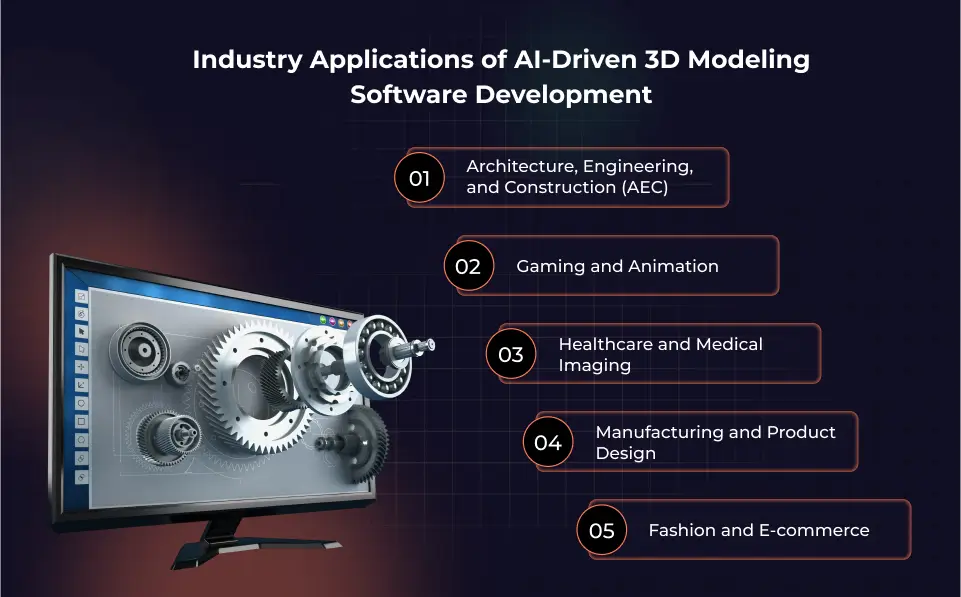
1. Gaming and Animation
At every stage of video game and movie-making, 3D modeling has played an important role. Characters, scenery, props, and even all visual effects are modeled out in 3D. Whereas game developers employ 3D models for making large virtual worlds where consumers can spend their time, movie houses employ models for visual effects and CGI.
2. Healthcare and Medical Imaging
Use of 3D modeling in medicine such as – prosthetics, customized medical devices, and even printing organs. Furthermore, surgeons can also practice intended interventions using realistic 3D models created from the patient’s CT or MRI scan data during interventions. 3D printing has increasingly been utilized to manufacture customized prosthetics and implants for patients with unique requirements.
3. Manufacturing and Product Design
AI in Product Development is making prototypes easier for engineers and manufacturers today, as they can make models to test without having to follow the long processes of making prototypes. Additive manufacturing or 3D printing has made it even easier by allowing direct manufacturing of parts from 3D models.
4. Fashion and E-commerce
For the fashion and ecommerce segments, 3D modeling allows try-ons virtually. The consumers are able to see how makeup, clothes, or accessories will appear on them prior to buying. It improves the shopping process online and discourages return purchases as consumers are confident in their choices. Retailers are able to develop stunning visuals and animation that will attract people.
Whether highlighting products as 3D models, developing interactive experiences, or designing engaging advertisements, 3D modeling maximizes the effect of e-commerce initiatives, making them more appealing and convincing.
Step-by-Step Guide to Develop AI 3D Model Generator
1. Establish Goals & Success Criteria
The initial one is to set the objectives of your AI 3D model generator clearly. Determine whether the tool is intended for – rapid prototyping, design exploration, game development, AR/VR, or product modeling in an industrial environment. Establish measurable goals of success, e.g., model generation time, accuracy, photorealism, adoption, or integration into existing design workflows. Having precise objectives ensures the business needs and stakeholder needs are satisfied with the AI solution.
2. Choose Ideal AI Capabilities & Models
Selecting appropriate AI models matters. They could be generative adversarial networks (GANs), diffusion models, transformer-based or hybrid models. Choose models based on their high-fidelity 3D geometry generation, texture, and multi-modal inputs (sketches, images, CAD models, or text inputs). Choose pre-trained models for efficiency and speed, and look for whether custom training is necessary for industry-specific designs.
3. Design the Integration Architecture
A solid architecture ensures smooth interaction among – AI modules, 3D modeling engines, cloud platforms, and user interfaces. Decide how AI talks to rendering engines, asset libraries, and design tools. This means defining APIs, data pipelines, storage solutions, and the computing environment to process high-performance model generation.
4. Data Flow & Asset Provenance
Carefully manage input data and design assets for – provenance, version control, and traceability. Proper curation, labeling, and storage of training datasets, user inputs and current models must be ensured. Data flow planning ensures relevant data availability to AI models and adherence to licensing and intellectual property laws.
5. Quality Control & Human-in-the-Loop
Even top-of-the-line AI requires quality monitoring. Set up human-in-the-loop mechanisms through which designers can – inspect, approve, or modify models created. Use feedback loops to correct errors, improve realism, and ensure output adheres to creative or functional requirements.
6. Testing, CI/CD, and Model Governance
Continuous deployment and integration pipelines help iteratively, adjust AI models and software pieces. Add stringent test procedures to deliver – accuracy, performance, and compatibility. Add governance policies to monitor ethical usage of AI, IP compliance, and version control in updating.
7. Monitoring, Analytics & Continuous Improvement
Track model performance, usage, and error rates post-deployment. Make use of analytics for identifying bottlenecks and areas for enhancement. Continuously adjust algorithms, refresh data sets, and fine-tune workflows to ensure the AI 3D model generator is able to meet evolving creative and business requirements.
Challenges Businesses Face in Adopting AI-Powered 3D Modeling Services
Implementing 3D Modeling custom software development services, is not an easy task and comes with its own set of challenges. Let’s take a look at some of them.
1. High Initial Investment
AI-driven 3D modeling services are expensive upfront. GPUs, cloud computing, AI software licensing, and training datasets, are needed by businesses. Although it improves efficiency, this high capital cost can turn-off small and medium-sized firms from adopting it.
2. Data Privacy and Security Concerns
AI models need lots of data, including private design and IP. Protecting this sensitive data is crucial. Breaches or misuse of design data can cost money and reputation. Businesses must strengthen cybersecurity and follow regulations to protect data.
3. Need for Skilled Workforce
Operators of AI-powered 3D modeling tools must comprehend 3D design and AI technologies. In tight-talent industries – recruiting or upskilling machine learning, computer graphics, and generative modeling experts is difficult. Companies may struggle to use AI without skilled staff.
4. Integration with Existing Workflows
AI integration into design and production pipelines is difficult. AI-powered products may not function with legacy software or workflows – requiring customization. Businesses must enable smooth interoperability so AI enhances workflows.
5. Bias and Lack of Diversity
Existing datasets may have biases or few design examples for AI algorithms. Consumer-facing applications like – fashion, gaming, and architectural design can suffer from a lack of diversity, inventiveness, and inclusivity. Businesses must carefully select datasets and refine models, to prevent bias and repetition.
AI for 3D Modeling – Future Trends
Future AI in 3D modeling will focus on – realism, digital immersion, intelligent copies of the physical, and sustainability. This creates cross-sector opportunities.
1. Generative AI for Realistic Models
Generative AI will drive 3D modeling to hyper-realism. Next-generation tools will generate ultra-realistic and highly detailed models from – text inputs, sketches, or photographs. Such models will have realistic textures, exact lighting, and physics-based natural characteristics, which will make them priceless in game development, movies, architectural visualization, and product prototyping.
2. Integration with Metaverse Applications
As the metaverse grows, AI-powered 3D modeling will be a key part in making a lot of immersive virtual worlds, avatars, and virtual objects. Instead of making each component by hand – AI will make them in large quantities with consistency and realism. This will let businesses create interactive experiences for – buying, training, education, and entertainment in virtual reality.
3. Application of Digital Twins
AI will make it faster to make digital twins, which are virtual copies of real things, systems, or places. Twins will let firms test and improve how well they work in – smart cities, healthcare, construction, and manufacturing. AI-powered 3D models that are updated in real time will help with predictive maintenance and making operations more efficient.
4. AI-driven sustainability
Sustainability is becoming more and more important in design and industry. AI-powered 3D product modeling software will help with creating structures that use less energy – getting the most out of materials, and modeling eco-friendly alternatives. Companies can cut down on waste and make sure that projects are in line with sustainable aims – by looking at how resources are used, and how they affect the environment – throughout the planning phase.
Why is A3Logics Your Ideal Partner for Building 3D Model Software?
A3Logics is your ideal AI Development Company for – creating high-performance 3D-model software, blending technical know-how, with innovative approaches for high-performance solutions. We provide, scalable, rich feature 3D modeling services for – video games, real estate, healthcare, manufacturing, and retail sectors through emerging technologies, and years of experience in software development.
We use Generative AI Development Services to create realistic models for faster content creation. Businesses can improve – simulations, product designs, and operational efficiency by replicating real-world assets via digital twin technologies. Aligning with metaverse apps makes your 3D models future-ready and immersive, providing seamless virtual experiences.
We optimize modelling workflows for sustainability-driven AI at A3Logics to reduce resource utilization and retain high-quality outputs. As Microsoft and AWS partners – we provide enterprise-grade, security, scalability, and cloud readiness to every project.
Conclusion
In conclusion, the future is brighter than ever for 3D modeling with tremendous progress in – artificial intelligence, cloud-based collaboration, real-time rendering, and immersive-technologies. From automating complicated processes to enabling real-time collaboration and immersive experiences – the advantages of these technologies are many and thrilling.
The most significant points from this article are the increasing role of AI-driven 3D model generators, the emergence of cloud collaboration platforms, and the demand for real-time rendering and immersive technologies. It’s crucial that companies and individuals – remain in front of the curve, and use these trends to fuel innovation and progress.