Fresh air and optimum temperature level are the most essential requisites for living or working comfortably in an indoor space. This is exactly what the HVAC system does through its Heating, Ventilation, and Air conditioning units within a building.
Importance of HVAC in Modern Infrastructure
Changing climate conditions and a hard environment make it challenging for the local people to live and thrive in such a state. Uncomfortable surroundings can impact their health and productivity in the long run. Therefore, it is mandatory for builders to ensure that a proper HVAC system is installed in all their construction projects.
It regulates air flow, enhances its quality, controls temperature as per weather conditions, and decreases humidity within an enclosed area. Innovative HVAC monitoring solutions ensure comfortable heating or cooling, fresh air, and optimal moisture levels in homes, offices, or industrial areas. It makes living comfortable in residential areas and increases productivity in commercial areas.
The Shift from Traditional HVAC to IoT and AI-driven Systems
HVAC is not a new concept, and some of its components have been in existence for a long time, such as the thermostat, which was introduced in 1883. Primarily, this system focused on temperature settings in a scheduled pattern and was manually handled. However, as time passed, new technologies were introduced in this field, transforming the way HVAC systems function.
IOT and AI-driven HVAC monitoring system development are the latest additions in this industry. Traditional HVAC systems were solely focused on maintaining an optimal environment inside a building and did not incorporate the concept of resource optimization. The shift towards IoT and AI-driven systems has enabled HVAC units to operate more sustainably and reduce their carbon footprint.
Market Trends in IoT and AI-Driven HVAC Systems
Increasing pollution levels and climate change have made it almost impossible to live in enclosed settings without proper ventilation, air conditioning, and humidity control units. IOT and AI-Driven HVAC Monitoring System Development is no longer a luxury but an essential incorporation for ensuring comfort inside any estate with eco-friendly practices. Following market trends are redefining smart HVAC monitoring solutions:
1. Rising Demand for Smart Buildings and Green Energy Initiatives
People are well aware of the climate change conditions and the impact of fossil fuels on both the global and local environment. Also, the unlimited use of valuable resources across the world has raised concerns about their depletion on the planet. Thus, demand for green energy sources is increasing in all industries, streamlining IoT in the HVAC industry.
Additionally, smart buildings are a growing concept in modern cities, which can adapt the inner atmosphere according to harsh weather conditions outside. These modern trends demand sustainable HVAC solutions with AI and IoT to provide ultimate comfort to the occupants, while using energy sources efficiently.
2. Market Growth Statistics and Future Projections
Environmental concerns and rising interference of regulatory bodies are persuading the HVAC industry to adopt innovative tools like AI and IoT in their operations. Increasing urban localities and highly technological additions are creating more and more smart buildings equipped with HVAC systems incorporated with artificial intelligence and IoT infrastructure.
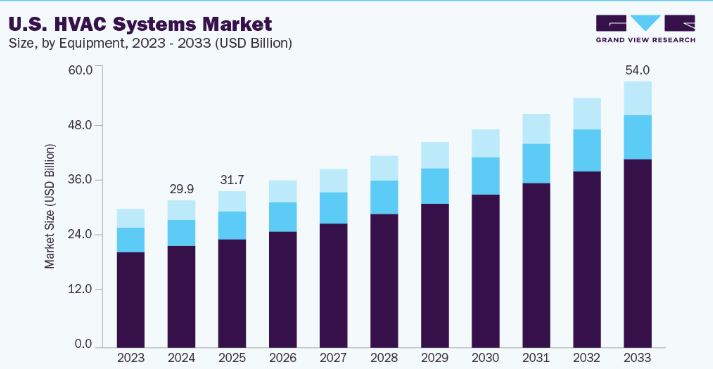
It is evident from the overall market growth in this field in different zones worldwide. For example, the Asia Pacific region, falling under the leadership of India and China, generated 46.8% of total revenue globally in 2024, whereas the US market is projected to grow between 2024 and 2030 with a CAGR of 7.4%.
Core Components of IoT and AI-Driven HVAC Monitoring Systems
A network of the following elements is mainly responsible for the efficient working of an AI and IoT-based HVAC system:
1. IoT Sensors and Devices
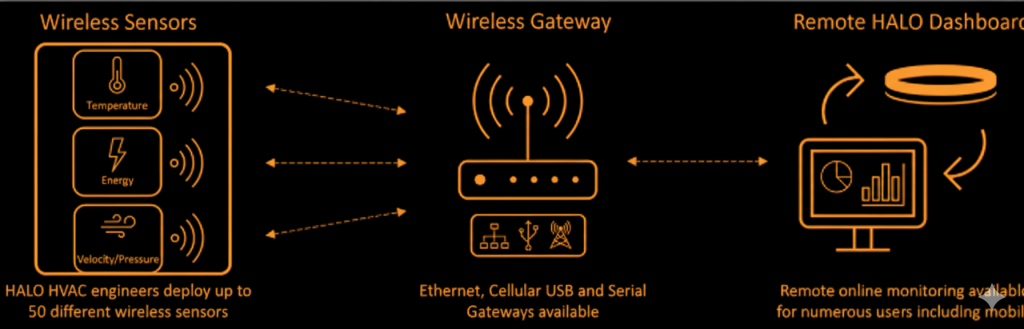
These collect and analyse real-time data of the surrounding environment and HVAC tools to enable efficient performance of the system. Different types of sensors are installed on the site to track temperature, air quality, occupancy rate within a building, energy consumption, and anomalies in the nearby equipment. These insights enable smart HVAC monitoring solutions to enhance a healthy and comfortable indoor environment in sustainable ways.
2. AI Algorithms
AI algorithms do predictive analytics on the live data that is collected from IoT sensors, to optimize energy efficiency and offer personalized comfort. Artificial intelligence and machine learning work together to identify patterns in the environmental conditions and the use of energy resources. The results help in the automated maintenance of the internal quality of air and temperature while using energy efficiently.
3. Cloud Platforms
This works as a center spot for storing, processing, and analyzing the data collected by IoT sensors and devices. Cloud platforms provide remote access to the predictive insights driven by AI and IoT in the HVAC industry. It facilitates mobile application frameworks to control the system from anywhere.
4. User Interfaces
Customers interact with the HVAC arrangements through the user interface and can also see the results of predictive analysis over it. It includes the interactive dashboards that represent crucial data about air flow, humidity level, and surrounding temperature. At the same time, it also pushes the notification when any maintenance issues are recognized into the system.
5. Integration with Building Management Systems
IOT and AI-driven HVAC monitoring system development integrates with the overall building management system to provide centralized control. It enables the IoT sensors and devices to share real-time data of all the electronic equipment and mechanical framework within the entire property with the BMS. This merger enhances indoor comfort in a cost-effective manner.
Role of IoT in HVAC Monitoring System
Traditional HVAC systems required manual handling and labour presence to keep them working efficiently. The emergence of IoT in the HVAC industry has facilitated interconnected control and insights into the indoor environment to optimize its functionality.
1. Real-time HVAC System Monitoring and Data Collection
IoT sensors collect and share real-time data about the internal variables such as humidity, flow, pressure, temperature, vibration, and fault potentials. This level of information guides the technicians to maintain a healthy HVAC system by continuously monitoring its components.
2. Remote HVAC Management with IoT-based Dashboards
HVAC management is no longer a labour-intensive process with the adoption of IoT technology. It enables remote access to the valuable data instantly, allowing the property managers or homeowners to make an early diagnosis of any potential inefficiency in the indoor system. With interactive dashboards on mobile applications, they can take a quick glance at the HVAC operations.
3. Predictive Maintenance in HVAC using IoT Data
The AI algorithms developed according to the historical data and the past pattern of equipment failure learn the maintenance requirements after some time. It follows the instant performance of the HVAC system in order to detect any inefficiency or abnormalities in its operation. These inputs help the maintenance crews forecast their servicing requirements and establish schedules when they need to service in the future.
4. Energy Efficiency and Cost Reduction
The IoT systems adjust the HVAC system to the climate conditions and the presence of people in the building without being unreasonable when using the energy resources. Owners or operators of the property will not need to be on-site to locate HVAC performance and can do so remotely. Wireless control not only achieves power saving but also saves operating costs.
Role of AI in HVAC System Optimization
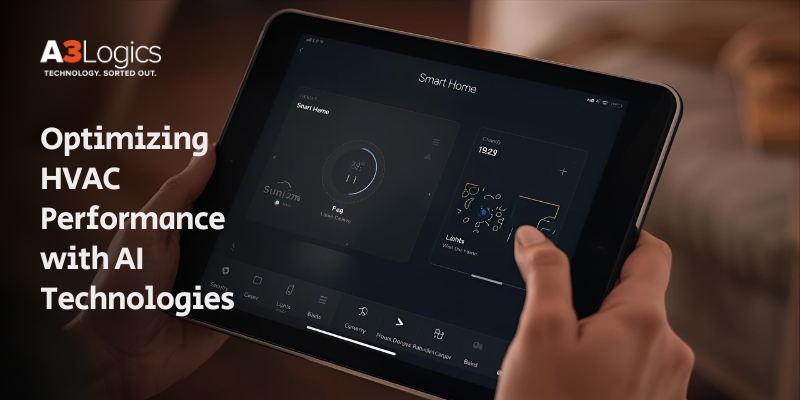
AI accumulates each detail, such as environmental factors, past patterns, and occupancy rate, for generating effective insights and optimizing HVAC operations.
1. AI-powered HVAC Systems for Automated Decision-making
Sustainable HVAC solutions with AI integrate real-time data for throughout analysis of indoor variables and offer automated adaptability in the heating, ventilation, and air conditioning components. AI communicates 24/7 with IoT sensors, providing constant data flow, which enables the technical team to take informed and proactive decisions regarding the HVAC settings.
2. Predictive Analytics for Maintenance Scheduling
The maintenance needed after a certain period is learnt by the AI algorithms based on historical data and past equipment failure patterns. It follows the instant performance of the HVAC system in order to detect any inefficiency or abnormalities in its operation. These inputs help the maintenance crews forecast their servicing requirements and establish when they need to service in the future.
3. Machine Learning for Occupancy-based Climate Control
AI uses Machine Learning models to analyse the weather forecast report regularly and check current climate conditions. It tracks the occupancy rate in the building to predict the heating or cooling needs. This advanced mechanism allows predictive adjustments in the HVAC system as per the real-time atmosphere and the user’s preferences.
4. AI-driven Anomaly Detection for Fault Prevention
The AI constantly checks the operation of the HVAC devices and reports at the first signs of deviation or machine malfunction. This anticipation prevents the loss of the system and maintains the operation of the system. By controlling temperature and air quality control equipment, it maintains a desired comfort level within the building.
5. Adaptive Energy Optimization Models
Sustainable HVAC solutions with AI learns users’ preferences for indoor atmosphere, analyze their routines, and detect people’s proximity in the building. In this way, they adjust the equipment on and off cycle, change temperature and air flow settings, and maintain optimum comfort level with reduced energy wastage.
Benefits of IoT and AI-Driven HVAC Monitoring System Development
AI and IoT in commercial HVAC, as well as in residential HVAC, serve several benefits, ranging from automation, efficiency, cost control, and many more. The following are the key advantages of adopting IOT and AI-driven HVAC monitoring system development:
1. Improved Energy Efficiency and Cost Savings
IoT sensors track environmental, occupancy, and energy consumption data, and AI runs logical algorithms over them to make balanced adjustments in HVAC settings. It improves energy usage on a daily basis, and automates units to turn on or off as per the required comfort level, reducing electricity bills alongside.
2. Reduced Downtime through Predictive Maintenance
IOT and AI-driven HVAC monitoring system development enables real-time monitoring of the equipment. This allows them to instantly alert the technician team or managers about the signs of maintenance requirements in the system. Early detection of faults prevents the entire infrastructure from major failure, which could lead to long downtime.
3. Enhanced Comfort and Air Quality for Occupants
Sensors trace air pollutants and pressure levels in the atmosphere, and command HVAC units to modify ventilation accordingly. AI analyzes the air quality index of a particular space, identifies CO2 immersion, and other harmful components. It enables automatic air freshening in a building, thereby making occupants more comfortable.
4. Sustainability and Eco-friendly HVAC Management
AI and IoT in commercial HVAC systems are substantial in the sustainable control of the indoor atmosphere. Air conditioning and heating operations are controlled based on the people and use per the weather outdoors. One can observe that it does not take long to make this small adjustment in duty cycles, and the energy savings are enormous, with the carbon footprint being minimal.
5. Long-term Business ROI
With the collaboration of AI and IoT in the HVAC industry, the data-driven insights, predictive maintenance, energy use, and comfort of the occupants will be provided, leading to increased productivity and retention levels of the employees. Such characteristics lead to an increased revenue with lower operational and constant repair expenses high payback in the long run.
Industry-Specific Use Cases of AI + IoT in HVAC
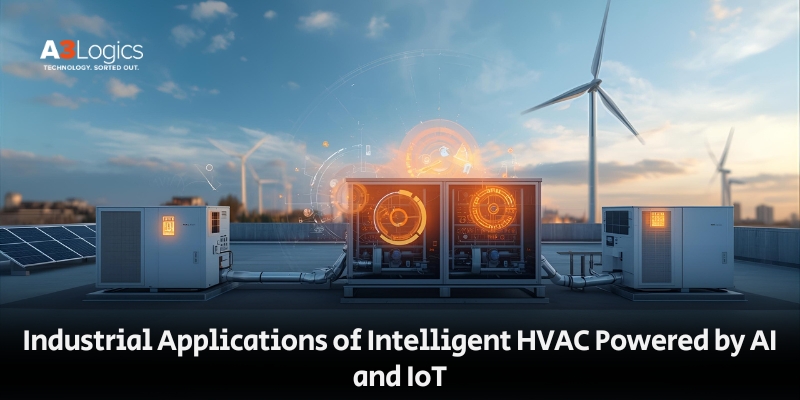
IOT and AI-driven HVAC monitoring system development enhances indoor comfort by adjusting the temperature, ventilation, and humidity automatically. Various sectors use this technology to enrich their internal space while not compromising on environmental responsibilities.
1. Commercial Buildings
AI and IoT in commercial HVAC automate the heating and cooling settings as per the staff preferences and occupancy. Automatic turn-on and off settings minimize the energy consumption in empty spaces, saving energy and cost for the company. Sensors monitor air quality in the offices, specifically those located in factories, and run filtration to detect CO2 or other pollutants. These environmental control features make the workplace comfortable for working and increase productivity.
2. Healthcare
In the healthcare industry, sustainable HVAC solutions with AI and IoT are most essential to keep the indoor environment healthy for the patients and medical staff. They strictly adhere to standards of temperature, humidity, and air quality in hospitals and medical labs to preserve sensitive supplies. Patient comfort is also the cornerstone of IOT and AI-driven HVAC monitoring system development.
3. Hospitality
Hotels and restaurants use AI and IoT in the HVAC industry to provide a pleasant and cosy environment to their customers. Smart rooms are preconditioned as per the guest’s preferences with proper ventilation and moisture level. Additionally, a sensor-enabled HVAC system saves energy consumption by automatically turning off the lights and ACs in vacant areas.
4. Manufacturing & Industrial
AI and IoT empowered HVAC solutions optimize the internal environment as per the specific requirements of manufacturing units. For example, the pharma industry needs cold temperatures in its production centers to preserve drugs and comfortable cooling in the working area for the staff. Automated HVAC control in the industrial sector ensures operational efficiency by providing an adequate thermal environment.
5. Smart Homes: Personalized Climate Settings, Voice-Controlled Systems
Residential buildings are equipped with AI and IoT-based sensors installed in HVAC systems in order to ensure a comfortable and cozy environment inside the building. These technologies require smart homes to keep the inside temperature, ventilation, and level of humidity to their preference.
It is not only beneficial in the increase of internal space, but it also optimally utilizes electric appliances like AC, heater, air purifier, and moisture controller. Predictive maintenance can assist homeowners in identifying signs of equipment failure in time and begin repairs before damages occur, as well, which can save them a lot of money that is otherwise spent on prolonged damage.

Key Challenges in Developing Smart HVAC Systems
As every technology has some pros and cons, IOT and AI-driven HVAC monitoring system development also comes with certain challenges:
1. Cybersecurity and Data Privacy Risks in IoT-enabled HVAC
Unlike traditional HVAC, modern systems work on real-time data collected and analysed by IoT sensors and AI algorithms. The interconnected devices in this network share a huge amount of facts and figures on a daily basis, which can expose personal and inner information of a space to cyber criminals.
Smart HVAC monitoring solutions depend on internet access, and thus, when installed in interiors with sensitive operational data, they are highly prone to online attacks. In order to prevent these risks, IoT-enabled HVAC equipment must follow data privacy and security measures with encrypted communication of internal details.
2. High Initial Development and Deployment Costs
The transition of a manually operated system to a smart IOT and AI-based HVAC monitoring system development is a costly process. Automated networks, sensors, and thermostats are generally expensive devices, and this can deter small contractors or building owners from upgrading their premises. Additionally, proper installation and maintenance of the HVAC setup require a skilled and professional team, adding to the ongoing costs.
3. Integration Issues with Legacy HVAC Systems
Uniting modern technologies like AI and IoT with the existing HVAC infrastructure is a complex process. Old establishments may not be compatible with the latest devices and thermostat sensors, and hence may not work seamlessly with each other. One solution to this problem is reinstalling the entire HVAC mechanism, but it is again a costly move and not feasible for all buildings or property owners.
4. Scalability Challenges in Large Commercial Properties
Large commercial properties include wide surroundings, a large indoor space, and a huge infrastructure with a variety of small areas for different purposes. Occupancy rates and use of a specific space keep changing in these types of business estates to increase operational efficiency.
AI and IoT in commercial HVAC require vast numbers of versatile equipment to scale with the changing indoor requirements and maintain the preferred thermal environment in each section of the building. The deployment of scalable energy-efficient automation in the course of such commercial building HVAC systems installation is therefore an issue.
5. Reliability and Accuracy of IoT Sensors
IoT sensors need maintenance to be effectively used and gather correct and real-time data. Moreover, they should be revised on a periodic basis, and otherwise their validity may be compromised. The misinformation may end up in an unsuccessful control of the HVAC parameters that contribute to an unproductive temperature or an ineffective air ventilation service.
Thus, to ensure proper continuity of IoT sensors, the continuous presence of trained professionals with technical skills is a must.
Future of IoT and AI in HVAC Monitoring
Continuous evolutions in the IT field are leading to the emergence of several new tools and digital solutions for upgrading modern automation. The HVAC monitoring system also seems to keep the AI and IOT technology deeply rooted within its operations to leverage their growing capabilities.
1. Integration with Smart City Initiatives
The concept of a smart city relies on the integration of intelligent technologies and modern infrastructure. Their primary goals include providing better living conditions for the citizens, while sustainability and cost efficiency are the key considerations in the management operations.
IOT and AI-driven HVAC monitoring system development blends perfectly with the smart city initiatives. It not only ensures occupants’ comfort in internal spaces but also contributes to energy saving and cost optimization with its predictive maintenance capabilities.
2. Role of Digital Twins in HVAC Performance Modeling
The emerging technology of digital twins is becoming popular in building management systems for remote monitoring. These replicas of physical infrastructures will help in installing optimized HVAC systems in the physical property. Contractors or land owners can investigate the number of IoT sensors and other devices that should be installed in the building on a particular plot. The exact visuals of virtually designed buildings will assist in formulating energy management strategies and enhancing HVAC performance.
3. Use of Blockchain for Secure IoT Data Exchange
As the use of real-time data becomes increasingly central to making informed decisions in AI and IoT applications in commercial HVAC (heating, ventilation, and air conditioning), security concerns are also at stake. Blockchain technologies will be a saviour for protecting internal information from cyber risks. It can provide a secure and immutable storage system for safely storing and processing sensitive data.
4. Autonomous HVAC Systems with Minimal Human Intervention
AI and IoT allow unassisted functionality in the HVAC system, where the devices are automatically controlled without having to be physically present to do so. Smart measuring devices can conduct measurements of the temperature, humidity, and the quality of the air on a regular basis without being monitored.
They can use thermostats and ventilation to control heating or cooling conditions and air flow to maximum comfort. These self-helping systems will keep on optimizing the indoor environment with future-ready solutions and do not need human intervention.

Why Partner with an IoT Development Company Like A3Logics
An effective HVAC system in a property is not only about purchasing and installing a device. It has more to do with forming a clever combination of AI and IoT technologies that can be simultaneously integrated with the thermal infrastructure. It will only be possible with the help of a professional IoT development company like A3Logic that transforms the simplest HVAC system into an efficient and entirely robotized one due to the introduction of AI and IoT capabilities.
A3Logics has decades of experience in providing bespoke IoTs and AI integration to turn your HVAC setup into an autonomous and intelligent system.
A long-time history of successful projects of smart building system development and our satisfied business clients (500 and more) provide us with a good track record.
At A3Logics, we focus on offering total consulting, design and development.
Our solutions are innovative thus ensuring the real-time thermal environment optimisation and adherence to the data security standards.
Our services are customized and tailored to businesses 24/7 during and after the creation of the HVAC monitoring system based on the IoT and artificial intelligence.
Conclusion
Every individual seeks a pleasant and comfortable indoor environment for living and working efficiently. HVAC setup is no longer a luxury but a necessity for providing better thermal conditions, specifically in harsh climate locations. IoT and AI-driven HVAC monitoring system development is increasingly used in Building Management systems (BMS) due to its automation and energy optimization capabilities.
Most of the residential, commercial, or industrial properties are equipped with advanced heating, cooling, ventilation, and humidity management solutions, specifically in developed nations. The inclusion of AI and IoT in the HVAC industry is revolutionizing its operations and offering undeniable benefits like energy efficiency, predictive maintenance, and cost-effective convenience.