
The world today generates more data every minute than it did in a whole day a decade ago. But amid the data explosion, most organizations are totally uncertain. Reports reveal that while the data of enterprises doubles roughly every 18 months, nearly 80% remain unstructured, unused, and buried in silos. The core issue is not the accessibility of knowledge, but the unlocking of its value.
Traditional systems are built for storage only, not intelligence. They are incapable of matching the velocity, variety, and volume of today’s data. And as a result, teams end up wasting long hours searching for the files, decision-making takes more time, and business opportunities go to waste.
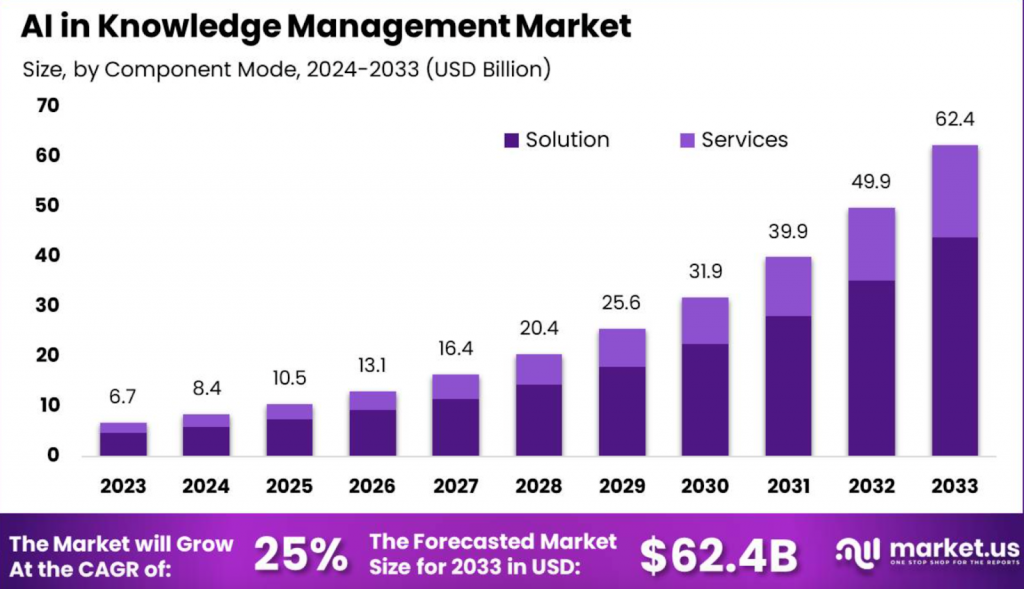
AI in Knowledge Management has addressed this very issue through innovation. In 2025, the market is worth over $10.5 billion, and it will reach $62.4 billion in 2033, representing a CAGR of 25%.
By fusing AI into knowledge workflows, organizations transform their disorganized information terrain into smart, adaptable ecosystems. These AI driven systems not only store data, they comprehend it, interconnect it, and they grow with it.
In this blog, we will understand AI powered Knowledge Management Software, its use cases, benefits, best practices, and more. Let’s get started!
What is AI-Powered Knowledge Management Software?
AI powered Knowledge Management Software uses AI to pick up, sort, take out, and show knowledge on an enterprise-wide level. Unlike traditional systems that rely on manual programming and static structures, AI-driven platforms employ advanced algorithms in a highly automated operation.
The main features:
- The contextual understanding through NLP and semantic search allows employees to find not only keywords but also the most relevant knowledge.
- Automated classification of data.
- Using existing knowledge to create new ideas.
Types of Knowledge Management Software
1. Document Management Systems (DMS)
The DMS platforms store and manage all digital documents. With the help of AI, you can now have categorization of multiple types, version control, and full A-to-Z compliance monitoring.
2. Content Management Systems (CMS)
CMS basically helps in organizing digital content on the website and other portals. CMS systems also use AI to increase the personalization of content based on user behavior. It also suggests content and optimizes SEO, among other features.
3. Learning Management Systems (LMS)
LMS platforms are the backbone of structured training and development. They use AI in Knowledge Management to empower adaptive learning paths, skills-gap analysis, and predictive insights into workforce upskilling. In particular, AI can be used to suggest personalized microlearning modules tailored to an employee’s role progression.
4. Collaboration Tools
There are many platforms for collaboration like Microsoft Teams and Slack. They use AI for transcription and fetch information from the meetings, all in real time. This makes it possible to automatically store contextual insights for future retrieval, thus eliminating knowledge silos.
5. Knowledge Base Software
AI fortified databases are the driving force of the websites for self-service, FAQs, and help centers. The AI-driven search and the automated tagging functionalities enhance the accessibility of content while generative AI is the enabler of the auto-drafting of support articles from ticket data.
6. Enterprise Wikis
Enterprise wikis can be described as collaborative repositories of the organization’s knowledge. AI incorporates this by tagging old entries, proposing amendments, and linking knowledge automatically.
7. Customer Relationship Management (CRM) with KM Features
The AI Knowledge Management Software that is embedded in modern CRMs allows the user to capture customer interactions, recommend actions, and provide contextual insights during either sales or support initiatives. Salesforce and HubSpot are more and more dependent on AI to make CRM knowledge proactive as opposed to being reactive.
8. Business Intelligence & Analytics Platforms
Business Intelligence tools evolve into Enterprise Knowledge Management Software when paired with AI. They provide not only dashboards but also narrative insights, predictive forecasting, and natural language querying.
9. Knowledge Discovery & Search Tools
AI discovery websites are the ones that embed semantic search and use embeddings to connect across data sets semantically. This process can be utilized at R&D, where the recognition of patterns in patents, research papers, and internal experiments speeds up the innovation through collaboration.
10. Innovation Management Software
These tools are used for capturing ideas and also for the evaluation of ideas across the enterprise. This includes the ability to analyze the feasibility of an idea, categorize proposals, and even provide market impact forecasts that align innovation with strategic goals.
How AI is Transforming Traditional Knowledge Management Systems?
1. Intelligent Search and Retrieval
Traditional systems were usually keyword-spam search engines that sometimes led to irrelevant reports. The use of AI in Knowledge Management, however, marks the introduction of semantic and contextual search, which allows the systems to interpret user motivation.
2. Automated Knowledge Capture
AI catches insights automatically via emails, chats, project notes, and documents. Such functions obviate knowledge loss and managed institutional memory is the result of the whole process without manually doing anything.
3. Personalized Knowledge Delivery
AI is able to draw personal conclusions for individuals by analyzing their roles, tasks, and behavior. For example, employees can get strategic summaries and datasets to ensure relevancy and reduce cognitive load.
4. Conversational Interfaces
AI chatbots interacting with knowledge bases are the ones that employee can ask questions to the system literally in their own language. This suggests the improvement of accessibility, especially for non-technical users, as well as accelerating the adaptation.
5. Predictive Analytics and Insights
AI in Knowledge Management gives powers to predictive models to forecast trends such as employee attrition, market demand, or customer churn through the analysis of enterprise knowledge. Furthermore, the embedding of such insights in the decision-making process transforms static information into forward-looking intelligence that supports proactive and data-driven decisions.
6. Continuous Learning and Adaptation
We can train models by fine tuning, RAG or just prompting. The self learning process of AI ensures that the knowledge system stays useful when the market evolves and strategies change.
7. Enhanced Collaboration
AI tools analyze communication patterns and all the project data, thus suggesting possible collaborators, surfacing related projects, and avoiding duplication of efforts. This will ultimately result in better cross-functional focus on innovation and efficiency.
Key Use Cases of AI in Knowledge Management for Modern Enterprises
1. The Intelligent Enterprise Search (“Google” for Your Company)
AI in Knowledge Management powers enterprise search engines that work by unifying the focus on folders, email, and task apps. These systems embed NLP and vector embeddings that lean on context-aware search and significantly cut the time spent finding information.
2. AI in Knowledge Discovery
Generative AI in Knowledge Management is the one that facilitates generation by synthesizing patterns in vast amounts of disorganized datasets. One notable example is a pharmaceutical company that is able to discover new drug interactions from research sources.
3. Chatbots and Virtual Assistants for Knowledge Sharing
AI-bots support employees and customers with live access to organization knowledge that is required for their task in order to do it well. In customer support, the bots are covering and reducing the handling time of cases as well as maintaining the same accuracy level.
4. AI in Customer Support and Self-Service Portals
Introducing AI Knowledge Management Software into customer support operations elevates first-call resolution and lowers escalations. AI checks historical ticket data to propose solutions in advance, before a support agent intervenes.
5. Predictive Analytics for Knowledge-Driven Decision-Making
Businesses use predictive models in knowledge systems to speed up decision making with more accurate results. For example, in the case of supply chain management, AI can forecast disruptions by analyzing logistics information and weather data.
6. AI-Powered Knowledge Curation and Content Tagging
AI has the role of automatic content curation by extracting metadata, assigning categories, and linking related resources without manual tagging dependency. This guarantees efficient retrieval and better compliance monitoring.
7. Content Gap Analysis
By monitoring usage trends and identifying inconsistently available content, the AI powered Knowledge Management Software detects missing or outdated documentation.
8. Automated Question Answering
AI systems are not like static FAQs. They understand user context really well. With the help of LLMs, Generative AI in Knowledge Management enables companies to handle complex customer queries easily.
9. Ethical and Compliance Monitoring
Big corporations today not only run a business but also partner with various entities that have their own sets of rules concerning data protection, labor law, and ESG reporting. With AI, the verification of policy adherence is made more accessible by linking knowledge repositories with data that are subject to privacy or other compliance concerns.
Core AI Technologies Powering Modern KMS
1. Natural Language Processing (NLP) and Understanding (NLU)
NLP is a powerful tool that allows systems to analyze and process unstructured text effectively. In knowledge management, the major function of NLP is semantic search, automated summarization, and intelligent tagging. NLU is the next logical step since it is capable of understanding the intention of the message and the context; therefore, query resolution becomes more precise.
2. Machine Learning (ML)
AI in Knowledge Management harnesses the power of machine learning algorithms to discover patterns and present different uses of the organizational data. This makes the recommendations more accurate over time.
3. Generative AI and Large Language Models (LLMs)
Generative AI in Knowledge Management leverages LLMs for new ideas, summaries, and drafts. For instance, sales teams can automatically generate client proposals along with the knowledge they have from the CRM, case studies, and product documentation. This way, they can do their tasks much faster and with fewer errors.
4. Semantic Search and Vector Embeddings
Vector-based semantic search, which is based on the meaning rather than the surface terms, replaces the traditional keyword search as the main method of information retrieval. An example of this is searching for “supply chain disruptions” resulting in “logistics risks” and “inventory shortages” documents.
5. Intelligent Automation and Robotic Process Automation (RPA)
Document indexing, data migration, and compliance checks are some of the repetitive tasks that can be automated with RPA. With the use of AI, RPA systems has evolved into a more adaptive and knowledge-driven approach.
Benefits of AI in Knowledge Management for Organizations
1. Faster Decision-Making with Real-Time Insights
AI knowledge management software reduces decision-making times by furnishing dynamic insights in real-time, rather than just producing them. Now, the teams do not have to search for relevant, accurate, and contextual knowledge manually; they are getting this data in a second. This up-to-date information helps in faster understanding, alignment, and action across the entire firm’s departments.
2. Reducing Information Overload with Smart Filtering
Information seeking is one of the most time-consuming tasks for knowledge workers, comprising 20–30% of their work. AI reduces this by removing irrelevant data and focusing on the priority only. Consequently, time is not only saved, but this practice also helps keep employees free from cognitive fatigue.
3. Improving Customer Experience through AI-Driven Knowledge Sharing
AI-driven self-service portals are made available to customers to get accurate answers instantly and reduce the dependency on humans. These systems notably surface knowledge articles and support creating personalized experiences that increase customer satisfaction and brand trust.
4. Cost Reduction and Increased Productivity
Enterprise Knowledge Management Software eliminates the need for manual knowledge management by automating knowledge capture, tagging, and retrieval. Reports have shown a 20 to 25% reduction in operation costs with the help of KMS platforms.
5. Enhancing Innovation by Unlocking Hidden Insights
AI detects the relationship that is not obvious through data. In terms of product development, this fosters the mingling of ideas where R&D insights can inform marketing or even supply chain decisions. Also, generative AI makes the ideation of developing concepts faster leading to the quicker transition from the idea stage to implementation.

Best Practices for Successful AI Knowledge Management Implementation
1. Start with Clear Knowledge Management Objectives
Before enterprises deploy AI in Knowledge Management, they should set specific, measurable objectives. The goals can include reducing customer response time by 30% or improving the accuracy of compliance.
2. Invest in High-Quality Data and AI Training Models
The functionality of AI systems is influenced by the underlying quality of data. The poor quality of data destroys trust and success. A Knowledge Management System Development strategy should be accompanied by strong data governance and continuous data cleansing.
3. Encourage Collaboration Between IT and Business Teams
The primary key to the successful implementation of the project is the alliance of the IT architects, business users, and domain experts, who thus make the dual assurance of: a technical problem-proofing solution; and compliance with business priorities.
4. Prioritize the Human-in-the-Loop Model
Even if AI handles the workflow to a large extent, human supervision is essential for the ethical and contextual correctness, as well as for the strategic aspect. For instance, regulatory officers should make certain that the AI alert system of the rules/regulations is validated by them.
5. Provide Training and Change Management Programs
Staff shows resistance to AI adoption in the beginning. Enterprises must create programs that will not only gain the trust of employees but also yield positive results like quicker workflows and less manual effort.
6. Continuously Monitor, Measure and Optimize AI KM Systems
AI-based systems grow, but are subjected to measurement. Companies should measure KPIs like retrieval accuracy, user adoption rates, and resolution times’ reduction to continue their ROI justification.
Best Knowledge Management Software to Inspire Your Next Innovation
1. Document360

Document360 is an advanced AI Knowledge Management Software platform with advanced analytics, AI-driven search, and multilingual support. It is mainly found among SaaS and technological companies.
2. Confluence

Atlassian’s Confluence is perfectly integrated with Jira and Trello; thus, it is a suitable choice for agile teams. With the help of AI, it provides a smart page recommendation, auto-tagging, and integration with enterprise workflows.
3. Bloomfire

AI in Knowledge Management is a significant focus in Bloomfire. It stands out through its AI-powered search, auto-indexing, and video transcription functionalities, which promote knowledge democratization. It is a prevalent tool in customer service and marketing departments.
4. Notion

Notion is the combination of collaboration and knowledge management, plus it also has the support of AI tools like auto-summarization and intelligent templates. The flexibility of the program supports cross-functional teams that are managing hybrid workflows.
5. Tettra

Tettra is designed for internal knowledge bases and connects with Slack and MS Teams. The AI Q&A features in Tettra allow employees to ask and receive instant responses from the internal documents of the organization.
Challenges of Implementing AI in Knowledge Management Systems
1. Data Privacy and Security Concerns
Securing data privacy and meeting regulatory requirements is one of the major challenges while implementing AI Knowledge Management Software. When the large language models are learning from enterprises’ knowledge, there is a risk of revealing sensitive data, particularly in the healthcare or financial services sectors.
2. Poor Data Quality and Knowledge Gaps
What makes AI systems incompetent is the poor data quality. Consequences like making bad recommendations and causing users to lose trust are due to poor quality, outdated, and fragmented knowledge. Therefore, the organizations that go for Knowledge Management Systems Development should first focus on data governance.
3. Resistance to Change and Workforce Adoption Issues
It is hard initially for staff to adapt to new technologies like AI. Employees may doubt their jobs are at stake or may not trust the outputs that machines generate. Studies indicate that managing the change involved through active involvement, the clear communication of potential benefits, and the introduction of human-operated models that will be used alongside machines are the critical factors.
4. High Implementation Costs and ROI Concerns
While Knowledge Management Software Development can have a massive ROI in the future, the initial investments can be high. The costs of the infrastructure, licensing, integration, and training are notable. To validate the investment, you must identify ROI metrics, such as the reduction in resolution times or an increase in productivity.
5. Ethical Challenges in AI Knowledge Systems
Companies must prioritize addressing biases in the training data. It ensures algorithm transparency and the ability of the system to give certain accurate recommendations. The KM systems must have measures to ensure ethics; otherwise, they will produce stereotypes or lack transparency in their decision-making.
Future Trends of AI in Knowledge Management
1. Multimodal AI Integration
AI in Knowledge Management is transforming systems into multimedia of intelligence that includes text, voice, video, and image-based knowledge. Now organizations can analyze training videos, meeting transcripts, and diagrams under the same framework, which is a better way to see a piece of knowledge (with more parts).
2. Explainable AI (XAI)
Due to the increasing demand for transparency from regulators and executives, XAI is poised to become the cornerstone of knowledge management strategies. Instead of just delivering a recommendation, the necessary systems will have to state their reasons for that, which leads to better assurance.
3. Generative AI and Knowledge Automation
Generative AI in Knowledge Management will go beyond auto-summarization to also being able to write reports, generate proposals, and produce compliance documentation. With the help of enterprise knowledge graphs and generative models, they will be able to implement large-scale automation in the companies.
4. Conversational AI for Real-Time Knowledge Access
The smart chatbots and voice assistants will be the gateway to the enterprise knowledge. Employees will “speak” to systems, and systems of knowledge retrieval will be part of workflows for employees naturally.
5. Knowledge Graphs and Semantic Search Enhancements
The knowledge graphs will be the basis for the next enterprise KM wave, mapping the data, people, and process connections. The improved search for the meaning of the terms will make sure challenging inquiries about complex topics are precise and informative in their context.
6. AI-Powered Personalization in Knowledge Delivery
AI is going to provide hyper-personalized information to the end users. For instance, a financial analyst could focus on the latest developments in the market, while a project manager would have access to the changes in compliance that are relevant to his/her role, thus achieving their role-based effectiveness.
7. The Role of Quantum Computing in Future KM Systems
Quantum computing will solve the most sophisticated and complex problems in KMS. It will speed up the Knowledge Management Software development by processing complex datasets. It can completely transform predictive analytics, compliance work and much more.
Why Choose A3Logics for Implementing AI in a Knowledge Management System?
A3Logics has established itself as a trusted partner for enterprises navigating AI adoption. With over 20 years of global experience, A3Logics provides end-to-end Software Development Services with a specialized focus on enterprise-grade KM solutions.
Key differentiators include:
- Strategic AI Roadmaps: Aligning KM initiatives with business objectives and measurable ROI outcomes.
- Custom LLM Implementations: Our Generative AI Development Services empower enterprises to build scalable, secure, and domain-specific knowledge automation.
- Cross-Industry Expertise: Proven track record across healthcare, finance, retail, and technology sectors, ensuring regulatory compliance and tailored solutions.
- Integration Capabilities: Expertise in embedding AI in Project Management, CRM, and collaboration platforms, ensuring seamless interoperability.
- Security and Trust Layers: Incorporating data encryption, audit trails, and compliance monitoring to safeguard enterprise knowledge.
Conclusion
The introduction of AI in Knowledge Management is a historical moment in the enterprise strategy sector. Renowned technologies such as NLP, ML, semantic search, and generative AI enable enterprises to change the ways in which information is collected, organized, and referenced.
However, some problems still exist like data quality, ethical risks, and resistance to adoption which need proactive governance and human oversight. By employing best practices and working with a reputable AI development company, enterprises will be able to do exceptionally well in the new AI-driven knowledge economy.
At A3Logics, we help businesses convert disconnected information into strategic intelligence by creating AI systems that think, learn, and evolve with your company.
It’s time to take your knowledge beyond spreadsheets.
Contact us today!