What if the biggest financial risk for your business isn’t high taxes — but outdated tax processes?
Across industries, small and medium-sized enterprises (SMEs) are realizing that spreadsheets and manual filings can no longer keep pace with evolving tax regulations, shrinking deadlines, and the increasing complexity of global compliance.
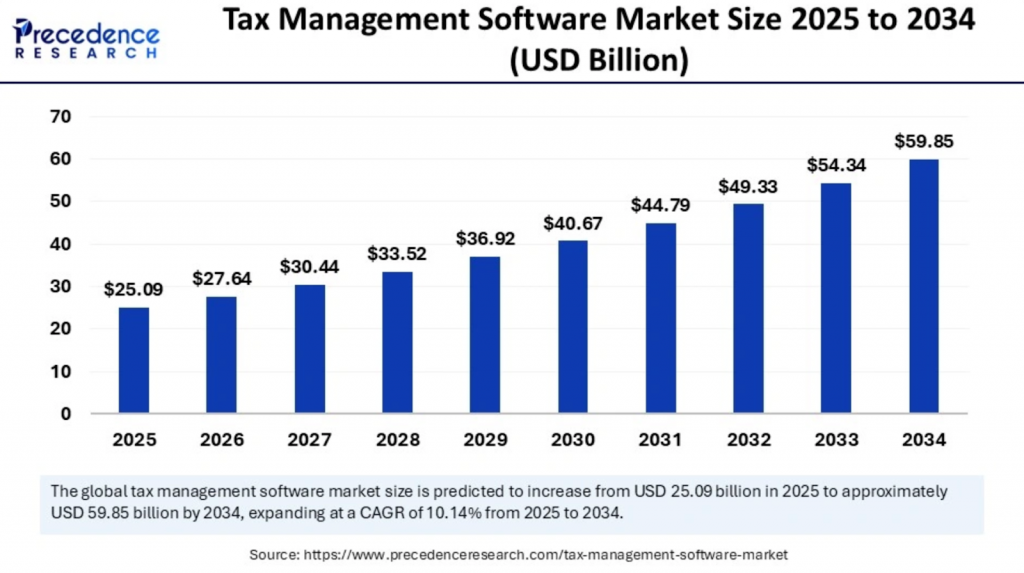
According to Precedence Research, the global tax management software market is projected to surge from USD 25.09 billion in 2025 to USD 59.85 billion by 2034, growing at a CAGR of 10.14%. This rapid growth underscores how businesses are increasingly adopting intelligent automation to simplify compliance, minimize errors, and gain real-time financial visibility.
In this blog, we’ll explore how AI Tax Software is revolutionizing tax management for SMEs, its key benefits, must-have features, development costs, and future trends.
Let’s begin with a precise definition.
What is AI Tax Software?
AI Tax Software is a class of tax systems augmented with machine learning (ML), natural language processing (NLP), robotic automation, and predictive analytics to execute tax compliance, planning, and filing functions that traditionally required manual effort. Unlike rule-based tax systems, AI Tax Software learns from data, applies context-aware logic, and adapts to evolving tax rules.
In an SME environment, AI Tax Software acts as a virtual tax analyst, bridging bookkeeping and tax filing under one intelligent roof.
Traditional Pain Points in Corporate Tax Preparation
1. Complexity of Tax Laws and Compliance
SMEs face complex, ever-changing tax laws across multiple jurisdictions. Without in-house specialists, they often rely on manual interpretation or external accountants, increasing the risk of errors.
2. Data Management and Manual Processes
SMEs often rely on manual consolidation or “swivel-chair” data entry. Reconciliation from bookkeeping to tax schedules remains manual. On average, an SME may spend 120 hours per year on tax preparation – a significant labor cost and error vector.
3. Time, Deadlines, and Workflow Issues
Strict filing deadlines and quarterly estimates force SMEs into bottlenecks. Last-minute corrections cause cascade effects across spreadsheets and forms. Waiting on missing data or approvals can stall entire tax cycles.
4. Resource and Operational Constraints
Most SMEs operate with small finance teams or outsource to external CPAs. They lack bandwidth to absorb surges in tax volume. Hiring full-time tax specialists is often unsustainable. The result is that tax compliance becomes a recurring disruption.
Core Benefits of AI-Powered Tax Software for SMEs
1. Automation of Tax Processes
One of the most immediate gains is automation. Using RPA and AI, the AI Tax Software can ingest data from accounting systems, banks, or receipts, eliminate manual entry, and auto-populate tax forms. Automation treats data flows, mapping entries into schedules and forms with minimal human intervention.
2. Enhanced Accuracy and Compliance
With AI assisting calculations and compliance checks, SMEs have seen error rates drop by almost 100% in form populated accuracy and a 25% reduction in mistakes overall. The enhancement of accuracy is a compelling benefit of AI Tax Preparation Software.
3. Real-Time Insights and Analytics
Unlike static tax tools, AI platforms provide continuous insight. With real-time dashboards, SMEs can monitor taxable income, estimated liabilities, and effective tax rates dynamically. Predictive analytics used in some systems achieves upto 90% accuracy in forecasting tax liabilities.
4. Cost Efficiency
Companies adopting AI in taxes report 30% reductions in compliance costs and, in some cases, up to 40% savings. Labor costs shrink as fewer hours are spent crunching numbers.
5. Time Savings
Many firms report that AI Tax Software reduces preparation time by 50–70%. A cycle that once took days may now take hours. Cross-department delays shrink, and tax planning becomes continuous rather than seasonal.
6. Fraud Detection and Risk Management
AI models detect anomalies and outliers that suggest fraud or data errors (e.g. duplicate invoices, odd expense patterns). In one example, a popular accounting platform flagged duplicated bills in real time.
7. Scalability for Growing Businesses
As transaction volume or entities grow, AI systems scale efficiently. Cloud infrastructure manages increased data without linear cost growth. Feature modules (sales tax, multi-state, international) can be added.
8. User-Friendly and Accessible
Despite sophisticated back ends, well-designed AI Tax Planning Software offers guided workflows, conversational assistants, and plain-English explanations (via generative AI).
Benefits of AI in Tax Compliance
1. Real-Time Updates on Tax Regulations
AI systems monitor legislative and regulatory pipelines and use NLP to parse changes automatically. Some platforms update within hours of new law enactments.
2. Automated Compliance Checks
As users input data, the system automatically verifies each entry against internalized tax rules. It flags violations such as exceeding deduction thresholds or mismatched reporting.
3. Audit Trail and Documentation Features
Every user action, data source, and adjustment is logged in an immutable, time-stamped audit trail. In advanced systems, generative AI collates supporting documents, receipts, and explanations into audit packets within minutes.
Key Features of AI Tax Software for SMEs
1. Automated Tax Calculations
The system must compute liabilities, refunds, credits, depreciation, alternative minimum tax, loss carryforwards, and other tax constructs automatically. Because AI logic adapts, it also simulates alternative outcomes and recommends more efficient paths.
2. Real-Time Data Analysis
With each transaction, the AI Tax Software updates tax metrics (e.g., taxable income, effective tax rate) live. It also detects anomalies, trend deviations, or forecast divergences and surfaces them to users.
3. Smart Transaction Categorization
Machine learning models learn from prior classification and predict the correct tax bucket for each new transaction. Over time, accuracy improves, reducing manual recategorization.
4. Regulatory Compliance Updates
AI Tax Compliance Software must support automated updates to tax rules, rates, and forms. Multi-jurisdictional support is critical (state, federal). Users should see notifications like “Tax tables updated for 2025.” The tax engine must adapt without requiring full software upgrades.
5. Tax Filing Assistance
The platform should generate final returns, support e-filing, guide through signature or attachments, and manage submission-to-agency acknowledgments. A user should be able to complete filings (e.g. with the IRS) with minimal manual intervention.
6. Fraud Detection and Error Alerts
The module watches for duplications, inconsistent vendor data, and outlier entries. It alerts when data falls outside expected bounds. As models mature, alerts shrink to real risks, limiting false positives.
7. Integration with Accounting Software
Seamless API or connector integration with accounting platforms (e.g., QuickBooks, Xero) ensures the tax system ingests live general ledger and transaction data. It eliminates manual CSV exports or imports.
8. Customizable Reports and Dashboards
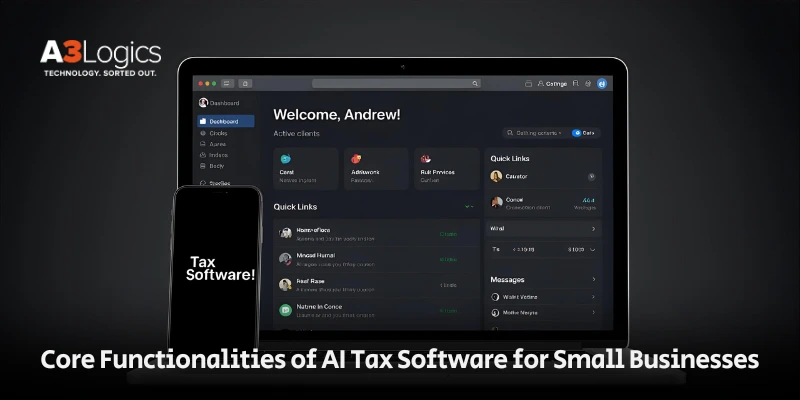
Users should generate or configure reports such as taxable breakdowns, comparisons year-over-year, or component analyses (e.g. deductions by category). Dashboards present executive-level views or detailed drill-downs.
9. Cloud-Based Access
The platform must operate in the cloud, offering universal access across devices. It supports multi-user collaboration, secure backups, and real-time updates without local installation.
10. Scalability
The architecture of AI Tax Automation Software must accommodate growth in data volume and user count. Modules (sales tax, entity consolidation, multi-state) should be activatable. New AI models or integrations should plug in without major rewrites.

Key AI Technologies Powering Modern Tax Software
1. Machine Learning (ML) for Smarter Categorization and Prediction
ML models classify transactions, detect anomalies, predict tax outcomes, and refine their intelligence over time. For example, QuickBooks uses ML to automate expense categorization, and Intuit’s tax tools use ML to estimate the likelihood of an audit for clients.
2. Natural Language Processing (NLP) for Document Understanding
NLP enables interpreting unstructured text—such as tax code, IRS publications, contracts, or communications. It helps AI assistants respond to user queries (“How does Section 179 change affect me?”). In AI Tax Software, NLP parses legal documents, notices, and instructions and turns them into executable rules or user guidance.
3. Optical Character Recognition (OCR) with AI for Data Extraction
OCR extracts text from scanned documents or images (invoices, receipts, tax statements). AI layer maps those textual fields (dates, amounts, vendor names) into structured transaction data. This minimizes manual entry and feeds the system with precise inputs.
4. Robotic Process Automation (RPA) for Workflow Efficiency
RPA bots automate multi-step workflows such as uploading data, triggering sequences of analysis, notifications, and submission. For example, when the books close, RPA can kick off tax calculations, alerts, and draft generation automatically.
5. Predictive Analytics for Proactive Tax Planning
Predictive analytics in AI Tax Filing Software uses historic and current data to forecast outcomes. AI applies models to suggest tax-efficient actions, simulate scenarios, and guide estimating. It moves tax activity from reactive to strategic.
Top AI-Powered Tax Software Solutions for SMEs
1. Intuit QuickBooks Online + TurboTax Integration

Intuit remains a front-runner in AI-driven finance. Its AI Tax Software ecosystem integrates QuickBooks Online for accounting with TurboTax for automated filing. AI classifies transactions, matches receipts using OCR, and recommends deductions. The Intuit Assist generative AI layer explains financial data conversationally, serving as an intelligent advisor.
2. Xero + Tax Integration Partners

Xero leverages open APIs and partnerships with tax modules such as TaxCycle and Avalara to extend AI capabilities. Its machine learning models automatically categorize transactions and detect anomalies. The system syncs in real-time with bank feeds, providing rolling tax forecasts. For compliance, Xero integrates with AI Tax Compliance Software modules that update tax rate changes and generate filing-ready statements.
3. FreshBooks

FreshBooks uses an AI-assisted classification and time-tracking engine that automatically links revenue streams to tax categories. Its AI Tax Planning Software component identifies missed deductions or credits and flags expenses inconsistent with past behavior. This reduces audit exposure and simplifies reporting.
4. Bench (Bench.co)

Bench combines human accountants with AI Tax Preparation Software for small businesses. AI reconciles transactions, classifies receipts, and generates filing-ready summaries, while human experts validate outputs. This hybrid model ensures quality assurance alongside automation.
5. Keeper

Keeper’s AI Tax Automation Software focuses on freelancers and small firms. It employs NLP and predictive algorithms to detect potential write-offs automatically. By connecting to bank and card feeds, it identifies deductible expenses in real time.
Development Considerations and Cost Factors
i. Factors Influencing Development Cost
Several cost drivers determine the overall project scope for developing AI Powered Tax Software:
- Feature Complexity: Adding multi-jurisdictional tax support, OCR, and predictive analytics increases development cost by 40–60% compared to simple filing tools.
- AI Model Depth: A system that trains on extensive financial data for categorization and risk detection requires larger model training budgets and specialized talent.
- Integration Requirements: APIs for accounting software, banks, and government e-filing portals (e.g., IRS) demand extensive middleware.
- Security and Compliance: End-to-end encryption, SOC 2, and GDPR compliance add 15–20% to cost but are mandatory for financial software.
- Scalability Architecture: Cloud-native design and microservices deployment introduce infrastructure costs but future-proof the system.
Typical development costs for production-ready AI Tax Software range between $80,000 and $250,000. Enterprise-grade projects with generative and predictive components may exceed $400,000, depending on customization.
ii. Stages of Development
1. Data Strategy and Data Cleansing
The first step in building a robust AI Tax Filing Software is aggregating high-quality training data. It can be transactions, receipts, tax records, and compliance templates. Data is anonymized and cleansed to eliminate duplication or inconsistency.
2. Model Training and Validation
Machine learning models are trained for transaction classification, anomaly detection, and tax liability prediction. Supervised learning algorithms such as Random Forests and Gradient Boosted Trees are common. Validation ensures models generalize across varied industries.
3. User Interface (UI/UX) Design
Usability is crucial for SMEs. A clutter-free interface showing only relevant tasks—filing status, pending approvals, or upcoming payments—improves adoption. Conversational AI and embedded chatbots guide users through forms or FAQs, replicating a digital accountant experience.
iii. Build vs. Buy Decision for SMEs
When considering automation, SMEs face a strategic choice: whether to build their own AI Tax Compliance Software or buy an existing one.
- Build (Custom Development): Provides flexibility to tailor models to internal accounting workflows and industry-specific tax rules. Ideal for firms with unique reporting structures or privacy requirements. However, custom builds require higher upfront investment and skilled teams.
- Buy (Ready-Made Software): Offers lower cost and faster deployment but limited customization. Platforms like QuickBooks or Xero are excellent for general use but may lack deep integration for multi-entity businesses.
Custom vs. Ready-Made Solutions – Which One Should You Choose?
When deciding between custom-built and ready-made AI powered Tax Software, SMEs must weigh control, scalability, and speed to deploy.
A custom solution is ideal for organizations with complex tax operations, multi-entity structures, or proprietary workflows. It allows deep integration with internal accounting systems, precise compliance automation, and predictive tax modeling tuned to the company’s data. On the other hand, ready-made AI Tax Software offers faster implementation and lower upfront costs. It is suitable for smaller firms seeking reliable automation without heavy IT involvement.
In 2025, custom solutions are emerging as the smarter long-term choice. It enables SMEs to future-proof operations, maintain data sovereignty, and continuously refine performance as tax regulations and AI technologies evolve.

Future Trends in AI Tax Automation
1. The Shift from Reactive Compliance to Proactive, Predictive Guidance
The next generation of AI Tax Planning Software will move beyond post-transaction reporting to predictive optimization. Using reinforcement learning, it will forecast tax implications in real time. It helps finance teams act strategically, not reactively, by identifying deductions or credits before filing.
2. The Rise of the Conversational AI Tax Assistant
With NLP-powered interfaces, SMEs will interact with AI Tax Filing Software conversationally. They can ask questions like “What’s my next payment due?” and receive real-time, plain-language responses. This intuitive guidance will reduce dependency on accountants and simplify decision-making.
3. Continuous, Real-Time Audit and Compliance
AI Tax Software will enable continuous monitoring, validating every transaction as it occurs. Automated anomaly detection and instant flagging will replace after-the-fact audits, aligning with emerging global digital compliance standards.
4. Hyper-Personalization through Deep Data Integration
Modern AI Powered Tax Software will merge transactional, industry, and regional data to deliver tailored recommendations. It can identify eligible R&D tax credits to optimize regional incentives. This deep personalization will transform static filing into an adaptive tax strategy.
5. Generative AI for Documentation and Strategy
Integrated AI Tax Preparation Software will use generative AI to summarize IRS updates, create audit-ready documents, and explain year-end changes. Automating 70% of documentation will let professionals focus on advisory roles rather than paperwork.
6. Blockchain and AI for Immutable Audit Trails
The fusion of blockchain and AI Tax Software will ensure transparency and tamper-proof records. Immutable ledgers verified by AI will redefine compliance integrity, providing SMEs with secure, traceable, and regulator-ready audit histories.
Why Choose A3Logics for Developing Cutting-Edge AI Tax Software?
With 20+ years of experience, A3Logics delivers secure, compliant, and intelligent financial solutions through expert Software Development Services. Its deep specialization in AI and taxation makes it a leader in creating custom AI Tax Software that aligns with global standards and evolving compliance needs.
1. End-to-End Expertise
Through full-cycle AI Development Services, A3Logics handles ML, UI/UX, and cloud deployment — delivering scalable, regulation-ready platforms.
2. Proven Domain Experience
A3Logics has built NLP-based compliance tools and predictive dashboards with 98%+ accuracy, showcasing excellence in AI Tax Planning Software.
3. Security & Compliance
With AES-256 encryption and SOC 2, ISO 27001 standards, every AI Tax Software ensures GDPR-compliant data protection.
4. Integration & Support
Seamless QuickBooks and Xero integration with 24/7 post-launch support for continuous reliability.
5. Conversational AI & Scalability
Using Enterprise Chatbot Development Company expertise, A3Logics creates intuitive assistants and scalable AI Tax Software solutions.
Conclusion
SMEs face mounting compliance pressure with limited resources, but embedding intelligence into tax operations transforms that challenge into an opportunity. By adopting AI Tax Software, businesses gain efficiency, accuracy, and the ability to predict outcomes before they happen.
At A3Logics, we believe innovation in taxation should feel simple, transparent, and empowering. If your goal is to develop Tax Filling App for internal use or launch enterprise-grade solutions for clients, we’re here to help you design it right the first time.
Contact A3Logics today!