
All companies agree on the fact that excellent customer service means more than just replying to questions. Trust is gained by rapid problem-solving. Nowadays, in the digital world, customers expect support that is not only fast but also tailor-made, and this is precisely what ServiceNow Customer Service Management CSM delivers. According to statistics, ServiceNow CSM holds a market share of 9.04% in its segment with 1884 companies as the primary user of this tool, as of 2025.
ServiceNow, a reputable cloud-based platform known for its workflow automation and enterprise solutions, brings IT, HR, and customer operations under one roof. By using the ServiceNow CSM system, companies quickly resolve customer issues through fully integrated channels. Because CSM ties so closely into ticketing and incident workflows, many organizations evaluate it alongside broader ITSM tools to keep service delivery consistent. The connection of departments and the elimination of monotonous tasks are helping service teams not only to eliminate simple ticketing but also to engage in genuine problem-solving.
The use of CSM in various industries is due to its capability of simplifying complicated workflows, increasing inter-department cooperation, and speeding up the response time. Instead of keeping track of many different tools, employees can manage customer requests, get notifications, and view solutions all from one interface that is easy to navigate. This is not only advantageous to employees but also to the clients.
How ServiceNow Customer Service Management Works?
Reference: servicenow.com
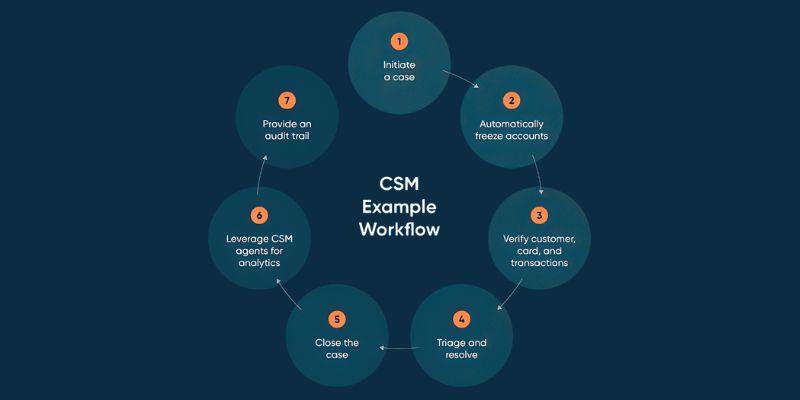
ServiceNow Customer Service Management CSM is a software that connects people, processes, and systems and provides a more efficient and proactive customer service. It consolidates all service activities in one place, enabling teams to track cases, assign tasks, and resolve problems more efficiently.
The ServiceNow CSM Module unpacks the cases and manages them directly through a process consisting of multiple steps. The first step, which is the customer’s report of a malfunction, will immediately lead to the creation of a support case, the allocation of the case to an agent, and the supervision of the case until it reaches closure. Complete visibility and liability are provided during the entire process.
One of the most significant features in ServiceNow is the seamless integration with other ServiceNow modules such as IT Service Management (ITSM), Field Service Management, and Knowledge Management. This integration allows service teams to obtain technical support, schedule field visits, or consult shared articles without switching back and forth between platforms.
The ServiceNow CSM usage of virtual agents, predictive intelligence, and automated workflows not only aids in handling the monotonous tasks but also contributes to detecting the problems before they reach the customers.
Key Features of ServiceNow Customer Service Management

1. Omnichannel Customer Support
In the present times, customers are looking for support on every platform. The ServiceNow Customer Service Management CSM is the solution to this problem. It merges chats, calls, emails, and social media into one work area, allowing agents to handle communication effortlessly and answer quickly
2. Case and Incident Management
In case the customer reports a problem, the system will create a redundant case automatically and direct it to the proper team. The ServiceNow CSM keeps track of every single step, thereby guaranteeing clarity, responsibility, and timely resolution from the very beginning to the end.
3. Knowledge Management
A powerful knowledge base assists the customers in getting answers without having to wait for an agent. The ServiceNow Customer Service Management allows the teams to generate solution articles through FAQs.
4. Virtual Agent and AI Chatbots
The AI-enabled apps for task handling are faster. In the ServiceNow CSM Module, virtual agents settle simple queries, direct customers, and forward issues to the human agent, allowing human agents to work on cases with higher priority.
5. Field Service Management
Field Service Management connects technicians on the ground with agents who provide services through Service Now CSM. It enables scheduling in real-time, tracking live, and giving updates instantly so that the coordination is smoother and service is delivered faster.
6. Self-Service Portals
Customers can file a complaint, monitor the status, or read FAQs whenever they want. The portal is user-friendly, engaging, and cuts down the agent’s workload while providing customers with greater control over their requests.
7. Performance Analytics and Reporting
One of the numerous capabilities of the ServiceNow CSM Module is to provide the managers with information about case trends, the agents’ productivity, and the level of customer satisfaction, along with other management functions.
Business Benefits of Implementing ServiceNow Customer Service Management CSM
1. Enhanced Customer Experience
Automated workflows, integrated systems, and data-driven insights work together to make the service journey—from logging the issue to resolving it—smooth and efficient.
2. Streamlined Operations and Faster Resolutions
Centralized dashboards, together with automation of workflows, are facilitating seamless handling of customer queries by the teams. The cases are progressing through the predetermined stages without any manual errors, thereby reducing response time and increasing the total operational efficiency.
3. Proactive Issue Management
Predictive analytics and AI tools are being used to enable ServiceNow CSM Developer capabilities that allow the organizations to detect and rectify issues before the customers are aware of them. This proactive way not only helps in building a relationship of trust but also in maintaining customer satisfaction at a high level.
4. Improved Agent Productivity
Instead of being busy with repetitive administrative tasks that provide no value, the agents now get to interact with the customers correctly. The daily operations of the service team are made easier and their morale is raised by smart routing, automated notifications and AI recommendations.
5. Cost Efficiency and ROI
Businesses through automation and intelligent case can significantly reduce support costs. The analytics of the platform help in measuring productivity and ROI , making it easier to evaluate the performance improvements.

ServiceNow CSM vs Traditional Customer Service Platforms
Conventional customer service methods typically depend on manual tracking, limited integration and communication amongst the departments. As a result, teams do not cooperate with each other and the customer journey is not understood. ServiceNow Customer Service Management, however, is a comprehensive platform that integrates all the different areas of the organisation. By directing cases automatically and supplying agents with the most recent customer information, it enhances the collaboration among different departments.
The three components of future customer service are service automation, connected experiences, and intelligent insights. The combination of AI, analytics, and workflow in CSM makes it the right choice for businesses that are future-ready and value responsiveness, reliability, and happy customers the most.
Industries Leveraging ServiceNow CSM
1. IT and Technology
ServiceNow Customer Service Management CSM is the tool of choice for a leading IT company worldwide to control and manage thousands of daily tech support requests. In case of a software bug, the system will generate a ticket automatically, send it to the right engineer, and monitor progress until the problem has been fixed. This results in less downtime and everyone, including the clients and the team, being on the same page.
2. Healthcare
The platform is a multi-specialty hospital that manages patient records and service requests in one location. Changes in appointments, questions about billing, and verifications of insurance coverage are now fully automated, so wait times are substantially reduced. This means that doctors and nurses will spend more time on treatment as they will not need to do administrative follow-ups.
3. Banking and Financial Services
Another banking and financial services sector where the leading bank giant uses the ServiceNow CSM Module for not just digital banking errors but also credit card disputes. A system that notifies the support team, checks the details, and promptly resolves the issue, resulting in both compliance and customer trust.
4. Manufacturing and Logistics
This is a smart manufacturing company that has the ServiceNow tool to keep track of its equipment’s upkeep, monitoring, and supplier coordination. If there is a machine breakdown, the system sends out a service request and simultaneously alerts the maintenance and logistics teams.
5. Education and Public Sector
Whenever there is an application for which the university needs to admit students, it employs the ServiceNow Customer Service Management as part of the process to automatically handle Student Admissions and requests. Students are able to find out the status of their application or open support tickets over the internet.
Integration Capabilities of ServiceNow Customer Service Management CSM
Reference – plat4mation.com
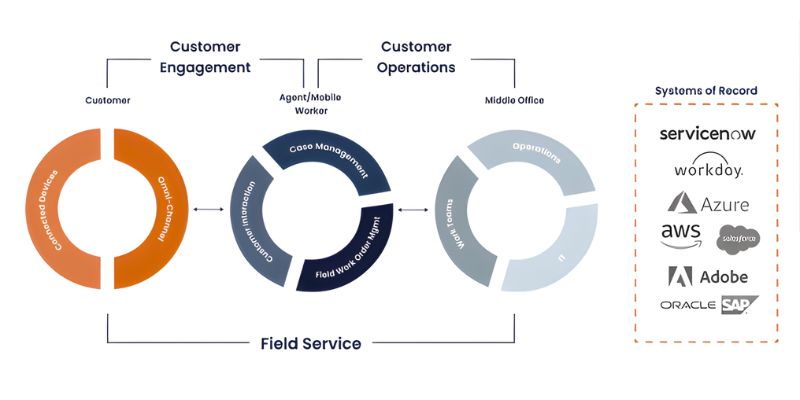
ServiceNow CSM Module complements the CRM and ERP solutions, such as Salesforce, SAP, and Oracle perfectly. It provides a real-time view of all operations of sales, finance, and support. This integration has done away with the problem of having the same data in multiple places, has been a significant boost to the consistency of workflow, and has made it possible for the customer service agents to get the right customer and order information in a matter of seconds in one single interface.
It’s the open APIs of the platform that enable ServiceNow Customer Service Management CSM to be integrable into complex enterprise ecosystems. This means that integrations with analytics tools, billing systems, or any other apps can be done while data flow remains constant. The entire process is not only error-proof but also allows for case creation and better customer interaction tracking across multiple channels to be automated.
With unified workflows, CSM links customer support with IT, logistics, and field service departments. The use of shared dashboards and automated task routing has led to a significant increase in accountability and visibility among the different departments. The teams can escalate issues together, get the contextual information, and solve cases faster, all without involving the lengthy and time-consuming process of communication between the departments.
Implementation Process of ServiceNow CSM
Step 1
First, determine precise aims and success criteria. Pinpoint the problems you wish to tackle and elicit the needs from the major departments involved to ensure that there is a common understanding of the situation before the setup gets underway.
Step 2
Design the workflows, automate the processes, and make the integrations according to your business needs. Data preparation and migration should be done very carefully, assuring that the data is accurate, consistent, and secure throughout the whole process.
Step 3
Conduct a thorough test to verify the workflows and fix any errors. Plan the training hands-on for the users and support staff so that they are not only secure in becoming part of the tasks but also utilise the platform through effective means.
Step 4
Introduce the platform gradually, while monitoring the performance and collecting user input. Work on the changes to the workflows and the reports in a manner that will lead to an increase in efficiency, user-friendliness, and the overall quality of the service a customer receives.
Cost of ServiceNow Customer Service Management Development and Implementation
The cost for implementing the CSM system is influenced by different factors like the company’s size, the level of complexity in the workflows, and the requirement for integrations. It is not just purchasing a software package, but rather an investment in customer experience quality and operational efficiency.
The expenses differ depending on the number of users, the amount of data, and the degree of automation. Besides, larger companies usually need to add more modules and integrations to their systems. If a company opts for professional services, it will probably save on maintenance and will have an even faster deployment thanks to the expert setup.
Licensing and customisation constitute a large part of the costs. The licenses are subscription-based, and their price scales with the number of users and the modules. The team will help you through the process of TCO Management, which usually amounts to $150,000 to $450,000 for medium-scale companies and up to $1.2M to $4.5M for large-scale enterprises. Consulting and installation may increase the cost by $20,000 – $500,000, while customisation can cost $10,000 or more.
Future of Customer Service with ServiceNow CSM
The customer service future is going to be very different from what it is today. Besides speeding up the work, the ServiceNow CSM Module will make it more intelligent. Automation will free teams to focus on decisions that require human judgment, while AI handles everyday requests. Self-learning systems will analyse previously done interactions and start suggesting better responses to provide more precise responses.
The ServiceNow CSM implementation will also enhance cooperation by connecting departments and providing everyone with the same information in real time. Predictive tools will be used by companies to plan their workforce, allocate jobs, and avoid customer service waiting times.
The growth of voice technology and chat-based customer support will assist customers in having natural interactions through different devices, while companies will gradually adopt a “zero-touch service” model.

Why Choose A3Logics for ServiceNow CSM Implementation?
At A3Logics, we feel that every ServiceNow project must emphasise a solid knowledge of your business. Our team applies experience, technical competency, and application expertise to every implementation. Our ServiceNow Implementation Services help organisations focus on simplifying customer service operations, automating workflows, and building systems that actually ease the work. From the first consultation through post-launch, we stay involved every step along the way. The differentiator will be how we work with you and not just for you.
Conclusion
In most cases, it is not the failure of products that causes businesses to lose customers but the failure of their service systems. Agents switch tools, emails are the place where data gets lost, and customers have to tell their story again and again. A very annoying situation for everyone involved.
ServiceNow Consulting Services help to eliminate this situation by creating a unified system where the entire history of every case, update, and conversation is kept visible. When a customer calls, the agent is already aware of the customer’s past, the issue’s current state, and the next step to take.
For businesses moving from obsolete ticketing systems, ServiceNow Migration Services ensure safe data transfer and no downtime during the upgrade. Technological change may start the process, but it ultimately empowers teams and helps customers feel truly heard.