
Do you want to keep a proper track of your organization’s IT assets? Do you find yourself constantly searching for all the necessary information on your company’s hardware and software? But, ending up struggling with this? Then, it’s time that you switch to the ServiceNow CMDB.
CMDB in ServiceNow is a robust and vital tool that enables businesses to manage their IT infrastructure and services easily. So, when you properly use CMDB, you can easily create and manage different Configuration Items (CIs) in ServiceNow CMDB. Thus, you can also gain the power to manage your IT assets effectively. According to ServiceNow’s “Analyst Reports” page, they highlight being #1 in six segments in Gartner Market Share, 2024.
Today, in this article, we will cover everything from the basics to advanced management techniques of CMDB in ServiceNow. So, get the most out of this powerful tool and prepare to streamline your various IT needs, enabling you to successfully take your organization to the next level using the popular ServiceNow CMDB.
What is ServiceNow CMDB?
The Configuration Management Database (CMDB) in ServiceNow is a fundamental component of the IT Service Management (ITSM) suite. Not only that, it is a centralized repository that successfully stores all the necessary information about an organization’s IT infrastructure and services.
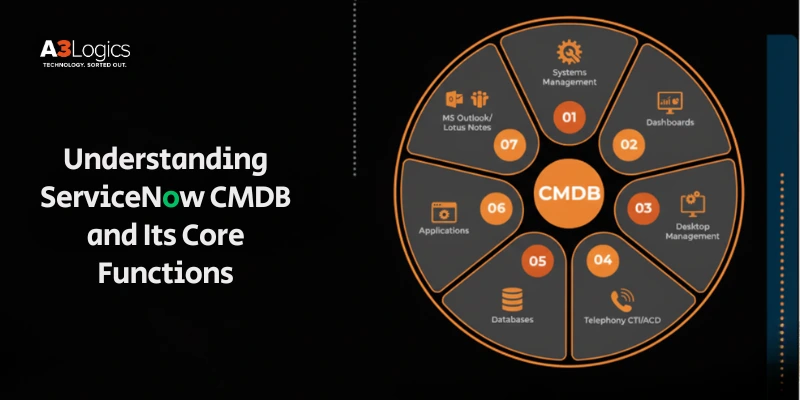
Additionally, the CMDB offers a comprehensive view of an organization’s IT assets and their relationships, highlighting key benefits of ServiceNow CMDB, including streamlined asset tracking, faster incident resolution, and improved change management. This allows IT teams to help you manage and track different changes to these assets over time. Additionally, with ServiceNow CMDB, IT teams can easily identify and resolve various issues, plan and implement multiple changes, and maintain accurate records of all IT assets.
By following the ServiceNow CMDB guide and best practices, these processes are not only carried out efficiently, but also ensure the database remains accurate and actionable over time. This also helps organizations reduce overall downtime, improve service delivery, and optimize their IT operations.
What is a CMDB Used For?
Like ServiceNow ITOM and ServiceNow ITSM, the CMDB in ServiceNow is used to enhance the outcomes of various IT services within an organization. ServiceNow CMDB also provides the right data required to support various service management practices.
Additionally, apart from Event and Incident Management, the CMBD provides accurate information about the CIs that may be the root cause of a reported issue. It also provides a proper insight into the ServiceNow services that may be significantly affected by a problem detected by the overall monitoring systems.
When combined with proper historical data in service management platforms, the ServiceNow CMDB serves as the primary centre that consolidates various historical information from multiple events, incidents, problems, and change records. This, in turn, empowers predictive analytics capabilities backed by the power of artificial intelligence. This also allows artificial intelligence to analyse the data in these records and assist with risk management and proactive activities.
Why is ServiceNow CMDB Important?
CMDB ServiceNow is the ultimate database, known for its service management capabilities, according to Gartner, Inc. Market Share reports (2023), ServiceNow states it is “ranked No. 1 in five and No. 2 in one of the technology workflow markets by market share”. The Configuration Management Database enables organizations to manage their infrastructure more effectively in accordance with their business needs.
The value of CI is highly dependent on the use of services that support it. As a result, every incident is very crucial in the absence of a CMDB, necessitating some fire drills and forcing employees to treat each failure equally. ServiceNow CMDB allows you to prioritize different issues based on the operation of the failed CI, and you can also easily focus more on the CIs that disturb some business-critical services.
However, this is not all! The CMDB’s capabilities also go beyond that. Here, the ServiceNow Configuration Management Database is also very essential as a superior risk reduction tool. Understanding a change’s potential effects is also crucial when planning to make necessary changes.
This makes it highly likely for multiple risk management activities to occur before implementing the change, thereby significantly reducing the overall risk. Additionally, it enables IT to communicate proposed changes to the relevant business stakeholders by utilizing the CMDB to identify the appropriate service users and consumers.
Similarly, the ability to identify the cost of a service function is another benefit of the CMDB. The company can also easily calculate the service’s total cost of ownership (TCO) by determining the components required for different business operations, tracking maintenance costs, and modifying these components as needed. This information can help an enterprise determine whether the services it uses are worth paying for.
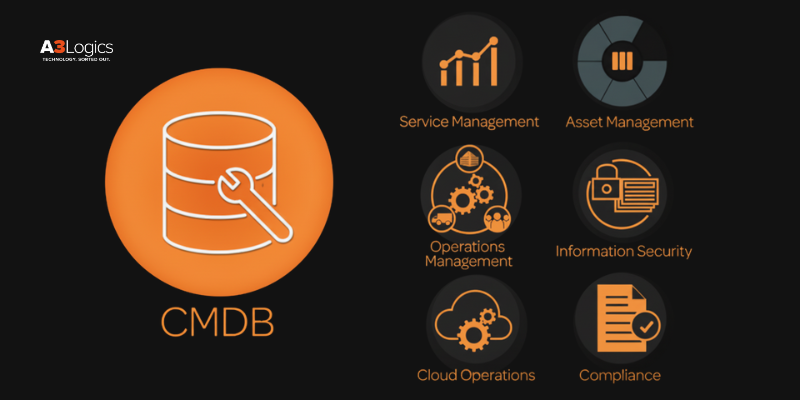
Key Benefits of ServiceNow CMDB
ServiceNow CMDB offers numerous benefits to its users. So, here are a few of the advantages of using configuration management:
1. Prompt Incident Resolution
The ServiceNow CMDB is excellent for identifying the overall root cause of an issue and then resolving it immediately.
CMDB is also the component that allows for identifying how an incident occurred, where it happened, and who it affected the most when it occurred. It also allows you to promptly find the problem so you can start working on the accurate solution without wasting any time.
2. Reduced Risk in IT Changes
Changes to IT systems can have a significant impact on the business. These changes are very time-consuming and expensive.
Additionally, when learning the benefits of ServiceNow CMDB, it helps determine how these different changes impact your organization’s IT infrastructure. Therefore, learning about the risks before implementing changes enables you to manage them effectively and minimize their negative impact on your enterprise.
3. Quick Decision-making
ServiceNow CMDB is an excellent tool that facilitates the decision-making process for various IT teams. Also, the Configuration Management Database provides an excellent centralized repository of information about IT assets and services.
By having proper access to accurate and up-to-date information, IT teams can make faster and more informed decisions about IT asset management, change management, incident management, and other critical IT processes.
4. Boosted Security & ESM Processes
The CMDB plays a vital role in enhancing your organization’s IT security by making it simple to identify the software running on your systems. This information also enables you to predict if any software is suddenly malfunctioning in your system.
ServiceNow CMDB also provides a detailed inventory of all the hardware and applications in your organization, making it very convenient for you to manage greater compliance with proper industry regulations.
5. Improved Strategic Planning
ServiceNow CMDB provides a single source of truth for all your business’s IT processes, allowing you to plan and strategize future actions with confidence and reliability.
CMDB saves you from the hassle of searching out your archives or maintaining those complex spreadsheets, so you can easily focus on other things that are very important for your business.
6. Enhanced Operations & Efficiency
To detect issues more quickly and resolve them more efficiently, having a comprehensive view of the health and proper status of various assets in your environment is essential.
It also enables you to link different problems to specific assets or resources, while empowering you to follow better practices for your business that improve overall stability.
7. Streamlined Knowledge Management
CMDB in ServiceNow is considered highly valuable in knowledge management. It provides multiple benefits to various enterprises by offering a correct way to store, find, and manage all necessary data in a single place.
Therefore, when an employee needs to find information, they can easily locate it through the CMDB with minimal effort. It also helps many companies to provide an exceptional customer service.
ServiceNow CMDB Components & Structure
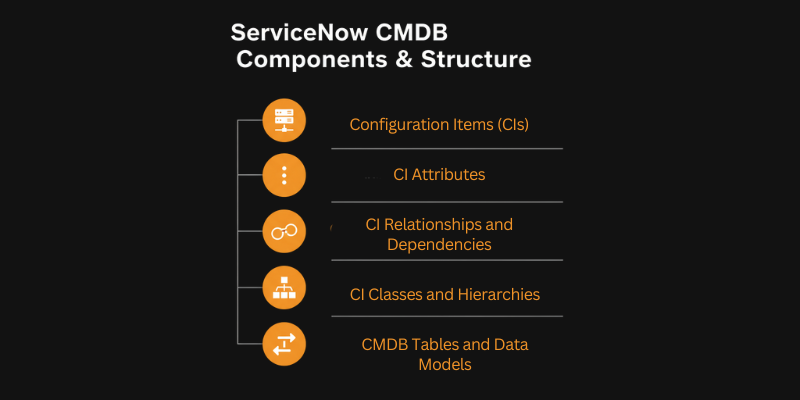
The ServiceNow CMDB guide is also considered the backbone of effective IT configuration management, providing a superior and centralized database for gathering crucial information about a company’s IT assets and their interactions and relationships with one another.
1. Configuration Items (CIs)
CIs are the individual entities within the IT environment. This includes everything, from hardware components such as the servers and routers to software applications and multiple network devices.
Similarly, CIs form the foundation of a clear and comprehensive configuration management.
2. CI Attributes
In ServiceNow CMDB, Configuration Item (CI) attributes are the specific properties or details that describe each CI, helping identify and manage it effectively.
These attributes include information such as name, type, status, owner, location, manufacturer, and relationships with other CIs.
3. CI Relationships and Dependencies
The strength of a CMDB lies in its overall ability to map and understand the intricate relationships between different configuration items.
When it comes to handling the CMDB implementation challenges, CI relationships as well as dependencies define how CI interact with one another, creating a complete picture of the business’s IT landscape.
4. CI Classes and Hierarchies
Configuration Items in the ServiceNow CMDB are properly categorized into some specific different classes. And, each of this represents some specific asset types, such as servers, applications, or networks.
These classes form different hierarchical relationships, enabling a better and greater efficient management, visualization, as well as proper tracking of IT infrastructure components.
5. CMDB Tables and Data Models
ServiceNow CMDB organizes proper configuration data in structured tables, where each CI class corresponds to a specific table. These tables follow a proper relational data model, linking the CIs through multiple references and dependencies.
This structure also ensures superior data integrity, supports automation, and also provides a unified view of different assets across the IT ecosystem.
ServiceNow CMDB Best Practices
CMDB implementation challenges are not new. So, here are some of the best CMDB practices that can help you get the most out of the CMDB in ServiceNow.
1. Define Clear Goals & Scope
Always define some proper, measurable goals for your CMDB initiative. This will enable you to compare the overall progress with the initiative and make any necessary adjustments, as well as multiple changes if required.
2. Develop a Strong Governance Framework
To ensure you get the most out of CMDB in ServiceNow, it is crucial to have a governing structure in place to maintain control over the processes. This not only empowers proper documentation, review, and also assist with accurate approval of all changes before implementation.
3. Integrate CMDB with ITSM Processes
Connecting with the CMDB with different IT Service Management processes ensures accurate and real-time configuration data across multiple incident, problem, besides change management workflows.
This ServiceNow integration also enhances visibility, reduces service disruptions, and improves decision-making by providing a single source of truth for all IT assets and relationships.
4. Automate Discovery & Data Updates
Automation actually plays a vital role in maintaining a trustworthy and agile CMDB. Similarly, automation not only enhances efficiency but also minimizes the overall risk of manual errors.
With the exclusive automation technology that is continually evolving, there are numerous opportunities to effectively integrate automation into established processes and workflows.
5. Regular Data Audits & Reconciliation
Performing routine data audits and reconciliations also helps maintain the accuracy and reliability of the CMDB. It also involves validating CI details, removing duplicates, and aligning data with actual infrastructure changes.
Furthermore, regular reviews prevent configuration drift, ensure compliance, and help build trust in the CMDB as a dependable and robust foundation for IT operations.

Common CMDB Challenges & How to Overcome Them
According to the Forrester report: “Just 40% of organizations report success with CMDB initiatives”. But, just like other architectural implementations, different CMDB implementation challenges are not uncommon. So, implementing and maintaining a ServiceNow CMDB can be very complex due to some issues related to data, processes, and integrations.
However, with a proper strategic planning and continuous improvement, organizations can also overcome these challenges to ensure a reliable and high-performing CMDB foundation.
| Challenge | Solution |
| Data Accuracy | Automate a proper discovery and different verification processes to keep configuration data current. Use ServiceNow Discovery and regular reconciliation checks to eliminate duplicates, ensure accuracy, and maintain real-time visibility of assets and dependencies. |
| Data Governance Gaps | Establish some clear ownership by assigning CI managers and defining governance policies. This results in regular audits, validation workflows, and assistance with approval processes to ensure greater accountability and consistency across the CMDB. |
| Integration with Other Systems | Leverage the proper ServiceNow APIs, Service Mapping, and also the properly standardized data models that help to easily connect CMDB with ITSM, monitoring, and different asset management tools. This also enables a proper and smooth data exchange, eliminates the chances of silos, and also enhances operational efficiency. |
| Over-Scoping Too Early | Begin with some critical business services and then gradually expand coverage. Additionally, implement in different phases that help to avoid the chances of complexity, ensure proper data quality, and allow different teams to refine different processes and governance before scaling up. |
Real-World Use Cases of ServiceNow CMDB
The CMDB in ServiceNow plays an excellent and vital role in enhancing different IT operations by providing centralized visibility, control, and data accuracy across the IT ecosystem. It also helps organizations streamline different processes, reduce risks, and enhance decision-making by maintaining a unified view of all configuration items.
1. Cloud Infrastructure Visibility
CMDB provides a superior and comprehensive view of cloud resources, including some virtual machines, storage, and network components across multi-cloud environments.
It automatically tracks different configuration changes, dependencies, and usage metrics, besides ensuring better monitoring and optimization of cloud assets. Thus, it also leads to improved operational efficiency and reduced resource duplication or overspending.
2. Minimizing System Downtime During Deployments
For the ServiceNow CMDB guide, by mapping different relationships and dependencies among the configuration items, CMDB also helps IT teams identify potential risks before implementing changes. This insight allows controlled deployments, minimizing service interruptions.
With accurate data on affected systems, businesses can plan maintenance windows effectively, reduce downtime, and maintain seamless service continuity during proper software or infrastructure updates.
3. Faster Compliance & Audit Reporting
ServiceNow CMDB also simplifies proper compliance management by maintaining up-to-date records of all IT assets and their latest configurations. It also provides an audit-ready database with detailed change histories, ownership information, and proper dependency data.
This transparency enables multiple organizations to quickly generate compliance reports, meet regulatory requirements, and respond efficiently during overall security or governance audits.
4. IT Cost Optimization and Budget Forecasting
By consolidating the right amount of data on asset utilization, lifecycle, and ownership, CMDB helps identify underused or redundant resources. Furthermore, the IT teams can make some data-driven decisions to optimize licensing, reduce maintenance costs, and accurately forecast future expenses.
This leads to more efficient budgeting, proper resource allocation, and overall cost savings for the organization.
Boost Your Company’s Growth With CMDB
A well-implemented CMDB in ServiceNow empowers different organizations to easily manage their IT assets intelligently, improve service delivery, and make some excellent data-driven decisions that accelerate proper business growth and digital transformation.
1. Enables Proactive IT Service Management
CMDB provides better and real-time visibility into the IT infrastructure. Thus, it helps teams to detect different issues early and prevent service disruptions.
Furthermore, with proper configuration data, the right IT staff can anticipate various problems, automate responses, and enhance overall service quality through proactive management rather than reactive troubleshooting.
2. Reduces Operational Risk and Downtime
Similarly, by mapping different dependencies among different systems and applications, CMDB also minimizes the overall risk of errors during changes or updates.
It also enables a proper impact analysis before superior implementation, ensuring smoother deployments, fewer outages, and improved business continuity through controlled and informed IT operations.
3. Supports Scalable Digital Transformation Strategies
Though CMDB implementation challenges sometimes bring a negative impact, CMDB also creates a structured foundation for scaling digital initiatives. It also unifies proper configuration data across cloud, hybrid, and on-premise environments. Thus, it supports proper agile development and modernization efforts.
Furthermore, this centralized visibility also ensures smoother technology adoption, streamlined integrations, and some future-ready scalability that aligns perfectly with evolving business goals.
How A3Logics Can Help?
A3Logics empowers different organizations with some end-to-end ServiceNow implementation services. From proper setup and customization to accurate discovery, migration, training, and ongoing managed support, the architecture ensures that your configuration data is accurate, actionable, and aligned with business objectives.
i. ServiceNow CMDB setup, Implementation & Customization
A3Logics helps you define your CMDB strategy, configure the ServiceNow CMDB module, tailor specific workflows and dashboards, and implement best-practice customizations. This ensures your CMDB aligns with the latest operational model, besides supporting future growth.
ii. CI class Modelling & Data Migration Support
A3Logics assists in building appropriate CI classes (e.g., hardware, applications, services), establishing class hierarchies, and migrating legacy data into ServiceNow with improved integrity. This also ensures that your CI taxonomy is logical, and your historical data is clean and useful.
iii. Discovery, Service Mapping & Continuous Improvement
A3Logics also conducts proper discovery and service-mapping efforts to populate the CMDB with some accurate CI relationships and dependencies. They also support proper ongoing refinement, health monitoring, and proper optimization to keep the CMDB more reliable and aligned with evolving infrastructure.
iv. Hands-on Training, Integration & Managed Support
They provide proper training for different users and administrators on ServiceNow CMDB and A3Logics also follow some related processes and help to integrate CMDB with other systems. Thus, they offer managed support to properly maintain, govern, and evolve the CMDB over time.
Conclusion
ServiceNow CMDB is now considered as a crucial and indispensable tool for multiple organizations seeking to optimize their overall IT infrastructure and superior service management. Furthermore, by centralizing and accurately maintaining the configuration data, businesses can successfully enhance visibility, streamline different operations, manage risks, and make informed decisions.
So, following ServiceNow’s best practices, such as automating proper data collection, maintaining overall data accuracy, implementing governance, and integrating with other ITSM processes, also ensures that the CMDB remains a reliable and valuable asset.
Furthermore, by partnering with a leading and reliable ServiceNow consulting company and implementing some continuous improvement and proper training, you can also effectively leverage the configuration management database. So, embrace the architecture and drive efficiency and achieve your IT management objectives.