
The way employees experience HR today can make or break an organization’s culture. Yet, many HR teams are still trapped in outdated processes. They are stuck with manual requests, juggling disconnected systems, and struggling to deliver timely, consistent support.
In a world where employees expect seamless digital experiences, HR can’t afford to lag behind. According to Gartner, only 24% of HR teams believe they’re maximizing the value of their HR technology investments.
ServiceNow HR Service Delivery provides a strategic solution to this challenge. It brings together powerful workflow automation, intelligent case management, and unified self-service experiences into a single enterprise platform.
In this blog, we’ll explore what ServiceNow HR Service Delivery (HRSD) is, the business challenges it solves, its core capabilities, and more. Let’s dive in!
What is ServiceNow HR Service Delivery (HRSD)?
For organizations seeking to streamline their HR operations, one of the most frequently asked questions is: What is HRSD in ServiceNow?
ServiceNow HRSD (Human Resource Service Delivery) is a suite of applications that centralizes, automates, and standardizes how HR services are delivered. It includes functionality for case and knowledge management, lifecycle event automation, AI-powered virtual agents, and seamless integration with IT, facilities, and other enterprise systems.

Unlike traditional HRIS systems, which serve as systems of record, HR Service Delivery ServiceNow acts as the system of engagement. This digital layer helps employees access HR support, policies, and services. It complements core HR systems like Workday or SAP by handling the “moments that matter” throughout the employee journey.
Key Business Problems Solved by HRSD in ServiceNow
1. Fragmented Employee Experience
In many organizations, employees must navigate multiple systems, forms, and email threads to resolve simple HR issues. This fragmentation creates confusion, delays, and inconsistent support. ServiceNow HRSD addresses this by offering a unified portal that consolidates all HR services and information into one accessible location. This reduces friction and enhances the employee experience.
2. Manual and Repetitive HR Tasks
HR teams often spend a significant portion of their time handling repetitive queries and tasks, such as answering FAQs or routing requests. By implementing HR Service Delivery ServiceNow, organizations can reduce this burden through AI-powered knowledge bases and virtual agents that automatically resolve common inquiries.
3. Lack of Visibility and Analytics
Without centralized service tracking, HR leaders struggle to access real-time insights into performance, volumes, and trends. ServiceNow HR Service Delivery Module integrates dashboards and performance analytics that provide transparency across HR processes.
4. Inconsistent Service Delivery
Variations in how different HR reps respond to similar issues lead to inconsistent employee experiences and policy enforcement. ServiceNow HR Service Delivery solves this with standardized workflows and structured case templates, ensuring consistent resolution regardless of who handles the request.
5. Poor Integration with Other Systems
Legacy HR tools often operate in silos, limiting collaboration between HR, IT, facilities, and other support functions. The ServiceNow HR Service Delivery Module offers seamless integration across departments, using Universal Request to connect interdependent processes like onboarding and offboarding across multiple systems.
Core Capabilities of ServiceNow HR Service Delivery Platform
1. Employee Center
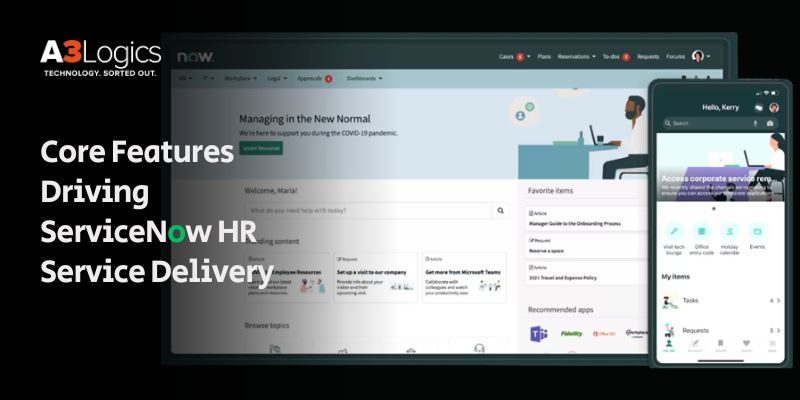
The Employee Center is the central hub for HR service access. It functions as a personalized, role-aware portal where employees can search HR content, submit requests, check task statuses, and interact with AI-powered chatbots. It also delivers targeted content, such as onboarding resources or location-specific policies.
2. Case & Knowledge Management
ServiceNow HR Service Delivery Module includes robust case management that enables HR agents to handle requests in a structured and trackable way. Employees can log cases through the portal or chatbot, and the system routes them to the appropriate support group based on category, urgency, and business rules.
With knowledge management, HR teams can maintain internal and external knowledge bases to deflect tickets and ensure consistent responses.
3. Lifecycle Event Management
Lifecycle Event Management automates complex, multi-step processes like onboarding, promotions, relocations, or leaves of absence. Each event becomes a workflow that assigns tasks across HR, IT, facilities, and finance, ensuring nothing falls through the cracks.
4. AI, Virtual Agent & Now Assist
ServiceNow leverages multiple layers of AI in HRSD. The Virtual Agent is a conversational chatbot that handles Tier-1 HR queries, deflecting cases through self-service. It integrates with knowledge articles and request forms, and is available on web, mobile, and collaboration tools like Teams or Slack.
Additionally, Now Assist for HRSD introduces generative AI to summarize chat histories, suggest next steps, and help HR agents draft resolution notes. These features reduce handling time, improve consistency, and enhance agent productivity.
5. Mobile & Multi-Channel Access
Modern HR support must be available everywhere. ServiceNow HRSD offers mobile-first experiences through the Now Mobile app, allowing employees to interact with HR on the go.
The platform also supports omnichannel access, including chatbots in Teams, Slack, or web, and traditional channels like email.
6. Analytics & Dashboards
With built-in performance analytics, it offers real-time visibility into service metrics such as:
- Average time to resolution
- Case volumes by type or location
- Knowledge base usage and deflection rates
- SLA compliance
This enables HR leaders to proactively address trends, redistribute workloads, and measure the ROI of HR service initiatives
7. Integration & Extensibility
ServiceNow HR Service Delivery supports deep integrations with Workday, SAP SuccessFactors, Oracle HCM, Active Directory, e-signature tools, background check vendors, and more.
Pre-built spokes and APIs simplify connection, while Universal Request facilitates collaboration across departments. The platform is also extensible via low-code tools, enabling HR teams to configure new services, workflows, or content without heavy development.
Major Modules Inside ServiceNow HRSD You Must Know
Reference:- trustvergence.com
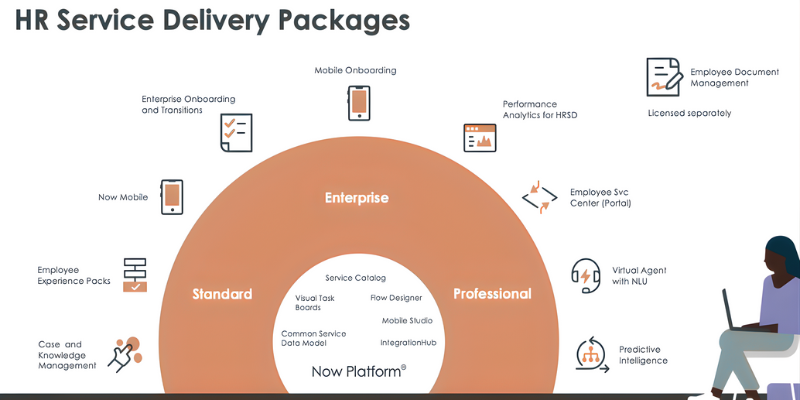
1. Employee Center & Unified Self-Service
The Employee Center is a single, consumer-grade interface where users can access HR services, search knowledge, view tasks, and receive communications. This unified approach is crucial for reducing friction.
2. Case and Knowledge Management
These two modules work together to streamline service delivery. Case management ensures that every HR issue is logged, assigned, and resolved systematically. Knowledge management supports self-service by offering employees immediate access to policies, guides, and FAQs.
3. Lifecycle Events (Onboarding, Transitions, Offboarding)
The Lifecycle Events module orchestrates end-to-end employee transitions across the organization. Whether it’s onboarding a new hire, processing an internal transfer, or managing offboarding, this module ensures that all related tasks across HR, IT, facilities, and finance are automatically triggered and tracked.
4. Employee Relations & Sensitive Case Handling
Handling sensitive HR cases like workplace investigations or compliance violations demands high confidentiality. The Employee Relations module within the ServiceNow HR Service Delivery Module enables segregated case management with restricted access and role-based visibility.
5. Virtual Agent, Now Assist AI & Mobile Access
The Virtual Agent and Now Assist AI are central to HRSD’s digital service strategy. The Virtual Agent uses Natural Language Understanding (NLU) to interpret queries and suggest solutions or initiate transactions.
Now Assist AI assists HR reps by auto-summarizing conversations, drafting response templates, and predicting next-best actions. These tools accelerate case resolution and improve overall service quality.
Combined with mobile access, these tools make HR Service Delivery ServiceNow available 24/7 across devices and channels.
6. Manager Hub, Alumni Service Center & Cross-Department Requests
Manager Hub provides a dashboard for supervisors to view their team’s HR tasks, performance milestones, and approvals. This empowers people managers to support their teams more proactively without depending on HR for every update.
The Alumni Service Center extends HRSD functionality to former employees, enabling them to access documents, tax forms, and remain engaged with the company post-employment.
Cross-departmental workflows are handled via Universal Request, ensuring that requests involving multiple teams (e.g., onboarding involving HR, IT, and security) remain unified from the employee’s perspective.
How ServiceNow HR Service Delivery Features Boost HR Productivity?
1. Faster Resolution of Employee Requests
By streamlining intake through the Employee Center, routing cases intelligently, and integrating self-service resources, ServiceNow HR Service Delivery reduces employee wait times and improves first-contact resolution.
2. Less Manual, Repetitive Work
Repetitive tasks like status updates, routing, and documentation are fully automated. HR Service Delivery ServiceNow uses workflow orchestration and predictive intelligence to automatically categorize and assign cases, suggest resolutions, and send notifications.
3. Better Visibility & Control
With dashboards tracking KPIs like case volumes, SLA compliance, and knowledge deflection rates, HR teams gain real-time control over service performance. Trends can be identified quickly and actioned before they escalate into systemic issues.
4. Consistent and Quality Service Delivery
Standardized workflows, approval chains, and response templates ensure that every case follows a structured process. Employees receive uniform service regardless of the location, issue type, or HR agent involved.
5. Improved Employee Engagement
When employees can resolve issues quickly and efficiently, their perception of HR improves. The intuitive Employee Center, AI chatbot, and personalized communications all contribute to a consumer-grade experience. This increases employee satisfaction and loyalty.
6. Cost Reduction & Operational Efficiency
Automation, self-service, and system consolidation generate measurable cost savings. Forrester’s analysis showed companies saved $1.1M in end-user time and $1.1M from system consolidation over three years.

Benefits of Implementing ServiceNow HRSD
1. Unified Employee Experience
Employees interact with a single, consistent portal regardless of whether their request pertains to HR, IT, or facilities. The Employee Center and Universal Request capabilities eliminate silos and improve usability.
2. Reduced HR Operational Cost
By automating processes and consolidating tools, ServiceNow HR Service Delivery reduces licensing, support, and labor costs. Fewer manual processes mean fewer errors, less rework, and better compliance.
3. Higher HR Team Productivity
Tools like the HR Agent Workspace, Now Assist, and case playbooks allow HR teams to resolve issues faster and at scale. Agents spend less time on repetitive cases and more on complex, high-impact interactions. It results in 20 to 30% productivity gains, according to Forrester.
4. Better Compliance and Risk Management
Sensitive cases are isolated in the Employee Relations module with strict role-based access. Document retention policies ensure data privacy, while all activities are logged for audits. Organizations using ServiceNow HR Service Delivery Module reported feeling more audit-ready, with complete traceability and adherence to HR policies.
5. Improved Analytics and Decision-Making
Performance Analytics and the HR Success Dashboard provide real-time insight into service quality, usage trends, and process bottlenecks. By making data visible and actionable, HR leaders can identify what’s working, what’s not, and where to invest next.
6. Scalable and Flexible Platform
Built on the Now Platform, ServiceNow HR Service Delivery scales with your organization. You can start with a core set of services and expand to additional modules, geographies, or departments as needed.
Typical ServiceNow HRSD Implementation Process & Roadmap
1. Define Business Outcomes & Services
Begin by aligning stakeholders and defining the strategic goals of the implementation. Identify which HR services to deliver, what success looks like, and how HRSD will enhance employee experience and operational efficiency. Identify friction points that the platform must address.
2. Set Up Employee Center and Case Management
Configure the Employee Center as the unified entry point for all HR services. Deploy Case and Knowledge Management as foundational modules to digitize request handling and self-service. Set up user roles, service categories, and routing rules to ensure requests reach the right HR teams.
3. Migrate and Integrate Existing Data/Systems
Migrate key HR data (e.g., policies, employee profiles, case history) and integrate with HCM platforms like Workday or SAP SuccessFactors. Leverage ServiceNow Integration Services to connect external systems using pre-built connectors, APIs, and integration spokes for faster go-live.
4. Configure Workflows, Approvals, Tasks, and Automation
Design and build workflows to automate lifecycle events, employee transitions, and standard HR services. Configure automated task assignment, approval routing, and SLA tracking. Use drag-and-drop flow designers or scripting where needed for complex logic.
5. Enable Self-Service and Mobile Access
Activate knowledge articles, service catalogs, and the Virtual Agent to support self-service. Enable access via web and mobile, and deploy in messaging platforms like MS Teams or Slack. Ensure all interfaces are branded and aligned with your organization’s tone and policies.
6. Pilot, Train, and Change-Manage
Roll out HRSD to a test group or specific location before full deployment. Collect feedback and adjust configurations. Invest in training HR agents, managers, and employees. Use ServiceNow Implementation Services to support change management, adoption, and communications.
7. Roll-Out Broadly and Optimize
Deploy HRSD organization-wide. Monitor performance closely using dashboards and employee feedback. Identify service gaps, iterate on workflows, and expand to additional services or departments as needed.
8. Measure ROI and Drive Continuous Improvement
Track outcomes aligned to your original goals: request resolution times, employee satisfaction, deflection rates, etc. Use Performance Analytics and employee sentiment to fine-tune service delivery.
Best Practices for a Successful ServiceNow HR Service Delivery Rollout
1. Start with a Minimum Viable Set of HR Services
Rather than deploying every module at once, begin with high-impact services like onboarding, leave management, and payroll inquiries. This allows you to stabilize core workflows, gather feedback, and prove value early in the process.
2. Build a Solid Knowledge Base
A robust and well-maintained knowledge base drives self-service success. Curate content based on real case history, use AI suggestions, and regularly update based on usage analytics. Ensure articles are concise, searchable, and accessible on all devices.
3. Ensure Cross-Department Collaboration
HRSD workflows often span departments like IT, facilities, finance, etc. Foster collaboration early to map dependencies and align teams on shared service delivery. Use Universal Request to break down silos and ensure integrated, consistent support.
4. Invest in Change Management and Training
Successful adoption hinges on effective communication, stakeholder alignment, and user training. Develop personas and journey maps, and tailor communications to each group.
5. Use Data and Analytics from Day One
Embed dashboards and performance indicators into your HRSD environment at launch. Monitor early usage and iterate based on trends. This ensures transparency, accountability, and quick wins.
6. Iterate and Improve
Adopt an agile mindset. Treat HRSD as an evolving product, not a one-time project. Use regular check-ins, employee surveys, and new feature rollouts to drive continual enhancements.
7. Maintain Governance and Data Privacy
Establish data governance rules and ensure HRSD aligns with privacy laws like GDPR and HIPAA. Use role-based access controls and encryption.
Integration of ServiceNow HRSD with Other Systems and Modules
ServiceNow HR Service Delivery is designed to integrate seamlessly with enterprise systems like:
- Core HRIS platforms (e.g., Workday, SAP)
- ITSM tools
- Identity systems (Active Directory, Okta)
- eSignature tools (DocuSign, Adobe Sign)
- Payroll and benefits platforms
This interoperability allows for cross-functional workflows such as triggering laptop provisioning from IT during onboarding, or updating payroll systems when an address change is submitted.
Using ServiceNow Consulting Services or a specialized partner, organizations can configure secure integrations that avoid data silos and support real-time process orchestration.
The Future of HR Service Delivery: What ServiceNow HRSD Evolves Into
1. Generative AI & Automation
Generative AI will continue to reduce manual HR tasks like drafting responses, summarizing case histories, and suggesting knowledge articles. Future iterations will likely bring even deeper conversational capabilities, context-aware actions, and predictive workflows.
2. Employee Experience Focus
HRSD’s evolution centers around holistic employee experience. Personalized dashboards, nudges, and sentiment analysis will inform how services are delivered and improved.
3. Gig, Contingent and Remote Workforce Support
With the rise of alternative work models, HRSD will expand support for gig workers, contractors, and remote employees. It can offer tailored lifecycle events and dynamic access policies.
4. Analytics and Predictive HR
AI-driven analytics will provide predictive insights into attrition risk, policy effectiveness, and service trends. HR leaders will shift from reactive issue resolution to proactive workforce planning.
5. Integration into Enterprise Service Factories
As enterprises embrace service factories, ServiceNow HR Service Delivery will act as the HR engine, tightly integrated into larger employee experience ecosystems.

How A3Logics Helps Businesses with ServiceNow HRSD Implementation
As a ServiceNow HRSD Developer and strategic implementation partner, A3Logics delivers full-spectrum services: from consulting and architecture to configuration and continuous improvement.
Our experts specialize in:
- Rapid HRSD deployment and configuration
- Workflow and lifecycle automation
- Custom integrations with third-party tools
- Knowledge base development and training programs
A3Logics supports clients across industries and geographies, ensuring scalable, secure, and value-driven ServiceNow HRSD Implementation.
Conclusion
ServiceNow HR Service Delivery transforms how organizations deliver HR services. It is moving from fragmented, manual, and reactive processes to a centralized, automated, and employee-centric model.
Whether you’re a large enterprise or a growing business, a well-planned ServiceNow HRSD Implementation can be the turning point toward a more connected, efficient, and meaningful employee experience.
At A3Logics, we understand that every organization’s journey is unique. Our goal is to help you build an HR environment where employees feel supported, valued, and empowered to do their best work.
Connect with us today!