Customers are sharing their opinions more and more openly in today’s digital age via social media, reviews, chat platforms, surveys, and support channels. The organizations not only have to hear what the customers say but also understand their feelings. AI for sentiment analysis is the tool on which the companies rely to figure out the emotions, attitudes, and opinions concealed in the massive volumes of text.
By using natural language processing and machine learning for sentiment analysis, AI sentiment analysis tools change the unstructured content into valuable emotional intelligence. The main benefits are quicker decision-making, enhanced customer experiences, better market understanding, as well as instant brand monitoring. In a situation where competition is getting tougher in every industry, those businesses which can accurately capture customer sentiment are the winners since they will have the power to act with precision and empathy.
AI for sentiment analysis can manage extensive datasets, has the possibility of enhancing customer satisfaction scores by as much as 25% and decreasing complaints by up to 30%, and the market is expected to have a CAGR of 18.9% from 2026 to 2033. In this blog we are going to talk about how AI for sentiment analysis is making a difference across industries and how AI development service providers like A3Logics can help in custom sentiment analysis solution development.
What is Sentiment Analysis?
Sentiment analysis or opinion mining is the method of going through the text to find the emotional tone connected to that text. This tool helps in distinguishing which category the content belongs to – whether it is positive, negative, or neutral. It can also sense the moods of the text like anger, delight, or even sarcasm. The main purpose of the exercise is to get, on a large scale and thus in a short time, the public opinion, customer mood, and overall sentiment, which would be impossible if done manually.
Earlier sentiment analysis was based on rule systems that involved the use of fixed word dictionaries and certain linguistic patterns. Although such a method was effective with simple text, it had a hard time dealing with slang, sarcasm, ambiguous language, and context.
Present-day AI for sentiment analysis far exceeds the mere keyword matching. It employs highly sophisticated natural language processing and machine learning algorithms that can identify context, intent, grammar, and even the tone. Such AI models keep improving through learning from current data, thus they become more and more correct in deciphering complex cases of irony, various cultural references, emojis, and casual digital language. Thanks to deep learning, semantic understanding, and transformer-based models, AI has made sentiment analysis more intelligent, adaptable, and capable of handling large-scale, real-time feedback across digital environments.
Types of Sentiment Analysis
Sentiment analysis refers to various analytical methods that reveal the sentiment or feeling expressed in a text. Below are the four main types:
1. Fine-grained sentiment analysis
This method changes the sentiment polarity by recognizing degrees of sentiment. Instead of only classifying sentiments as positive, negative, or neutral, it divides them into more detailed categories like “very positive,” “somewhat positive,” “neutral,” “somewhat negative,” or “very negative.” This is extremely helpful when one wants to do the deep analysis of reviews or ratings, as it provides customers’ sentiments in a detailed manner.
2. Emotion detection
This type of sentiment analysis picks up the emotions in a text. It doesn’t just say if the sentiment is – positive, neutral, or negative. Instead, it assigns the emotions that the text expresses – such as joy, surprise, anger, sadness, fear, etc. This gives a much clearer picture of the user’s emotional state.
3. Aspect-based sentiment analysis
This method helps us get the sentiment of specific aspects of a product or service. Instead of just telling if the sentiment is good or bad, it goes through each feature or aspect to find out the sentiment there. For instance, in a restaurant case, aspects may be “food quality,” “ambiance,” or “service speed.”
4. Intent-based sentiment analysis
The goal of this type is to figure out the intention or purpose of a text. When the underlying intent is found, companies can understand customer behavior, foresee their next moves, and change their strategies accordingly. It is a great help in customer-service situations, for instance, where knowing the customer’s next move helps you prepare the most effective response.
How Does AI in Sentiment Analysis Work?
1. Data Collection and Preprocessing
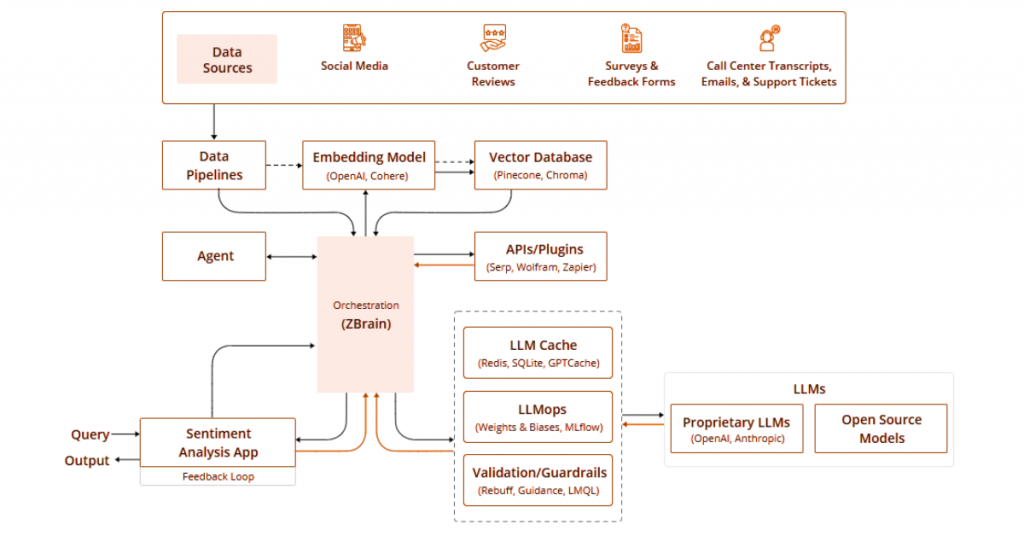
The first step of AI for sentiment analysis is gathering text data from sources such as social media platforms, emails, customer reviews, support chat logs, and surveys. Since the material frequently includes noise (slang, typos, emojis, or irrelevant content) – AI systems preprocess it by removing and standardizing the text. This stage gets rid of the unnecessary parts, corrects the errors, and makes sure the text is not – only organized but also suitable for precise sentiment detection.
2. Tokenization and Embedding
Once the text is cleaned, it is divided into smaller tokens through tokenization. Every token is converted to a numerical form by embedding methods. Advanced NLP models, e.g., Word2Vec, BERT, and GPT, create the embeddings that not only link the words but also capture the context, tone, and semantic relations. Thanks to this, AI for sentiment can grasp the meaning of a text far beyond just a few keywords, which also applies to such things as sarcasm, subtlety, or the emotional tone.
3. Training Machine Learning or Deep Learning Models
The numeric data is thus used to train machine learning and deep learning models on labeled sentiment datasets. These datasets are designed in a way that the system can identify sentiments as positive, negative, neutral, or even more specific emotional states. The deep learning models, i.e. the ones with the transformer-based architecture, have the capability of understanding the context, the real gist of the sentences and even the tiniest linguistic hints, which is something that traditional rule-based systems can’t accomplish.
Choose machine learning development services from A3Logics for seamless machine learning development.
4. Sentiment Scoring and Visualization
When the training is complete, the AI system goes through the new and incoming text and gives it sentiment scores. Usually, these results are presented through analytic tools and dashboards, which facilitate the stakeholders to track sentiment changes, emotional fluctuations as well as customer satisfaction levels in real time. Visualized data allows companies not only to keep monitoring the brand’s condition, but also to raise service quality and better craft communication strategies.
5. Continuous Learning with Feedback Loops
One of the features that keep modern AI sentiment analysis tools in a state of perpetual progress is feedback loops. Corrections given by users and more real-world texts being fed to the model help it discover new expressions, slang, emojis, cultural references, and the language styles that are constantly changing. Thanks to this continuous training, the system stays precise, capable of understanding the context, and highly flexible when it comes to the changes in the way people communicate and express their emotions.

Key Applications of AI-Based Sentiment Analysis
1. Social media monitoring and brand reputation
Many brand-related topics are discussed not only on social media but also on a variety of platforms such as blogs, news sites, forums, and product reviews. AI for sentiment analysis gives these discussions important context by recognizing the subtle customer opinions. In this way – you can figure out how a PR disaster has affected your brand and the degree to which the measures taken to control the situation have been successful.
2. Customer feedback and product improvement
Customer feedback is a treasure of insights. With the help of sentiment analysis – companies can decode this information, spotting improvement areas. By obtaining the sentiment of customer feedback, companies are able to craft strategies that lead to increased customer satisfaction and loyalty.
3. Market research and consumer insights
Sentiment analysis is a marketing research instrument that should not be overlooked. Monitoring the sentiments around your competitors will give you a clear indication of their strengths and weaknesses, thus, you will be able to set your strategies accordingly.
Furthermore, the usage of industry-specific keywords or hashtags can not only help you to identify future market trends but also to measure the level of interest in certain topics, thus, it will be easier for you to stay ahead in the competition.
4. Political and public opinion analysis
In political science, sentiment analysis is a very powerful instrument that helps the analysts to forecast the election results just by analyzing the public sentiments towards the candidates. By digging into the news, social media, public opinions, and suggestions, one can make a much more accurate prediction of the election’s outcome.
5. Customer service and chatbot sentiment understanding
Through sentiment analysis, companies can have a better understanding of the consumers’ perception of their products or services. By evaluating product-related chats and the overall mood towards the product, businesses can make the right decisions to improve or change the product with the help of their development teams.
Get the best AI chatbot support with our AI agent/copilot development services.
Benefits of AI-Based Sentiment Analysis
1. Real-Time Insights for Decision-Making
Using AI for sentiment analysis, emotional information is automatically extracted from customer interactions across digital platforms, thus facilitating fast and well-informed decisions. In this day and age, companies are not dependent on the manual report cycle as AI performs real-time monitoring of consumer sentiment on reviews, social media, chats, and surveys.
2. Improved Customer Experience
On recognising customer sentiments, firms will have the ability to respond in an understanding manner and also to tailor the messages of their support interaction. By means of AI, support teams get the power to contact the customer service team whenever they find a customer dissatisfied with a call or a chat session and the customer gives a feedback form; the AI in use thus detects anger, pleasure, or confusion from voice calls, chat messages, or feedback forms.
3. Enhanced Marketing and Communication Strategies
Marketing teams utilize sentiment insights to adjust their messages, polish brand tone, and generate campaigns which attract, emotionally, their target market. AI for sentiment analysis helps a brand in recognizing the changes in the attitude of its customers through the analysis of the content and in that way the brand can decide on the content, pricing or the products it wishes to promote next.
4. Scalable and Automated Sentiment Classification
Performing manual sentiment coding for an increasing amount of textual content is a very demanding task in terms of time and human resources, and one that is fraught with errors and subjectivity. Besides that, there is the issue of scalability. In contrast to a human being, AI can perform this task very efficiently, in other words, in one go it can analyze several million texts and also it can keep the accuracy of its computations constant.
5. Data-Driven Reputation Management
How the public views a brand is, certainly, one of the most important factors in the determination of brand value. AI sentiment systems are very efficient in following up on brand mentions and feelings triggered by posts on social media, comments, and reviews, as well as news sources, and they notify companies about new topics of discussion even before these get out of control.
- Also Read: The Best Sentiment Analysis Tools Of 2025
Use Cases of AI-Enabled Sentiment Analysis Across Industry Verticals
AI for sentiment analysis has an important role to play across industries. It helps in streamlining customer experiences aiming to improve customer service and experience through getting a clear picture of what are the customer expectations and what are the areas that need to be worked on. In this section let’s try to decipher how AI for sentiment analysis is making a difference across various industry verticals.
1. AI-Driven Sentiment Analysis in Retail
Sentiment analysis in the retail industry is a helpful tool for brands to comprehend customer desires, their buying patterns, and the emotional aspects that most likely decide their purchase. It is through these means that companies are able to gather the words of users expressed in product reviews, social media, and customer service dialogues, in order to know what drives consumers to react positively or negatively to their merchandise or services.
Consequently, profits can be tremendously elevated by businesses who can make stock choices more accurately, enhance recommendation engines, and tailor promotions when they decode customer emotions. Consumer sentiment data, to retailers, means the market niches they can address through new and improved line extensions.
2. AI-Based Sentiment Analysis in Tourism and Hospitality
Customer experience is paramount for travel and hospitality brands whose success goes hand in hand with the use of AI sentiment analysis tools to understand the feedback contributed by travelers. Such a diverse set of content posted in hotel reviews, travel blogs, booking websites, and comments made by customers, are evaluated by the companies for them to know what they bring to the table or fail in their service.
The interpretation of these statements encourages hotel and the travel industry to stir up their service levels, provide better facilities, and fix shortages of services before destinatary groups will be affected. Further, being able to operate quickly on social media or review sites, in real-time, enables online reputation management through which brands can get ahead of issues and therefore, up their reputation in the digital age.
3. AI for Sentiment Analysis in Telecommunications
Telecom companies are encouraged by customer sentiment analysis to gather real-time customer feedback about network quality, billing issues, and support experiences. Through AI, complaints and annoyances expressed in customer dialogues using different communication channels such as chats, calls, and emails are unearthed and addressed by telecom providers. Sentiment information can also be used to keep an eye on churn by spotting users most likely to leave the company.
On top of that, embracing emotional intelligence, telecom firms are able to curate personalized communication strategies enhancing that marketing messages and service notifications are in tune with customers’ wants and needs.
4. AI-Driven Sentiment Analysis in Healthcare
Sentiment analysis techniques in healthcare equip providers to track, among other things, patient feelings, satisfaction with treatments, and the general experience of care. Various healthcare providers from Hospitals to telehealth platforms are engaged in listening to patient’s voices expressed in surveys, online consultations, and health communities, in order to be aware of issues related to treatment quality, delays in service, or communication barriers.
The understanding derived from these interactions is instrumental in medical teams to involve patients more and improve doctor-patient communication which altogether leads to better care outcomes. Also, Healthcare bodies learn public sentiment towards diseases, medicines, and wellness programs in order to build more user-friendly and empathetic healthcare experiences.
5. AI-Powered Sentiment Analysis in Banking
With the help of sentiment analysis, Banks and financial institutions aim to spot disgruntled customers and unearth potential problems with services that may exist in different touchpoints like digital and branch. An Emotional Cues Detection tool helps identification of areas where banking services may raise customer outrage, e.g. in cases of late transactions, loan rejections, or fraud-induced anxiety.
Financial Institutions then, use this information to elevate the quality of consumer-support-processes; improve digital banking features and extend personalized financial advisory services to their customers. Meanwhile, Banks sentiment surveillance is also instrumental in spotting early signals of fraudulent activities thereby catering to the implementation of a combined strategy for customer security.
Streamlining Sentiment Analysis Workflow with GenAI
Generative AI transforms traditional sentiment analysis workflows by providing them with a deeper layer of context and emotional nuance. While standard sentiment analysis models usually assign a particular category to the given text from the patterns they have already seen, Generative AI sentiment analysis can decode the feeling, irony, alteration of the subject, even unsaid emotions, and on top of that, GenAI creates results that are very close to the human sentiment understanding.
One of the biggest obstacles in sentiment analysis is the acquisition of well-labeled, balanced datasets. GenAI quickly completes this task by the synthetic production of text samples that are close to real, and at the same time, the sentiment categories are automatically labeled.
Such an automated system drastically reduces the time for manual annotations and at the same time contributes to the building of larger and more diverse training sets that increase the model’s accuracy in different industries and even when using different linguistic styles.
Conventional sentiment models may only look at text through the lens of positive, negative, or neutral. With help from Generative AI sentiment analysis, as well as sophisticated transformer-based models, even the slightest emotional tones like frustration, trust, excitement, sadness, doubt, or urgency become clear.
This expanded emotional awareness equips firms to go beyond capturing the gist of the feedback given and realize the true underlying factors that cause customer satisfaction or dissatisfaction, and even predict their future behavior.
Future Scope: Multimodal Sentiment Analysis (Text + Voice + Video)
Sentiment analysis will be the next generation of technologies that could effortlessly understand textual, vocal, and visual emotional signs simultaneously and in real time. GenAI models are already enabling the next stage of multimodal emotion recognition, which takes into account not only the tone of the voice, but also the facial expressions and textual cues.
This future-oriented solution will allow companies not only to gauge customer sentiment in text-based dialogues but also understand the emotional connection during videos call sessions, customer service calls or digital expressions with the ultimate goal being emotional insight accuracy and personalized experience delivery.

A3Logics AI Development Services for Sentiment Analysis
A3Logics is a leader in creating custom sentiment analysis solution development based on state-of-the-art NLP and machine learning technologies. We have the knowledge of transformer models, emotional analytics, and domain-specific text processing to create products that are capable of dealing with language structures and understanding industry jargon and can process languages of different origins.
In addition to custom software development services, A3Logics takes care of effortless product placement throughout the business ecosystems. The sentiment models are compatible with CRM platforms, social media monitoring tools, analytics dashboards, and customer engagement systems.
Such an integration allows companies to be aware of the emotional changes coming from the different touchpoints, to have the reaction strategies automated, and to facilitate customer experience through the use of emotional intelligence in their workflows which is directly actionable. Get in touch with us for leading AI consulting services.
How to Do Sentiment Analysis Using LSTM?
LSTM (Long Short-Term Memory) networks act as a subclass of recurrent neural networks that handle sequential data, making them a natural fit for sentiment analysis tasks. They effectively capture long-range textual dependencies, enabling them to retain important contextual information from the beginning of a sentence even when predicting the emotional tone at the end.
1. Data Collection and Text Preprocessing
The very first step is to collect text data from the most relevant sources and then cleanse it in order to rid it of the noise. The noise may include punctuations, URLs, stop words, or symbols. The preprocessing step plays a crucial role because, without it, a language model cannot recognize meaningful sentiment patterns and may become heavily influenced by irrelevant information.
2. Tokenization and Padding
After cleaning the text, the model breaks it down into numerical tokens that represent words or sub-words from the vocabulary, calling this process tokenization. To keep input sequences uniform, we pad the sentences so they all have the same length, which makes model training more efficient.
3. Building the LSTM Model
Typically, the LSTM network consists of an embedding layer, a couple of LSTM layers, and a few fully connected layers for the task of predictive classification. The embedding layer transforms the words into dense vectors, and the LSTM units learn the contextual relations from the given text.
4. Training and Evaluation
We train the LSTM model on sentiment-labeled datasets, which updates the network’s weights. Afterwards, we measure the quality of its classifications across different sentiment categories using accuracy, F1-scores, and confusion matrices, enabling a thorough evaluation of the model.
5. Predicting Sentiment Outputs
The model then processes fresh text input and generates likely sentiment responses by assessing the linguistic emotional weight. Various systems such as customer support solutions, review analyzers, and social monitoring tools—can use this output.
6. Comparison with Other Models (CNN, Transformers)
LSTMs are still valuable tools for grasping the sequential nature of text, but the leading-edge models like CNN-based text networks and transformer-based architectures such as BERT and GPT frequently outperform them in terms of accuracy because they handle context better. Nevertheless, LSTMs are still viable for use in resource-constrained scenarios or small-scale tasks.
Future of AI in Sentiment Analysis
1. Role of Large Language Models (LLMs) in Contextual Understanding
LLMs mark a giant step forward in the field of sentiment analysis and as a result, they provide the capability of deeply understanding the layered meaning, emotional nuance, and evolving language patterns to the models. One of their advantages is understanding the cultural context of the text, identifying sarcasm, humor, and even recognizing the writer’s intention which is a big leap from the basic polarity classification to the complex field of affective computing. As LLMs keep developing, they will have the capacity to perform sentiment analysis at the level of human understanding but on a much larger scale.
2. Sentiment Detection in Multimodal Content
Imagine sentiment analysis that moves beyond text and actively derives a speaker’s sentiment from voice tone, recognizes emotion in facial expressions and body movements, and interprets surrounding visual cues. This new multimodal perception of emotion will allow for an extraction of the user’s emotional state at a more profound level from virtual assistance, telehealth consultations, call center analytics, and video feedback.
3. Real-Time Emotion AI Integration in Businesses
Emotion-detecting future architectures will be capable of recognizing the customer’s emotional aim instantly no matter which channel of his engagement with the brand is utilized. Among other things, this will allow for immediate intervention in case of disappointed customers, offering of support services to users who experience problems, sending of empathetic messages from bots, and providing marketing messages tailored to the individual on a much deeper level than before.
The systems that are able to comprehend emotions digitally will be among the surrounding factors working together to improve the customer experience in the enterprises that are future-orientated.
Conclusion
AI for sentiment analysis has progressed substantially. It has moved from simply determining whether the opinion is positive or negative to being a complex layer of intelligence that can comprehend human emotions, intentions, and the context even on a large scale. Due to the advances in generative AI, transformers, and multimodal learning, firms are able to interpret the emotional intricacies of their customers’ texts, voices, and even videos, thus they can make decisions instantly, get a deep insight into their customers, and engage them in a proactive way.
As corporations keep on installing smart CX systems, sentiment analysis will be the primary instrument to staff personalized experiences, deepen brand loyalty, and fuel business strategies based on data. Those companies which decide to leverage this emotional intelligence asset now will be in a position to become the leaders in a future when AI-driven empathy and customer understanding will be the key factors that differentiate rivals.