
The current digital landscape involving AI, IoT, blockchain, data analytics, and cloud computing is impacting the InsurTech ecosystem by automating its business operations and boosting customer satisfaction. New-age customer expectations are no longer limited to the promised services only, but they also want continuous access to their policy information along with convenient communication.
This changing paradigm is witnessing an immense market evolution in the form of a customer-centric, technically equipped insurance ecosystem with hyper competition. In this blog we have taken a deep dive to understand what is an insurtech ecosystem, what makes up an insurtech ecosystem, what are the various benefits that it offers and how a leading insurance software development company like A3Logics can help your business.
Summary & Global Market Insights
According to Grand View Research, the global market size of insurTech in 2022 was evaluated at USD 5.45 billion and was projected to grow at a CAGR of 52.7% from 2023 to 2030, reaching USD 152.43 billion. Other reports state that it was valued at USD 15.56 billion in 2024 and USD 19.06 billion in 2025.

With the emergence of technical advancements in the insurance industry, every domain is facing transformations in customer expectations, technological advancements, and market drivers such as the level of competition and regulatory frameworks. These factors are the key motivations for insurance companies to take a technological shift in their business.
North America is leading in the InsurTech Ecosystem by heavily investing in modern technology and holds a 47.62% share in the global market in 2024. In the European region, the UK, France, and Germany are the dominating countries with the growing adoption of insurance digital transformation.
In the Asia Pacific countries, a major portion of the population is uninsured and well-penetrated with smartphones, opening the doors to increased advancement opportunities in insurTech solutions.
What is an InsurTech Ecosystem?

The InsurTech ecosystem is a comprehensive system of linking insurance companies with other businesses to leverage each other’s skills and specific capabilities to serve their customers better. The core idea behind this modern network is to replace traditional workflow with a modern approach encompassing insurance automation technologies.
InsurTech ecosystem connects insurers, tech enablers, distributors, and customers by utilizing digital platforms and APIs. The connectivity between different stakeholders enables them to enjoy the advantages of insurance digital transformation, such as reduced operational cost, enhanced productivity, customization of policies, and reduction in workload with increased customer satisfaction.
An ecosystem model benefits the insurance businesses and several other relevant companies by increasing their revenue streams and accelerating primary functions. Policy providers can fasten the repetitive but essential processes such as underwriting, risk management, plan distribution, and claim processing. Whereas their intersection with other companies helps them generate new products and services, enhancing the overall business growth.
Types of InsurTech Solutions
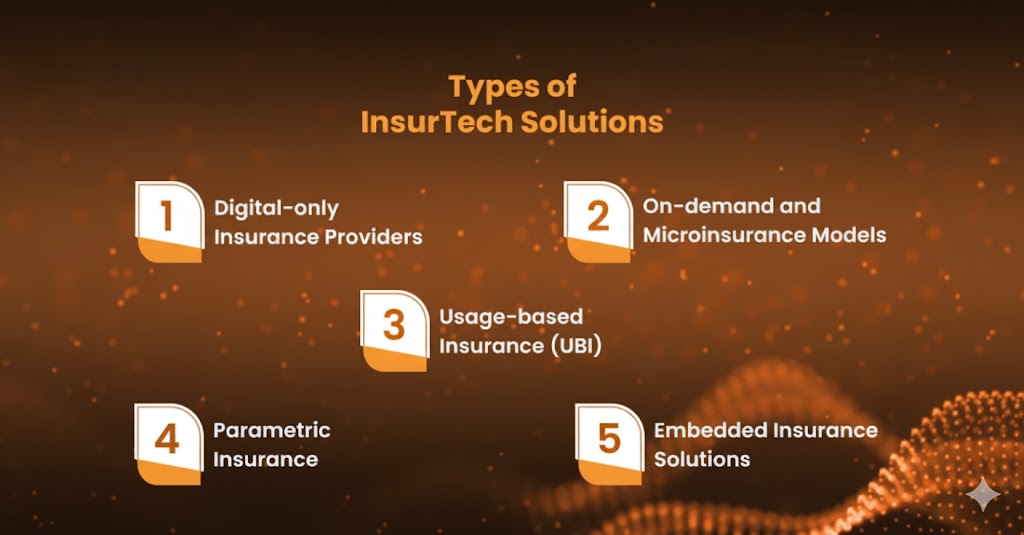
Digital insurance innovation brings several types of insurTech solutions that enable the industry to streamline its routine operation with minimum cost and maximum output. Let us dig into some of the major ones:
1. Digital-only Insurance Providers
These types of companies are solely digital-based with no physical units that used to work on traditional methods. The policy providers offer only online insurance services backed by their digital expertise, using data analytics and Artificial Intelligence.
2. Usage-based Insurance (UBI)
This UBI model is mostly used for automobile insurance, where the premium is charged on the basis of usage or driving behaviour. Telematics devices are installed on the vehicle to collect required data such as driver’s behavior, mileage, and the state of the vehicle. Personalized pricing and motivating safer driving using real-time data are the core ideas of this insurance model.
3. On-Demand and Microinsurance Models
These are dynamic insurance policies provided for specific events or periods, and can be activated or terminated via a mobile application. Low-income groups and individuals mainly use this microinsurance to cover temporary risks, such as crop failure or illness during a specific time. These policies come at a low cost and cover only a limited amount of loss.
4. Parametric Insurance
Under this approach of insurance, a coverage amount is decided in advance by the provider and policyholder and paid when the condition of payment is met. Actual loss is not considered by the company when the real event, such as a flood, earthquake, or rainfall, occurs.
5. Embedded Insurance Solutions
Insurance providers collaborate with other companies and integrate insurance plans into their products, such as automobiles, travel tickets, and electric appliances. This way, customers get risk protection for their purchased product without applying separately.
6. Peer-to-Peer (P2P) Insurance
It is a community-wide insurance model where a group of people collectively combine their premiums in a shared fund to cover each other’s risks. Apart from individual insurance, this P2P approach emphasizes risk sharing and motivates its members to keep their costs low for the betterment of everyone.
Key Components of the InsurTech Ecosystem
InsurTech economy encompasses the following key components:
1. InsurTech Startups & Digital Disruptors
New ventures incorporate digital insurance innovation in their business model to break the old-school operational cycle of risk coverage. These firms focus only on their targeted customers to deliver new products and better services to enhance their insurance journey.
2. Traditional Insurers Adopting Digital Transformation
Already existing companies using legacy methods of insurance distribution are increasingly shifting towards InsurTech solutions to stay ahead of their competitors.
3. Technology Enablers (Cloud, AI, API Platforms)
These are the technical partners that offer AI, cloud platforms, blockchain, and IoT products to enable insurance digital transformation in traditional enterprises.
4. Regulatory Bodies & Compliance Frameworks
National, regional, and local-level government agencies that supervise the insurance industry and its operations to protect customers’ rights and ensure fair practices.
5. InsurTech Investors & Venture Capital Ecosystem
These firms provide funds to startups or small companies for integrating insurance automation technologies in their business to boost their growth and earn high ROI.
6. Policyholders & End Users (Digital-first Behavior)
They are the ultimate users of insurance policies and services and benefit most from the insurTech solutions.

How Technology is Powering the InsurTech Revolution
Advanced technologies are the fundamental pillar of the insurTech ecosystem, and the following are primarily used digital insurance innovations:
1. Artificial Intelligence & Machine Learning
AI and ML are the most prominently used solutions in the insurance sector to automate its primary functions, such as:
- Facilitate AI underwriting by automating risk assessment and pattern analysis from past data.
- AI-based fraud detection in insurance enables real-time tracking of any suspicious or fake transactions, preventing businesses from fraudulent activities.
- Chatbots and virtual agents are another key advantage for streamlining customer communication and experience.
2. Big Data & Predictive Analytics
Insurance digital transformation leverages huge amounts of data collected from various internal and external sources. Then it uses predictive analytics in insurance to identify customer behavior and their risk profile, to generate personalized policies for them.
3. Internet of Things (IoT) in Connected Insurance
Smart IoT devices connected to customer or assets gather real-time data on their movements and state of health or working condition. These live updates help the provider to calculate claims accurately, provide usage-based insurance, and assess potential risk in advance.
4. Blockchain for Transparent & Fast Claims Processing
Insurance companies use blockchain to securely store their transaction history in an immutable ledger. At the time of claim processing, the insurer can easily look up the saved data and prevent fraudulent entries. Customers and other related stakeholders get a transparent record of events, increasing their trust in the settlement process.
5. Cloud-based Infrastructure for Agility & Scale
Cloud-based computing eliminates the requirement for physical infrastructure consisting of several hardware. It reduces the initial investment and provides better scalability for the company’s growing needs. With better flexibility, companies can easily integrate new applications, develop new products, and introduce them in the market faster.
Benefits of the InsurTech Ecosystem
There are numerous benefits of insurance digital transformation, discussed as follows:
- InsurTech solutions help to streamline claims faster by processing real-time data that is offered by AI-driven Internet of Things and cloud computing.
- It reduces the operational and administrative expenses through streamlining of the simple tasks and raising productivity.
- Enhanced risk assessment and fraud prevention are other primary benefits of insurance automation technologies, driven by data-enriched, accurate policy underwriting.
- The AI analytics gives insightful information on customer behaviour, and the insurTech economy enables the diversified companies to collaborate to offer a highly personalized customer experience.
- Blockchain and cloud computing technologies replace physical hardware with web-based platforms, enhancing the level of data accessibility and transparency. These tools come with greater scalability and can easily cater to growing data needs and boost product innovations.

Real-world Use Cases & Success Stories
InsurTech solutions are disrupting the legacy frameworks with the following practical usage of the emerging insurance automation technologies:
1. AI-powered Claims Handling
Artificial Intelligence and Machine Learning algorithms automate claim processing and reduce human intervention significantly. These tools can actively detect fraud activities, cross-check claim requests, and even initiate the payment process.
Lemonade is the prime example of leveraging technology for Claims handling, as its “AI Jim” (an AI chatbot) processes 30% of the company’s claims within seconds.
2. Usage-based Auto Insurance
Root Insurance Company is successfully delivering usage-based insurance for automobiles, using telematic technology. It collects live data of the driver’s behaviour and charges a premium according to their habits of braking and speed, inculcating their risk profile.
3. On-demand Microinsurance
A Chinese company named ZhongAn provides on-demand or microinsurance to its customer for their short-term risk coverage, such as flight delay, shipment return.
4. Digital Insurance for Underserved Markets
Digital insurance is provided through mobile applications using telematics technology, and Bima is leveraging this insurance model for underserved markets. The company offers an economical and easily accessible protection plan to low-income group customers.
5. Pay-Per-Mile Auto Insurance
This model charges for the Auto insurance on the basis of miles driven by the vehicle. For example, Metromile applies this approach in its business and uses smart sensors and mobile apps to track the distance covered by insured vehicles. Customers have to pay a small basic amount and extra fees per mile.
Challenges in the InsurTech Ecosystem 200
Every change comes with some sort of challenges, and one seeking insurance digital transformation faces the following difficulties:
1. Data privacy & cybersecurity threats
Cybersecurity threats and the protection of customers’ sensitive data are two of the most concerning matters in the insurTech ecosystem.
2. Integrating new systems with legacy infrastructure
It is a hectic procedure to merge modern technologies with the outdated work infrastructure and ensure smooth operations.
3. Complex regulatory environments
Regulatory pressure from local and regional authorities hardens the whole workflow in the insurTech ecosystem.
4. Lack of customer trust in digital-only insurance
Customers still prefer to trust physical entities in front of their eyes, limiting the market exposure of digital insurance providers.
5. High customer acquisition and retention costs
It is a costly affair to attract customers for your insurance product and then retain them for the long term. High competition pressures the companies to spend more on innovative product ideas that can lure new customers.
How to Develop an InsurTech Product (Step-by-Step Guide)

Here is the systematic process of developing an insurTech product:
1. Define Your Niche, Business Model & Product Vision
The journey starts by identifying your target market through in-depth research. Next is to select the business model, such as B2B or B2C. Once you are clear about both terms, proceed to defining the core values that your product will deliver.
2. Map the User Journey & Create a UX Strategy
In this phase, prepare a complete roadmap of how customers will connect and engage with the product, starting from finding out and applying till the claim settlement.
3. Choose the Right Tech Stack & Architecture
As technology is the key factor of insurTech products, it is crucial to select a sophisticated and modern infrastructure that can easily scale and match your product’s requirements.
4. Build the MVP & Integrate Core Insurance Features
Before developing an end product and introducing it in the market, test the market reaction by launching a Minimum Viable Product (MVP) with just essential features. It will give an idea about the required modification in the final development.
5. Ensure Compliance, Security & Data Protection
When the product is ready to launch, make sure that it complies with the relevant regulatory laws and includes proper security measures in order to avoid any post-launch objections or fraud.
6. Launch, Test, Optimize & Improve Continuously
After completing the product development and ensuring compliance fulfillment, introduce it in a small group of people and continuously track its performance. Introduce upgrades, improvements, and alterations in the product as per the received feedback.
7. Scale with Automation, Analytics & AI Enhancements
Keep a flexible and scalable infrastructure ready for the automated upgradations, data revisions, and new feature additions in the insurTech product. Apply AI and data analytics to ensure scalability in the newly launched products so that they can accommodate ongoing improvements and updates.
Conclusion
The InsurTech economy truly builds a network of distinct organizations, coming together to innovate new products and services in the insurance industry. Automation, data-driven decisions, enhanced customer experience, and personalized products are some of the major advantages given by digital insurance innovation.
However, to enjoy these perks, one has to go through the associated challenges as well, and partnering with a pioneering insurance software development company can help you out. By following the above-discussed step-by-step guide of InsurTech product development, you can also leverage the benefits of modern tools in your insurance business.
How A3Logics Can Help?
A3Logic has been serving a variety of clients from different industries as an AI development company for more than 20 years. We stand out from other names in the market due to the following reasons:
- Custom InsurTech software development is the main focus of our expert teams, and they not only integrate AI in insurance system but also ensure its practical and measurable impacts on the workflow productivity.
- Our customized AI/ML-driven insurance automation solutions enable AI for insurance underwriting, claim settlements, and policy design functions, enhancing the overall operational efficiency.
- At A3Logic, we deliver an end-to-end InsurTech product development & platform modernization support to our clients, as well as catering to their unique needs.
- Being a key player in the insurTech ecosystem development industry, we hold specialized expertise across various segments, including claims automation, underwriting AI, UBI, microinsurance, and more.
Also Read: Digital Transformation in Insurance: Benefits, Challenges, Use Cases, Trends & More