
As more and more people are going online, we are seeing a rapid increase in the number of online frauds. When it comes to the insurance industry, detecting insurance fraud is difficult because of varied fraud patterns and the rarity of occurrence of known cases of fraud with ordinary data sets. Insurance fraud results in a loss of $6 billion per year, and at least 10% of insurers’ premium income goes towards insurance fraud.
Insurance claim fraud accounts for the largest percentage of all insurance frauds that affect the insurance industry. Conventionally, insurers identify fraud manually. The manual process is based on established and older fraud information, and new fraud can easily remain undetected. Pressure from the cost of investigations and regulators makes it harder.

The manual process is also not geared to address volumes of data insurers must build capability and employ technologies and solutions to find insurance fraud. In this blog we are going to take a look at the key aspects of insurance fraud detection automation development, the role of machine learning in insurance and how an automated insurance fraud detection system works and its use cases. Let’s dive in!
Insurance Fraud Detection Automation: Key Aspects
As defined by the Association of Certified Fraud Examiners (ACFE); a fraud control activity is a particular process or procedure designed to avoid fraud or, if fraud occurs, to identify fraud promptly. Automated fraud control activities implemented via monitoring and in real-time or near real-time notices are essential for enhancing fraud detection and prevention capabilities as well as lowering operational expenses.
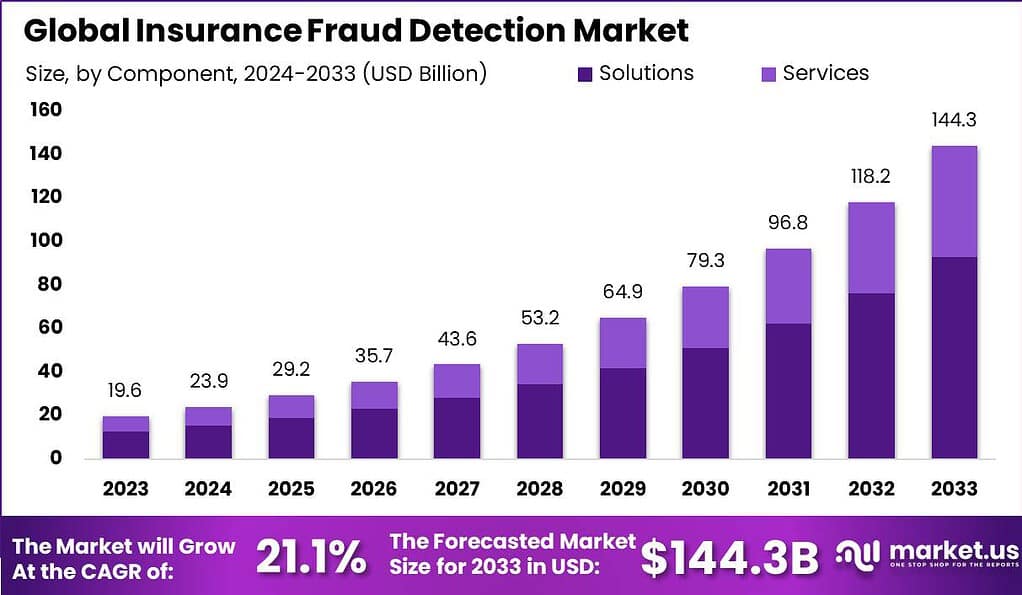
The insurance fraud detection automation development has to anticipate the potential for fraud at any point in the value chain of insurance – application, policy issuance, customer service, processing claims, payments, or exit. Automation uses strengths in pattern recognition, data analysis, and anomaly detection to handle large amounts of data. This data comes from diverse sources, including financial transactions, customer information, and history. Automated systems review interactions between various, data points to identify fraudulent activity.
Let’s take a look at some of the key aspects of insurance fraud detection automation development.
- Data Integration – Integrating – policy, claims, social, and third-party data for an end-to-end view.
- AI & Machine Learning – Applying AI and ML to identify anomalies, and forecast fraud patterns in real time.
- Rule-Based Systems – Use business rules for triggering suspicious claims real-time.
- Natural Language Processing – Using NLP to examine – documents, emails, and notes for concealed red flags.
- Behavioral Analytics – Monitor aberrant policyholder or claimant behavior.
- Real-Time Alerts – Lessen losses with timely fraud alerts.
- Continuous Learning – Models update with changing fraud strategies.
How to Automate Fraud Detection Across 8 Major Risk Areas?

1. Identity fraud detection
Take automated customer identity checks to terminate manual processes throughout client information processing, make sure compliance with KYC/AML requirements, and avoid unauthorized access to insurance.
2. Underwriting fraud detection
Track the manner your underwriters calculate risks and accept insurance applications. Alert instantly if underwriting doesn’t align with internal and legal standards.
3. Policy data fraud detection
Implement smart validation of policy information to ensure that there are no fictitious beneficiaries, the worth of the insured property is not exaggerated, and the risk details are correct and comprehensive.
4. Policy manipulation fraud detection
Receive real-time notifications on the efforts to formulate, alter, or distribute insurance policies by unauthorized actors to stop nefarious players quickly and avoid document fraud and sensitive information exposure.
5. Claim fraud detection
Utilize AI-driven validation of claim information and auto-detection of fictitious cases to achieve 2x faster and 99%+ accurate claim adjudication, streamline settlement activities, and stop excessive and inflated payments.
6. Sourcing fraud detection
Achieve 100% visibility into your damage handling partner selection processes and auto-detect suspicious agreements and payment transactions that did not pass the predetermined approval process.
7. Reinsurance fraud detection
Track reinsurance deals and agent conduct to rapidly identify an excessively high volume of reinsurance deals or policy swaps that can indicate fee churning.
8. Accounting fraud detection
Use automation to rapidly detect and block malicious tampering’s on business-critical financial information and provide consistent and compliant financial reporting.

Common Insurance Fraud Schemes Software Helps Recognize
1. Customer Identity Theft
Thieves steal or create fake identities to buy insurance plans and then make false claims. Customer information is matched against authenticated databases by insurance fraud detection automation development – marked for inconsistencies, and tracked for unusual patterns in real time.
2. Document Forgery
Counterfeit medical reports, receipts, or repair invoices are usually presented to overstate claims. Artificial intelligence-based systems scan – metadata, signatures, and digital signatures of documents, which makes it simpler to detect forged or altered records.
3. Misrepresentation of Risk Data
Candidates can falsify their age, driving record, state of health, or habits to gain lower premiums. Automated insurance fraud detection system check this information against third-party databases, ensuring that risk is correctly evaluated.
4. Car Insurance Fronting
This happens when an at-risk driver (e.g., a youth) lists a lower-risk member of their family as the primary driver to keep premiums low. Models to detect fraud monitor driving patterns and policyholder records to identify discrepancies.
5. Premium Diversion
Brokers or agents might embezzle premiums rather than forwarding them to insurers. Payment tracking software follows premium flows to ensure that money reaches the insurer and immediately reports anomalies.
6. Inventing Losses
Fraudsters make claims for non-existent accidents, thefts, or damages. AI cross-checks claims against police reports, geospatial information, or IoT sensors to check for authenticity.
7. Claim Misclassification
Policyholders misclassify claims—e.g., categorizing damage to business vehicles as personal use in order to maximize payout. Automated claim classification systems, ensure claims are in line with policy conditions.
8. Claim Exaggeration
Real losses are overstated by padding with – spurious damages, or exaggerated repair amounts. Machine learning algorithms compare claims to past averages, in order to find improbable spikes.
9. Double Billing
Repeating the same claim or bill several times is an old trick. Sophisticated duplicate detection software identifies repeated submissions even when minor changes are introduced to cover them up.
10. Fee Churning
Fraud schemes in some cases include unnecessary middlemen or inflated fees for services. Fraud analytics identify billing anomalies and target excessive intermediary involvement.
Key Features of an Automated Insurance Fraud Detection System
Features play a key role in any automated insurance fraud detection development. This helps in understanding and finding the right solution according to the needs of the business. In this section we are taking a look at the various key features that an Automated insurance fraud detection system must have.
1. Insurance Compliance Rule Management
Compliant Compliance Rules: There is a need to create and administer company-specific rules. These include customer acquisition, underwriting, policy issuance, claims settlement, document management and insurance based record keeping.
Configurable Eligibility Criteria: Establishing qualification parameters for individuals and companies for salary slips, utility bills, rental contracts property ownership rules and other environmental reports for corporate clients.
Policy-Linked Rules: Automate the translation of personalized policy conditions into claim approval rules to facilitate trouble-free settlement.
Multi-Jurisdictional Compliance: Another important thing is to compliant across various frameworks like KYC/AML, OFAC, IFRS17, GDPR, HIPAA, NYDFS, CCPA, CPRA, GLBA, SAMA (KSA), and other local and global regulations.
2. Automated Validation of Customer & Business Data
Data Capture & Processing: Process batch and real-time data ingestion from various customer sources.
AI plus OCR for Unstructured Data: With this feature it becomes easier to process handwritten, printed and other digital documents like images.
Cross-Verification: Verify customer information against internal rules, credit bureaus, and medical data repositories.
Identity Authentication: Conduct AML/CFT and OFAC screening, biometric verification, and digital signature validation.
AI-Based Anomaly Detection: Recognize discrepancies like income-to-spend mismatch levels or suspicious ownership of assets.
LLM-Based Claim Validation: Verify entered claim data and documents against policy conditions, supplier data, and financial institution information.
3. Intelligent Insurance Fraud Detection Powered by AI/ML
Real-Time Fraud Detection: This feature offers real time fraud detection for automatically flagging counterfeit IDs., forged receipts, exaggerated claims or suspicious behaviour patterns.
Cross-Referencing Data: Match customer transactions and insurance events to internal history and external fraud databases.
Employee Activity Monitoring: Identify non-compliance, mis-underwriting, suspicious payments, or attempts at manipulation of sensitive data.
Loss Estimate Verification: AI provides precise evaluation of claimed damages and losses.
Instant Alerts & Penalty Enforcement: This feature will automatically alert investigators to attempted fraud. This will help in imposing penalties according to the company’s and legal policies.
4. Insurance Fraud Analytics and Reporting Dashboard
Predictive Fraud Analytics: With AI it is easy to predict probable fraud with the help of evaluating past cases and behaviour patterns.
Actionable Fraud Insights: Get actionable insights into how to act based on the severity of the fraud. Produce rule-based or AI-based recommendation for the right action.
Comprehensive Metrics Tracking: Track fraud cases, investigation rates, false positives, and financial impact by department and segment.
Automated Reporting: With this feature automatically schedule or produce on demand suspicious activity reports and suspicious transaction reports.
Regulatory Submissions: This feature offers secure, rule-governed submission to regulators like NICB and NAIC plus for business partners for example reinsurers.
Secure Data Management: Encrypt fraud data in transit and at rest using blockchain-capable asymmetric encryption and role-based access control.

How to Drive High Payback from Insurance Fraud Detection Automation?
1. Formalization of compliance rules with accuracy
Transformation of internal and regulatory compliance requirements into unambiguous automation rules provides software with a uniform foundation for identifying non-compliant servicing processes and unauthorized customer transactions.
2. ML-driven analytics
ML-based algorithms assist in identifying known and new insurance fraud patterns, such as deepfakes and AI-generated fake documents. ML models learn and refine fraud detection over time based on new data.
3. Integration with various data sources
Integration of insurance fraud detection automation development with corporate systems and third-party sources, including non-traditional ones such as IoT devices and social media, enables quick collection of extensive information on customer and worker behaviors.
4. Real time monitoring and alerts
With machine learning coming into the picture, real time monitoring and alerting becomes more attainable as and when the fraud occurs. With automated insurance fraud detection systems coming into the scenario frauds can be avoided even before it occurs conserving reputations and financial losses.
Case Study: Insurance Data Analysis & Fraud Detection
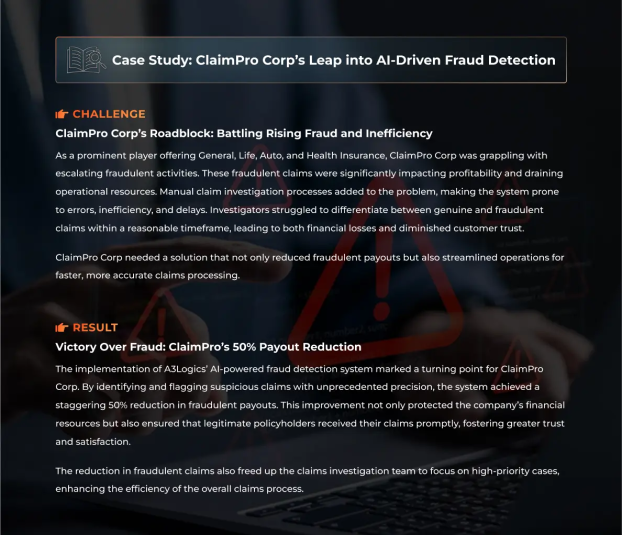
Our client, a leading insurance company, was facing serious issues with the rising fraudulent claims, inefficiencies, and this was causing customer trust issues. Together with A3Logics, they deployed an automated insurance fraud detection system powered by machine learning, real-time analytics, and investigator dashboards.
The results were transformative
- 50% reduction in fraudulent payouts.
- 5% annual profit increase.
- 20% lower operational costs.
- 100% transparent reporting.
This scalable, future-ready solution rapidly improved efficiency and profitability. It also positioned our client as a tech-forward insurer ready to tackle evolving fraud challenges. Read more about how we made a difference for our client right here.

Key Financial Outcomes of Insurance Fraud Detection Automation
There are various tangible financial outcomes of fraud detection automation in insurance. In this section we are going to take a look at some of highly sought after financial benefits that can be achieved with the help of automated insurance fraud detection system.
> Reduction in Fraudulent Claims
With insurance fraud detection automation development it is easy to spot the fraud claims. Deploying strict detection and monitoring mechanism allows a organization to prevent and avoid fraud schemes. This means lower chances of financial losses and an overall improve operational integrity.
> Cost Savings and Increased Profitability
Through simplified process, automation and risk management automated insurance fraud detection systems reduces operational costs, increases efficiency and there is better gap in the profit margins.
> Improved Compliance with Regulations
Compliance with industry practices and regulatory standards ensures legal compliance, minimizes the risk of fines, and enhances organizational reputation.
> Enhanced Customer Trust and Retention
With the systems continuously giving a accurate, transparent and dependable service there is more trust. This customer trust is important to foster faithfulness and long-term loyalty. With the enhanced customer trust there is improved organization reputation and position in the market perfect for customer retention.
When to Opt for Custom Insurance Fraud Detection Software?
Want to create a custom insurance fraud detection automation system? Our specialists suggest it in the following situations:
> High volume of complex claims
You are required to automate intricate or special fraud detection processes, for example, checking insurance workflow compliance with in-house policies and country-specific laws. Extracting and processing claim-related information in different formats, such as voice calls, handwritten text, video, IoT sensor readings.
> Exposure to multiple fraud risk areas
Checking loss estimates for particular types of insurance, like professional liability insurance or catastrophe insurance. You wish to use cutting-edge technologies, for example, ML to prescriptively prevent insurance fraud or smart contracts to automate fraud reporting.
> Integration needs with legacy insurance systems
You wish seamless and affordable integration of your insurance fraud solution with all the software your business may need, including historical insurance systems and third-party systems.
> Need for scalable fraud detection tailored to business workflows
You require a solution that can be rapidly evolved with new functionality to enable sustainable business growth and rapidly evolve to meet changing regulatory compliance requirements.

Insurance Fraud Detection Automation with A3Logics
Fraud Detection Automation Consulting
We offer expert consulting services to insurers which helps them detect vulnerabilities, redefining how fraud risk assessment is done. We offer tailored automation strategies that go well with business goals and compliance standards.
End-to-End Implementation of AI-Driven Fraud Detection Systems
Looking for end to end Insurance software development services at A3logics we offer it. Whether it is data integration or model training to dashboard development we are the one stop solution for complete implementation of intelligence fraud detection frameworks the streamline claim investigations and lower false payouts.
Continuous Monitoring and System Optimization
Fraudsters don’t rest so shouldn’t your solution- With the changing fraud and scamming techniques constant evolving A3Logics ensures ongoing monitoring, model retraining, and performance optimization to adapt to evolving fraud patterns, keeping insurers ahead of emerging threats.
Conclusion
One of the most essential things to possess for all ages is insurance, but the harsh reality is that this is one sector which is becoming increasingly vulnerable to fraud and scam. With the fast-growing scams there is a need to introduce a solution. Considering insurance fraud detection software integrated with the concerned systems eliminates manual processing and aggregation of insurance information and speeds up the detection of fraud cases. Employing AI development services such as A3Logics assists in identifying the appropriate insurance fraud detection automation development services that transforms a way a insurance company operates.