
Underwriting is one of the most vital operations in the insurance sector. It is essentially dependent on the underwriter’s ability to assess the risk properly, set the prices correctly, and make the decisions quickly. On the other hand, in a market like the present one, consumers demand immediate approvals, operational costs keep increasing, and the level of competition is also rising which, overall, puts a great pressure on traditional underwriting models.
The requirement for shorter turnaround times, greater accuracy, and scalable workforces has led insurance companies worldwide to implement underwriting automation.
Executives from McKinsey, Deloitte, and Accenture have been in agreement that the use of AI in underwriting is one of the top three areas where insurers are putting their money. Insurers that operate in different markets globally are recording up to 70 percent of the time for the underwriting process, cost savings of 30 to 40 percent, and a considerable increase in decision accuracy.
In fact, AI-powered underwriting is transforming the insurance business and client insurance experience by enabling on-the-fly data handling, predictive analytics, and automated workflows.
This blog presents a thorough comparison of AI vs Traditional Underwriting, supported by industry statistics, real-world trends, and futuristic insights and how hiring an AI development company like A3Logics revolutionizing the insurance sector.
Market Data & Industry Trends
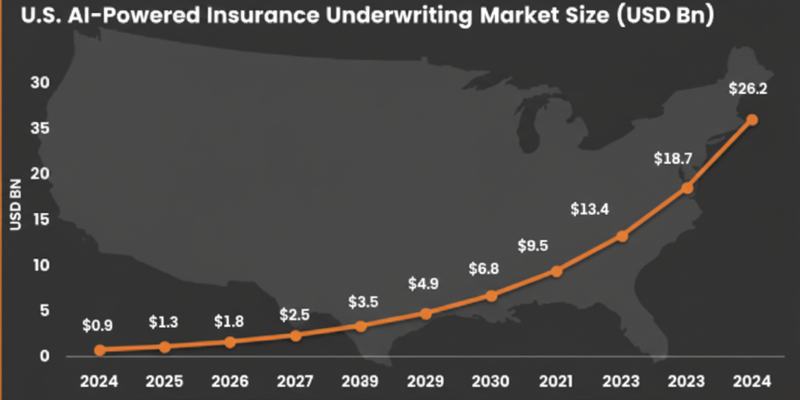
Let’s take a look at the numbers of how AI underwriting is making a major difference:
- AI adoption is rising fast: McKinsey reports nearly 60% of insurers now use AI in underwriting.
- Cost benefits are proven: Deloitte notes 20–40% lower underwriting costs for AI adopters.
- Global insurers show real results: A U.S. life insurer cut underwriting time from 14 days to less than 24 hours; a P&C carrier improved loss ratios by 30% using ML models.
- Massive time savings: AI reduces underwriting turnaround from days to minutes for simple cases.
- Significant operational savings: AI automation cuts expenses by 25–60%, with McKinsey estimating 40% of underwriting tasks can be automated.
What is Traditional Underwriting?
Comparing AI vs traditional underwriting, historically, traditional underwriting has been a process that requires a significant amount of hands-on work and handling of physical documents. Typically it moves forward by fetching the data from a variety of sources such as the application forms, statements, medical records, property documents, and third-party data providers. The underwriters have to go through all this data manually, check the inconsistencies, and apply the given rules before making the final call.
Common Limitations
Traditional underwriting has several weaknesses:
- Slow turnaround times due to manual review
- High labor and administrative costs
- Human bias and inconsistent decisions
- Difficulty scaling during peak seasons
- Limited visibility into deep data patterns
- Errors from manual data entry
These limitations increase operational pressure and negatively impact customer experience—making underwriting automation a critical necessity.
What is AI-Based Underwriting?
Now when it comes to AI vs traditional underwriting, using AI underwriting, the slow manual workflows are changed to smart, automated systems that can handle large amounts of both structured and unstructured data in real time. Machine learning, natural language processing, optical character recognition, computer vision, and predictive analytics technology elements, when used together, basically invent a new underwriting model that is not only faster but also more accurate.
AI systems upon receiving a customer application will immediately ingest the documents, extract the relevant data, check the data for correctness by going through various databases, score the risks by using the past patterns, and generate the recommendations.
Basically, underwriters are only allowed to step in in the most difficult or borderline cases, whereas all other cases are automatically approved within a matter of seconds or minutes. AI should not be considered as a replacement of human underwriters, but rather, as a means which enables them to be more analytical, efficient and scalable.
Key Advantages
The key advantages of AI underwriting include:
- High speed — the decisions could be made in a matter of minutes rather than days
- Enhanced accuracy due to the use of data-driven modeling
- Reduction in operational costs
- Ability to grow without the need of more manpower
- Excellence in customer service resulting from quicker approvals
In a competition between AI vs traditional underwriting, AI in underwriting is capable of being a significant tool that enhances the traditional underwriting workflow.
AI vs Traditional Underwriting: Detailed Comparison
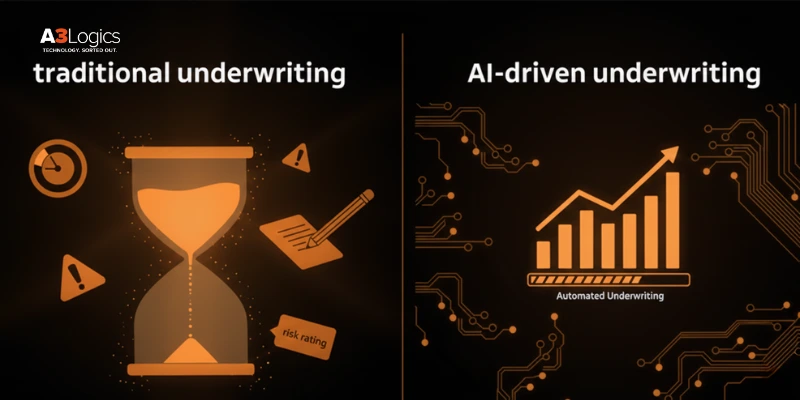
When comparing AI vs Traditional underwriting, there are various places where the traditional underwriting is lagging behind. Whether it is speed, accuracy and operational efficiency and cost, AI underwriting is becoming more and more mainstream as insurance companies are looking to streamline operations and reduce time taken and costs. In this section we have made a detailed comparison of AI vs traditional underwriting to help you choose the right one for your needs.
| Factor | Traditional Underwriting | AI-Based Underwriting | Impact |
| Speed | Takes days to weeks due to manual reviews and document handling | Processes applications in seconds to minutes with automation | Faster onboarding, improved customer satisfaction |
| Accuracy | Prone to human errors and limited data usage | Uses data-driven risk scoring, pattern detection, and predictive analytics | More accurate decisions, lower loss ratios |
| Cost | High operational and labor costs; scales only with more staff | Lower cost per application through automation | Strong long-term ROI and reduced underwriting expenses |
| Efficiency & Productivity | Repetitive manual tasks create bottlenecks | Automated workflows reduce manual load | Higher productivity with 20–40% increase in underwriter capacity |
How AI Improves the Underwriting Workflow
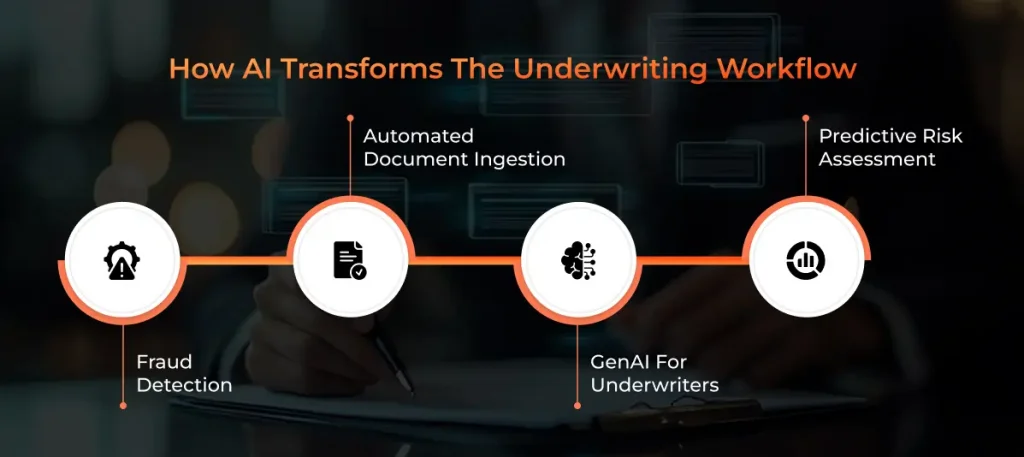
1. Automated Document Ingestion (OCR + NLP)
AI-based OCR and NLP help alleviate some of the most challenging and time-consuming tasks in underwriting, i.e., data extraction from long, unstructured documents, which refer to the steps of that workflow. With remarkable precision, the technology reads automatically the documents in PDF formats, claim histories, medical reports, financial statements, and KYC forms. It changes the scattered data into neat, structured data that is ready for use.
By removing the need for manual data entry, the chances of making mistakes are also greatly lowered, enabling the risk evaluation process to be done much faster.
2. Predictive Risk Assessment
Machine learning models are used to perform risk assessments that are more accurate by considering a greater number of data points which are rarely, if at all, taken into account by traditional methods. These models look at past claims, behavioral data, external risk factors, and variables of the industry to create by far the most exact risk score.
Resulting in more steady decisions being made, loss ratios going down and pricing becoming more accurate. The underwriters get a dependable base to work through complicated scenarios without having to wait for them.
3. Fraud Detection
Insurance fraud detection automation is intended to identify fraudulent activities and keep a watch on patterns that show up in applications, claims, and customer history. They look for, and can even in some cases immediately, find irregularities, contradictions, or deceitful conduct and thus gain the ability to alert the persons concerned with the investigation of these kinds of cases.
With this sending to a minimum of investigation and detection work, setup, fraud prevention strategies are able to contribute to the limitation of the financial impact of leakage, improve integrity in underwriting processes, and enhance portfolios’ security before giving the policy.
4. GenAI for Underwriters
Generative AI is able to serve the role of an intellectual helper among the underwriters-group by doing the long work of document summarization, risk gaining the insight, and providing the recommendation of the next step.
Through a quick brief, underwriters are able to grasp the complicated case, consider the different possibilities, and direct their knowledge-expertise to the areas where it is most valuable. GenAI is an effective decision support tool because it provides the necessary background information practically instantly, enabling decisions to be made quicker and better.

Key Benefits for Modern Insurers
1. Faster policy issuance
The use of AI in underwriting has a ripple effect that is felt throughout the insurance value chain; this means policy issuance happens faster.
2. Reduced underwriting cycle times
Underwriting automation reduces the time required for underwriting,meaning insurers gain the ability to issue policies much more rapidly.
3. Improved customer satisfaction
Customers also benefit from underwriting automation, as they can easily enjoy quick approvals and a hassle-free onboarding process, thus satisfaction and loyalty get boosted.
4. Operational cost reduction
The productivity potential is ramped up through the automation of repetitive tasks thereby reducing administrative costs and allowing the underwriters to do more valuable work.
5. Better compliance & audit trail
AI brings about uniformity in decision-making and facilitates keeping a transparent record of the audit trail, thereby enhancing compliance and readiness for regulation.
Challenges in AI Adoption
However, there are challenges when using AI in underwriting. We have listed some of the challenges that can arise while adopting AI underwriting.
1. Data quality
If the data is of poor quality or is fragmented, the models may not work effectively, therefore it is very important that data quality is the first thing that gets prioritized.
2. Model bias
Additionally, AI models can, by chance, inherit bias from past data, hence the requirement for constant monitoring and adjustment.
3. Regulatory compliance
Adhering to regulations may pose a problem especially in places where there are strict rules requiring the AI to be transparent and able to give explanations for its decisions.
4. Legacy system integration
The problem of implementing AI solutions arises from the slow-working backing systems that are extensively used by the insurance industry, so the implementation of the solution needs to be carefully planned.
5. Need for human oversight
Besides, even though the system is automated, human monitoring is still indispensable to verify the decisions made and manage complex, rare situations.

Future Outlook: Human + AI Hybrid Underwriting
At the center of the future of the underwriting field is a cooperative model in which the two types of intelligence, AI, and human work side by side.
The AI will keep performing the monotonous jobs that are currently part of the routine, such as data extraction, the first risk scoring, the processing of documents, and the detection of anomalies. All of these activities compose a faster and more efficient workflow.
On the other hand, the decision-makers will be handling the intricacies of sound judgment, decisions based on relationships, and risk assessment at the highest level.
The influence of predictive models coupled with GenAI will be instrumental in the emergence of the next generation of proactive underwriting that foresees risks instead of reacting to them thus, giving the insurers the room to innovate, lower losses, and strengthen the trust of customers.

How A3Logics Can Help?
1. AI-Driven Underwriting Automation Platforms
A3Logics automates the entire process of an AI underwriting engine with one main idea in mind, namely: decision-making, risk evaluation, and policy validation have to be done by the machine, not by a human. The carriers’ particular rules and product lines determine the platforms.
2. OCR + NLP Document Processing
The document automation solution we bring to the table is so advanced that it extracts the most important data with top-level accuracy and unnoticeably aligns that data with the policy systems. This kind of solution is capable of reducing the manual document review by 60–90%.
3. Predictive Analytics & ML Models
To improve our models, we use machine learning methods as part of our:
- Fraud detection
- Risk scoring
- Pricing recommendations
Besides, the models are in line with regulations and policies of the insurer.
4. Integration with Legacy Core Insurance Systems
In addition to systems like Guidewire, Duck Creek, and custom PAS, we ensure seamless integration. This eventually leads to improved system interoperability and speeding up the digital transformation process.
5. GenAI for Underwriters
The decision-making process can be improved by means of our GenAI solutions in different ways, such as:
- Automated summaries
- Intelligent queries
- Underwriting assistance
- Policy analysis
Custom Development + Consultation
A3Logics provides:
- AI roadmap planning
- Workflow optimization
- Pilot projects and POCs
- End-to-end product implementation
We are the insurers’ support throughout.

Conclusion
It is a transition requirement from the traditional underwriting system to AI-powered underwriting, i.e, the change can no longer be postponed if the company wants to survive in the market. By leveraging AI-driven underwriting, which is faster, more accurate, less costly, and more customer friendly, underwriting is becoming the core of the whole restructuring process in insurers’ operations.
The advantages are very large in number such that they like 100 times surpass the problems. The gradual shift of hybrid underwriting models by more and more insurers sets the scene for smart automation, predictive insights, and scalable digital workflows to be the industry’s next era.
A3Logics is fully equipped and has the necessary resources to implement cutting-edge AI driven insurance software development services that facilitate a quick transformation of the insurance sector.