
Insurtech has been the indention underground of the insurance world for many years, but in the last ten years it has grown and become the most disruptive force in the insurance ecosystem. Insurtech was at first only a niche concept, but now it has become the most disruptive force in the global insurance ecosystem. The customer expectation changes to instant experience, transparency of policy, and mobile-first engagement made it difficult for traditional insurers to follow up with the hype.
Charlie Munger said that this is like “event-driven history,” where a new moment in history creates a disruption in the old industries and in this case, revolutionizes the old insurance world. This was the perfect environment for the early movers like Lemonade, a digital-native insurer that decided to reboot the use of AI at the core for underwriting, policy issuance, and claims. Insurance app like Lemonade have a fast growth pattern that is supported by conversational AI, behavioral economics, and a simplified business model. Many startups and enterprises have been encouraged by this and are looking to replicate or surpass its success.
In this guide for insurance app development we have taken a deep dive into how to build an insurtech platform like Lemonade with AI chatbot integration, digital-first workflows, and a highly automated claim process.
What is a Lemonade Insurance App?
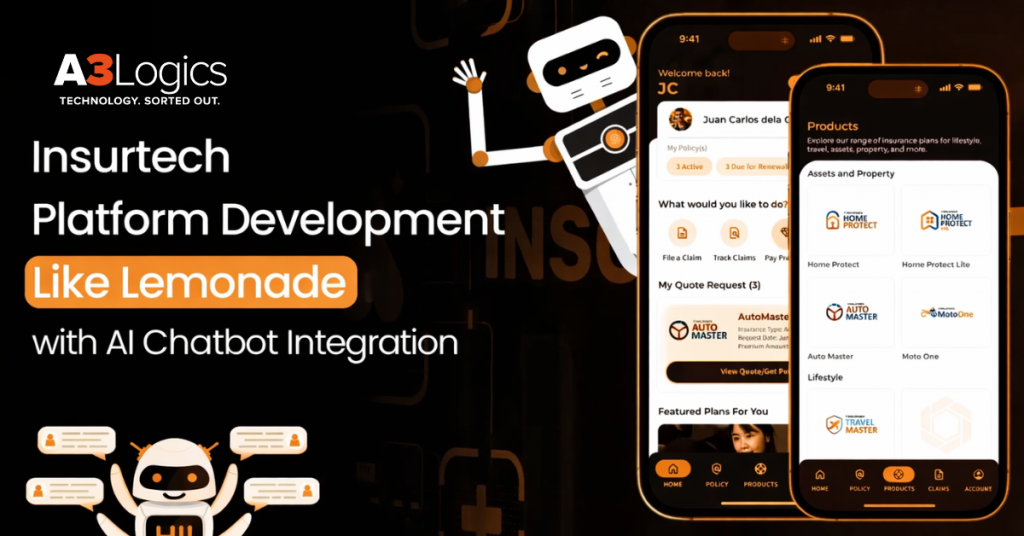
An Insurance app like Lemonade is indicative of a contemporary, digitally-focused strategy that aims at eliminating the friction in customer interactions. Simplicity, transparency, and customer empowerment are the core of Lemonade’s mission. Through the app, users can easily manage renters, home, pet health, and term life insurance, mostly by using conversational interfaces.
In contrast to conventional insurers, insurance app like Lemonade emphasize on providing customers with seamless self-service experiences only. That is why they give customers the ability to obtain coverage, adjust policies, and file claims within a few minutes.By using artificial intelligence at every step from the very first contact to the final claim settlement, Lemonade has set a completely new level of convenience and user satisfaction.
What is the Lemonade Platform?
Knowing how insurance app like Lemonade works internally and externally is essential if you want to build an Insurtech platform like Lemonade. The infrastructure used by Lemonade is scalable and cloud-based, which allows for quick data processing, safe policy management, and efficient automation. Besides, the company has adopted a peer-to-peer–style model that basically puts policyholders with similar features in a group, thus, helping to lower the instances of fraud and increase the trust levels in risk pools.
Lemonade relies heavily on big data analytics to understand user behavior, claims history, device data, and other public sources. The company also uses behavioral economics principles in its platform which, among other things, promotes honesty and fairness and makes the claim process easier. All these elements, in concert, make up the digital operational environment of Lemonade.
Key Features of the Lemonade Platform
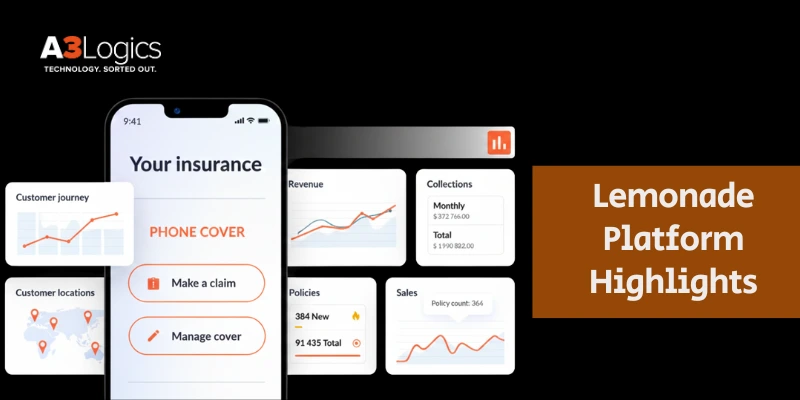
If you’re looking to build an Insurtech platform like Lemonade, these are the essentials your product must include.
1. AI Integration (Chatbots + Underwriting + Claims)
Artificial Intelligence is what keeps Lemonade running smoothly from the very beginning of the customer lifecycle to the detection of fraudulent activities.
- AI Chatbot Functions
- Quote generation
- Policy recommendations
- Conversational onboarding
- FNOL (First Notice of Loss) handling
- Coverage explanations
An AI chatbot that is fully integrated helps to lessen the work that is traditionally done by humans, hence the workload, while at the same time creating a better customer experience.
2. Instant Claim Settlements
Lemonade set a new industry standard by processing a claim in three seconds, and this is what everyone is now expected to emulate. Your platform should include:
Automated document verification
- Fraud probability scoring
- AI-powered image recognition
- Straight-through processing (STP)
- Real-time disbursal workflows
Not only does this put a smile on the face of the customers, but it also helps in reducing claims leakage and the company’s operational costs.
3. Behavioral Economics for Fraud Prevention
Lemonade utilizes behavior science concepts such as “honesty pledges” and “social framing” to help stop fraud from happening.
An insurance portal development for an insurance app like Lemonade can replicate this through:
- Ethical UX prompts
- Transparent claim declarations
- Peer-group-based risk pools
- AI-driven fraud signals
The main benefit of this is that it helps to lower the amount of manipulation that takes place and, at the same time, increase the trust level.
4. Mobile-First User Experience
Your Insurtech platform is obliged to be very efficient (fast), user-friendly (simple), and touch-friendly and thus should offer:
- 60-second quote flows
- Tap-to-file claims
- Instant policy issuance
- Renewal push notifications
- Seamless payment integrations
Lemonade’s achievement is basically through the removal of points of interaction, thus your app should be equally concerned.
5. Reinsurance-Backed Financial Model
Just to mention a few, reinsurance ensures stability by passing parts of the risk to big reinsurers like:
- Swiss Re
- Munich Re
- Hannover Re
Automatic reinsurance trigger integrations should be present.
Key Market Takeaways for Insurtech Platforms
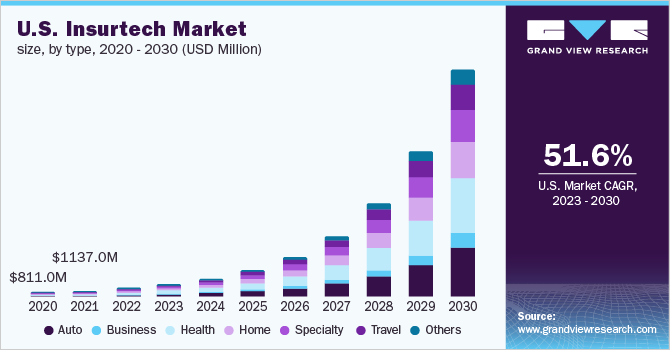
The worldwide Insurtech industry is changing rapidly and will be worth nearly $9.5 billion in 2025 and is expected to reach nearly $42.8 billion by 2035 with a strong CAGR of 20.6%. The main factors for the growth are digital adoption and the increasing venture capital funding. AI is the main factor of the growth in the AI-in-Insurtech market that is increasing from 4.9 billion dollars in 2024 to 60.8 billion dollars by 2034 at a CAGR of 27.6% as the use of AI by the insurers helps them to have claims processing 50-75% faster, fraud detection more accurate, and cost savings up to 20%.
Younger generations are fast-tracking this transition – Millennials and Gen Z are responsible for 85% of insurance sales while 80% of them prefer digital-first insurance. Researches reveal that 32% of Millennials and 16% of Gen Z find it easy to buy AI-powered insurance which makes AI-driven Insurtech platforms an obvious competitive advantage.
Business Model of the Lemonade Insurtech Platform
1. Flat Fee Model
Insurance app like Lemonade implements a business model with a flat fee approach by charging a fixed percentage as a fee of customer premiums, which makes the revenue model transparent and predictable and differs from those of traditional insurers who focus on underwriting profits.
2. Reinsurance Model
Most of the premiums collected are transferred to reinsurance partners. This lets insurance apps like Lemonade reduce its risk exposure, stabilize its operations and ensure financial results that are predictable.
3. Social Impact (Giveback Program)
With the help of the Giveback program, Lemonade donates the leftover premiums to the charities that the users select.Thus, it helps build trust and positions the brand as a purpose-driven one which is an approach that appeals to the socially conscious Millennials.
4. Highly Automated Operations Drastically Cut Operational Expenses
By utilizing AI bots such as “AI Maya” and “AI Jim,” Lemonade is able to use technology to carry out functions such as underwriting, fraud detection, and claims processing. This, in turn, greatly cuts the company’s payroll costs and expedites its operations.
5. Underwriting and Data Analytics
Insurance app like Lemonade take a broad range of behavioral data with an aim to pinpoint the most accurate and reliable data sources for underwriting. AI-based analytics also help determine risk patterns, locate potential fraud scenarios, and decide on the appropriate pricing that leads to increased profits in general.
Popular Apps Like Lemonade
1. Next Insurance

Next Insurance primarily focuses on small businesses and is providing fast, digital-first, and customized policies for contractors, freelancers, and service providers. With AI underwriting and instant certificates of insurance, it is quite similar to Lemonade in terms of customer convenience.
2. Metromile

Metromile is a leader in pay-per-mile automobile insurance that is powered by telematics. Its app not only keeps track of mileage but also evaluates the driver’s habits and, in result, gives them the most suitable prices, thus becoming the best Insurtech platform for low-mileage drivers.
3. Root Insurance

Root determines its insurance rates through driving behavior analytics done via smartphone.The company aims to reward safe drivers only by getting rid of the traditional demographic-based pricing, thus paving the way for a modern, mobile-first experience.
4. Oscar Health

Oscar contributes to the health of the society by introducing tech-driven health insurance that includes virtual care, telemedicine, and AI-powered member support. The company largely concentrates on personalized recommendations and an easy-going digital experience.
5. PolicyGenius

PolicyGenius is a major online insurance marketplace committed to helping people in comparing different policies across various carriers. The AI-driven tools make it easy for users to decide on coverage options suitable for their needs.
6. Hippo Insurance
Hippo is the smart choice for home and homeowners insurance that comes with IoT sensors and AI monitoring for the home’s safety. By integrating prevention tools with a quick claims process, Hippo is lowering the risk while building customer loyalty.
7. Embrace

Embrace concentrates on pet insurance with flexible plans, mobile claims, and fast reimbursements. It is mainly focused on convenience and affordability, thus, making pet insurance easily accessible.
8. Kin Insurance

Kin offers home insurance that is particularly designed for areas affected by climate change.It accurately prices the policies with the help of real-time data and predictive analytics and also makes the process easy for people living in disaster-prone areas.
9. Branch Insurance

Branch is the instant solution when it comes to bundled home and auto insurance verification, powered by AI. Its main objective is to cut down the expenses through faster underwriting and less customer onboarding.
10. Lemonade (Benchmark)

Lemonade is an industry leader thanks to its use of AI-driven underwriting, instant claims, behavioral economics, and a flat-fee model. It is still the standard Insurtech platform that offers speed, automation, and transparency.
Why Do Entrepreneurs Build Insurance Apps Like Lemonade?
1. Seamless Customer Experience
Lemonade demonstrates that insurance is not something to be complicated. Entrepreneurs mimic this template so as to provide user-friendly, mobile-first experiences that are attractive to customers who are digitally proficient.
2. Quick Claim Processing
AI in insurance claim management is what makes approvals possible within seconds. Entrepreneurs want to do away with long and tedious manual claim cycles so as to have a competitive advantage and increase customer trust.
3. Fair & Transparent Pricing
The flat-fee and clear pricing structure of Lemonade is what made the entrepreneurs build the insurance apps that do not have hidden charges and are in line with customer-friendly models.
4. Innovation & Data-Driven Insights
The present Insurtech solutions can only be effective if they generate valuable data. This data includes risk behavior, user patterns, fraud signals, and by using this data the companies can innovate faster and make more intelligent decisions.
5. Brand Differentiation + Social Impact
The Giveback Program is an example of how social good can be integrated into your business model. The startups decide to implement similar strategies as a way to establish a purpose-driven identity.
Unique Features of an Insurance App Like Lemonade
1. Seamless Onboarding
Quick sign-up procedures, automated KYC, and instant data retrieval take out the long-form parts, thus normal users can be allowed insurance in a matter of minutes.
2. AI-Powered Chatbot
By means of natural language processing, AI chatbots walk users through the stages of: policy selection, claims submission, and customer support, thus the need for human staff is reduced and response time is accelerated.
3. Personalized Policy Suggestions
Artificial intelligence algorithms consider customer data such as location, lifestyle, and risks to provide the most suitable insurance coverage, thus accuracy and customer satisfaction are improved.
4. Instant Policy Purchase
Customers have the opportunity to get a quote, modify their coverage, and buy the policy right away together with the automated generation of documents.
5. Video-Based Claim Filing
Clients may take a brief video expressing their claim, thereby helping the insurance companies to acquire the evidence promptly and deter the fraudulent activities.
6. Real-Time Claim Tracking
Users can keep track of their claim status through interactive platforms and receive immediate updates without the need to frequently contact support.
7. Gamification Elements
Incentive frameworks, micro-interactions, and catchy UI components transform the insurance world into a more approachable one and also motivate users to stay engaged consistently.
8. Social Impact Integration
One such feature as the option of giving the unused premiums to a charity creates an emotional connection facilitating loyalty building and strengthening of brand values.
9. Data Visualization & Insights
Present simple dashboards showing coverage, claims, and premium trends which help users to understand insurance data and also empower insurers with the most valuable insights for quick and efficient decision-making.
10. Blockchain for Security
Records implemented are immutable policy and claims, fraud is reduced, and smart contracts can be used for secure, automated, and transparent insurance transactions.

Can Insurtech Platforms with AI Chatbot Integration Be Profitable?
1. Reduced Operational Costs
AI chatbots take over customer support, onboarding, policy updates, and claims intake, thus significantly decreasing employee-related costs and making the overall operational process more efficient.
2. Automation means Higher Margins
Automated processes, such as underwriting, fraud checks, and claim decisions, that are performed without human intervention, reduce the amount of manual work and thus help Insurtech platforms keep healthier profit margins.
3. Faster Claims → Higher Customer Satisfaction
Immediate claim responses and expedited approvals result in a better customer experience, which leads to higher retention and stronger brand loyalty.
4. Upselling Opportunities
Artificial Intelligence studies the user’s habits to offer add-ons, coverage upgrades, and cross-sell recommendations when the user is most willing to buy, thus increasing the revenue per customer.
5. Better Fraud Detection Using AI
Insurance fraud detection automation using machine learning models can detect irregularities, alert patterns, or even anticipate certain scenarios, thus helping the fraud department to be proactive, not reactive, and minimize fraudulent losses which improves the bottom line.
6. Scalable Digital Operations
Insurtech platforms that are cloud-native can easily ramp up their capacity without needing a big operational team thus they can support long-term growth with less overhead.
Other Popular Insurtech Platforms with AI Integration
1. Metromile – Mileage-Based Auto Insurance with AI Telematics
By leveraging telematics and AI, Metromile adjusts the insurance price by only taking into account the exact number of miles driven, thus offering customers personalized and fair premiums.
2. Insurify – AI-Powered Insurance Comparison
Insurify solves the problem of users comparing various insurance options by providing AI-driven recommendations; thus making the decision process easier and more accurate.
3. Geico – AI Virtual Assistant “Kate”
Kate is Geico’s virtual assistant that helps customers find answers quickly, provides policy details, and assists with billing – the customer experience is improved by 24/7 support.

Development Steps for an Insurtech Platform with AI Chatbot Integration
1. Define Business Objectives & User Needs
The first step before you build an insurtech platform like Lemonade is to understand the insurance product, target audience, and value proposition that would be the platform’s central idea.
2. Choose the Right Tech Stack (AI, Cloud, Backend, Mobile)
Identify the technology components and tools needed to deliver solutions for chatbot development, server-side logic, cloud hosting, and mobile app frameworks.
3. Develop Strong Data Management & Security Protocols
Implement a wide range of measures aimed at the safe handling of highly sensitive insurance data. In doing so one should use encryption, access control, and compliance frameworks.
4. Build AI Chatbot Using NLP + Predictive Analytics
Develop conversational AI that will be able to understand the queries of users, give them the necessary information, guide them through the claim process, and also be able to recognize the fraud situations.
5. Integrate Core Insurance Functionalities
It is advisable that the company link together underwriting, policy management, payments, document processing, and claims through a single unified system.
6. Design a Simple & Intuitive UI/UX
Develop a user-friendly interface that comes with – easily accessible buttons, straightforward onboarding, and easy-to-understand information about policies.
7. Set Up Analytics, Performance Monitoring, Fraud Detection
Install resources like dashboards, behavioral analysis, and monitoring tools that will support performance optimization and anomaly detection.
8. Test, Refine, and Launch the Platform
Carry out detailed QA, ensure compliance with all regulations, polish chatbot interactions, and release the platform for public use.
Factors Affecting the Cost of Developing an Insurtech App
1. AI Chatbot Complexity
The money increases proportionally to how sophisticated your chatbot is – for instance, a simple rule-based bot will cost less than an NLP-driven conversational AI that interacts with claims processing, fraud detection, and underwriting support, thus, requiring a deeper development.
2. Data Integration Requirements
Connecting the application to policy databases, claims systems, third-party APIs, telematics, payment gateways, and CRM platforms increases both the time and the complexity of the development process.
3. Security & Regulatory Compliance
Insurance applications have to meet very strict requirements such as GDPR, PCI-DSS, HIPAA (if the application is related to the health sector), and state-specific regulations for the insurance industry. The work of ensuring encryption, access control, and audit logs will definitely require more development work.
4. Cloud Infrastructure
The choice of scalable cloud hosting (AWS, Azure, Google Cloud) influences the price that varies depending on the factors such as the amount of storage needed, server load, AI compute, and disaster recovery configurations.
5. Third-Party Integrations
Integration like identity verification (KYC), payment processors, reinsurance systems, telematics, or document-scanning APIs can increase your initial costs as well as the fees that you will be required to pay regularly.
6. Continuous Learning & AI Improvements
The constantly evolving features of AI require that the model be regularly trained, supervised, and updated, which means that the maintenance costs will be higher with time.
7. Development Team Size & Region
The price for creating an insurtech app similar to lemonade varies significantly depending on the location of the team: the US, Europe, or Asia. A larger team and more experienced AI engineers will definitely increase the overall development costs.

How Much Does It Cost to Make an Insurance App Like Lemonade?
1. Cost by Complexity
Simple insurance app will cost you less, but they come without AI automation.Fully automated apps similar to Lemonade, which feature instant claims and AI underwriting, are a necessity for larger budgets.
2. Platform (iOS/Android)
It will take more time to develop two native apps— one for iOS and another for Android. You can choose to develop cross-platform to save money but it will have limitations.
3. Design & UX
Innovative onboarding, gamification, animations, policy dashboards, and claim flows are some of the many things that an expert UI/UX designer will have to do in order to make your app user-friendly, and as a result, your cost will go up.
4. Backend + AI Development
The backend is the part that handles the following: underwriting, claims workflows, policy creation, user data, fraud detection, and chatbot intelligence, thus, it is the most extensive component of the cost to build an insurtech app like Lemonade.
How Do Insurance Apps Like Lemonade Make Money?
1. Flat Fee Model
Lemonade charges a fixed percentage of the premiums as its revenue, which makes the whole operation very transparent and free from any conflict of interest.
2. Reinsurance Partnerships
Most of the premiums are being sent to the reinsurance partners, thus, the insurers can grow their business without the need to take heavy financial risks.
3. Data-Driven Insights
The apps collect data on risk behavior, claims history, and customer trends to fine-tune their pricing and lower their losses which in turn leads to higher profits.
4. Customer Loyalty & Upselling
Good experiences and instant support are two factors contributing to the loyalty of customers, whereas AI suggestions are great for cross-selling and up-selling new coverage options.
5. Investment Income
Without a doubt, the most common thing for the insurers to do is to invest the float (premium reserves), thus, they are able to generate additional streams of revenue.

In Conclusion
It takes the right combination of automation, artificial intelligence, data analytics, and underwriting logic to create an insurtech app like Lemonade. Companies investing in AI chatbot integration, instant claims processing, secure cloud infrastructure, and customer-centric design stand a good chance of building digital insurance platforms that are not only highly profitable but also scalable.
How A3Logics Can Help?
As a leading Fintech App Development Service provider A3Logics offers:
a. Expertise in AI-Powered Insurance Solutions
A3Logics is the right partner to develop advanced AI-driven platforms for claims automation, underwriting, customer experience, and fraud detection as it has been in this field for years.
b. Custom Insurtech Product Development
We design and develop insurance apps that fit your business objectives, target market, and comply with regulations.
c. NLP Chatbots for Underwriting & Claims
Our smart chatbot development services can perform FNOL, claims triage, customer support, and answer policy-related questions; resulting in increased productivity and reduced expenses.
d. Compliance-Ready Architectures
We guarantee that your application will be compliant with the industry regulations concerning data privacy, insurance compliance, and security standards.
e. End-to-End Development & Maintenance
From the creation of the idea, through the execution, to the ongoing improvement stage, A3Logics is with you every step of the way with your Insurtech product.