
Insurers worldwide are facing increased cost pressures. To cope with the workload, almost 65% of commercial insurers have already adopted artificial intelligence (AI) into their underwriting processes by 2025. The craze for AI is so high that the AI in the insurance market will see a 27.32% hike in the upcoming years from 2026 to 2033.
As premiums and claims volumes continue to increase, cost reduction in insurance underwriting is critical to an organization’s success. AI and automation aid in this cost reduction by almost 40%. In this blog, you will get a detailed understanding of how AI is making such claims possible.
The True Cost of Traditional Underwriting
When an insurance company used to underwrite a policy earlier, it would do so through a manual data collection/verification process. Traditional underwriting is very strenuous and human-oriented. The layer of work and labor dependency makes the traditional process costly.
1. Manual Data Collection & Verification
The manual data collection and verification process typically requires a lot of time to complete. So, many potential customers will have to wait for the final approval. This results in decreased customer satisfaction and creates potential for loss of customers.
2. High Operational & Labor Costs
Many insurers employ large teams of underwriters to manually review every application. Many times, multiple underwriters will review the same application prior to making an approval decision. The costs associated with employing many underwriters will be more costly to the insurer.
3. Slow Turnaround Time (TAT)
The multiple document checks and approvals, as well as the number of communications that take place between an insurer and a potential policyholder, will result in a longer TAT. Because of the slow turnaround time, customers will be less satisfied and may abandon the process due to the long wait for obtaining the policy.
4. Error Rates & Rework
With human involvement, the chances of mistakes like incorrect data entry, misjudged risks, and overlooked documents can increase. These errors then lead to rework or correction, which again increases the cost factors.
5. Limited Scalability
In the traditional system with an increasing number of applications, stress occurs on the existing manpower. The insurer then cannot provide on-time claim processing and settlements. This lack of scalability can also harm the company and its growth.
What is AI-Driven Underwriting?
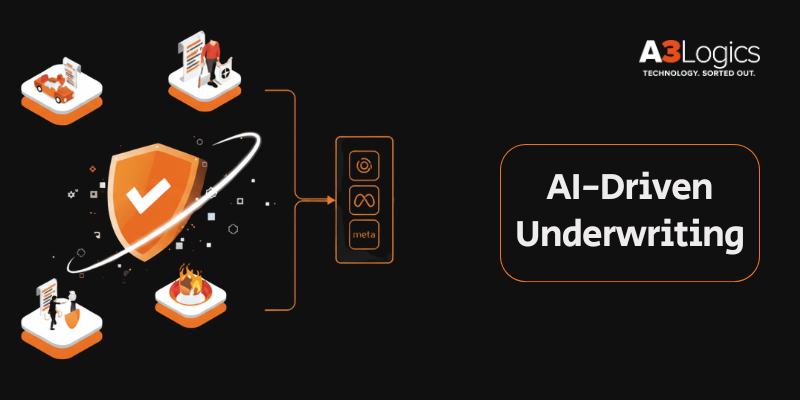
AI-driven underwriting is a quicker and more accurate way to automate the traditional manual underwriting process. It uses artificial intelligence (AI) and machine learning (ML) technology on a massive scale.
1. Key Technologies
- AI and ML Models: These are algorithms that can learn from historical data sets of underwriting to identify patterns to assess risks and predict future outcomes.
- OCR and NLP: OCR converts printed documents into digital text, and NLP provides structured data from the information in free text.
- Predictive Analytics: This technique uses data analysis to predict the likelihood of risk and claims.
- Gen-AI-based Underwriting Assistance: The use of generative AI tools will help an underwriter by summarizing the documents, identifying any anomalies, and suggesting a decision for the underwriting process.
2. How It Works?
At first, AI in underwriting makes the document ingestion process fully automated. This means insurance companies will upload scanned underwriting forms, KYC documents, medical history, and claims history for conversion. Once the documents are scanned, the OCR and NLP will automatically convert them into data fields. ML models will calculate and assign a risk score for the applicant in real time, generating either a risk score or a recommendation for decision-making.
Lastly, the use of intelligent decision support tools will allow for seamless integration into existing insurance systems and enable immediate approvals and/or human review for more complicated cases.
How AI Helps Insurers Reduce Operational Costs by 40%
Automation of underwriting processes has led to the largest cost savings across the insurance industry. Up to a 40% cost reduction in insurance underwriting becomes possible simply by automating the underwriting process.
a. Automation of Document Processing
By automating document processing using OCR, NLP, and other technologies, insurance companies will be able to reduce insurance operational costs. With the aid of automation, insurers have significantly decreased manual efforts to handle documents by up to 80%. As much as 50% of the work that previously required a human being for completion can now be completed by automated means (Source).
b. Reduction in Underwriting Cycle Time
The application processing time for AI-based underwriters is only a few seconds or minutes compared to traditional underwriting cycles that can take days or even weeks. With AI-assisted underwriting, there is no longer any need for insurers or underwriters to wait for manual assessments.
c. Improved Accuracy → Lower Rework & Errors
With the assistance of machine learning (ML), AI-powered models apply the same standard principles consistently throughout the entire process. Because of this consistency and lack of error, the insurers can aim for underwriting cost optimization. Some insurers estimate that they experienced a 31% reduction in the amount of time needed for the rework due to AI-driven underwriting methodology (Source).
d. Smart Risk Scoring & Prioritization
AI will automatically eliminate applications that present little or no risk to insurers. Underwriters will only evaluate the most complex or high-risk cases, reducing the number of cases underwriter review. This filtering of applications allows underwriters to take on a larger volume of cases with an average 35% more accuracy (Source).
e. AI-Powered Fraud Detection
AI helps to detect fraud cases before processing an application/claim. This decreases the risk to the insurer of issuing a policy to an applicant who has the potential to commit fraud. Many insurance companies are reporting as much as 28% lower loss leakage and fewer false positive results associated with the detection of fraud.
f. Enhanced Productivity for Underwriters
Underwriters can utilize generative AI to efficiently summarize lengthy documents, compare the history of applicants, and help make decisions. This means that underwriter productivity increases significantly due to generative AI, allowing each underwriter to process 3 or 4 times (3-5x) more cases than they previously processed.
Breakdown: Where the 40% Cost Reduction Comes From
Identifying potential savings tells us where cost-reduction methods exist. To understand how AI reduces underwriting costs, you will have to note the key ways it works.
1. 15–20%: Automation of document workflows
First, automating the management of document workflows results in approximately 15-20% in savings. Automating the extraction of routine data (KYC verification, intake of medical reports) provides savings to insurers through reductions in labor expenses.
2. 10–15%: Reduced manpower requirements
A reduction in the number of employees required for underwriting results in cost savings of between 10% and 15%. Computer-based systems allow for the processing of greater volumes of business through the use of AI.
3. 5–10%: Lower error and rework-related costs
The use of machine learning (ML) provides insurers with the ability to be more consistent in their decision-making. By reducing the number of reworks, insurance compliance and correction costs, insurers can reduce 5% to 10%.
4. 10–12%: Fraud detection and prevention
The detection and prevention of fraud can lead to savings of between 10% and 12%. By identifying potential fraudulent applications, the insurer can minimize the potential for large losses and reduce the amount of payment leakage.
5. 5–8%: Faster cycle time, better application throughput
Accelerated cycle time and higher levels of application throughput yield savings between 5% and 8%. A faster turnaround time for risk score generation and policy issuance means a quicker underwriting process. A higher rate of business processed per underwriter means reduced per-policy overhead costs.
These savings add together to create a total savings to the insurer of approximately 40% for their total operating costs. This helps insurers to create and maintain underwriting efficiency with AI.
Technology Components Enabling Cost Reduction
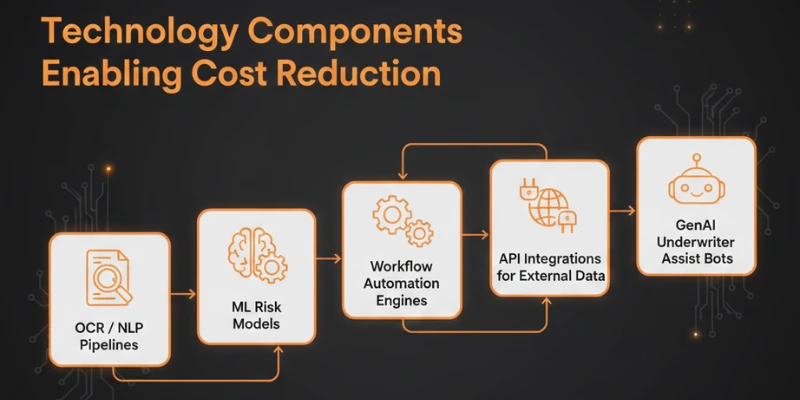
Different technologies are involved to make the entire insurance process automation run smoothly. With the perfect synchronization of different AI, NLP and ML models, the system eventually proves to be cost-effective for the insurer.
1. OCR / NLP Pipelines
These technologies allow the automation of scanning and digitizing of all documents that need to be scanned and digitized. They will also allow for the automatic extraction of data from structured data fields.
2. ML Risk Models
Machine-learning models use actual historical claims and underwriting data to learn risk behavior patterns. They identify errant behaviors and provide risk scores in real time.
3. Workflow Automation Engines
These engines facilitate all aspects of processing job applications, including: managing assignments, initiating/approving status changes, and interfacing with back-end systems.
4. API Integrations for External Data
API helps to gather data through credit reports, employment history, financial information, fraud watch lists, and medical records. This increases the amount of information used to evaluate the risk of a case.
5. GenAI Underwriter Assist Bots
Generative AI Bots assist underwriters with case documentation by providing summaries, identifying the presence of red flags, and making decision recommendations.
The combination of these components creates an integrated AI underwriting workflow. This helps underwriters to work smarter, faster, and more accurately.

Implementation Roadmap to Achieve 40% Savings
Insurers should take a structured and phased approach to implementing AI Underwriting and should work closely with all stakeholders during the rollout of the AI Underwriting.
a. Underwriting Workflow Assessment
Assess the current state of your underwriting operations, from start to finish. Identify where problems exist, gaps in workflow, excessive manual steps, and errors on both the part of the underwriter and the insurer.
b. Define Automation Opportunities
You will need to determine where the best opportunities exist for automation through document ingestion, data extraction, and risk rating. Prioritize items for automation based on volume and the repetitive nature of tasks.
c. Deploy AI Models for Risk Scoring
Create or purchase AI models from an AI development company and feed your historical data. Assess its outcomes regarding validation of performance, instances of bias in the model, and compliance with various regulations.
d. Integrate OCR/NLP Document Automation
Implement pipelines for digitizing and parsing various types of documents from the client. Make sure that this data extraction and mapping run smoothly with all sorts of data, structures, semi-structures, or informal data.
e. Launch Pilot for One Product Line
Launch a pilot for an easy and established product line, such as term-life or auto-insurance. Then you can test its accuracy, TAT, error rates, productivity, and coordination with the underwriter before actual integration.
f. Full Rollout + Optimization
Finally, continue to roll out the implementation of automation through all existing product lines. Then, constantly monitor to optimize workflow, refine your automation logic, reduce errors, and increase throughput.
Key Challenges & Solutions
Despite the potential cost savings associated with AI-based underwriting, there are a few challenges that you may have to face. Note the challenges to mitigate them better.
1. Legacy System Integration
Many insurance companies still operate on legacy PAS/CRM systems that can make it difficult to integrate an AI pipeline into existing workflows. It may take a significant investment in IT resources to complete the necessary changes. The most effective recommendation is to find a modular, API-based automated solution and begin with pilot projects.
2. Data Quality & Model Bias
Loads of contradictory historical data can confuse the model, leading to incorrect assessment and losing the client. So, clean unnecessary historical data and validate that the data and underlying assumptions are accurate prior to training an ML model.
3. Regulatory Compliance Requirements
Insurance regulators expect insurers to operate transparently and fairly. Automated underwriting solutions may also come under scrutiny. Therefore, it is essential to have a “human in the loop” when underwriting sensitive and/or high-risk cases.
4. Workforce Adoption & Change Management
The adoption of AI underwriting workflow by the existing workforce can take time and may even face resistance. Hence, insurers should provide training for staff working on AI, demonstrate increased productivity in complex underwriting and fraud investigations to keep them motivated.

How A3Logics Helps Insurers Reduce Costs by 40%
When insurers seek qualified professionals to assist in the cost reduction in insurance underwriting, A3Logics offers complete support.
As a supplier of AI-powered underwriting platforms with custom AI engines, they provide their customers with the tools necessary to perform the automation. Also, they offer OCR + NLP document automation solutions, currently for improved underwriter productivity. Their systems are capable of extracting information from documents with high levels of accuracy, then automatically mapping that information to PAS/CRM systems.
A3Logics also provides GenAI assistance to improve productivity. Using their GenAI, you can make case summaries, compare recent documents with existing ones, and get recommendations for further actions.
You also get end-to-end integration and strategic AI consulting to insurers. With their help, you can better perform insurance fraud detection automation. With such solutions, insurers partnering with A3Logics can seamlessly reduce their insurance operational cost by 40%.

Conclusion
In conclusion, the transition to an AI underwriting workflow is crucial for insurers to limit unnecessary expenses and meet customer demands. This allows better operational efficiency and scalability. With the right set of skills, technology, and a knowledgeable AI insurance software development services company, you can act faster towards innovation in insurance underwriting.