
Insurance companies are primarily dependent on data: policies, claims, reports, assessments, and forms. But with thousands of documents coming in every day, the process of manually extracting accurate information is not only time-consuming but also expensive and prone to mistakes. To meet this challenge, insurers have turned to modern data extraction technologies, which help them to process information, automate workflows, and enhance decision-making. In fact, the use of AI data extraction in insurance is a big step forward – insurance document extraction technologies, in essence, provide a safe and efficient way of handling the huge amount of data and documents insurers deal with.
AI data extraction in insurance delivers dramatic accuracy and efficiency gains. Modern intelligent document processing (IDP) systems can achieve up to 99% data extraction accuracy and enable up to 10 times faster document processing compared to manual methods, significantly reducing error rates and turnaround times. So, let’s see why insurance data extraction automation is so important and how insurers can put it into practice.
Why Insurance Data Extraction Is Challenging — And What You Can Do About It
1. Underwriting Delays
One of the main problems for underwriters is the lack of data, which is often hidden deep inside PDFs, scanned forms, or handwritten documents. Slow extraction brings about the increase of the turnaround time and also the impact on quote accuracy. The insurance data extraction automation is an effective way of quickening risk assessment with the result of more accurate pricing.
2. Claims Leakage
Errors in manual claims data entry, such as missed fields, incorrect values, and overlooked red flags, cause significant leakage. However, a fully automated system drastically reduces errors and ensures consistent workflows for claims adjusters.
3. Audit Stress
Audits require that the documentation should not only be complete and accurate but also well-organized. When data is unorganized and stored in different systems, audits become stressful and time-consuming tasks. Properly structured extraction is, therefore, the only way to ensure clean, compliant, and easily retrievable records.
4. Loss of Customer Loyalty
As always, customers want to be given a fast quote and have their claims decided quickly. Data delays are the reason for slower services thus leading to customer churn. On the other hand, the automation of the process is a great way of speeding up the response time, which in turn has a positive effect on customer experience and retention.
5. High Volume of Unstructured Documents
The insurance sector is what most of the time deals with various formats such as PDFs, images, handwritten notes, and emails that cannot be processed by traditional systems. What NLP-enabled extraction does is it takes unstructured data and immediately turns it into usable, structured formats.
6. Legacy System Limitations
On the other hand, a lot of carriers are still dependent on old systems that are not capable of handling modern data formats. The use of AI data extraction in insurance may be a solution as they serve as a bridge with which integration with core platforms like Guidewire, Duck Creek, and Sapiens is possible.
What Is Insurance Data Extraction?

Insurance document extraction automates capturing, organizing, and validating document data. As a result, insurers can use this data for underwriting, claims, compliance, and analytics.
The development of the four essential core technologies to the modern insurance market is as follows:
1. Optical Character Recognition (OCR)
OCR works to a great extent on insurance data automation in paper-based industries by transforming the already hard copy of the records (scanned documents and images) to be in a machine-readable text version.
2. Natural Language Processing (NLP)
NLP recognizes the context, gets entities (like names, dates, claim numbers), and gathers the data from the nonstructured text such as adjuster notes or medical reports.
3. Machine Learning (ML)
ML models identify patterns in documents, get better and more accurate as time goes by, classify documents, and are able to detect the inconsistencies or the fraud scenarios.
4. Business Rules Engines
The rules engine checks the data gotten from the extraction process with the underwriting and claims guidelines to then create the workflows, alerts, or decisions that it visualizes.
These are the technologies that, when used collectively, have the potential of completely eradicating manual data entry from the insurance sector and fasten all other major processes.
Core Document Types Extracted in Insurance
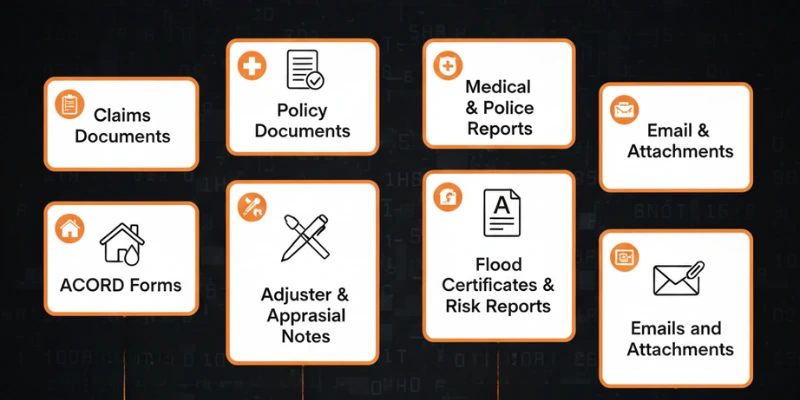
AI data extraction in insurance is very flexible in terms of the different types of documents that they can handle in areas like underwriting, claims, compliance, and customer service.
1. Claims Documents
FNOL (First Notice of Loss), estimates, invoices, claim forms, repair bills, and photos are some of the documents that can be extracted and then the data can be routed into systems designed for handling claims.
2. Policy Documents
Declarations pages, endorsements, binders, coverage schedules, renewal forms, and applications are all parsed with the help of a machine automatically for subsequent processing.
3. Medical & Police Reports
These are the most important documents for the cases of auto, health, workers’ compensation, and liability claims—NLP extracts injuries, diagnoses, accident details, and timelines.
4. Adjuster & Appraisal Notes
Whether they are handwritten or typed notes, phone logs, and field assessments are all converted into structured data with the sole purpose of supporting claim decisions and audits.
5. Flood Certificates & Risk Reports
AI data extraction in insurance specifically for insurance underwriting & risk assessment not only drags the hazard data out but also location information, risk classifying, and compliance fields that are very necessary for the accurate underwriting.
6. ACORD Forms (e.g., 125, 127)
The role of insurance data extraction automation is there to completely do away with manual typing as well as to prevent errors that are very costly as far as complex standardized forms that have dozens of fields are concerned.
7. Emails and Attachments
With the help of AI, the process of email management can be made much easier by extracting key details from emails, request threads, customer communications, and any attached files for the purpose of faster response and case resolution.
Manual vs. Automated Insurance Data Extraction
1. Speed Comparison
Manual data entry might last from a few minutes to several hours per document, especially if the documents are related to complex claims or policy forms. On the other hand, AI data extraction in insurance can handle the same volume in a matter of seconds which is why real-time decisions can be made using AI in underwriting and claims.
2. Accuracy Comparison
The input by a human can be a mistake due to tiredness, carelessness, and inconsistency. AI data extraction in insurance applies OCR, NLP, and ML to achieve the accuracy level of 95–99% and above which is basically for ensuring precise and reliable data for downstream workflows.
3. Cost Differences
It costs a lot to have teams for data entry, QA, and verification. AI data extraction in insurance is a major factor in cutting down labor costs thereby allowing the rest of the skilled staff to concentrate on the review and decision-making which they do not have to type.
4. Compliance and Audit Impact
Manual workflows are a recipe for missing fields, losing documents, and holding records inconsistently. The use of automation ensures that the structured templates are followed and complete audit trails are created—very important during regulatory reviews.
5. Scalability in High-Volume Environments
In the case of catastrophe events or seasonal peaks, the manual teams cannot be scaled up to a higher level while the insurance data automation can be scaled up at any time to process thousands of documents per hour without any interruption.
Why Insurance Data Extraction Matters in 2025–26
1. Increasing Data Complexity
The insurance companies are holding the responsibility of handling even more types of documents which are photos, scanned forms, emails, PDFs, IoT feeds, etc. Thus, manual processing is out of the question when it comes to a large scale.
2. Rising Fraud Cases
There are three main fraud scenarios to be pointed out, i.e., synthetic identities, inflated invoices, and tampered documents. The best way to detect these frauds is to use insurance fraud detection automation along with AI that can alert the anomalies before the money is handed over.
3. Tightening Compliance Expectations
Regulators expect full traceability, accuracy, and instant reporting from the organizations. AI data extraction in insurance assists in abiding by these regulations consistently for both policies and claims.
4. Customer Expectation for Faster Decisions
The policyholders are the ones demanding immediate quotes and the approval of the claim in the same day. The main reason decision cycles are done very fast is because of automated extraction.
5. AI-Powered Competition in the Insurance Market
Insurtechs and just digital carriers are the ones who are setting the new standards of efficiency. Traditional insurance carriers have to either follow the automated workflows or be threatened with losing market share.
Why CEOs, CFOs & COOs Should Care About Insurance Data Extraction?
1. Operational Cost Reduction
By employing automation in handling repetitive tasks, the company is able to save on operational costs in different departments including underwriting, claims, and back-office.
Read more about the role of AI in helping insurers reduce underwriting costs.
2. Faster Time to Decision
The bottlenecks are removed as a result of real-time document processing, thus the time needed for giving the quote, settling the claim, and customer satisfaction is improved.
3. Better Risk Accuracy & Fraud Detection
The better the input data, the more accurate the risk scoring models will be and also the fraud analytics will be stronger thus the leakage and loss ratios will be reduced.
4. Compliance & Audit Readiness
With insurance data extraction automation, every document is saved, indexed, and checked–making the process of auditing easy and compliance penalties lower.
5. Improved Customer Experience
Quick processing is the cause of customer journeys being smooth–from onboarding to claim settlement–which, in turn, increases loyalty and retention.
Why Legacy Systems Can’t Handle Insurance Data Extraction Today
1. Limited Unstructured Data Processing
Legacy systems are not designed for handling content such as PDFs, images, emails, or handwritten forms which makes them inadequate for modern workflows.
2. Lack of AI Capabilities
Traditional platforms don’t have the features of OCR, NLP, and ML which are essential for the smart understanding of the documents.
3. Poor Integration Flexibility
The older systems are not able to connect easily with the modern APIs, data lakes, or cloud engines which causes the slow down of the transformation process.
4. Slow Performance Under High Document Volume
The old software that comes with limitations is not able to perform the scale function automatically and as a result, it may crash or slow down during periods of high-volume intake.
5. Manual Intervention Dependency
All these systems are dependent on human review heavily, thus the processes are slow, inconsistent, and costly.
Use the insurance software development services like A3Logics to upgrade to modern insurance document extraction tools.

C-Suite Benefits: Where Insurance Data Extraction Delivers Real Impact
1. Claims Transformation
Through automated AI insurance claim processing, extraction enables FNOL to be done faster, the adjusters’ workload to be lightened, and leakage to be shortened with the help of cleaner, validated data.
2. Underwriting Intelligence
The underwriters get the data that is not only structured but also verified in no time which leads to accurate pricing and a shorter turnaround time.
3. Compliance & Audit Readiness
The organizations will have a consistent and traceable documentation system as a result of which they will be at a lower risk of regulatory penalties.
4. AI-Driven Operations
When data is structured, it becomes a fuel for AI models in areas such as fraud detection, triage, risk scoring, and workflow automation.
Bringing It All Together: A Step-by-Step Path to Scale
1. Identify the Pain Points
Figuring out the document workflows that take a lot of time and are prone to errors in the teams of underwriting, claims, or back-office is what you should do first.
2. Prioritize Pilot-Ready Areas
High-volume document types such as ACORD forms, FNOLs, or invoices are the places where you can start for immediate results.
3. Build the ROI Case
Collect baseline data that includes processing time, error rates, leakage, etc. and then put a number on the savings through automation.
4. Choose the Right Partner
Pick a provider who is an expert in OCR, NLP, has models for insurance, and can integrate with the legacy system.
5. Launch a Pilot
Start using extraction in one business line (auto, property, health) to confirm the accuracy and the performance.
6. Track What Matters
Keep an eye on the accuracy, reduction of processing time, savings in costs, and improvement of fraud detection.
7. Scale with Confidence
Go beyond the business lines, automate more kinds of documents, and bring in more advanced AI workflows.
8. Turn Data Into Intelligence
The process of insurance data extraction is not merely automation but rather the base for AI-powered decision-making that could happen in underwriting, claims, and customer experience.
6 Things to Check in an Insurance Data Extraction Platform
1. Insurance-Trained AI Intelligence
The platform must feature models that have been specifically trained on various insurance documents such as ACORD forms, FNOLs, declarations, adjuster notes, appraisals, and medical/police reports. AI trained in the particular domain yields higher precision and a smaller number of manual interventions.
2. Ability to Handle Unstructured Data
An insurance document extraction tool that is truly effective should be able to deal with PDFs and scanned images of hard copies, typed text, handwriting, emails, tables, and long-form narratives. The combination of NLP and OCR is necessary to transform the most disorganized data into well-structured, user-friendly information.
3. Built-In Feedback Loops
One of the main features of modern AI data extraction in insurance is that it learns continuously. In fact, every time users correct the data or insert the missing details, the system should become more precise—this is how insurance AI becomes adaptive and self-improving.
4. Integration-Ready Architecture
APIs, webhooks, and connectors simplify AI integration with Guidewire, Duck Creek, Sapiens, OneShield, and data lakes. Consequently, greater integration flexibility enables faster automation scaling.
5. Compliance-First Features
Insurance-related workflows require that the system be not only safe but also highly compliant with the modern security standards. The data platform in question should implement measures including data encryption, role-based access, audit logs, PII masking, and also be compatible with the likes of HIPAA, SOC 2, GDPR.
6. Enterprise Scalability
An enterprise carrier processes millions of documents annually. So, the selected platform should have the capability to expand on its own, keep the response time short, and allow for multi-region deployments while maintaining the performance level.

How A3Logics Can Help?
a. AI-Driven Document Extraction for Insurance
A3Logics – a leading AI development company develops intelligent extraction engines that can handle claims, underwriting, billing, and compliance documents with a high degree of accuracy.
b. Pre-Trained Models for Claims, Underwriting & Policy Workflows
Our domain-specific AI understands ACORDs, FNOLs, medical records, repair estimates, declarations pages, and other inputs relevant to the insurance industry.
c. Seamless Integration with Core Systems
We work with Guidewire, Duck Creek, Salesforce, custom policy admin systems, and cloud platforms to integrate directly and thus enable complete automation.
d. Compliance-Ready Solutions (HIPAA, SOC 2, GDPR)
Every solution is designed with top-notch security at the enterprise level, thus ensuring the safety of sensitive policyholder and claim data.
e. Automation Accelerators for Fast Deployment
A3Logics provides pre-built components, templates, and reference architectures that help cut down the development time and fast-track the ROI process.
f. End-to-End Data Validation and Enrichment
The company is also into data validation, enrichment, and preparation, apart from mere data extraction. Thus, the data is ready for underwriting, claims, analytics, and regulatory reporting.
Future Trends to Watch in Insurance Data Extraction
1. Zero-Shot Extraction
The AI model identifies extraction fields without prior training. As a result, it reduces setup time and enables rapid onboarding of new document types.
2. Multi-Document Chaining
Programs will be able to connect/document insights from several sources (e.g., FNOL + estimate + police report) in order to generate a single-source case intelligence for claims automation.
3. Conversational Review Workflows
With the help of chat interfaces adjusters, and underwriters will be able to communicate with documents – “Indicate inconsistencies,” “Summarize damages,” “Mark missing fields.”
4. Context-Aware Compliance Tagging
AI will be there to identify the most privacy-sensitive fields, recognize compliance gaps, and tag those areas that are at the highest risk level to facilitate the work of the regulatory reviewers.
Conclusion
AI data extraction in insurance records is the core of modern underwriting, claims automation, compliance, and customer experience and thus can no longer be considered optional. AI-driven extraction is a fast-track to operations for carriers, as it also brings about cost savings, a reduction of leakage, and better decision-making. Smart automation is going to be the main tool that will differentiate insurers in 2025 and later, as data amounts will be soaring, and competition will be fierce.
By offering domain-trained AI models, easy integrations, and compliance at an enterprise level, A3Logics makes it possible for insurance companies to turn their raw paperwork into real-time insight and overhaul their end-to-end workflows in a reassuring way.