
Underwriting is the powerhouse of any insurance enterprise—it’s all about risk calculation, the right premium setting, and the assurance of the company’s long-term viability. Nevertheless, as the complexity of the insurance products increases and customer expectations soar, the conventional underwriting procedures seem to be less and less effective.

Insurers face rising pressure to deliver faster answers and offer personalized pricing. Moreover, they must create frictionless experiences while keeping operational costs manageable.
Traditional underwriting is mainly based on manual workflows, data collection that is heavily dependent on paperwork, performance of the same administrative tasks over and over, and very long verification cycles. Not only do these processes delay decision-making but also they raise costs considerably.
It is a competitive market where speed and accuracy are the key factors for customer satisfaction. Hence, these inefficiencies have a direct bearing on the company’s profitability. According to the CGAA, implementing AI for underwriting cost reduction can go down to 30% by automating many manual processes.
AI for underwriting cost reduction is the next solution that is changing the environment. AI in underwriting systems automates routine jobs, heightens the accuracy of the risk assessment, lessens manual work, and facilitates instant decision-making. Insurers, by applying machine learning, predictive analytics, natural language processing, and intelligent document processing, can reduce underwriting costs with AI while at the same time upgrading the precision and the consistency of the process.
AI for underwriting cost reduction is not a far-off idea anymore, but rather it is rapidly becoming a strategic weapon for companies in the insurance industry that are willing to reduce underwriting costs with AI, do away with bottlenecks, and refurbish underwriting for the digital era.
The Challenges of Traditional Underwriting
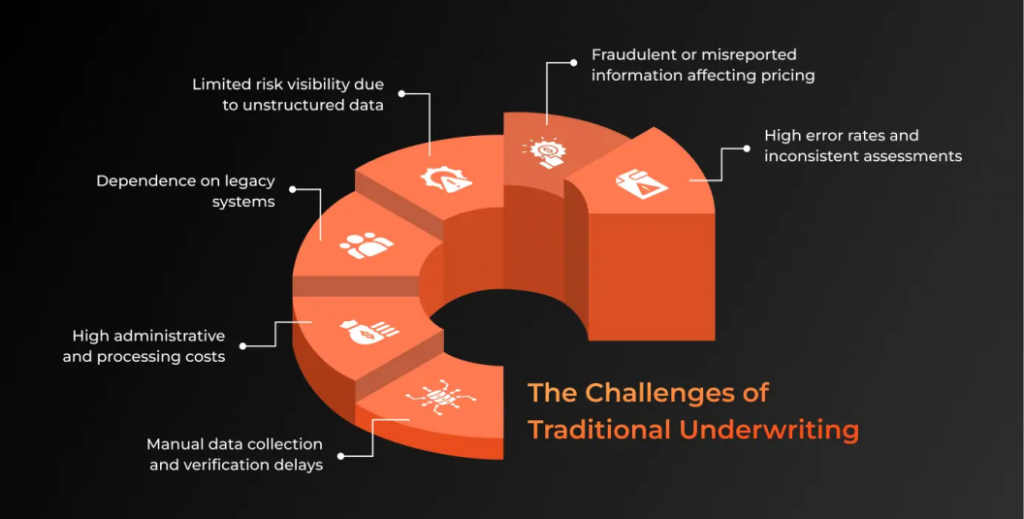
Traditional underwriting, which is fraught with inefficiencies hacking away at operational costs thus slowing down insurance workflows, is still the main obstacle on the company’s way despite being a vital function. Here are the common traditional underwriting challenges that the insurers have to deal with in great detail:
1. Manual data collection and verification delays
Underwriters are overloaded with the job of extracting customer data from forms, emails, medical records, financial documents, and third-party sources, which takes up a lot of their time. The manual verification and cross-checking that go hand in hand with this work directly increase the times of turnaround and, therefore, elevate the costs of labor.
2. High administrative and processing costs
Traditional underwriting requires teams to gather multiple documents, communicate continuously, complete documentation manually, and handle repetitive tasks. Moreover, these administrative burdens significantly increase overhead costs, especially in life, health, and commercial insurance sectors.
3. Dependence on legacy systems
There are still quite a few insurers who run their businesses on obsolete IT systems that have very little or no automation at all. These legacy platforms are not designed to work together; hence, searching for data is a slow process, and there is no easy integration with the latest underwriting tools.
4. Limited risk visibility due to unstructured or incomplete data
Much of the information needed for underwriting—be it medical notes, financial statements, claims histories, or inspection reports—is in an unstructured format. Traditional methods fail to process such data efficiently, and thus, they miss out on portions of risk evaluation and give inaccurate prices.
5. High error rates and inconsistent underwriting decisions
Typing errors, taking a subjective point of view, and doing the work in silos are some of the causes of the divergences between the underwriters. Errors in gathering or interpreting data may become the genesis of pricing inaccuracies, setting off claim disputes, and escalating financial risks.
6. Fraudulent or misreported information affecting risk evaluation
The information that underwriters get from applicants is what they rely on most of the time. The provided data may be incomplete or the applicant may be falsifying it intentionally. Traditional methods hardly detect discrepancies or identify suspicious trends, thus the overexposure to fraudulent claims and wrongly priced policies keeps increasing.

How AI is Transforming Underwriting
1. Automating Data Collection and Processing
AI Underwriting Automation streamlines the whole process of underwriting by going through the medical reports, financial statements, legal documents, and customer forms and extracting only the relevant data.
It keeps the human data entry work out of the way, speeds up the process of putting together the case, and shortens the whole time that goes into handling the case by a large margin. By decreasing the number of mistakes that humans make, the companies keep labor costs down and at the same time they are able to deliver faster and more accurate decisions on the underwriting questions.
2. Enhancing Risk Assessment with Machine Learning
Machine learning strengthens underwriting by analyzing vast amounts of historical data and uncovering correlations that human researchers often overlook in risk evaluation. Predictive analytics in underwriting give more accurate risk scoring thus, insurance companies can further utilize pricing accuracy, keep away from high-risk cases, and reduce their future liabilities by quite a bit.
3. Fraud Detection and Prevention
Fraud analytics powered by AI go through the application data looking for the signs, the inconsistencies, or the behavioral anomalies. Insurance fraud detection automation systems identify false statements, mismatches of identities, and fraudulent goals long before a policy is issued. Early fraud intervention thus, not only stops the leakage of funds but also reinvigorates the integrity of underwriting.
4. Improving Underwriting Efficiency with NLP
The main objective of the NLP for insurance underwriting is to take the unstructured content and make it understandable and usable. Such content can be medical records, physician notes, claim histories, or legal documents. AI-powered systems bring together essential data points and present the key information within a very short time, freeing many underwriters from spending days reviewing large piles of files.
5. Personalized Policy Pricing
With AI for underwriting cost reduction, insurers can get out of the demographic cage of pricing used prior. AI helps micro-segmented underwriting by studying the behavioral data, lifestyle patterns, telematics, and risk indicators. This results in more reasonable premiums, the mispricing risk is lowered and the insurers are able to have profitable portfolios at the same time.
6. Reducing Administrative & Operational Costs
AI for underwriting cost reduction happens when AI takes over the low-value tasks of form validation, document routing, email classification, and data updating that span across the underwriting workflow and automates them. With AI for underwriting cost reduction the administrative burden is lessened, team productivity is at its best, and operational costs are reduced throughout the insurance value chain.

AI as a Communication Tool for Customers and Brokers
1. AI Chatbots for Customer Interaction
AI chatbots improve customer engagement by offering instant solutions, 24/7 assistance, and automated support for quotes, policies, and claims. What they do is call center relief, response speed is improved, and the service cost is decreased while the customer satisfaction level is elevated.
2. AI-Powered Assistance for Brokers
With data driven recommendations reduce underwriting costs with AI that help brokers in finding the right policies for the customers by understanding their unique risk profiles and needs. Automated insights enable brokers to have more clients, be less dependent on the manual support teams, and give more accurate and personalized advice.
Real-Life Examples of AI in Underwriting
i. AXA
AI is a long history for AXA, and the first one who implements the idea technically while using AI. Alongside with integrating machine learning models advanced techniques of ML models have been used to improve both risk evaluation and fraud detection. So, their AI systems evaluate nearly unlimited – medical history, lifestyle data, claim trends, financial indicators, and even behavioral patterns- to create precise risk profiles.
UI automation greatly reduces underwriting turnaround time. Moreover, it helps underwriters approve or reject applications quickly and confidently. In addition, by operation on the basis of anomalies, the fraud detection models on the part of AXA spot out those occasions and inconsistencies that human fraud examiners neglect that help the giant firm cut off financial leakages significantly, and decrease the number of fraudulent claims considerably before they hit the profit side.
ii. Zurich Insurance
Zurich is an insurer that uses AI-powered Optical Character Recognition (OCR) with the help of the Natural Language Processing (NLP) method to process easy-to-read docs such as medical records, legal cases statistical data, and other components of the underwriting dossier. Traditionally reviewing these docs was following some steps which would consume time i.e., hours or even days in manual reading. In the case of AI technology, documentation is getting handled by the Zurich team within 30% of the time.
It is not only the accelerated document processing that results in quick underwriting decisions; there is also a great benefit in the underwriters becoming free from monotonous admin tasks and therefore they can concentrate on the risk department and Premium calculation for big accounts. This also leads to a faster, scalable, and consistent underwriting flow across global markets. Using AI for underwriting cost reduction results in a faster, more scalable, and more consistent underwriting workflow across the global markets.
iii. Aviva
Aviva has embraced conversational AI to solve routine customer questions regarding underwriting, policy clarifications, and quote-related inquiries. The company’s AI-driven customer engagement platform is capable of handling thousands of interactions in a single day. It delivers emphatic answers instantaneously and directs users along the implementation and underwriting steps. As a result, the call center’s workload has dramatically decreased and the customers’ satisfaction level has increased due to the elimination of long waiting times.
Therefore, underwriters have access to the more complete applications, and they can communicate with applicants less, thus decision-making is accelerated. In addition, Aviva’s use of AI for underwriting cost reduction and communication is also a great broker support tool as it certainly leads to policy recommendations and quoting done in a shorter time frame.

How A3Logics Can Help?
A3Logics as a leading AI development company offers AI-powered insurance software development services from start to finish that are customized for Insurers, MGA/MGUs, and InsurTechs. Our scope of work for AI for underwriting cost reduction includes:
- The development of tailor-made AI underwriting automation tools and AI claim management software development.
- Predictive analytics and machine learning-based risk scoring
- NLP powered by AI for efficient document intake
- AI facilitated fraud detection and anomaly recognition
- Effortless integration with the main policy administration, claims, and CRM systems
- Consulting, implementation, optimization, and support – the full cycle
In conjunction with highly advanced technical abilities and profound industry knowledge, A3Logics is instrumental in helping insurance companies to fasten the underwriting process, reduce underwriting costs with AI and improve their overall accuracy.
One of our clients, ClaimPro Corp, a leading insurance provider, was struggling with a high volume of fraudulent claims that were causing substantial financial losses. A3Logics implemented an advanced AI-driven fraud and anomaly detection solution that transformed their claims operations. By automating risk assessment, identifying hidden fraud patterns, and flagging suspicious claims in real time, the system helped ClaimPro reduce fraud by nearly 50%.
Conclusion
AI is leading the way to a totally different underwriting landscape, which is more efficient, accurate, and less costly operational-wise. The capabilities of AI for underwriting cost reduction is not just limited there, it ranges from automated data extraction through predictive risk modeling to real-time fraud detection, providing power to the insurers to come up with underwriting decisions that are not only faster but also more intelligent, and thus, profitable.
The move towards digitization by insurers cannot be completed without the use of AI which has become a must for keeping the competitive edge and sustainable growth in the future.