
With the rise in digital banking, cryptocurrencies, and online transactions, there is also a rise in financial crimes. These are sophesticated and criminals use multiple intermediaries, complex networks, and even AI to carry out illegal activities, making detection next to impossible.
That’s where there is a need for Anti-Money Laundering in banking, especially in a scenario where banking institutions face growing regulatory scrutiny and heavy fines. The traditional systems that are used for detecting money laundering are often manual, fragmented, and reactive. They don’t just impair operational efficiency, but also lead to false positives. To balance compliance requirements while enhancing operational efficiency, the need of the hour is to deploy AI-powered digital AML solutions in banks.
These systems facilitate real-time and contextual monitoring of transactions while conducting smarter risk predictions. If you are planning to deploy sophisticated AML systems, you have come to the right place. Here we’ll discuss the challenges, while also diving into how such systems can be used to prevent money laundering in banks.
The Anti-Money Laundering (AML) Landscape in Banking

1. What AML means for modern banks and financial institutions
For modern banks and financial institutions, AML is more than just a compliance checklist. It is a strategic risk function that continuously monitors real-time transactions, especially in digital payments, to stop illegal money early and protect banks from fines.
2. Global regulatory expectations
Organizations like FATF set global standards while FinCEN (US), AMLD (EU), and RBI (India), etc now mandate robust frameworks. Key requirements include in-depth ongoing customer due diligence, rapid reporting of suspicious activities (SARs); and ultimate beneficial ownership (UBO).
3. Evolution from compliance-driven AML to risk-driven and AI-assisted AML
Unlike legacy AML systems that generate high false positives, AI-assisted systems are proactive. They use machine learning for detecting behavioral anomaly, letting firms focus resources on genuine threats. These enable banks to identify complex laundering typologies.
4. Role of digital platforms and advanced analytics in AML ecosystems
Digital platforms and advanced analytics break down data silos. They integrate AI; graph analytics, and RPA to analyze massive datasets to uncover hidden links between entities. The technology speeds up KYC onboarding; ensures audit transparency, and dynamically updates risk scores.
Important Stats
- The estimated amount of money laundered globally in a year is $800 billion to $2 trillion.
- The traditional rules-based methods utilised in banks produce high false positive rates, nearly 90-95%
- By replacing rules-based software tools with AI-based AML applications, banks can improve their identification of suspicious activities by up to 40%
- US banks spend approximately $25 billion annually on processes to fight money laundering.
- HSBC reported a 60% reduction in false positives after deploying AI‑driven AML analytics.
Key AML Challenges Banks Face
1. High False Positive Rates
Some systems that carry out Anti-Money Laundering in banking generate an enormous amount of false positives. If left unchecked, this strains compliance streams, increases operational costs, and creates investigation backlogs, among other repercussions.
2. Disconnected and Siloed Data Sources
One of the AML challenges in banking is that data essential for a holistic customer view is often stored in fragmented systems such as CRMs, payment gateways, etc. These systems maybe hard to integrate and if they are integrated, there may be a lack of unified data.
3. Manual Review and Investigation Bottlenecks
With a high volume of false positives; Anti-Money Laundering in banking faces numerous challenges. It forces compliance teams to focus on manual processes to review data. This also results in operational inefficiencies, a slowdown in investigations, and a delay in filing of Suspicious Activity Reports (SARs).
4. Lack of Real-Time Monitoring and Alerts
With many institutions still relying on batch-based processing systems, one of the AML challenges in banking is real-time monitoring. Without real-time data access, time-critical transactions may slip past AML systems allowing criminals to act beforehand.
5. Limitations of Static, Rule-Based AML Engines
Rigid rule-based systems pose major AML challenges in banking. With these in place, it becomes easy for criminals to outsmart solutions. For instance, older AML solutions for banks used fixed rules such as flag transaction as suspicious if they are over $10000, failing to identify genuine customer behavior, or generating too many false alerts.
6. Scalability, Performance & Regulatory Adaptability Issues
Handling ever increasing transaction volumes and adapting to quickly changing local and global regulatory requirements are major strategic and technical challenges when implementing Anti-Money Laundering in banking. A non-scalable system can face performance issues while at the same time incur heavy penalties from regulators.
Why Traditional AML Programs Are Failing Banks Today
1. Operational overload and rising compliance costs
Traditional AML solutions for banks often rely on manual processes and rigid rules. As a result, they generate an overwhelming amount of false positives. This forces banks; to hire large compliance teams; which can lead to increased costs.
2. Delayed risk detection and reactive investigations
Traditional AML systems struggle with high speed; complexity and volume of modern financial transactions. They generate alerts after suspicious activity occurs instead of acting proactively beforehand.
3. Poor customer experience due to unnecessary alerts and freezes
Traditional AML systems can incorrectly flag normal transactions as suspicious; which can lead to unnecessary alerts; causing account freezes, and payment delays. This can hamper customer experience and make them lose trust in bank.
4. Inability to detect complex, evolving money laundering patterns
Traditional AML platforms follow traditional and static rules; and can be easily bypassed by professional launderers using techniques such as smurfing. Also, since criminals constantly evolve and exploit digital currencies, traditional AML programs fail to adapt. Furthermore, legacy stacks prevent banks from getting a holistic context of customers’ behavior.
5. Lack of intelligence, adaptability, and automation
Manual workflows and static models make traditional AML slow and error-prone. Since they haven’t integrated AI and ML, they fail against complex, evolving laundering patterns, unlike modern systems that automatically spot high-risk activity in real time.
The Role of AI in Modern Anti-Money Laundering in Banking
1. Why AI is critical for next-generation AML systems
AI in AML in banking uses machine learning to distinguish between genuinely suspicious behavior and normal behavior, hence, it is able to reduce false positives. Secondly, AI powered Anti-Money Laundering in banking identifies complex patterns and anomalies across vast datasets. As a result it can catch advanced money launderers by adapting to real-time or previously hidden risks.
2. Difference between rule-based AML vs AI-driven AML
Let’s have a look at a comprehensive comparison between rule-based and AI-driven digital AML solutions –
| Aspect | Rule-Based AML Systems | AI-Driven Digital AML Solutions |
| Approach | Fixed, manual and predefined rules | Use machine learning to detect patterns and anomalies |
| Adaptability | Static and slow to change | Continuous learning; adapts to new risks. |
| False Positives | High; flags legitimate transactions | Lower due to contextual analysis |
| Risk Assessment | Transaction-focused and not customer-centric | Behavior-based customer risk profiling |
| Scalability | One of the AML challenges in banking with rules-based systems is that they can’t manage high transaction volumes | Scales efficiently with growing data and volumes |
| Detection speed | Based on batch processing | Real-time |
| Operational cost | High since teams have to conduct manual reviews | Lower |
3. How AI learns patterns, behaviors, and anomalies over time
AI-based AML automation in banking offers the ability to monitor vast datasets in real-time. Based on these datasets; the systems flag suspicious behavior early, which may take weeks or months if done traditionally using manual methods. AI models can continuously learn and adapt to new patterns, helping identify previously known risks. The anomaly detection capability helps anti-money laundering in banking to spot transactions that could indicate money laundering.
4. AI’s role in reducing false positives and improving detection accuracy
AI reduces false alerts by learning normal customer behavior; instead of using fixed rules. It finds hidden patterns across linked accounts, understands transaction context and improves over time by learning from past investigations; so only genuinely suspicious activity is flagged.

How AI-Powered AML Strategies Address Banking Sector’s Growing Risks
1. Shift from reactive compliance to predictive and proactive AML
By analyzing current trends and historical data; AI-powered AML banking software can predict future money laundering activities. This proactive approach lets banks to implement preventive measures before illegal transactions occur.
2. AI-led risk assessment and behavioral modeling
AI-powered AML strategies use machine learning to predict risk, score customer behavior, and spot unusual transactions. They reduce false positives, detect changing patterns, and automatically prioritize high-risk cases.
3. Continuous, real-time monitoring across the customer lifecycle
AML digital solutions track the entire customer relationship. They adapt to risk levels as behavior changes. Integrated workflows unify CDD refresh cycles; KYB verification and sanctions screening to maintain constant visibility.
4. Intelligent prioritization of alerts and cases
AI-powered AML systems prioritize alerts by scoring risk in real time. They analyze customer behavior, transaction patterns, and network activity. Alerts indicating genuine money-laundering risk are reviewed first, while false or low-impact alerts are deprioritized or automatically closed.
5. Alignment of AML outcomes with business efficiency and CX
These systems minimize false alerts; accelerating customer onboarding and lowering operational costs. By avoiding unnecessary blocks on normal transactions they also save customers’ time and improve overall banking experience.
Key Digital & AI Strategies to Transform AML in Banking
1. From Rules-Based to AI-Driven, Risk-Based Monitoring
Anti-Money laundering in banking is moving from rigid; rule-based systems to risk-based, analytics-driven approaches. Banks use machine learning; behavioral profiling, and dynamic scoring to reduce false positives, detect complex threats; and improve overall accuracy while following compliance.
2. AI-Powered Automation of KYC, CDD & EDD Workflows
AML automation in banking uses AI and RPA; to streamline routine intensive activities such as identity verification; data extraction, sanctions screening, etc., within KYC, CDD, and EDD workflows. Automation helps reduce manual work and reduce errors. It also allows compliance officers; to focus on high-risk cases, leading to faster onboarding.
3. Building a Unified, AI-Ready AML Data Architecture
Organizations are now building banking AML software that have unified data architecture. These consolidate CRM systems, transaction logs, KYC and risk scoring modules, third-party data providers, and customer onboarding
4. Real-Time Alerting with Machine Learning–Based Dynamic Risk Scoring
Modern AML solutions for banks employ machine learning to continuously monitor transactions in real-time. AI models analyze the context of transactions to update risk profiles. This results in more accurate alerts for genuinely suspicious activity, allowing for a proactive response to evolving money laundering tactics.
5. End-to-End AML Workflow Integration Across Core Banking Platforms
Fintech companies integrating AML with core banking; CRM, and reporting systems turn compliance from a reactive task into a simpler, scalable, and supportive of business growth. Banks that remove siloed systems and invest in integration allow for connected processes from initial customer onboarding to the generation of suspicious activity reports (SARs).
AI & Emerging Technologies Reinventing Anti-Money Laundering in Banking
i. Machine Learning for Smarter Transaction Monitoring & Pattern Detection
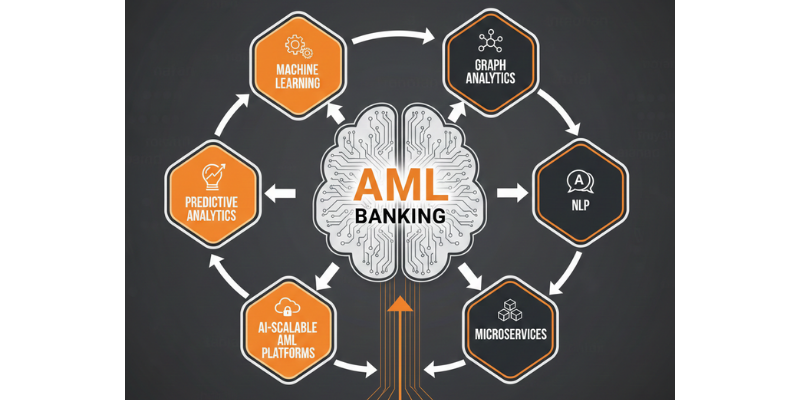
Systems using AI/ML for anti-money laundering in banking; recognize transaction patterns from training data. They can model expected customer behaviors; as well as deviations from those behaviors that can indicate money laundering criminal activity.
ii. Graph Analytics to Identify Hidden Networks & Mule Accounts
AI-based AML in banking uses graph analytics to map customers accounts and transactions. This helps detect suspicious networks – such as circular fund transfers; chains of mule accounts, or linked shell companies. By tracking these relationships; banks can find out hidden patterns and stop money-laundering.
iii. Predictive Analytics for Early Risk Identification
By analyzing patterns more efficiently, predictive models in AML solutions for banks prioritize high-risk alerts letting investigators focus on actual threats. The tools identify hidden; complex relationships between transactions, catching money laundering at beginning stages.
iv. Natural Language Processing (NLP) for Case Notes, Alerts & SAR Automation
NLP in digital AML solutions lets compliance teams automatically mine unstructured text such as news articles, sanction lists, social media, etc., for insights. The solutions also parse sanction lists and watchlists in multiple languages; flagging negative news about a client indicating enhanced due diligence. By converting unstructured data to structured risk indicators; NLP enriches AML monitoring process with context beyond transaction data.
v. Cloud-Native & AI-Scalable AML Platforms
Banking AML software are developed with cloud-first strategies, meaning they run on scalable cloud infrastructure. Using microservices, the application is split into independent modules, while container orchestration manages these efficiently, enabling faster transaction monitoring.
vi. APIs & Microservices for Seamless Internal & External Integration
Using APIs and microservices; banks can unify AML with core banking, CRM, and external data systems. This can result in real-time data sharing; which would further remove silos and improve coordination. Additionally; this also enables end-to-end financial crime monitoring across the entire customer and transaction lifecycle.
Business Impact: What AI-Powered AML in Banking Truly Delivers
1. Significant Reduction in False Positives & Operational Costs
Since banking AML software reduce false positives, they can spend less time per case and close investigations faster. This translates to lower infrastructure needs and compliance overhead, directly cutting AML operating expenses.
2. Faster Investigations with AI-Assisted Case Prioritization
Through banking software development services, you can have AI-based AML systems that aggregate relevant data instantly. These visualize transactional flows and suggest similar historical cases based on which co-conspirators can be identified, and entire laundering networks can be uncovered.
3. Proactive Compliance & Audit-Ready Reporting
AML automation in banking, powered by AI; improves the quality of suspicious activity reports (SARs). It assists investigators by automating entity resolution generating risk narratives, and suggesting supporting documents. It helps reduce regulatory friction; and demonstrate proactive compliance.
4. Improved Customer Trust with Fewer Disruptions
By using adaptive machine learning models; AML systems in banking reduce false positives by a large margin, ensuring that customers face fewer payment delays or unnecessary account freezes. By finding hidden; complex, and previously unseen laundering patterns; the systems offer better protection against criminals.
5. Long-Term Cost Efficiency & Measurable ROI from AI Investments
AI-powered AML delivers long-term savings by automating heavy manual work, sharply reducing false alerts, and shortening investigation cycles. Banks lower staffing and compliance costs, avoid penalties, scale efficiently, and clearly measure ROI.
Why A3Logics Is the Right Technology Partner for AI-Driven AML Digitalization
We have experience in developing banking operation systems. We design fintech platforms; and financial crime prevention systems; delivered through robust Fintech software development services. A3Logics build custom AI-driven AML systems; customized to each bank’s risk profile. Our secure, scalable, regulation-ready architectures support real-time monitoring. As a proven banking technology partner; and AI development company, we enable measurable AML efficiency, accuracy, and long-term compliance performance.

How A3Logics Can Help Banks Modernize AML Programs
i. AML strategy consulting & AI transformation roadmap
We design systems that help financial institutions assess maturity, design modern AML frameworks, and plan transformation roadmaps before implementation.
ii. Custom banking AML software development
Our AML solutions are built to fit a bank’s risk profile, transaction volumes, and compliance goals.
iii. AI/ML model design, training, and optimization
We train and optimize AI/ML models to improve AML detection; reduce noise and learn complex patterns overtime.
iv. AML data engineering, integration & modernization
A3Logics drives AML data engineering, integration, and modernization; by unifying onboarding, sanctions, and transaction data into scalable platforms; enabling efficient monitoring, risk detection, and regulatory compliance.
v. Continuous optimization, compliance support & scalability
A3Logics uses scalable architectures with machine learning; and automation to continuously improve performance and support compliance needs
Conclusion
To effectively combat money laundering banks must adopt advanced AI-powered AML systems’ especially as regulations like FATF, FinCEN, and RBI guidelines grow increasingly stringent. Machine learning and predictive analytics enhance the detection of complex, evolving laundering patterns while reducing false alerts. If you wish to deploy AI-driven, intelligent AML solutions, you can partner with A3Logics to modernize, automate, and strengthen compliance.