More and more customers are gaining access to unlimited choices while expecting high levels of service. This is posing a serious challenge to the insurance companies in their efforts to keep their customers. Although the insurance industry has historically been able to retain its customers at a better rate than many other sectors about 84% on average there is still a churn rate of approximately 16% every year, which means that millions of policies are not renewed, and insurance companies lose substantial revenues annually.
Meanwhile, the expense involved in attracting new policyholders is still high. According to the industry’s standards, keeping existing customers may cost five to nine times less than attracting new ones, and the top 20% of policyholders who are the most profitable may give as much as 80% of total revenue. The discrepancy here is a clear indication that insurers cannot put all their focus on the growth of new business they have to play defense as well by protecting their existing customer base.
Renewals are not just another operational process, they are the lifeblood of profitability. A slight increase in retention can lead to a disproportionately large increase in profitability. Retaining just 5% more customers can greatly increase the lifetime value of customers and eventually double a company’s profit. Taking these risks into consideration, progressive insurers are now leveraging customer churn prediction, advanced analytics and automation to forecast a customer’s intention to exit before it actually happens.
This is when the churn prediction AI Agent for insurance becomes a differentiator of strategy. An AI agent, unlike traditional methods that only react to churn after it happens, will proactively identify the patterns signaling risk, thus enabling intervention with personalized retention strategies at the right time.
Understanding Policyholder Churn in Insurance
Insurance churn is the phenomenon of customers moving away from the insurance company in three ways: not renewing existing policies, allowing policies to lapse due to non, payment, or switching to competitors. While 84% retention may look quite high especially if compared to other industries such as retail or hospitality, it is still indicative of a significant leakage of customers, which has a direct negative impact on profitability.
Basically, insurance churn can be divided into two categories. Voluntary churn is when the policyholder deliberately chooses to leave usually, it is a case of switching to another insurer offering a lower premium, dissatisfaction with service, or lack of engagement from the insurer. On the contrary, involuntary churn refers to situations when a policy ends due to non payment, administrative errors, or unsuccessful communication concerning the renewal deadlines.
A significant frustration for insurance companies is that customer churn is not only caused by a single incident. Throughout the policy lifecycle, the various touchpoints such as the onboarding experience, customer service interactions, claims handling, billing workflows, digital engagement, and pricing adjustments collectively influence a customer’s decision to renew or leave.
The effects of churn extend beyond the loss of premiums. Excessive churn rates disrupt risk pools, worsen loss ratios, and reduce Customer Lifetime Value (CLV). A lower combined ratioan essential profitability metric for insurance is considerably easier to accomplish with higher policy persistency. In fact, leading agencies with retention levels above 93-95% consistently outperform their competitors financially, whereas those with average industry retention are deprived of such advantages.
In light of these facts, churn can no longer be considered a mere back, office metric; it is now a strategic business imperative.
Traditional Churn Identification Methods: Where Insurers Fall Short
Quite a few insurance companies still use old, fashioned ways of identifying customer churn such as rule, based scoring, checking renewals manually, and using spreadsheets to keep track of policy expiry dates. These methods have a number of drawbacks.
Rule – based systems use fixed thresholds like policyholder who has missed two payments or tenure over 3 years. They are not able to take into consideration multi-faceted data, such as claims history, behavioural signals, digital interactions, and customer feedback. Hence, these systems generally produce false alerts or do not spot the real risk in time.
Also, the manual renewal review is very much dependent on the agent’s discretion. Although skilled agents can understand customers’ needs quite well, they are just a handfuland it is almost impossible to scale personalization to hundreds of thousands of policies through manual review.
The major limitation of traditional methods is that they mainly focus on lagging indicators. They detect risk only after a customer has already disengaged like a payment not made or a cancellation request given thus, the chance to change the customer’s mind has gone.
Insurance companies also find it challenging to have their data in silos. The old systems still keep separate the underwriting information from claims, billing, CRM, and digital engagement logs, thus, overall churn risk profiling becomes nearly impossible without a major IT integration effort.
Last but not least, these approaches cannot bring a personalized experience to the customers on a large scale.
Today, customers expect personalized communication and offers tailored specifically to their needs. However, broad renewal reminders and large retention campaigns often fail to deliver results. As a result, insurer persistency continues to decline despite well-intentioned efforts.
What Is a Churn Prediction AI Agent?
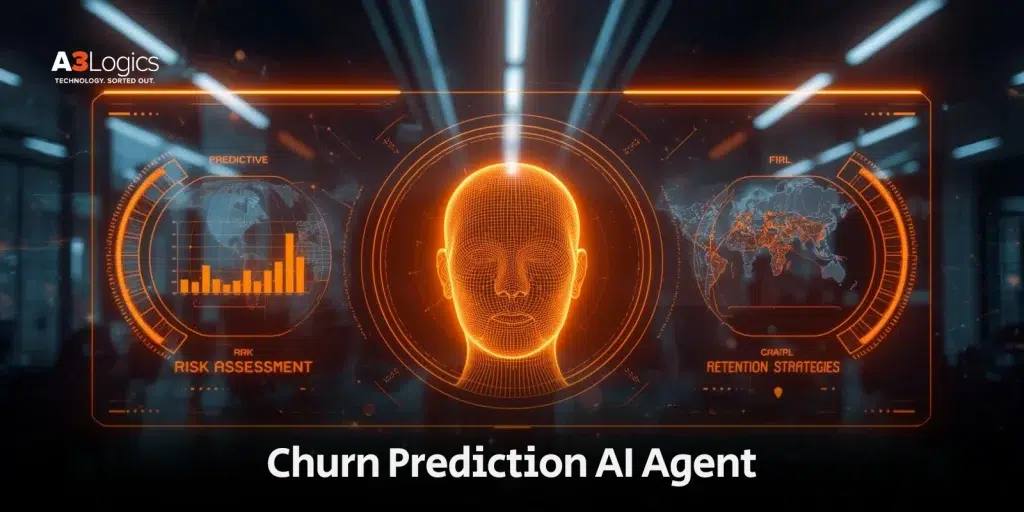
A churn prediction AI agent for insurance is basically a smart system that digs deep into customer interaction records, policy behaviors, and other external factors to accurately forecast which customer will most likely leave the company. It is these AI agents’ ability that goes far beyond your typical machine learning churn models, as they keep on learning, bring together multiple data types, and automatically generate actionable insights.
In sharp contrast to fixed models that just sit there doing their thing, an Churn Prediction AI Agent for Insurance is like a very lively decision, maker support tool. Besides figuring out who is likely to leave, the AI agent can also propose a set of prioritized measures, can be integrated with retention workflows, and as such, can initiate responses in real, time.
Generally speaking, AI agents can be divided into two groups, assisted and autonomous agents. Assisted agents are those who help human decision, makers by flagging the accounts that are at the highest risk and by giving intervention suggestions, whereas autonomous agents are capable of executing certain predefined strategies to trigger, for example, targeted notifications or renewal incentives.
Among the primary purposes of a Churn Prediction AI Agent for Insurance are, first and foremost, to be able to uncover risks in time; to divide policyholders into those who are traditional and those who are most likely to churn; and to provide such insights that make it possible to carry out retention actions at an individual level. According to a survey, as far as the use of predictive analytics by insurance is concerned, nearly 4 out of 5 (78%) of insurers are currently implementing or are intending to implement predictive churn analytics, which shows how this capability has become a standard feature nowadays.
How a Churn Prediction AI Agent Works
1. Data Inputs Used by the AI Agent
The effectiveness of an churn prediction AI Agent for insurance is largely determined by the range of data it is allowed to have access to. Among other things, policy data represents the ground where the whole thing is going to be builtinformation such as tenure, premium changes, endorsements, and coverage types help to understand the level of customer loyalty and the risk factor.
From claims behavior, we get a direct window into customer satisfaction: how often a customer claims, how long it takes to settle a claim, whether there are any disputes in the claims process. Payment history, including whether a customer has made late or partial payments, can be seen as a signal of potential disengagement which, if not stopped, may lead to churn.
Customer interactions through phone calls, e-mails, chatbot conversations, and complaints are qualitative signals that, with the help of sophisticated methods, can be quantified. Together with digital engagement data like portal logins, app usage, document download, and support queries, these inputs show the complete picture of policyholder behavior.
Additionally, insurers can use external and behavioral data, such as demographics or credit information, to improve prediction accuracy. However, they must apply this data ethically and within regulatory boundaries.
2. AI & Machine Learning Techniques Used
AI agents employ a variety of analytical methods. Using classification and probability scoring, predictive modeling forecasts how likely a customer is to churn by identifying patterns in historical data. Time, series analysis is another tool the agent uses to comprehend renewal cycles and customer behavior variations throughout the year.
Behavioral pattern recognition algorithms identify subtle changes in interaction patterns that are typically invisible to human observers. By applying Natural Language Processing (NLP) to customer communications (i. e , unstructured text), the agent gets assistance in interpreting both the sentiment and the issues behind the text.
Most importantly, the top, performing churn prediction AI Agent for insurance are dynamic rather than static. They stay in tune with customer behavior, market conditions, and product offerings changes through continuous learning and model retraining thus the model is always a reflection of current realities and not outdated assumptions.
3. Churn Risk Scoring & Segmentation
After data ingestion and analysis, the churn prediction AI agent generates real-time churn probability scores for each policyholder. As a result, insurers gain immediate, actionable insights.
With these scores, insurers can divide their book into different risk tiers such as low, medium, and high. Retention teams, by concentrating on high, risk segments, can thus use their resources more efficiently.
More than just tiers, sophisticated AI agents are capable of creating policyholder personas based on churn drivers. Take the example of a customer who has recently had an unsatisfactory claims experience and low digital engagement, such a customer might be categorized differently from one whose main indicator for churn is price sensitivity.
Furthermore, many systems now include Explainable AI features to strengthen business confidence and regulatory transparency. As a result, insurers clearly understand why a customer presents higher risk. Consequently, this capability meets critical requirements within tightly regulated financial services.
4. AI-Driven Renewal & Retention Strategies
Once equipped with churn scores and other insights, insurers are able to implement a range of AI, powered strategies for renewal and customer retention.
Firstly, personalized renewal pricing recommendation will be the way for customers to see the offers that are best reflecting their history, loyalty and risk profile. Thus, a customer being a high churn risk due to the regular increase in his/her premiums might be given a discounted solution and modular coverage options to suit the customers needs.
Proactive outreach is much more than just a reminder calendar; it is a well, planned strategy of contacting the potential customers through their chosen communication channels between 4 to 8 weeks before the renewal date and such communication may be through email, SMS, in, app notifications as well as through an agents direct call.
Furthermore, AI enables insurers to create and deliver highly targeted offers more effectively. For example, these include loyalty bonuses, value-added bundles, and claims resolution support. As a result, such initiatives strengthen customer loyalty and significantly reduce defection rates.
Agent, assisted retention workflows allow the human advisor to work with scripts, insights, and next, best actions tailored to each policyholder’s churn profile, thereby meshing human judgment with algorithmic intelligence.
Automated alerts are there to ensure that no renewal opportunity is neglected due to operational oversight of the extremely vulnerable accounts.
Learn more about how AI and ML are transforming customer churn prediction by clicking on the link.

Use Cases of Churn Prediction AI Agent in Insurance
Across insurance segments, churn prediction AI agents for insurance are reshaping retention strategies:
1. Health insurance renewals
In health insurance renewals, AI helps identify customers likely to leave due to premium hikes or service dissatisfaction and proactively offers wellness incentives or optimized coverage plans.
2. Life insurance policy persistency improvement
Life insurance carriers use churn prediction to flag policies with decreasing engagement or communication gaps and initiate trust-building outreach well before renewal windows.
3. Motor insurance annual renewals
In the motor insurance sector where customers usually decide to renew their policies yearly, churn prediction makes it possible to retarget customers in a tailored way by including driving behavior as well as bundling incentives in the campaign.
4. Commercial insurance retention strategies
Commercial insurers use these agents on intricate, broker, mediated portfolios, thus putting the retention strategies of high, value clients on a solid data, based footing.
5. Bancassurance and multi-channel renewals
Moreover, multi, channel distribution models such as bancassurance also reap the benefits of AI agents integration as they combine data from both bank and insurer systems in order to generate seamless, highly personalized renewal experiences.
Business Benefits of AI-Powered Churn Prediction
There are many advantages for an insurance company that chooses to use a churn prediction AI agent.
1. Increased renewal rates
Higher renewal rates have a direct impact on a company’s revenue streams to be more sustainable and premium persistency to be better.
2. Reduced customer acquisition costs (CAC)
As churn declines, the company reduces sales and customer acquisition costs. Consequently, it frees up resources for product innovation initiatives. Moreover, these savings support investments that enhance overall customer experience.
3. Higher policy persistence
Higher persistency makes the portfolio more predictable which helps actuarial forecasting to be more accurate.
4. Improved customer experience
One major customer benefit is faster response times combined with highly personalized interactions. As a result, customers feel more valued and understood. Consequently, this improved experience strengthens satisfaction and builds long-term loyalty.
5. Better portfolio profitability
Retention teams at the company also gain access to data, driven insights that help them prioritize their efforts and measure the results of the initiatives they brought.
6. Data-driven decision-making for retention teams
Moreover, advanced analytics facilitate higher profits through smart risk segmentation and pricing precision.
Key Metrics to Measure Churn Prediction Success
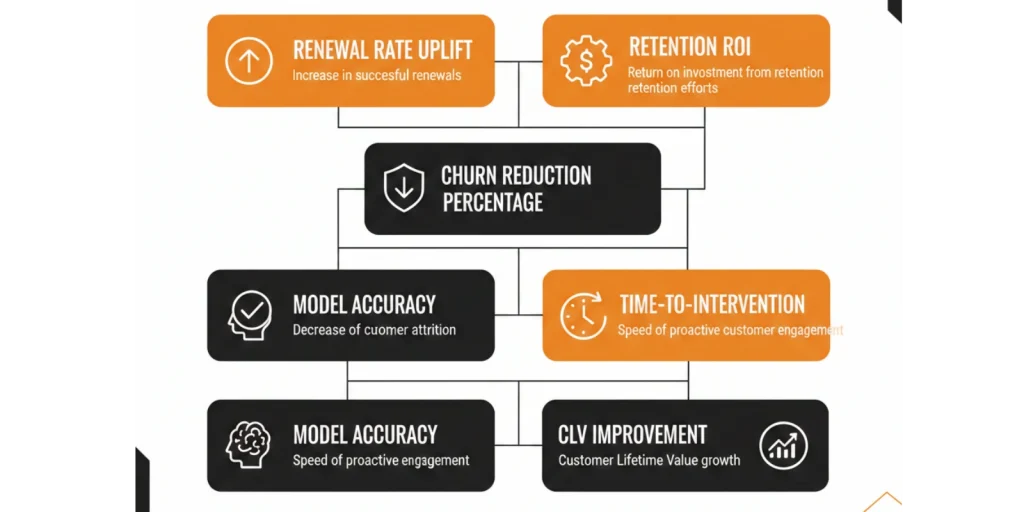
In order to measure how churn prediction AI agents for insurance have helped, insurers look at a few key metrics.
1. Renewal rate uplift
Renewal rate uplift is the increase in renewal rates from one year to the next that can be attributed to predictive retention efforts.
2. Churn reduction percentage
Churn reduction percentage is the metric that shows how much the rate of churn has gone down after the advent of such a system.
3. Retention ROI
Retention ROI measures the return on the investment into the technology in terms of the financial gains.
4. Model accuracy and precision
From a model point of view, accuracy, precision, and recall are used to judge the quality of the prediction, and time.
5. Time-to-intervention before renewal
Model accuracy and precision before renewal indicates how early is the detection of risks compared with the traditional methods.
6. CLV improvement
Customer Lifetime Value (CLV) improvement is a metric that shows the impact of retention strategies on the long, term profitability and value of customers.
Implementation Challenges & Best Practices
Despite clear benefits, implementing a churn prediction AI agent comes with challenges.
1. Data quality and integration challenges
Data quality and integration issues still top the list of challenges. A lot of insurers still use old systems; and their customer data is scattered over several platforms. It is very necessary to create a single data base first before AI agents can provide dependable insights.
2. Regulatory and compliance considerations
Above all, insurers must carefully address regulatory and compliance requirements, especially data privacy and consumer protection. Moreover, transparency and explainability play a critical role in building trust with customers and regulators alike.
3. Model bias and fairness
One major concern involves model bias, requiring AI systems to ensure fairness and avoid user discrimination. Therefore, teams must conduct frequent validation and continuous monitoring.
4. Change management for sales & retention teams
Change management plays a critical role in successful AI adoption. Therefore, organizations must train and motivate sales and retention teams to trust and use AI-generated insights effectively.
5. Best practices for phased rollout
Best practices include phased rollouts that begin with pilot programs. Moreover, organizations need strong governance, cross-functional collaboration, and continuous performance tracking. Importantly, automation should enhance human judgment rather than replace it.

How A3Logics Can Help Build a Churn Prediction AI Agent
A3Logics as a AI development company teams up with insurers and InsurTechs to develop personalized churn prediction AI agents for insurance that match enterprise, grade performance, scalability, and compliance levels. Their products connect the dots between the core insurance frameworks, CRM systems, claims engines, and billing systems to lay down smooth data highways powered with predictive intelligence.
Designed to be safe and reliable, A3Logics insurance software development services use interpretable models that not only meet regulatory requirements; but also offer real insights into the business. Periodic updates and support guarantee that the AI keeps bringing in value even as the market situations and consumer patterns change.
Conclusion: Turning Churn Prediction into a Competitive Advantage
In an era defined by digital competition, customer expectations, and cost pressure, insurers can no longer rely on legacy churn identification methods. A churn prediction AI agent for insurance is not just a predictive tool—it is a strategic capability that transforms retention from a reactive task into a proactive, data-driven system.
With average retention rates hovering around 84%, even small gains in renewal performance can unlock substantial financial upside. As more insurers adopt predictive analytics and AI in insurance, 78% planning or using churn analytics today—the competitive divide will widen further between digital leaders and laggards.
Investing in churn prediction AI today is about protecting revenue, deepening relationships, and future-proofing insurance businesses in a rapidly changing market.