
The financial services sector has undergone radical changes in the last ten years. The once familiar sight of local bank branches is gradually giving way to the digital-first financial platforms that rely solely on mobile applications for their operations. This evolution has been largely influenced by a mix of consumer demand changes, widespread availability of high-speed internet, smartphone usage, and the increased capabilities of fintech innovation.
Several banking apps including Chime, have completely changed the relationship between customers and their money. Therefore, rather than physically going to banks and waiting in the line or following complicated banking procedures, a user can now open an account within a couple of minutes, get direct deposit a day earlier than usual, monitor their expenditure on the go, and control their debit card all from their smartphone. Given that these methods are not only time saving but also more straightforward and very affordable, it is no wonder that digital, only banking has become so popular.
If wanting to build banking app like Chime is in your plans, then this guide will walk you through the entire process, step by step. From understanding the market and meeting regulatory standards to planning the development and estimating the budget, this blog discusses how to develop a mobile banking app like Chime and presents a well organized path for startups, conventional banks, and fintech players looking to build banking app like Chime.
Mobile Banking App Market Overview
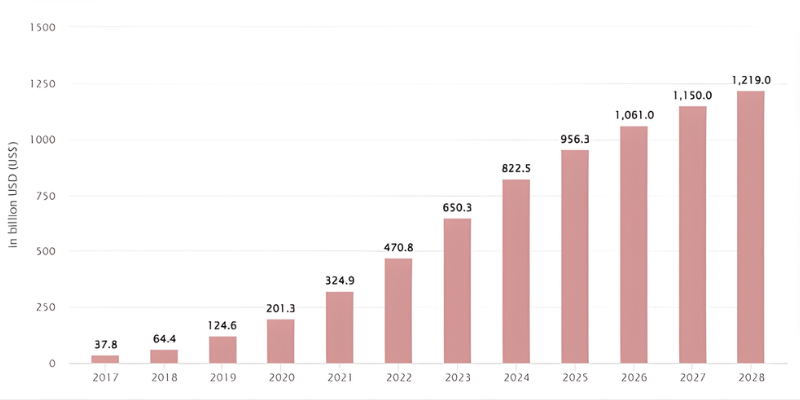
With the proliferation of smartphones and digital payments; the worldwide mobile banking market has expanded rapidly. Mobile banking was utilized by approximately 2. 17 billion people globally in 2025, which is around 35% more compared to 2020. The market was worth roughly USD 1.43 billion in 2024 and is anticipated to grow to USD 1.58 billion in 2025, with a CAGR of 12. 7% till 2032.
Developed areas hold the largest share of mobile banking customers; with 76% of U. S. clients using mobile applications as their primary banking method. Neobanks and challenger banks have played an important role in the market growth. Since they don’t have physical branches; these banks charge lower fees, provide faster services, and offer better digital experiences. The market for neobanks worldwide may increase from roughly USD 210 billion in 2025 to more than USD 3. 4 trillion in 2034.
Chime, as an example, keeps attracting millions of users by emphasizing ease of access and openness. This is in line with the strong demand from millennials and Gen Z for features like instant alerts, clever budgeting apps, and smooth payment integrations. These developments set 2026 as a perfect year for innovators and financial entities to put money in the making of a Chime, style mobile banking app.
What Is a Mobile Banking App?
A mobile banking app is basically a digital platform that gives the users the possibility of handling their financial affairs via a smartphone or a tablet. Through these apps, customers get the freedom to access their account and carry out operations like checking their account balances, transferring money, paying bills, depositing checks, and managing their cards all without going to a bank branch physically.
The main aim of a mobile banking app is to make the access to financial services convenient, secure, and real, time. It removes location limitations and thereby, gives more power and control to the user over their finances.
The fundamental difference between a conventional banking app and a neobank app such as Chime is in their infrastructure and customer approach. Traditional banking apps serve as the digital face of the branch and legacy systems. Neobank apps, however, are born digital platforms that are at the core of online banking. They focus on simplicity, automation, and low cost operations.
Types of Mobile Banking Apps
Before you choose to build banking app like Chime, let’s understand the various types of mobile banking apps.
1. Traditional Bank Mobile Apps
Traditional bank mobile apps refer to the extension of a physical bank branch in a digital form. Through these apps, customers can still enjoy the services of their local bank. Mostly, these apps allow account management, bill payments, and fund transfer. On the other hand, they still may depend on the old infrastructure.
2. Neobanking / Digital-Only Banking Apps
Neobanking apps such as Chime do not have a physical branch and are available only online. They team up with licensed banks, but their primary focus is on giving a digital, first experience. The main features of such platforms are a very engaging and user-friendly interface, notifications in real-time, and no hidden charges.
3. Wallet-Based Banking Apps
Wallet, based banking apps, as the name suggests, are mainly focused on the storage of digital money and facilitating transactions. They may sync with banking systems but the focus is primarily on the digital wallet feature and providing quick payments.
4. Payment-Focused Banking Apps
Payment-focused apps give first priority to P2P transfers, merchant payments, and world money transfers. They can provide a few banking features, but the core strength is in fast and smooth transaction processing.
Key Technologies Used in Mobile Banking Apps
Modern mobile banking applications rely on advanced technologies to ensure speed, security, and scalability.
1. NFC or Near Field Communication
Near Field Communication (NFC) allows people to make safe touchless payments using their mobile phones or wearables. When a smartphone or a wearable device is tapped on an NFC, compatible terminal, the device owner is able to make a payment instantly. Near Field Communication technology involves secured data transmission, tokenization, and multiple layers of authentication that together make the tap, to, pay purchases not only very fast and extremely convenient but also very safe for everyday transactions.
2. Internet and UPI Payments
Internet banking and UPI (Unified Payments Interface) based payment systems are so efficient that they provide instant transfer of funds from one account to another with minimum friction. Through the use of a mobile number, a QR code or a UPI ID, users are able to send or receive money straight away. Both these systems work around the clock without any breaks, they support peer, to, peer as well as payment to merchants, and they are able to greatly improve the accessibility of financial services through effortless digital transactions.
3. Digital Wallet Integration
Digital wallet integration is a feature that empowers users to connect their bank applications with popular payment platforms such as Apple Pay, Google Pay, or other e-wallets. It brings a single interface for payments, enables quicker checkout, keeps a record of rewards, and generally makes transactions easier while at the same time keeping authorization operations and data transfers highly secure through encryption.
4. Mobile Transaction and Account Management Systems
Mobile transaction and account management systems offer users the ability to check their balances, see their transaction history, manage their cards, and set spending limits all in real time. Backed by cloud infrastructure, such systems provide high availability, data redundancy, security controls, and great performance even at peak usage.
5. Cloud and API-Driven Banking Infrastructure
Cloud and API driven banking infrastructure enables seamless integration with third-party services like payment gateways, KYC verification tools, credit scoring platforms, and fraud detection systems. This setup makes the system easily scalable, allows faster rollout of new features, improves system flexibility, and helps innovations in modern digital banking ecosystems.
How to Develop a Mobile Banking App Like Chime
Step 1: Market & Compliance Research
Financial applications should adhere to KYC (Know Your Customer), AML (Anti, Money Laundering), and PCI, DSS. requirements. When you build banking app like Chime, this will guarantee that the application is trustworthy and safe for the users.
Step 2: Target Audience & Competitor Analysis
While you build banking app like Chime it is a must to identify your target audience. Demographics, spending patterns, and financial needs should be analyzed of the potential users. To point out the shortcomings of your app, you need to compare your app with Chime, Revolut, and Varo.
Step 3: Core & Advanced Banking Features
You have to make a decision about whether or not you want to develop an MVP (Minimum Viable Product) or a fully working app.
MVP only includes basic features such as account management and money transfer. You can add advanced features later on.
Step 4: Design Secure & User-Friendly UX/UI
First of all, user experience is an essential feature of any fintech application. The app should provide a user, friendly interface along with features related to accessibility immensely helpful in this regard. To earn users’ trust, one can resort to such elements as security messaging, etc.
Step 5: Choose the Right Tech Stack & Architecture
Tech stack choice defines the ability to scale and perform well. The frontend technology stack should provide seamless mobile experience, whereas the backend technology stack deals with transactions in a secure manner. Collaboration with a trustworthy Fintech app development company can make the architecture selection easier.
Step 6: Mobile Banking App Development
The development process should be carried out using agile approaches to enable continuous enhancements. The backend development involves API integration, database management, and payment gateway implementation. A reputable Mobile app development company will provide cross-platform support.
Step 7: Testing, Security Audit & App Launch
Testing is an absolute necessity when you try to build a banking app like Chime. Functional testing verifies the functionality of features. Penetration testing helps to detect flaws. Adherence to app store policies is essential for a successful app launch.
Key Features of a Mobile Banking App Like Chime
1. Core Banking Features
Core banking features to build banking app like Chime include account balance tracking and detailed transaction history. Users expect real-time updates and easy access to financial records. Mobile check deposit functionality allows users to deposit checks using smartphone cameras. Fund transfers and bill payments are essential. Seamless integration with payment systems ensures smooth financial transactions.
2. Card and Expense Management
Card management features allow users to freeze or unfreeze debit/ credit cards instantly; it also allows individuals to set a spending limit. Expense categorization and spending insights help users manage budgets effectively.
3. Smart and Security Features
Smart security features such as biometric authentication, push notifications, and fraud detection systems enhance user safety and confidence. This plays an important role in building customer trust especially with the rise in fraud and theft.

Advanced Features to Make Your Banking App Stand Out
1. Early Paycheck Access
Invite your customers to receive direct deposit payments ahead of the traditional schedule of paydays. This feature not only boosts cash flow flexibility but also raises user satisfaction levels and gives your app a distinct edge in the highly competitive fintech market.
2. AI-Powered Spending Insights
Deploy AI-powered analytics that can identify spending habits, automatically categorize transactions, and provide personalized financial guidance. These smart financial insights allow users to develop better budgeting skills and take control of their finances effortlessly.
3. Automated Savings Tools
Implement savings mechanisms that work automatically such as round, ups, percentage, based deposits, or goal, triggered transfers. Such automated savings tools bring about financial discipline and at the same time, help users to accomplish their financial goals, whether they are short, or long, term.
4. In App Customer Support & Chatbots
Enable users to contact either AI chatbots or live chat support whenever they want (i. e, 24/7). Immediate problem solving is advantageous for users, thus leading to a decrease in the churn rate and gaining trust for your mobile banking platform.
5. Credit Score Monitoring
Introduce credit score in real time coupled with notifications and advice for score improvement. Such openness in credit score monitoring is a way for the users to take charge of their credit management and at the same time, be more engaged in the banking app environment.
Popular Mobile Banking Apps Like Chime
Several digital banking apps have gained global popularity due to their innovative features and customer-centric approach.
1. Revolut

This is a worldwide digital banking app that has various features such as multi, currency accounts, international transfers, crypto trading, and advanced budgeting tools.
2. Varo

It is the digital bank located in the United States offering free banking services, early access to direct deposit, and high yield savings accounts.
3. Current

It is a mobile, first banking platform that concentrates on faster payments, providing accounts for teens, and real, time spending insights.
4. SoFi
It is a fintech platform that offers various financial services such as: digital banking, investing, loans, and credit monitoring through one integrated financial app.
Mobile Banking App Development Cost
The cost to build banking app like Chime depends on multiple factors; let’s take a look at some of them.
Factors Affecting the Cost
1. App Complexity
While MVP apps are essentially simple with the inclusion of only basic functionality and user interface, in contrast, complex apps typically implement AI features, analytics, and have high, end security designs. Naturally, the level of complexity impacts the time and cost of Chime-like mobile banking app development.
2. Features & Integrations
Integration of functionalities such as payment services, KYC solutions, fraud protection services, and third, party API raise the development costs. However, these integrations also significantly enhance the value of the app.
3. Security & Compliance
Chime-like mobile banking app development that is compliant with PCI, DSS, GDPR, AML, and banking regulations mandates security, encryption, audits, and certification, thus increasing not only development but also operational expenses.
4. Platform (iOS, Android, Both)
Development on one platform is less expensive, whereas development on multiple platforms or native development for both iOS and Android platforms is costlier but provides better market coverage.
Estimated Cost Breakdown
- An MVP banking app can be expected to cost within the range of $40, 000 to $80, 000 depending on features and integrations.
- A mid-scale banking app having advanced functionalities can cost somewhere between $80, 000 and $150, 000.
- An enterprise, grade neobank solution with complex integrations and multiple layers of security can easily go beyond $250, 000.
Partnering with an experienced ewallet app development company ensures cost efficiency and compliance adherence.
Challenges in Developing a Banking App Like Chime
1. Regulatory Compliance
Financial institutions that are regulated by different governments have to ensure their compliance with the AML, KYC and data protection laws of the respective countries which requires them to carry out regular audits and co, ordinate with the legal department.
2. Data Security & Privacy
The best way to protect financial information is by implementing encryption, multi, factor authentication, tokenization alongside real, time fraud monitoring making it almost impossible for attackers to breach the systems and keep the users trust.
3. Scalability
Whenever there is an increase in the number of users, the application must be able to perform high transaction processing without any downtime. By adopting a cloud, native architecture, organizations get the advantage of elasticity and thereby, the capability to maintain performance during peak loads.
4. User Trust & Adoption
Establishing trust requires a commitment to open, straightforward pricing, a dependable level of service, fortified security, and ensured customer satisfaction which could lead to a recurring customer.
5. Integration with Banking Partners
Integration with banking core systems, payment networks, and external providers, while offering many possibilities, can also be a significant technical challenge and development might take a long time.

How A3Logics Can Help You Build a Mobile Banking App
A3Logics offers full cycle fintech development solutions. Being a leading Fintech app development company – A3Logics develops secure, scalable, and compliant banking solutions customized to the client’s requirements.
They focus on unique UI/UX, API integration, payment gateway installation, and regulatory compliance consulting. Conforming to the expectations of a trustworthy Mobile app development company, A3Logics guarantees cross, platform support and future scalability.
By combining all the phases of a product life cycle, from ideation to product launch and beyond, A3Logics brings the necessary tools to the table in order for the businesses to build banking app like Chime securely and efficiently.
Conclusion
Digital banking is no longer a trend but a necessity. Apps such as Chime have raised the bar for accessibility, transparency, and user experiences. Companies that plan to enter the fintech sector should prioritize compliance, security, and user, friendly design.
If you want to build banking app like Chime, it is a must that you strategize properly and have good technical knowledge. In case you have a suitable development partner and clear business goals, you will be able to build a scalable, user, focused banking solution that fits the current financial requirements.