The $284 million virtual trading app market in 2026 is not just growing; rather, it is quietly reshaping how the next generation learns to invest in the virtual stock market. With a 6.5% CAGR, multiple stock market simulator apps are already becoming the gateway for students, aspiring beginners, and professional traders. Hence, they can be involved in risk-free investing in real time.
These stock market simulators are already considered valuable tools when it comes to investing in stock trading. The platform also helps to gain clear knowledge on practical stock trading experience without facing any kind of financial risk. Over time, the rising demand for stock market simulators has also urged businesses to invest in their development.
In this helpful guide, we will guide you through the process of developing a virtual stock market simulator, its cost, and features that will give you clear insights on how to create a stock trading simulator from scratch.
What is the Stock Market Simulator Gaming App?
When it comes to emulating the stock trading movement, the stock trading simulator development game app plays an essential role. The app also allows users to trade different stocks, ETFs, and financial instruments that use smart digital currency. Such apps also provide an excellent opportunity to explore the stock market without any kind of financial risk.
The global gaming simulator market size was estimated at USD 6.87 billion in 2023 and is projected to reach USD 16.17 billion by 2030, signaling excellent growth and the increasing demand among traders to use such apps. Using this app, traders can easily follow real-time data, analyze different market trends, and simulate different trading strategies to determine how they actually perform in the real market.
Types of Stock Market Simulator Mobile Apps
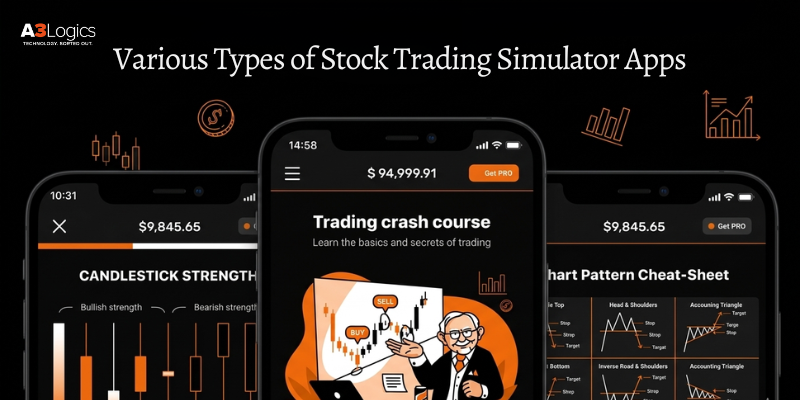
When it comes to virtual stock trading app development, there are multiple types that are particularly designed for different user needs. From beginners learning the basics to all the advanced traders testing certain complex strategies, the right insights can help make the right choice. Also, these apps combine the perfect real-time data, latest gamification, AI analytics, and different education-focused tools to create practical and risk-free investing environments.
Fantasy Stock Trading Apps
Gamified platforms are those where multiple users build virtual portfolios and compete in different contests or leaderboards. These apps also focus on genuine engagement, rewards, rankings, and certain time-bound challenges. They also use virtual cash and simplified trading mechanics that attract beginners and students.
Examples: MarketWatch Virtual Stock Exchange, Wall Street Survivor, Invstr.
Real-Time Market Simulation Apps
Real-time stock market simulator app helps mirror live market conditions using real-time or even delayed stock data. Users can also place the proper market, limit, and stop orders to simulate real trading scenarios. Similarly, the app incorporates advanced charting, portfolio tracking, and overall performance analytics to replicate brokerage experiences without any financial risk.
Examples: Investopedia Simulator, TradingView Paper Trading, Webull Paper Trading.
Educational Trading Simulator Apps
Educational trading simulator apps among virtual stock market game development are an ideal option for schools, universities, and financial literacy programs. These particular types of apps deliver structured lessons, quizzes, and instructor dashboards. They also focus on explaining market concepts like superior diversification, risk management, and proper asset allocation. Using these apps, teachers can also monitor student performance and create multiple classroom competitions.
Examples: StockTrak, HowTheMarketWorks, NextGen Personal Finance simulations.
Investment Strategy & Backtesting Apps
These types of apps assist in testing technical indicators and different trading strategies using historical data. These apps also allow users to backtest multiple strategies, analyze risk-reward ratios while optimizing certain entry/exit rules. These apps are also used by intermediate and advanced traders who aim to refine systematic approaches.
Examples: TradingView Strategy Tester, MetaTrader Demo Accounts, QuantConnect.
Broker & Advisor Training Simulators
A professional-grade stock market simulator app is also used for broker licensing preparation and financial advisor training. These help with margin trading simulations, derivatives exposure, some compliance-based scenarios, and portfolio management case studies. These help with authentic certification programs and financial institutions.
Examples: FINRA training simulations, CFA Institute investment tools (educational use), brokerage internal training platforms.
Below is a compact and proper budget table showing multiple aspects, along with the annual recurring cost estimates for each stock-simulator app type in 2026. These numbers show the genuine ranges, delivering insights for proper planning.
| Types | Key Features | Development Timing | One-time Development Cost |
| Fantasy Stock Trading | Virtual wallets, leaderboards, gamification, social sharing, simple order simulation, tournaments | 8 to 12 weeks | $15,000 – $40,000 |
| Real-Time Market Simulator | Real/near-real market feeds, advanced charting, order types, P&L, push alerts | 3 to 5 months | $60,000 – $140,000 |
| Educational Trading Simulator | Instructor dashboards, class groups, lessons/quizzes, controlled contests, CSV import/export | 3 to 4 months | $35,000 – $85,000 |
| Investment Strategy & Backtesting | Historical data, backtester, strategy library, performance analytics, replay mode | 4 to 8 months | $70,000 – $180,000 |
| Broker / Advisor Training Simulator | Margin, derivatives simulation, compliance scenarios, reporting, certification flows | 6 to 12+ months | $120,000 – $300,000+ |
Who Needs a Stock Trading Simulator App and Games?
A stock market simulator game software is designed for multiple users who want to learn, practice, or even refine certain trading investment skills without being involved in financial risk. Below, we are mentioning the users who can use these apps and games.
Students & Educational Institutions
Schools, colleges, and different universities use the advanced stock trading simulators to teach proper financial literacy, investment fundamentals, and all the latest market mechanics in a practical way. These tools also complement academic coursework in finance and economics by providing the best hands-on experience.
Aspiring Investors and Traders
Beginners, while entering the stock market, use the game app simulators to properly understand the order types, portfolio management, overall risk control, and market volatility. These platforms also allow them to gain strong confidence with practice strategies before committing real money in live trading environments.
Financial Advisors and Analysts in Training
Interns, trainees, and finance graduates can use these simulators to practice proper portfolio construction. When planning for the virtual stock market simulator development, the app helps in financial forecasting and investment analysis. These tools also help them strengthen proper analytical thinking while improving decision-making skills and building real-world market intuition in a controlled and risk-free setting.
Stockbrokers and Financial Services Professionals
Brokerage firms and financial institutions can use these trading simulators to achieve proper internal staff training and the latest trading strategy development. Professionals can also test certain trading approaches while evaluating new financial products and refining certain advisory techniques without affecting clients’ portfolios or organizational capital.
Corporate Trainers and Organizations
A virtual stock exchange software is the right option for corporates because such apps allow the corporates to take part in excellent employee upskilling programs and perform different finance-related roles. These apps also support corporate learning initiatives by enhancing overall financial awareness, excellent investment understanding, and multiple analytical capabilities.
Retail Investors Testing New Strategies
Experienced individual investors use simulators to experiment with new trading techniques, different asset allocation models, or short-term strategies. These tools also use historical and real-time data while evaluating potential outcomes and optimizing overall performance without risking actual capital.
Benefits of Using a Virtual Stock Trading Simulator App
Investing in different stock trading simulator apps is especially beneficial for businesses, as a stock market simulator can help them grow by attracting new users and keeping existing ones engaged.
Attracts a Broad Audience
A stock trading simulator development game attracts businesses because these apps perfectly appeal to students, beginners, and hobby traders who want to learn without any financial risk. These apps quickly grow a proper user base with a low entry barrier.
Boosts User Engagement
A stock market simulator comes with some exclusive features, such as leaderboards and certain significant challenges. These keep users engaged and keep them interested while increasing app usage time and user retention rates.
Promotes Financial Products
If you decide to invest in virtual stock exchange app development, it helps your business to develop a strong bridge that delivers different real trading services. Not only that, but simulator game apps also help convert many free users into long-time and reliable paying customers.
Smooth User Onboarding
Businesses that want to build an advanced and excellent stock market website or app, as they offer an ideal and superior friendly environment for many new users to explore different trading tools. Hence, users can gain genuine confidence before opting to make real investments.
Revenue Generation
Stock market simulator apps can also bring multiple revenue-generating benefits. The apps also allow traders to earn a sufficient amount through ads, premium features, and a multiple-subscription model. Therefore, the apps open up multiple income streams generated from a single product.
Users | Businesses
When it comes to the virtual stock market game development ecosystem, the “Users” refer to individual learners and traders who practice investing for personal growth, while “Businesses” include some institutions and organizations that adopt the platform for structured training, education programs, employee development, or excellent enterprise-level financial skill building.
Here is a clear and structured comparison table for Users vs Businesses in the context of a Stock Trading Simulator App:
| Aspect | Users ( Individual users) | Businesses |
| Primary Goal | Learn stock market basics, practice trading, and test strategies without financial risk. | Train students or employees who improve financial literacy, test financial models, and deliver structured learning programs. |
| Examples | Students, beginner investors, retail traders, finance interns, and hobby traders. | Schools, universities, brokerage firms, financial institutions, corporate training firms, and EdTech companies. |
| Usage Type | Personal, self-directed learning and experimentation. | Structured programs, classroom use, excellent employee training, and certification preparation. |
| Required Features | Virtual portfolio, real-time/delayed data, charts, leaderboards, gamification. | Admin dashboards, bulk user management, reporting tools, overall compliance controls, and white-label options. |
| Revenue Model | Subscription plans, in-app purchases, and ads. | Enterprise licensing, annual subscriptions, per-seat pricing, white-label agreements. |
Top Virtual Stock Market Simulator Apps to Inspire Your Development Roadmap
If you have decided to make an investment in a stock trading simulator development game, there are multiple platforms that can transform the concept so that beginners and aspiring traders can learn investing without financial risk.
From real-time market data to excellent gamified trading experiences, these platforms offer diversified features. Below is a comparison table highlighting the top apps to inspire your development roadmap.
| Apps | Launch Year | Platforms Available | Used for |
| Investopedia Simulator | 2003 | Web | Beginner-focused stock market education & virtual trading |
| TradingView | 2011 | Web, iOS, Android, Desktop (Windows/macOS) | Charting, paper trading, and social trading community |
| NinjaTrader | 2003 | Windows Desktop, Web (limited), Mobile | Futures & forex simulation, advanced technical trading |
| TradeStation | 1982 (brokerage) and then the platform evolved in the 1990s | Web, Windows Desktop, iOS, Android | Stocks, options & futures simulation and strategy testing |
| eToro | 2007 | Web, iOS, Android | Social trading & virtual portfolio simulation |
| MarketWatch Virtual Stock Exchange (VSE) | 1997, MarketWatch was founded, and then VSE was launched in the early 2000s | 1997, MarketWatch was founded, and then VSEwas launched in the early 2000s | Educational stock market simulation |
| Webull Paper Trading | 2017 (Webull launch) | iOS, Android, Web, Desktop | Commission-free simulated stock & options trading |
| Interactive Brokers (Paper Trading) | 1978 (IB founded; TWS simulator added later) | Web, Desktop (TWS), iOS, Android | Professional-grade stock, options & futures simulation |
| Thinkorswim (TD Ameritrade) | 1999, Thinkorswim was founded and then acquired in 2009 | Desktop, Web, iOS, Android | Advanced paper trading for stocks, options & derivatives |
| Chart MANTRA | 2022 | Web | Indian stock market simulation & trading education |
Key Features to Consider for Virtual Stock Trading Software Development
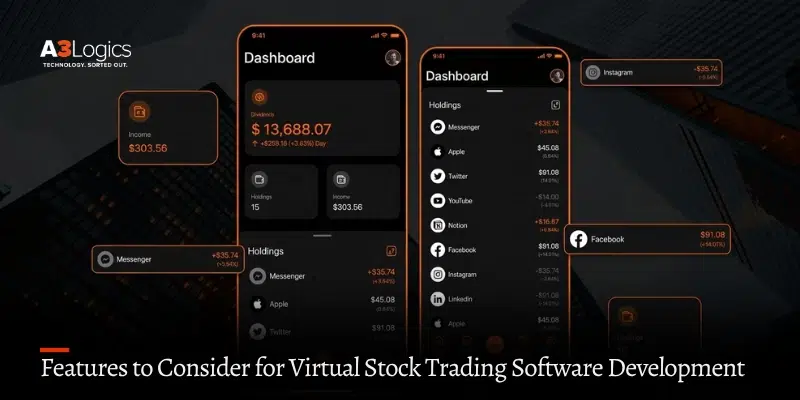
Virtual stock market simulator development is rapidly gaining popularity. As per 2024 data, there were more than 150 million retail investors who actively traded via mobile platforms worldwide, signaling huge demand for advanced simulation tools. However, when it comes to developing a competitive software, it is necessary to keep in mind some key features that add significant value to the app.
Live & Historical Market Data Engine
Integrates real-time and proper historical price feeds. This successfully enables the chances of realistic simulations, different backtesting strategies, and dynamic trading decisions that allow traders to make authentic market conditions.
Secure Multi-Level User Accounts
It supports encrypted registration with customizable dashboards and different trading preferences. This assists with superior performance tracking while maintaining overall data privacy.
Simulated Capital Allocation System
While planning for a virtual stock exchange app development, consider features such as a simulated capital allocation system. It provides adjustable virtual funds, proper margin simulation, transaction cost modeling, and also some automated balance updates. All these help reflect real-world trading mechanics.
Advanced Portfolio Analytics Dashboard
While developing a stock market simulator game software, it delivers proper asset allocation insights, performance metrics, different diversification analyses, and risk evaluation tools. These help users to understand genuine investment behavior.
Intelligent Asset Discovery & Watchlists
Intelligent asset discovery and watchlists, also smart stock filtering with sector-based search. These customizable watchlists and on-time price alerts help to monitor preferred securities efficiently.
Gamified Trading Challenges & Rewards
When deciding on an excellent and advanced virtual stock market game development, focus on features like gamified trading challenges and rewards. These allow traders to take part in different competitions with achievement badges, ranking systems, and milestone rewards. These strongly enhance genuine engagement while encouraging proper platform usage.
How to Make Your Virtual Stock Trading Platform Stand Out
Do you want to make the virtual stock trading platform a perfect standout? Hence, it is necessary to incorporate some advanced features. Below, we mention some of the advanced features that you can add during virtual stock exchange app development and make your clients’ experience different.
1. Trading Recommendations Based On AI
AI-based trading recommendations are an excellent feature that properly analyzes overall users’ behaviour, checks their trading patterns, and focuses on the latest market trends. It also helps beginners to make informed choices while keeping the users engaged with data-backed insights.
2. Blockchain Integration for Better Transparency
Blockchain integration is an excellent feature that ensures that all trades and competitions are recorded securely. This helps develop trust, particularly in the case of multi-users.
3. Real-time Chat Experience
Real-time chat experience within a virtual stock exchange software is an advanced feature that helps with real-time communication and also allows users to ask questions, discuss different strategies, and seek help during challenges. This develops a perfect sense of community along with user retention.
4. Augmented Reality for Immersive Learning
Augmented reality adds a perfect interactive layer to have the best experience. It also helps users to better understand different market movements or proper portfolio management to ensure performance through 3D visualization.
What Tech Stack is Required to Develop a Stock Trading Simulator Platform
When you decide to develop an innovative stock trading simulator platform, it requires a scalable, secure, and data-driven technology stack capable of handling certain aspects. These include – real-time market feeds, user transactions, and proper analytics. Below are some recommended tech stacks that could be a part of virtual stock trading app development.
| Tech Stack Layer | Technology Options | Key Aspects | Estimated Monthly Cost |
| Frontend | React.js / Next.js | Fast UI rendering, Component reusability | $0 for open-source, and the range varies, $3k–$8k for developer cost |
| Mobile App | Flutter / React Native | Cross-platform support, Faster development cycle | $0 for open-source and $4k–$10k for developer cost |
| Backend | Node.js / Django | Scalable APIs, High concurrency handling | $0 for open-source) and $5k–$12k for developer cost |
| Database | PostgreSQL / MongoDB | Structured & flexible storage, High reliability | $0–$300 for cloud hosting |
| Real-Time Data Integration | Alpha Vantage / IEX Cloud / Polygon API | Live & historical market data, REST/WebSocket support | $49–$499+ depending on data plan |
| Cloud Hosting | AWS / Google Cloud / Azure | Auto-scaling, High availability infrastructure | $100–$1,000+ based on traffic |
How to Monetize Your Stock Trading Simulator Game
When it comes to monetizing the proper stock market simulator game, applying some exclusive features can help meet the goals. From different models combining subscriptions, in-app purchases (IAP) for extra virtual currency, or applying some advanced tools, the right tools help with affiliating genuine partnerships with brokerages.
1. Subscription-Based Premium Features
While planning for a virtual stock exchange software, plan to offer a recurring monthly/annual fee for an ad-free experience, in-depth analytics, advanced charting tools (e.g., technical indicators), and exclusive content.
2. In-App Purchases (IAP)
Focus on selling additional virtual currency, resetting options, and solving some specialized trading challenges.
3. Advertising & Sponsorships
Integrate banner ads, rewarded video ads, and proper sponsored content from multiple financial institutions.
4. Affiliate Marketing
Partner with real-world brokerages and earn commissions when users sign up or trade via referral links within your app.
5. Educational Content & Premium Lessons
Sell premium educational material, such as interactive courses, trading psychology tips, or, as seen in apps like Trading Game, specialized quizzes.
6. Competition Entry Fees
Organize trading battles or leagues with entry fees and prizes, allowing users to compete for top leaderboard spots.
How Much Does It Cost to Develop a Stock Market Simulator App?
When you decide to build a stock market simulator game software, the app usually ranges widely in scope. While some simple apps can cost $5K–$50K, full-featured platforms exceed six figures. However, the ultimate costs depend on real-time data, security, integrations, and team location.
| App Types | Features | Cost Range |
| MVP | Core trading simulator, portfolio, basic charts, | $15K–$40K |
| Mid-range apps | Real-time feeds (limited), advanced charts, backtesting, user auth, payments | $50K–$120K |
| Advanced or Enterprise Level Apps | Real-time low-latency feeds, complex matching engine, AI analytics, multi-asset support | $120K–$400K+ depending on scale |
| Hourly Development Rates | Biggest leeway in budget — choose region based on cost vs speed/quality | US/UK: $80–$150/hr; E. Europe: $40–$70/hr; India: $20–$50/hr. |
| Timeline for MVP | Time is money — affects total cost via dev-hours | 3–5 months for a small team and for a complex, 6–12+ months. |
| Main Cost Drivers | Real-time data licensing, security/compliance, backend scalability, integrations, QA | Data APIs oftencost $500–$500+/month; integration & security add significant dev effort. |
| Maintenance and Hosting | Ongoing: patches, data feeds, cloud, monitoring, support | 15–25% of initial build/year (cloud + support) |
Why Partner With A3Logics for Stock Trading Simulator Game Development?
Partnering with A3Logics for developing a stock trading simulator would be one of the best choices because the professionals offer deep expertise in AI-powered, secure, and engaging financial gaming solutions. They specialize in creating customized, high-performance apps with live updates, data-driven insights, and secure, gamified experiences that cater to both novice and experienced traders.
- A3Logics, having expertise, leverages artificial intelligence and machine learning for proper predictive analysis. They work on advanced gameplay, trading apps, and sophisticated simulation models.
- They are a recognized stock trading app development company with great experience in building secure and high-performing apps. Those apps deliver real-time updates with accurate portfolio tracking.
- A3Logics can also create customized and engaging virtual stock trading app development that are featured with badges, levels, and rewards.
- They also prioritize proper regulatory compliance while ensuring that simulation platforms can successfully meet the ultimate industry standards and security requirements.
- A3Logics develops the best virtual stock exchange software and delivers end-to-end development, from proper strategy execution to ensuring ongoing maintenance.

Conclusion
Virtual stock market simulator development is one of the advanced methods because it transforms and revolutionizes how people learn trading and interact with the financial market. Also, such apps ensure that there is no risk or fear involved with trading, from fantasy gaming competitions to using the latest educational tools, such apps deliver a safe, secure, and scalable way to ensure financial accuracy with proper user engagement.
Partner with a reliable team, and you can successfully turn your vision into reality, bringing the virtual simulator app concept into real life.