
When it comes to challenges, legal firms don’t just have to face challenges inside courtrooms. In the digital landscape, where a significant amount of client and operational data is stored digitally, law firms are vulnerable to compliance risks, persistent cyber threats, and outdated IT infrastructure. It can be a daunting task if they try to juggle security management, compliance requirements, system upgrades, and daily technical issues on their own. Hence, the need for managed IT services for law firms arises.
If you are looking for a partner whom you can trust with your firm’s technology and sensitive data; this post is for you. In this blog; we’ll explore what managed IT services are, how to choose the right provider for your needs, the different types of services available, and other key factors that will help you make an informed decision when it comes to selecting the right managed IT partner for your law firm.
What Are Managed IT Services for Law Firms?
With cyberthreats increasing and IT infrastructure needs becoming more complex every passing day; many law firms may not have the right expertise or internal resources to manage it all effectively. In such a scenario, managed IT services for law firms aren’t an option; it is a necessity in a landscape where sensitive client data; complex compliance requirements, and strict deadlines are on the line. With IT managed services for law firms; organizations can proactively prevent security breaches, system crashes, and network slowdowns; protecting both their finances and reputation.
Why Law Firms Need Managed IT Services in 2026?
Let’s have a look at some of the reasons why managed IT services is non negotiable for law firms –
- Managed IT ensures strong cybersecurity; encryption, and continuous monitoring to prevent data breaches.
- Proactive monitoring helps reduce costly downtime.
- Managed IT services for legal professionals allow for secure remote work.
- Automated backup and fast restoration; in the event of disaster.
- Managed It ensures smooth integration with various applications such as document management tools, AI-powered research applications, etc.
Here are some stats demonstrating the importance of managed IT services for law firms –
- The legal technology market is expected to grow from USD 34.15 billion in 2025 to USD 38.67 billion in 2026 and is forecast to reach USD 71.95 billion by 2031.
- Around 5-7% of a law firm’s budget is allocated to tech.
- With 73% of law firms implementing security policies, IT services play a pivotal role in ensuring compliance with regulations like GDPR and HIPAA.
- 66.4% of legal professionals are concerned about cyberattacks.
Key Challenges Facing Law Firm IT Infrastructure
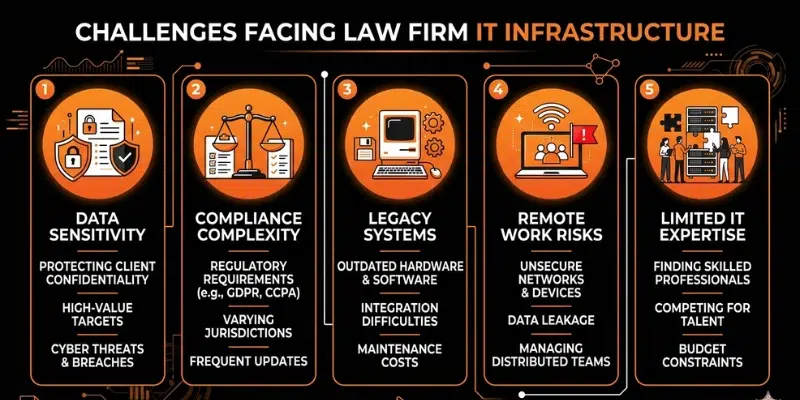
1. Data Sensitivity
Law firms are prime targets for cyberattacks since they store vast amounts of sensitive client information such as financial records and intellectual property. They are vulnerable to data breaches that can further have legal implications.
2. Compliance Complexity
For a law firm, it is of utmost importance to navigate through evolving regulations such as HIPAA, GDPR, etc., while it manages ethical obligations and document retention. The firms also have to take into consideration multiple jurisdictions that have differing privacy requirements.
3. Legacy Systems
There are many firms that still rely on outdated hardware and software. Such firms may find it challenging to fight security vulnerabilities and may face integration issues. Moreover, such systems reduce lawyer productivity and make it difficult to adapt to technologically advanced and secure cloud-based workflows.
4. Remote Work Risks
With the advent of hybrid working models, some legal teams might choose to work from a location other than their organization. Teams that work remotely may have unsecured personal devices; and home networks. This increases the risk of unauthorised access to sensitive case files.
5. Limited IT Expertise
Many firms lack dedicated; high-level IT staff that can deal with intricate cybersecurity issues or conduct data analysis. This resource shortage results; in reactive rather than proactive infrastructure management.
Core Components of Managed IT Services for Legal Practices
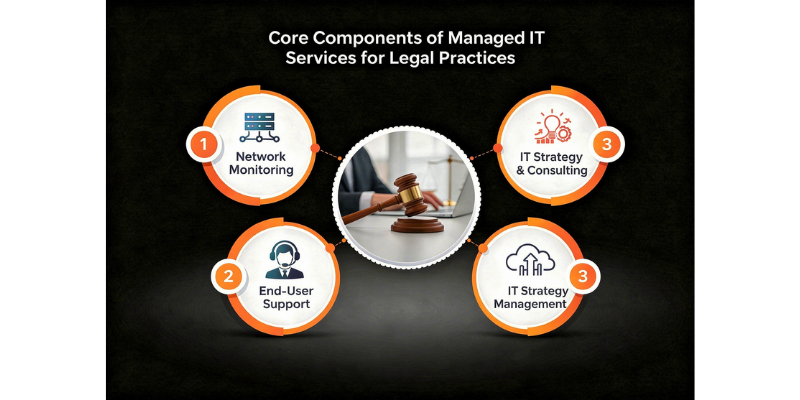
1. 24/7 Network Monitoring and Management
IT managed services for law firms offer continuous, 24/7 surveillance of firm infrastructure. They are able to detect threats and prevent downtimes; while ensuring that security protocols are active. In the process; they protect sensitive client information; and maintain operational continuity.
2. Helpdesk and End-User Support
Managed IT for law firms and legal services provide immediate; and specialized technical assistance for lawyers and staff resolving hardware; software, or document management system issues quickly. This helps minimize billable hour disruptions; and enhances productivity across the legal team.
3. Cloud Infrastructure Management
IT managed services for law firms help set up secure hosting. They also maintain and optimize legal applications in the cloud. This ensures accessibility; data compliance and robust backup solutions for remote and in-office work.
4. IT Strategy and Consulting
This component of managed IT services for law firms aligns technology with the firm’s long-term business goals. Legal IT experts analyze current workflows; and recommend cybersecurity measures, upgrades and compliance strategies. This also involves budgeting for future technology; and navigating regulatory compliance.
Types of Managed IT Services for Law Firms
1. Managed IT Infrastructure Services
IT managed services for law firms maintain the firm’s essential hardware and systems; including servers, desktops, and storage. Providers ensure hardware is updated; and performing optimally, allowing legal staff to work without technical interruptions or equipment failures.
2. Cybersecurity Managed Services
These kinds of managed IT services for law firms protect sensitive client data through continuous monitoring; firewall management; and threat detection. This includes defense against phishing and ransomware; ensuring that confidential attorney-client communications remain secure.
3. Compliance & Data Privacy Management
IT managed services for law firms ensure firms meet strict legal regulations like HIPAA or GDPR. Providers implement necessary security protocols; conduct regular audits; and manage data sovereignty; reducing the risk of hefty fines and reputational damage.
4. Cloud Managed Services
Managed IT services for law firms help migrate and manage legal resources in secure cloud environments; such as AWS or Azure. This lets anyone access to case files; enhances collaboration between remote teams; and provides scalable storage that grows as the firm grows.
5. Managed Network & Connectivity Services
Providers offering managed IT services for law firms manage the firm’s internet; VPNs, and Wi-Fi to ensure reliable and high-speed connectivity. This is important for accessing remote research databases and maintaining secure communication between multiple offices.
6. Backup, Disaster Recovery & Business Continuity
IT managed services for law firms are inclusive of automated data backups so that systems can be restored after a cyberattack or a crash. Furthermore; the backups ensure quick restoration of critical case documents even if server fails.
7. Legal Software & Application Management
Providers that render managed IT services for law firms; take care of end-to-end legal software and application management. They install, integrate, and update specialised tools; making sure that the applications run seamlessly and integrate smoothly with other systems in the firm.
8. Managed AI & Automation Support
Managed IT services for legal professionals implement AI tools to automate repetitive tasks such as legal research, document review, and contract analysis. Automation reduces manual errors; speeds up administrative workflows; and lets attorneys focus on strategy.
9. IT Strategy & Legal Consulting Services
Managed IT services for legal professionals act as a Virtual CIO (vCIO), helping law firms align technology with their business goals. They support long-term budgeting, plan digital transformation strategies, and select the right tech stack to give the firm a competitive advantage.

How Managed IT Services Support Legal AI, eDiscovery and Automation Tools?
Managed IT services handle the technical side of a law firm’s operations; so everything runs smoothly in the background. They make sure data loads quickly; cloud systems stay secure, and sensitive eDiscovery files are protected at all times. They also ensure AI tools for contract review; and document analysis work properly with the firm’s existing systems. Additionally; they help maintain compliance, and offer ongoing support.
Benefits of Managed IT for Law Firms and Legal Services
i. Enhanced Data Security and Client Confidentiality
Managed IT services for law firms play an important role in protecting sensitive case data 24/7. They deploy continuous monitoring; advanced firewalls and encryption to safeguard client information from breaches.
ii. Regulatory Compliance and Risk Management
Specialized IT managed services for law firms strictly adhere to financial, legal, and data protection standards such as ABA or GDPR rules. As a result, liabilities are reduced with regular audits and secure backups.
iii. Reduced IT Downtime and Business Continuity
Managed IT services for law firms provide proactive maintenance. To minimize failures, they provide instant technical support; as a result, they help legal teams keep operational during emergency events.
iv. Predictable and Cost-Effective IT Spending
Managed IT services for law firms replace unpredictable emergency; repair costs with a subscription-based model at a flat rate. This reduces the need for in-house staffing; and firms can allocate their budgets for better technology.
v. Access to Legal IT and Security Expertise
IT managed services for law firms help firms understand legal workflows and software. They offer specialized knowledge in infrastructure management and cybersecurity.
vi. Scalable IT Infrastructure
Managed IT services for law firms let IT systems grow as the operations of the firms grow. They help add users; storage and security measures in order to support extension without the need for upfront capital investments.
vii. Better Support for Legal Software and Tools
Specialized providers that deliver IT managed services for law firms handle installation; updates and maintenance of legal-specific software. They ensure optimal integration and performance.
viii. Strategic IT Planning and Digital Transformation
Managed IT services for law firms guide law firms in planning and managing their technology for the long term. They help update IT systems, move operations to the cloud, and use smart tools like AI, making sure the firm stays efficient and competitive as the market changes.
How to Choose a Managed IT Service Provider for Your Firm?
1. Experience in the Legal Industry
Legal-focused managed IT services for law firms take into account unique firm workflows such as e-discovery tools and document management systems. They are well-versed in legal-specific, ethical, and regulatory standards. With this specialized knowledge; they help align technology with the firm’s goals.
2. Strong Cybersecurity Credentials
Look for managed IT services from providers with strong cybersecurity credentials; such as SOC 2, CISA, CISSP, etc. They should offer multi-layered defense; including encryption, threat monitoring, and employee training.
3. Clear Service-level Agreements (SLAs)
When it comes to building custom legal AI models, clear service agreements are important. An SLA is a written agreement that explains what level of service you can expect, such as system uptime and how quickly issues will be fixed. It also sets responsibility if the provider does not meet those standards.
4. Transparent Pricing Models
Choose a managed IT service for law firms with clear, predictable billing such fixed monthly or person rates. The transparency lets your firm budget accurately and avoid any surprise charges. A reputable provider will conduct an IT audit first to provide an honest quote.
5. Proven Client References
Speaking directly with references; shows the true reliability of managed IT services for legal professionals. Long-term client relationships indicate consistent performance; and strong responsiveness.
Future Trends Shaping Managed IT Services for Law Firms
i. Zero-trust Security Architectures
As law firms handle increasingly sensitive client and case data; zero-trust security is emerging as a key trend in managed IT services for law firms. This approach is required. Every lawyer, staff member, and device must prove their identity before accessing any system. Each user gets only the minimum access needed for their work.
ii. AI-driven IT Operations
AI-powered eDiscovery software development; helps keep IT systems running smoothly and fixes problems quickly. It looks at lots of system data to predict and solve issues before they disrupt work, so lawyers don’t lose important billable hours.
iii. Increased Focus on Data Privacy
With rules like GDPR, law firms are making privacy a priority from the start. Managed IT services for law firms help by controlling who can access data; automatically checking compliance; and using strong encryption to keep client communications safe.
iv. Deeper Integration with Legal Tech Platforms
Managed IT services for law firms are now deeply integrated tools like AI, document automation, and billing platforms directly into a law firm’s core systems. This shift moves IT from just fixing computers to proactively managing, securing, and optimizing legal workflows.

Why You Should Outsource Managed IT Services for Law Firms from A3Logics?
Struggling with IT downtime; security risks, or compliance headaches? Outsource managed IT services to A3Logics; a trusted legal software development company, and get 24/7 monitoring, proactive issue resolution, and secure cloud management designed specifically for law firms.
With our services; your lawyers can focus entirely on clients and billable work while we protect sensitive data, ensure systems run smoothly, and help your firm operate efficiently; reducing risk and supporting growth from day one.
Conclusion
A firm’s success relies on legal insight and reliable technology. Managed IT services for law firms handle system monitoring, cybersecurity, and cloud management; letting firms focus on cases instead of technical issues. The real value comes from a partner who understands legal workflows; compliance requirements, and technology integration. With the right managed IT provider; your firm stays secure, and efficient.