
Insurance claim-related fraud costs insurers billions every year. This hampers the trust between insurers and policyholders. A claim fraud occurs in various forms, from fabrication to exaggerated claims. It doesn’t just lead to financial losses but also operational inefficiencies.
To fight the rising fraud cases in claims, the insurance industry is incorporating advanced technologies; such as the implementation of AI for insurance claims fraud detection.
As an insurer, if you are interested in enhancing fraud detection and wish to improve claims efficiency, you will find deep value in this post, as we take you through how real-time fraud scoring works in insurance claims processing, the top red flags that signal if a claim is fraudulent or not, and many other useful insights.
What Is AI for Insurance Claims Fraud Detection?
AI for Insurance Claims Fraud Detection is a system that uses machine learning to study claim behavior and detect irregular patterns. It evaluates data from many sources and identifies claims that show unusual traits or hidden risks. The technology helps you act before loss occurs and reduces the need for long investigations.
Key Statistics on AI’s Impact on Fraud Detection
- Out of millions of insurance claims that are processed in the U.S., approximately 20% of them are fraudulent.
- In terms of money, insurance fraud costs the U.S. $308.6 billion annually.
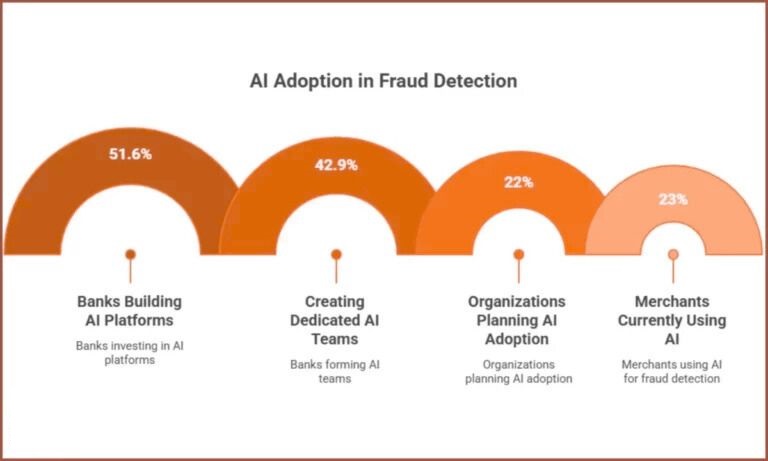
- 87% of global financial institutions now deploy AI-driven fraud detection.
- When an auto insurer used analytics to uncover a fraud network tied to a staged accident, it boosted subrogation recovery by $1 million in one month.
How Real-Time Fraud Scoring Works in Insurance Claims Processing?
AI examines dozens—sometimes hundreds—of indicators, such as:
1. Claimant History
In AI for insurance claims fraud detection, claimant history helps identify patterns of past claims. By reviewing past data; insurers can flag unusual behavior. They can analyze risk, and detect fraud in real time.
2. Repair Shop Patterns
Insurance claims fraud detection uses repair shop patterns to analyze parts replaced; costs, and maintenance timelines. This monitoring helps flag suspicious claims and inconsistencies; prompting early intervention against fraud.
3. Medical Provider Billing Patterns
AI for insurance claims fraud detection helps analyze hundreds of thousands of medical reports and loss run forms. Insurers can gain immediate access to all claims and investigate the provider’s legitimacy.
4. Location Anomalies
AI for insurance claims fraud detection tracks policyholders’ sudden changes in location or device usage patterns. It verifies claims and flags suspicious activities; helping prevent losses and reducing the chances of fraud.
5. Document Metadata
In insurance claims fraud detection; document metadata helps identify suspicious edits, unusual submission times, and file origins. It flags anomalies, verifies the authenticity of documents, and prevents fraud.
6. Claim Submission Timing
Claim submission timing demonstrates when a claim is filed by customers. Real-time scoring compares this timing with expected patterns to detect fraudulent claims instantly.
7. Duplicate Claim Behavior
Fraud detection in insurance claims checks suspicious claims for repeated submissions across the system. The real-time analysis flags duplicates and prevents insurers from paying fraudulent insurance claims.
Real-time scoring cuts down fraud detection from weeks to milliseconds.
Top AI-Detected Red Flags That Reveal Suspicious Insurance Claims
AI-powered systems flag red flags that humans often overlook:
1. Claims Filed Shortly After Policy Purchase
Software that use AI for insurance claims fraud detection monitor new policies. They flag claims that are filed too soon; and reveal suspicious insurance claims in real-time.
2. Multiple Claims Using the Same Contact Number or Address
Insurance claims fraud detection tracks contact details across several claims at once. These platforms spot repeated use; and reveal suspicious insurance claims quickly.
3. Photos that Appear Manipulated or AI-generated
Insurers can use AI for insurance claims fraud detection to analyze image data and detect AI generated or altered photos before approval.
4. Unusual Billing Codes from Medical Providers
Billing codes are carefully reviewed in insurance fraud detection automation. The tool detects unusual activity and supports fast decisions to mitigate frauds in time.
5. Claimant Involved in Multiple High-risk Claims
Platforms using AI for insurance claims fraud detection flag a claimant with multiple high-risk claims linking repeated injuries, risky providers and similar cases.
6. Geographical Inconsistencies in Accident Location
Insurance claims fraud detection tracks accident locations across claims. It identifies mismatches; and shows suspicious insurance claims in real-time so that accurate decisions can be made and escalations can be prevented.
AI never gets tired, or biased; it detects what humans might miss.

Pattern Recognition in Insurance Fraud: How AI Identifies Hidden Anomalies
Fraud patterns are often hidden. This is where AI uncovers hidden patterns such as:
1. Repeated Combinations of Events
AI for insurance claims fraud detection; compares new claims to past records and detects when a claimant files similar events repeatedly. Such repetitions may indicate a fraud.
2. Suspicious Provider-claimant Networks
By using AI in fraud detection in insurance claims, insurers can build graphs of claimants, clinics and providers. AI uncovers hidden collusion when the same providers repeatedly appear with many claimants.
3. Abnormal Timing or Frequency
Fraud detection in insurance claims use AI to flag claims that are submitted unusually soon after a policy activation or prior claim. Or, with abnormal frequency for one claimant.
4. Fake or Synthetic Identities
With software development services; you can create a platform that uses AI to detect identity anomalies, metadata mismatches, or repeated contact details across multiple claims, revealing identity theft.
5. Coordinated Fraud Rings
Insurance claims fraud detection platforms using AI, predictive analytics, and other advanced technologies; can detect clusters of interlinked claimants; providers or repair shops working together to conduct organized fraud.
Pattern recognition is especially powerful against complex fraud schemes.
How Predictive Analytics Prevents Future Claims Fraud Before It Happens?
In advanced fraud detection technologies – such as touchless claims insurance; predictive analytics recognizes hidden patterns and anomalies within large datasets. For instance; it can alert insurers when a claim shows abnormal activity; like many filings in a short span. With this capability; insurers can investigate suspicious claims before they escalate; saving resources.
Another important aspect of predictive analytics is the use of risk scoring. Using this technique; insurers can assign a number score to each claim based on various factors. High-risk claims with higher scores can be flagged for thorough investigation.
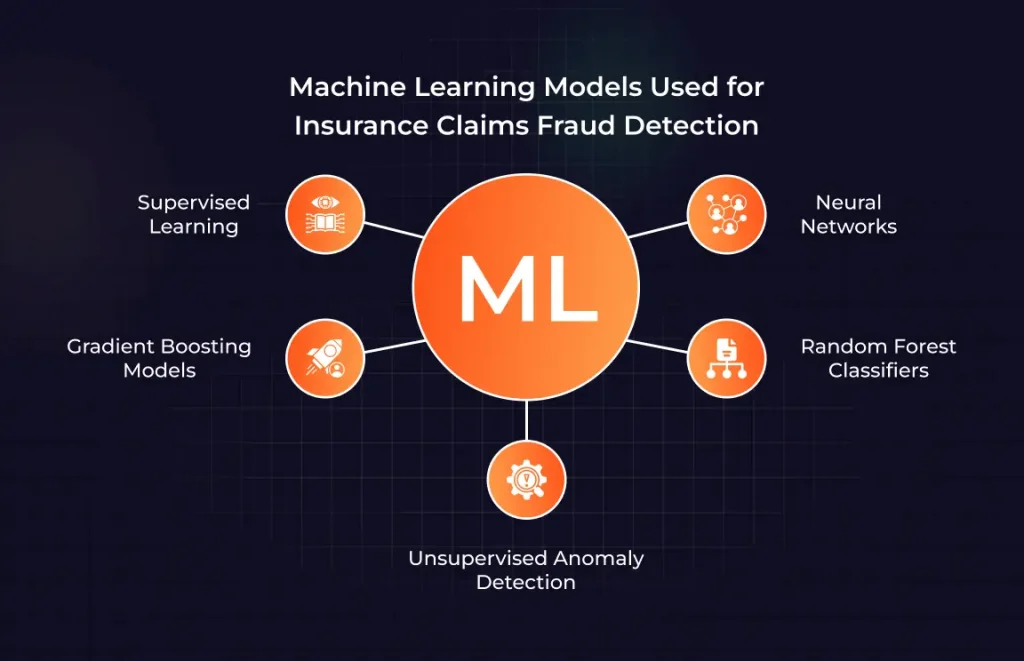
Machine learning is yet another important element that improves the efficacy of predictive analytics. Through machine learning algorithms; tools can identify complex patterns and relationships and reduce false positives.
Benefits of AI-Driven Fraud Detection for Modern Insurance Companies
Let’s have a look at some of the benefits of AI-based fraud detection tools –
1. Faster, More Accurate Claims Processing
AI-based fraud detection software; can analyze large volumes of data and accurately identify suspicious patterns. The tools recognize complex activity patterns and help insurers spot fraud.
2. Reduced Loss Ratios
AI-driven fraud detection tools can scan claim data; across documents, images, and other formats. They identify risky patterns and stop wrongful payouts. Hence, improve loss ratios.
3. Lower Investigation Costs
AI fraud detection tools lower investigation costs by automating risk checks, reducing unnecessary manual investigations; speeding up claims processing, and ultimately reducing investigation costs.
4. Better Customer Experiences
As opposed to traditional fraud detection, AI-driven platforms speed up genuine claim approvals. They reduce repeated document requests, investigation delays, and ensure fair decisions. Customers can get claims processed faster; and get better service.
5. Fewer False Positives
AI cuts down false positives; making sure that genuine claims are processed while fraudulent ones are red-flagged. It does this through real-time cross-checks against verified data sources.
6. Enhanced Regulatory Compliance
AI-driven fraud detection frameworks; ensure all data is access-controlled, encrypted, and compliant with regulatory frameworks such as HIPAA, GDPR, or ISO standards.
AI vs. Traditional Fraud Detection: A Detailed Comparison for Insurers
| Feature | Traditional Fraud Detection | AI-Driven Fraud Detection |
| Speed | Slow; investigation may take days or weeks | faster, real-time claim assessment. |
| Data analysis | Manual review of claim forms, invoices, and documents. Limited to detecting visible anomalies | Automated analysis of large datasets such as historical claims, images, patterns, etc. Capable of finding hidden patterns. |
| Investigation costs | High because of higher overhead expenses, operational costs, and extensive manual labor. | Lower since AI helps automate tasks, and staff can focus more on high-risk claims and reduce manual reviews. |
| Scalability | Can’t handle growing claim volume. | Scales easily, regardless of the number of claims. |
| Decision making | Less efficient; investigators make decisions based on past experience | Faster, data-driven, accurate decisions based on risk scores, explainable insights, and alerts |
| Fraud patterns | Can only detect obvious or previously known patterns | Identifies complex, hidden, and evolving fraud networks. This also includes collusion between claimants and providers |
Real-World Case Studies: How AI Helped Insurers Reduce Fraud Losses
ClaimPro Corp, a leading player offering life, general, auto and health insurance was struggling with escalating fraudulent activities. These were significantly hampering its profitability as well as operational resources.
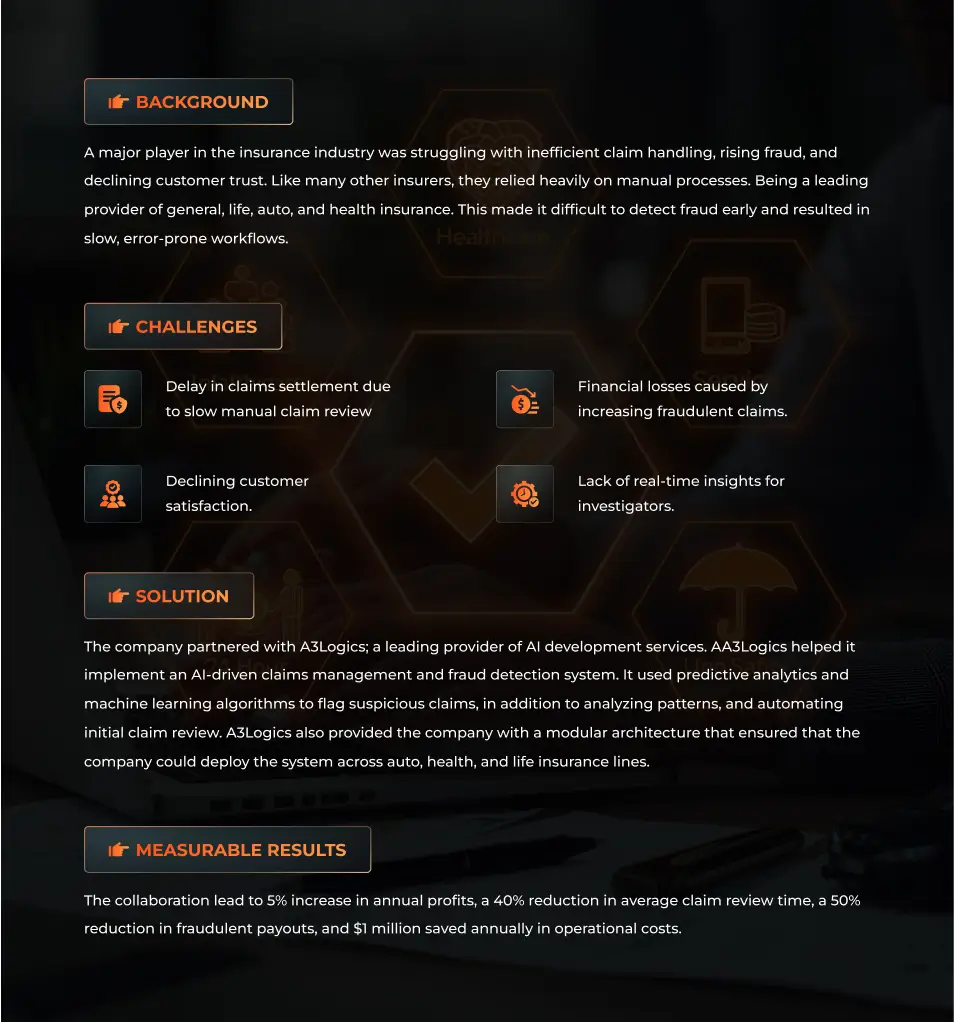
They partnered with A3Logics; a leading AI development company, who developed a bespoke fraud detection framework which was tailored to ClaimPro’s unique challenges. A3Logics leveraged machine learning; real-time data analytics and investigator-focused tools to help ClaimPro combat fraud with precision and even helped in enhancing operational efficiency.
To know more, you can go through the complete case study here.
Common Types of Insurance Fraud AI Can Detect Instantly
Insurers can deploy AI to recognize the following common types of insurance fraud –
1. Staged Auto Accidents
AI-based fraud detection in insurance claims detects accidents; that are intentionally arranged to claim money fraudulently. This prevents unnecessary payouts and protects insurer revenue.
2. Inflated Repair Bills
AI for insurance claims fraud detection identifies repair bills that are much higher than the amounts justified. It ensures accurate payments, preserves operational efficiency, and limits financial loss.
3. Fake Medical Claims
Custom health insurance software development integrates fraud detection tools that flag medical claims without proper verification or treatment.
4. Duplicate Claims
AI identifies multiple claims filed for the same incident. It prevents double payments, improves claim integrity; and reduces financial leakage.
5. Identity Fraud
By analyzing personal data, historical claims, and inconsistencies; AI detects claims made using fake identities. It protects insurers from policy misuse and fraudulent payouts.
6. Contractor Fraud
AI systems analyze reports and invoices submitted by contractors. They even consider their past work patterns to detect suspicious claims at an early stage. An insurer can identify these patterns early; and avoid paying extra
7. Fake Photos Or Digital Manipulation
AI analyzes images for signs of digital manipulation. It stops false visual evidence; prevents fraudulent payouts, and safeguards claim accuracy.

Future Trends in AI for Claims Fraud Detection: What Insurers Should Prepare For
Let’s discuss what we can expect to come in AI in claims fraud detection –
1. Generative AI for Risk Prediction
Generative AI will enable insurers to model complex claim scenarios that reveal subtle indicators of fraud and predict emerging risks with greater accuracy. The technology will strengthen claim review workflows by creating realistic training examples that help AI recognise hidden fraud behaviour and enable faster, more confident decision-making throughout the claims lifecycle.
2. Advanced Image Forensics
Image forensics will let insurers instantly scan submitted photos at the pixel level to uncover hidden alterations. The AI will detect subtle inconsistencies in lighting, metadata, and texture to identify staged, damaged or manipulated evidence in real-time while handling massive volumes of claims with efficiency and accuracy.
3. Cross-industry Fraud Intelligence Networks
These are the systems in which insurers, hospitals, banks, repair networks, and regulators share anonymized claim and fraud data in real time. AI analyzes this data to detect patterns and links indicating coordinated fraud rings and repeat offenders across sectors.
4. Self-learning Fraud Detection Models
Self-learning fraud detection models will keep improving; as they study new claims and learn new fraud tactics. They will adjust risk scores, become more accurate over time, and help insurers make reliable decisions across different types of claims.

Why Choose A3Logics for AI-Powered Insurance Claims Fraud Detection?
Are you losing millions to fraudulent claims without realizing it? Act now with AI-powered detection. Here’s how A3Logics can help –
1. Advanced Risk Analysis
Our AI algorithms analyze historical and real-time claim patterns; to quickly identify suspicious activity and thereby, reduce financial losses.
2. Insurance Software Development Services Expertise
We build intelligent, scalable Insurance Software Development solutions that integrate seamlessly with your existing systems; to enhance accuracy and make processing claims, a smooth process.
3. Continuous Learning and Adaptation
The system evolves with emerging fraud trends; making sure detection remains accurate and proactive against evolving threats.

Final Thought
Insurance claim-related frauds are rampant and if gone undetected, they can cost you millions in financial losses. Not just that, you would even lose credibility in the insurance industry since falling prey to such claim fraud implies that your processes are vulnerable and inefficient. Hence, we hope this post has encouraged you to incorporate advanced AI-based claim fraud detection tools in your workflow.