
AI is altering the way real estate agents work – from developing marketing content to evaluating market trends and automating routine activities. With so many new platforms emerging, it’s not always clear which ones are worth your time and money.
Agents and brokers are in need of efficient and effective real estate solutions that help in managing the ever increasing client demands and administrative tasks. This is where AI agents come in. AI agents in real estate are transforming how the industry works. They provide 24/7 property information, handle routine inquiries and streamline client communications. From answering the usual questions regarding listing and scheduling viewing and qualifying leads these AI agents help real estate businesses scale their operations while maintaining a level of personalization.
In this blog we are going to dive deeper into the importance of AI agents in real estate and how they are transforming the entire industry. Let’s understand the various real estate AI agents use cases and how to build AI agents for real estate.
Understanding AI Agents
AI agents are intelligent systems that are capable of – environmental perception, take actions and learn to achieve goals. They are autonomous entities that – communicate with the world, process information, make decisions and adapt their behaviour according to the experience. AI agents are capable of performing various tasks – whether it is a simple reactive task like adjusting the thermostat temperature or complex learning agent like self-driving cars, that navigate roads and learn from experience.
When it comes to decision making AI agents are dependent on algorithms, rules and even machine learning models to evaluate multiple inputs, consider various outcomes and choose between the most effective course of action. Take for an example that an AI agent in the finance industry can analyze in real time the market data and recommend trends based on the risk profiles.
For task automation AI agents reduce manual effort by taking care of handling repetitive or complex operations. They can schedule, process documents, monitor systems and even interact with the users with natural language. Unlike the traditional automation, AI agents adapt to changes in context, learn from past interactions and refine their performances on the regular basis.
Combining this adaptive decision making and automation, AI Agent Development Services are able to help businesses to improve efficiency, accuracy and scalability across sectors.
Types of AI Agents
AI agents can be of various types. Reactive, model based, goal oriented and other. In this section let’s take a look at some of the most popular types of AI agents.
1. Reactive agents
These are the most basic AI agents that respond to sensory stimuli directly without memory or planning. They behave as stimulus-response devices, responding based on the environment’s immediate state. Consider a thermostat that just turns the heat on or off in response to the room temperature as it is now. Reactive agents are appropriate for easy tasks but cannot learn from previous experiences or make future plans.
2. Model-based agents
These agents have a model of the world internal to them, from which they can project what the world would be like in the future and plan what to do. They don’t simply respond to the moment; they look ahead to see the results of what they do and make decisions based on how that is going to affect the future. A driverless car, from its sensors and maps, is an example. Model-based agents are more sophisticated than reactive agents and can exhibit more sophisticated and strategic behavior.
3. Goal-oriented agents
These agents possess clear-cut objectives they seek to accomplish via actions. They want to arrive at some desired state or finish a particular task, using strategies and planning in order to accomplish their goals. A piece of classic software exhibiting an AI-based playing to win chess by moving its pieces in a strategic manner is a good example. Goal-oriented agents are motivated by a distinct goal and engage in more goal-oriented behavior as compared to their reactive or model-based counterparts.
4. Utility-based agents
This kind of agent places values on various outcomes, choosing to make choices that optimize their total utility or “happiness.” They look at not only the objectives themselves but also at possible rewards or penalties that might come with various actions. A recommending shopping system that recommends products based on a customer’s previous purchases and interests is a nice illustration. Utility-based agents decide on the basis of calculated evaluation of possible consequences – preferring actions with the maximum expected value.
5. Learning agents
Over time, these AI agents improve through autonomous learning. With experience AI agents are able to behave more effectively and efficiently. A chatbot that learns from user interactions can provide more tailored answers. Learning agents are the most advanced, evolving and improving through environmental contact.
- Also Read: An Ultimate Guide to Building AI Agents
AI Agents in Real Estate
According to recent research AI and generative AI are going to have a significant impact on the real estate industry. With use cases of AI in the real estate industry expected to grow by $41.5 billion by 2033 at a CAGR of 30.5% we can expect to see a significant increase in the number of AI agents contributing to the real estate industry. But first, let’s understand the role of AI agents in real estate.
Real estate AI agents are computer-based assistants that utilize artificial intelligence in helping real estate agents and customers. They are capable of automating functionalities such as scheduling appointment times, handling listings, analyzing market trends, and even providing personalized suggestions.
Agents make use of algorithms to interpret – client specifications, determine compatible properties, and offer insights that smooth out the transaction process. They are smart middlemen, simplifying the real estate experience and making it faster, more efficient, more data-driven, and more customer-focused.
Differences between generic AI systems and real estate-specific AI agents:
| Aspect | Generic AI Systems | Real Estate AI Agents |
| Purpose | Broad, multi-domain tasks | Real estate–focused workflows |
| Data | General datasets | Market, MLS, pricing data |
| Insights | Generalized recommendations | Context-aware property insights |
| Automation | Basic tasks (FAQs, scheduling) | Property valuation, lead matching |
| Accuracy | Limited in real estate | High relevance, domain-specific |
| Integration | Generic tools (CRM, chat) | MLS, real estate CRMs |
| Compliance | General standards | Real estate laws & regulations |
| Experience | Limited personalization | Tailored client/property matching |

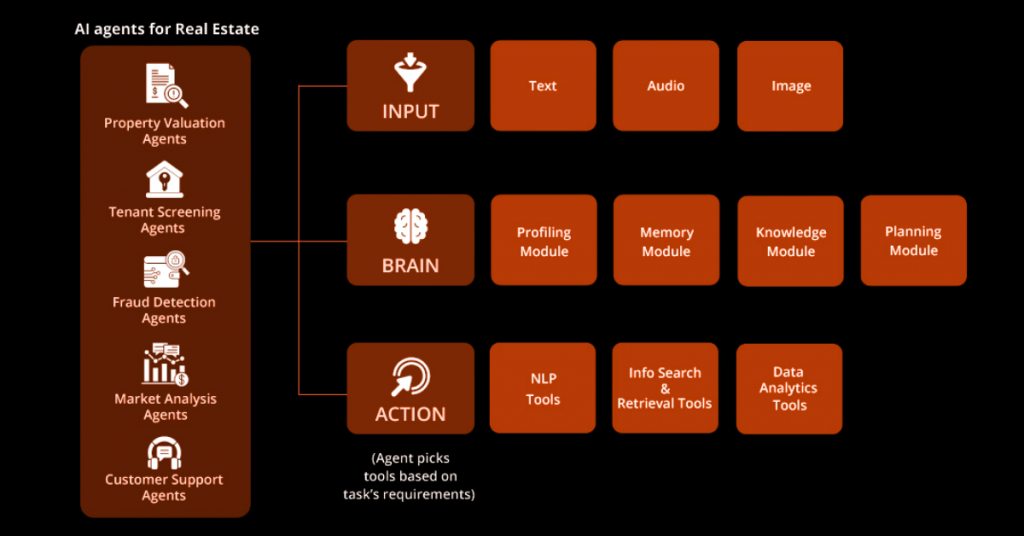
Key Components of AI Agents for Real Estate
1. Input (Data Sources & Signals)
The basis on which an AI agent comes to know about the real estate ecosystem. AI is incapable of making – trustworthy predictions or suggestions without good data.
Property Data & Listings: Extracts data from MLS databases, property management systems, and real estate websites. Provides information such as square footage, amenities, ownership history, and property age.
Market & Economic Indicators – Monitors interest rates, building activity, local buying habits, area price movements, and investment trends.
Client-Focused Inputs – Records purchaser and seller needs, browsing history, stored searches, and budgetary inclinations to tailor property recommendations.
External & Environmental Inputs: Examines school ratings, crime rates, proximity, weather risks, and regulative changes that impact property desirability and worth.
2. Brain (Processing, Reasoning & Decision-Making)
This is where the AI “thinks.” The brain interprets structured and unstructured data into insightful information with – sophisticated algorithms and models of reasoning.
Data Processing & Normalization – Removes – duplicates, standardizes formats, and merges cross-platform property data for uniformity.
Reasoning Engine – Executes real estate business rules, ]for example, determining whether a property is underpriced versus local comps.
Predictive Analytics & Forecasting: Forecasts future trends in pricing, rental returns, or the probability of selling properties on the basis of past data and prevailing market conditions.
Contextual Personalization: Personalizes offers for every customer – offering upmarket properties to one customer and low-budget flats to another depending on past interactions.
Risk & Compliance Analysis: Examines legal, zoning, or compliance risks that may impact transactions.
3. Action (Automation, Recommendations & Execution)
This is the “output” stage in which insights are converted into concrete business actions – that save time and money, as well as enhance customer experiences.
Automated Recommendations: Recommends properties, pricing strategies, or investment opportunities in real-time.
Workflow Automation – Manages activities such as arranging for property visits, sending follow-up emails, producing contracts, and routing leads to agents.
Smart Execution – Initiates automated activities; such as scheduling showings in a CRM or resetting price alerts for clients.
Conversational Interfaces – AI chatbots and virtual assistants engage both the buyers and tenants continuously answering queries and guiding them.
Continuous Learning Loop – whenever there is client interaction AI learns from it. This helps in improving the performance of AI enabling it to make recommendations sharper over time.
Applications and Use Cases of AI Agents in Real Estate
There are numerous applications and use cases of AI agents in real estate. In this section lets take a look at some of them.
1. Property valuation and dynamic pricing
Through automatic valuation models AI agents can evaluate property values pretty and fast, and this data is generally more accurate. These models make use of previous sales, property features and new market trends to understand the right value of the property. AI agents can deliver real-time updates and more accurate values by learning from fresh data.
The AI agents identify market trends to help investors and real estate professionals make judgments. AI agents can anticipate – property valuations, rental prices, and property type demand. This is possible by studying historical data and current market conditions. Strategic planning and investment require this data.
2. Enhanced customer service & virtual assistants
AI-driven virtual assistants and chatbots improve customer service through quick responses. These agents are capable of scheduling viewings and answering property listing questions saving time. Unlike their human counterparts these agents offer 24/7 availability which helps purchasers and renters get help quickly, enhancing consumer satisfaction.
Analysis of user preferences and behavior allows AI agents to recommend properties. These systems assess money, location, and amenities to recommend residences that meet user needs. Personalization boosts transaction success and client pleasure.
3. Efficient property management
With the help of predictive maintenance AI agents can help property managers to avoid any major issues. AI can help understand the insights through IoT sensors and maintenance record data to predict equipment breakdowns and repairs. With a proactive strategy in place it lowers the downtime and maintenance expenses.
AI agents analyze applications, credit records, and rental history to speed up tenant screening. These technologies can spot red flags and predict tenant default and property damage. Automating this process helps property managers make faster, better judgments.
4. Marketing and sales optimization
AI chatbots find good leads and using targeted advertising they optimize marketing. With this AI brokers are better able to identify possible buyers and renters. They are doing this through monitoring social media, search engines and other internet data with focused strategies that boost marketing efficiency.
With AI creating compelling descriptions, virtual tours and video property listings are much more interesting. These tools emphasize property attributes and produce appealing presentations using NLP and computer vision. Automation saves real estate agents time and assures high-quality listings.
5. Risk Assessment and Fraud Detection
By using machine learning it becomes so much easier to scan through enormous amounts of property records, financial histories, buying patterns making threat detection more accurate and quicker. Through anomaly detection, such as detecting duplicate claims of ownership, fraudulent documents, or suspicious buyer behaviors, the risk of fraud is lessened. This protects banks, brokers, and real estate companies from both their investments and client confidence.
6. Smart Contract Management (Blockchain + AI)
Combining blockchain with AI provides secure, autonomous smart contracts for Real Estate Software Development. AI agents can check for compliance, initiate contract milestones (such as payments or title transfer), and track conditions in real time. With this there is a decrease in manual intervention, more transparency, and lower conflicts in property transactions.
7. Environmental & Sustainability Analysis
With AI coming into play it is so much easier to analyze the environmental aspects like energy efficiency, carbon emissions, water consumptions and local environmental issues. It helps investors and developers in creating more eco-friendly projects and offer solutions in harmony with environmental regulations around sustainability. Feedback from such an analysis also increases a property’s long-term value and marketability.
8. Space Utilization and Design Recommendations
AI-based systems can evaluate floor plans, occupancy rates, and tenant habits to suggest improved space use. From streamlining office seating layouts to proposing residential renovations; the systems maximize both efficiency and comfort. Architects and developers utilize such knowledge to create more efficient, user-friendly properties.
9. Transaction Management and Automation
By using AI agents in real estate to facilitate property transactions through automated document validation, compliance and payment scheduling reduces the administrative burdens. This means faster closing periods and lower error risks. With this buyers, sellers and brokers are quicker with seamless deals that require less paperwork.
10. Market Research and Competitive Analysis
By using real time processing for property listings, sales statistics and market trend data analysis AI gives actionable insights for pricing, demand fluctuations and what the competition is doing. This tool can be used by brokers and developers if they are looking to find profitable opportunities. This means refined strategies and staying ahead of the competition.
11. Safety and Security Monitoring
Artificial intelligence-based surveillance and incorporation of IoT strengthen property security. The system is able to identify uncharacteristic activity, halt unauthorized entry, and even anticipate potential safety threats such as fire hazards or equipment breakdowns. This renders properties secure for tenants, while limiting liability exposure for the owners.
12. Financial Management and Investment Optimization
AI agents help investors and property managers to analyze rental returns, cash flows, mortgage issues and give ROI estimates. By creating various investment scenarios they help in making more intelligent portfolio decisions. This means more long term profitability along with lower chances of financial mistakes in ever-changing real estate markets.
- Also Read: AI Agents For Customer Service
Key Benefits of AI Agents in Real Estate
AI agents offer various benefits across the real estate industry. Let’s take a look at some of the advantages of AI agents in real estate.
1. 24/7 access
Humans get tired and need rest this means that human customer service representatives is that they work only during office hours. However, AI representatives are available 24/7 and respond to inquiries at any time and day. This means greater access to information for potential customers and tenants, whenever required and a generally improved customer experience and engagement.
2. Efficient customer assistance
AI agents are capable of processing a gargantuan number of questions at the same time without hesitation or error. They respond with short responses to routine questions regarding property characteristics, prices, availability, and other matters so that human agents can focus on more difficult tasks.
3. Personalized advice
With the help of machine learning it is possible to for AI agents to learn the user behaviour, thier interests and habits to make personalized property recommendation. Personalized strategy enhances the likelihood of matching buyers or renters with properties that meet their individual criteria.
4. Data-driven intelligence
AI agents have the capability to analyze massive data sets and deliver relevant insights into real estate market trends, property price movements, and investment prospects. Data-driven intelligence makes real estate agents able to make data-driven decisions and plan their strategy accordingly.
5. Automated procedures
AI agents can help with other administrative tasks too like scheduling property viewings, reminders and handle documents. This is especially possible through task automation, which means less manual labor and improve operational efficiency.
6. Enhanced lead generation
AI agents can identify and qualify leads by budget, location desires, and buying intentions. With a focus on high-quality leads, real estate salespeople can focus on prospects that are more likely to convert, maximizing sales efficiency.
7. Improved security and compliance
Processing sensitive data safely, AI agents can ensure regulatory compliance and data protection laws. This reduces the risk of human mistakes and enhances client trust in the process of buying and selling real estate.
How to Build an AI Agent for Real Estate?
Creating an AI agents in real estate involves integrating domain expertise, data engineering, LLM development services, classical ML, systems engineering, and UX design. The following is a clear, actionable roadmap that guides you from strategy to production and continuous improvement — including practical tips, pitfalls, and recommended tools.
1. Define scope, goals, and use cases
Begin with clear goals. Are you creating a buyer-assistant chatbot, an automated valuation model (AVM), a property-matching agent, a leasing automation assistant, or a full-stack agent that performs all of the above? For every use case, specify:
- Success metrics (e.g., lead conversion uplift, valuation MAE, time-to-schedule viewings).
- Inputs and outputs (documents, APIs, conversational UI, dashboards).
- Constraints (latency, compliance, offline availability).
- A well-scoped project avoids scope creep and concentrates data collection and engineering.
Tip: Write brief user stories (agent personas + tasks) to elicit requirements from brokers, agents, investors, and end-users.
2. Choose the appropriate LLM(s)
- Select LLM(s) on the basis of cost, latency, on-premises vs cloud requirement, and support for domain adaptation.
- General large models (GPT-class, Claude-class) are good for natural language and reasoning.
- Small/inference-optimized models and parameter-efficient fine-tuned variants (LoRA, adapters) are good for low-latency or edge situations.
- Have a consideration for hybrid structures: a smaller local model for routing/intent + a big cloud LLM for complicated reasoning or summarizing.
Tip: Check model hallucination bias and grounding; if extremely high factual correctness is paramount (valuations, legal/regulatory responses), budget a RAG layer and grounding tests.
3. Gather and prep the real estate data
Quality data is the backbone.
- Internal data: includes – CRM leads, transaction history, agent notes, and proprietary listings.
- External data: includes MLS/IDX feeds, public property records, tax rolls, demographics, and school ratings, crime statistics, zoning and regulation documents, market indices, satellite imagery, street view, etc.
- User signals: include search queries, saved listings, clickstreams, interaction logs.
- Documents: Contracts, inspection reports, appraisals, disclosures, PDFs.
- Do ETL: ingestion, normalization, deduplication, canonical schema mapping, and enrichment (geocoding, area normalization). Construct pipelines for ongoing updates.
Pitfall: Incomplete or biased historical data warps pricing models, proactively look for sampling biases (neighborhoods, price bands).
4. Train the model for domain-specific tasks
Determine which components need fine-tuning vs retrieval
- Fine-tune LLMs for conversational tone, regulatory jargon, and domain-specific nomenclature (e.g., local law jargon).
- Train classical ML models (gradient boosting, random forest, neural nets) for AVMs, lead scoring, churn prediction, or pricing drivers where structured features predominate.
- Use parameter-frugal tuning (LoRA, adapters) where compute or data is constrained.
- Data labeling: Construct human annotation workflows using comps selection, valuation labels, intent labels. Make use of active learning to optimize label efficiency.
5. Construct AI agent architecture
Create a modular architecture
- Front-end (chatbot UI, mobile app, dashboard).
- Orchestration layer (agent manager that sends tasks to modules).
- NLU/NLU pipeline (intent, entity extraction, dialog manager).
- RAG/Vector DB (embeddings, semantic search).
- Domain models like AVM, lead score, and recommendation engine.
- Action modules (calendar booking, CRM writebacks, contract generation).
- Monitoring & logging (observability, A/B testing, feedback loop).
- Pattern: Microservices + event-driven architecture for scale and easier iteration.
6. Integrate Natural Language Understanding (NLU)
NLU brings conversational intelligence to life
- Intent classification, slot/entity extraction, and context tracking.
- Utilize pretrained models for NER customized to property entities (sqft, beds, zip, lease terms).
- Develop slot-filling and multi-turn dialog handlers. Support fallback strategies and graceful handovers to human agents.
Best practice: Use rule-based protection for example, UPSERT only on confirmation in conjunction with ML intent predictions to minimize expensive errors.
7. Merge knowledge bases (property info, rules, trends)
Build a RAG pipeline
- Construct embeddings from structured & unstructured sources (listing text, PDFs, law).
- Index into a vector DB (Pinecone, Milvus, Weaviate) and use retrieval + reranking.
- Insert provenance metadata and confidence scores so the agent can cite sources.
Critical: For legal or compliance responses, insist on the agent appending citations or sending to human review.
8. Include reasoning & analytical strength
- Merge LLM reasoning with domain models
- Interpretable AVM outputs: display comps, adjustments, and confidence intervals.
- What-if analysis: the model price changes, rental yields, or investment returns.
- Decision logic: rules-driven automated recommendations for – pricing, rent hikes, and negotiation plays.
- Technique: Have a chain-of-thought-style prompts or maybe a symbolic reasoning module for more transparent decision traces where needed.
9. Generation & summarization of outputs
- Outputs should be actionable and clear.
- Provide brief summaries for instance, “Comparable sales indicate a reasonable listing price: ₹X–₹Y; confidence 78%”.
- Offer multi-format outputs: short answer for chat, in-depth report or downloadable PDF for clients and agents.
- Make tone/verbosity controllable (agent persona for buyers versus investor reports).
10. Ensure ethical AI & bias reduction
- Property can be sensitive to fairness and legal risk
- Assess models for bias (geography, race, income) and comply with fair housing regulations.
- Implement differential privacy or data minimization when necessary.
- Keep logging and audit trails for pricing or approval decisions.
- Governance: AI ethics checklist, sign-offs, and regular audits.
11. Design intuitive user interfaces (chatbots, dashboards, apps)
- UX is important for adoption
- Conversational UI must allow clarifying questions and progressive disclosure.
- Dashboards need to display analytics, alerts, and key metrics (lead velocity, listing performance).
- Mobile-first design for field agents with offline/low-connectivity modes.
Tip: Offer agent controls for override and feedback loops to enhance model output refinement.
12. Testing, validation & compliance checks
Strict QA is not negotiable
- Functional tests for workflows (booking, contract generation).
- Model validation: backtesting AVMs, validation sets for classification tasks.
- Safety tests: hallucination checks, out-of-distribution detection.
- Compliance tests: local real estate regulations, data residency, KYC/AML where relevant.
- Conduct small pilots and A/B tests prior to broad release.
13. Deployment and scalability considerations
- Deploy with production-level practices
- Containerize services (Docker/Kubernetes), autoscale, CDN/cache static assets.
- Optimize latency: cache retrieval results, async pipelines for heavy processing, offload lengthy computations.
- Plan multi-region deployments if serving multiple geographies (data locality laws).
- SLA: Establish uptime, response-time goals, and disaster recovery plans.
14. Continuous monitoring, updates & improvement
- Production AI requires constant nurturing
- Watch model performance (drift, MAE, precision/recall).
- Log user feedback and corrections to retrain models.
- Schedule regular retraining or refresh vector sources.
- Monitor business KPIs linked to the agent (lead-to-sale ratio, time-to-listing).
15. Documentation and end-user training
- Deliver clear materials
- API docs for integrations.
- Admin guides for tuning agent behavior.
- Training for agents/brokers in how to interpret suggestions and override safely.
- Change logs and versioning for model updates.
16. Platforms & tooling (examples)
- Typically utilized frameworks and services:
- Orchestration & agent frameworks: LangChain, AutoGen, CrewAI, LangGraph
- NLU/Dialog: Rasa, Dialogflow, Microsoft Bot Framework
- Vector DBs: Pinecone, Milvus, Weaviate, Qdrant
- ML/LLM hosts: OpenAI, Anthropic, Azure AI, AWS Bedrock, local inference stacks (VLLM, Ray, Ollama)
- Data & infra: PostgreSQL, BigQuery, Snowflake, Kafka, Kubernetes, Terraform
- Analytics & monitoring: Prometheus, Grafana, Sentry, MLflow, EvidentlyAI
How A3Logics Can Help You Build AI Agents for Real Estate?
As a leading AI development company, A3Logics is positioned to help real estate companies harness the power of AI agents. Our experts have a deep expertise in AI agent development services for the real estate sector, we can enhance your services by integrating advanced AI agents into your existing technology ecosystems. Here’s what the experts at A3Logics can offer.
- Get expert driven strategic consultation and requirement analysis for the perfect AI solution development
- Based on the requirement analysis our experts will design a custom AI agent that is tailored to real estate business needs
- Our developed AI agent solutions can be seamlessly integrated with various CRMs, ERPs, and property platforms
- Our job doesn’t end at launch; we also offer ongoing support, maintenance, and continuous scaling for the AI agent solution.

The Future of AI Agents in Real Estate
The future of real estate is pretty bright. With the emergence of AI and other technologies especially IoT is leading to the creation of intelligent buildings and this will make properties much more sustainable and efficient. This is possible through real time energy monitoring, predictive maintenance and personalized tenant experiences. AI-powered predictive real estate investment will enable investors to accurately predict market trends, property appreciation, and rental yields, lowering risk to finances.
Another revolutionary advancement is metaverse property management, where virtual real estate assets will be controlled by AI agents – simulate investment results, and generate new streams of revenue in digital property ecosystems.
In the long run, AI agents will revolutionize the way the real estate ecosystem functions. For brokers and agents, automation will take care of tedious tasks like – property matching, pricing analysis, and paperwork, freeing them to work on relationship-building with clients. For investors, AI-based insights will reduce risks and improve ROI through more intelligent decision-making and fact-supported predictions. Last but not the least, AI agents will usher in a change from reactive to proactive management of real estate – making activities more efficient, transparent, and future-proof.
Conclusion / Endnote
AI is revolutionizing the world to enhance productivity, efficiency, and automation. AI Agents in real estate are soon going to contribute these aspects to the business in the future. Whether it is about virtual tours, auto property valuation, or future real estate trends, AI agents are revolutionizing the real estate business.
AI agents provide innovative solutions to perennial issues – which is a paradigm shift for the real estate industry. Their adoption promises better customer experiences, more efficiency, and new avenues of growth. Embracing these AI-powered solutions will be crucial to staying competitive and current in the digital age as the business continues to evolve.