
Imagine a world where your end-to-end shopping transaction is completed without your involvement. Yes, there are systems that can shop on your behalf. Not just that, they find the best options and compare prices, so that you can land on the right purchase. And, it doesn’t end there; these systems even complete the purchase for you. You don’t have to browse, click, or pay manually. This new way of buying is made possible by Agentic Commerce. It allows AI-powered agents to act on your behalf.
But what is Agentic commerce? How does it work? What technologies power it? We’ll answer all such questions in this blog. Before we dive deeper, let’s have a look at some stats that justify the importance of Agentic commerce –
Stats:
- 20% of shoppers use generative AI for product discovery.
- 65% of online retailers have integrated AI agents in CRM systems to manage customer inquiries and support.
- By 2030, the US B2C retail market could see up to $1 trillion in revenue from agentic commerce. The global projections are expected to reach $3 trillion to $5 trillion.
- 79% of senior executives say their companies are already using AI agents.
What Is Agentic Commerce?
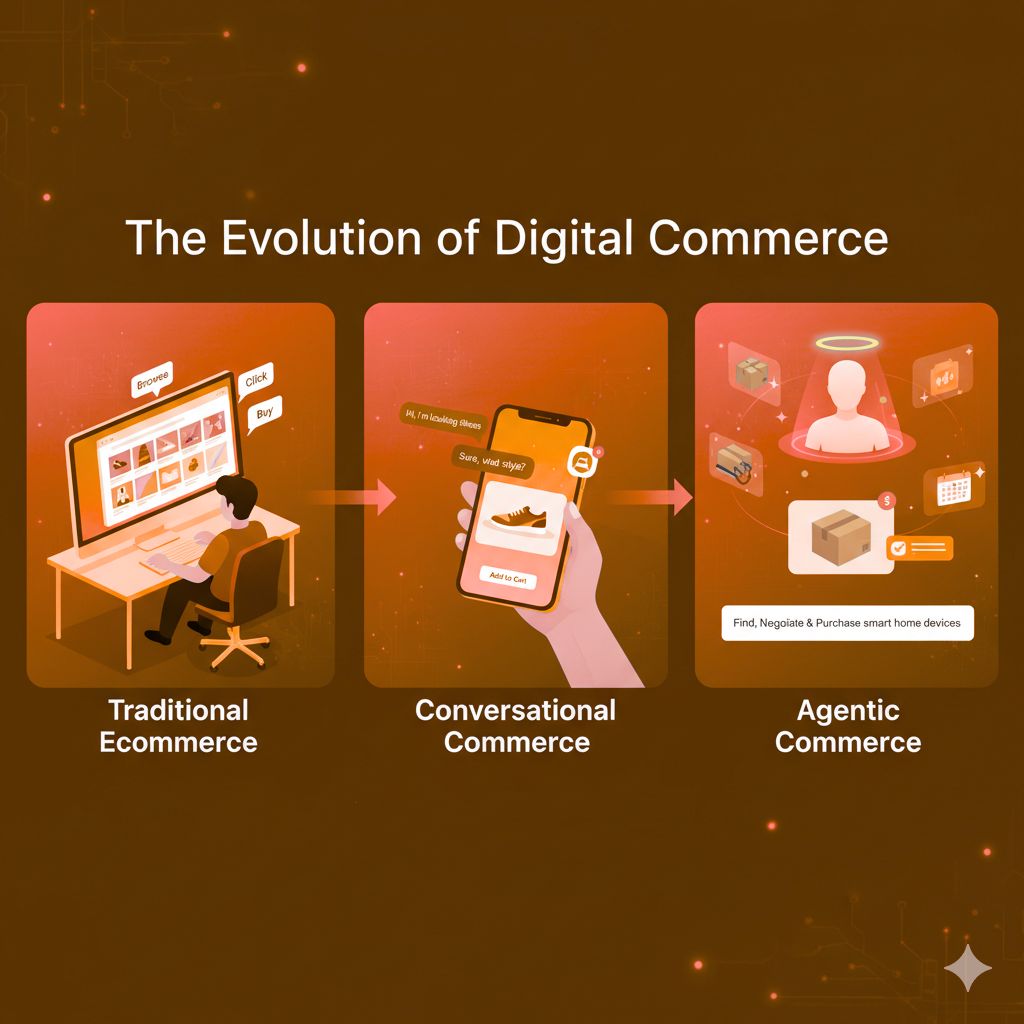
Agentic commerce is a new form of mobile and online shopping; in which an AI agent completes all shopping-related tasks for a user, such as searching for items, comparing options, and making a purchase. It removes the need for manual intervention.
Why Agentic Commerce is Emerging Now?
AI Maturity
Advancements in generative AI have let agents understand intent, context, and preferences with high accuracy. It is for this reason that these systems can now act independently; they can search, compare items, and transact in a secure manner. As AI becomes more advanced and connects easily with other platforms, it’s not just a suggestion tool; instead, it can act on those suggestions.
Consumer Demand for a Frictionless Experience
In both B2B and B2C environments, consumers expect instant, personalized, and hassle-free interactions. Agentic commerce eliminates the need to browse endlessly or fill forms; instead, it can handle purchase, discovery and negotiation autonomously. All of this, while maintaining precision and speed.
Payment Innovation
In Agentic AI commerce, payment innovation is powered by new layers of trust, digital identity, and security. The systems let AI Agents safely identify themselves. They follow zero-trust policies and use tokenized payments; this implies that no real financial data is exposed.
Competitive Pressure for Brands
In a landscape, where customers expect faster, smarter, and more personalized interactions, Agentic eCommerce can instantly understand customer intent. Based on this; it can personalize offers, negotiate prices and close sales autonomously. This helps brands gain a competitive edge over competitors.
Shift in Discovery Channels
As discovery shifts from search engines to AI agents; the traditional sales funnel is collapsing. Instead of going through stages such as awareness, interest, consideration and purchase, AI agents handle everything. They instantly find, compare and buy on behalf of users. Talking in terms of Agentic Commerce solutions, discovery and purchase happen simultaneously.
How Agentic Commerce Works?
Here is the typical workflow from a user’s command to a completed purchase:
1. User Goal & Delegation
In Agentic AI commerce, the process begins with users stating a goal. In the goal, they define their intent, preference, and boundaries and delegate it to an AI agent. The agent takes a purview of a user’s goals to understand what they want, i.e,. the outcome they wish to achieve.
2. Agent Interpretation & Planning
This stage in Agentic eCommerce is where the AI agent understands the user’s intent in natural language. It accesses and analyzes relevant data from memory and relevant sources and understands the context. Furthermore, it translates the context into machine-readable language. After interpreting the context, the agentic AI commerce breaks the complex goal into smaller, sequential tasks; thereby, transforming the intent into a concrete and executable workflow.
3. Information Gathering & “Actionization”
Agentic commerce solutions collect information from sources – such as marketplaces, websites, reviews, and product catalogs to provide comprehensive insights. After collecting the information; the AI agents sort, filter, and organize the data, converting it into structured and meaningful insights. The data is used to perform tasks or make decisions automatically. For instance, using the filtered data, it can make a purchasing decision on the user’s behalf.
4. Reasoning & Decision Making
This is the stage where the AI agent evaluates all options from the previous step. It compares aspects against the user’s preferences and constraints, such as – prices, products, reviews and product availability. Additionally, the agent may also negotiate with the seller or even, check for discounts. After comparing all available options and evaluating them, it selects the best options for the purchaser.
5. Execution & Transaction
Once a decision is made; the agent initiates a secure purchase where it completes all steps of the transaction, including checkout, authentication and payment. For the same, it uses a secure digital identity and tokenized payment systems. The systems make sure that transactions comply with user preferences, and are private and secure.
6. Confirmation & Post-Purchase Management
After the transaction; the agent confirms the order and provides tracking updates. The AI agent isn’t just confined to making purchases. Apart from purchase; the agent can also manage post-purchase activities such as -returns, cancellations or feedback submission. One of the best aspects of Agentic eCommerce is that it learns from past experience to improve future actions.
Core Technologies Powering Agentic Commerce
1. Artificial Intelligence (AI) and Machine Learning (ML)
Both the technologies; i.e., AI and ML, work in sync to make the Agentic commerce agent smart. AI understands what the user wants and interprets requests naturally, understanding the nuances of queries. ML, on the other hand, considers past choices to predict preferences and future needs. Together, AI and ML help the agent in performing tasks such as comparing products; making decisions, and completing experiences.
2. Natural Language Processing (NLP) and Conversational AI
NLP plays an important role in Agentic commerce; by enabling AI agents to understand and interact with human language in a way that mimics human-like communication. Conversational AI lets businesses automate the entire buying journey – from discovery to payment. In simple terms, it takes into purview the whole conversation and eliminates the need for multiple steps and platforms.
3. Large Language Models (LLMs) and Contextual Understanding
The large language models act as the “brain” of the eCommerce agent, enabling it to understand complex requests from users that are in the form of natural language. As a core component of Agentic commerce, contextual understanding allows the agent to interpret requests based on user intent, real-time situations, and preferences. It goes beyond simple automation, and understands the minute nuances of the request.
4. Blockchain and Smart Contracts for Secure Transactions
In Agentic commerce; blockchain delivers a secure ledger that records every transaction and ensures transparency. Since there are multiple parties involved; smart contracts are used to automate agreements between buyers, sellers, and AI agents. This makes sure that payments are only executed when they meet predefined conditions. These help prevent fraud and secure financial data.
5. IoT and Edge Computing for Real-time Decision-making
IoT devices such as sensors, and wearables collect real-world data. Some examples include – user behavior, inventory levels or delivery status. Complementing it is Edge computing; that processes this data locally. It doesn’t rely on distant cloud servers for processing. This helps in instant analysis and response, where AI agents can make quick, context-aware decisions such as price adjustments, or delivery rerouting.
Key Components of an Agentic Commerce Ecosystem
1. AI Agents
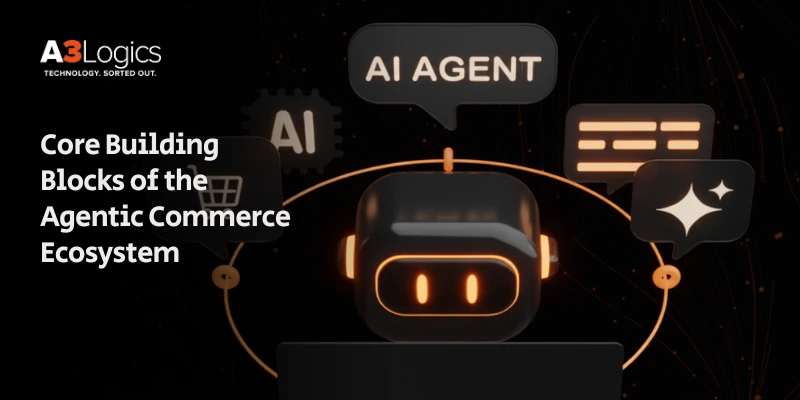
Agentic commerce is made of AI agents who comprehend user goals and gather all required information. They compare products and make purchase decisions autonomously i.e. with human involvement. This implies that they are intelligent enough to handle everything from intent recognition to conducting transactions; offering a user a seamless shopping experience.
2. Large Language Models (LLMs) and Decision/Planning Layers
LLMs help the agent understand the user query, which is in a natural communication language. What further enhances this understanding are the decision/ planning layers. They take this understanding and frame a clear plan; where they decide what steps to take next, which options to choose and most importantly, the way in which the purchase or any other task will be completed.
3. Agentic Commerce Protocols (ACP)
As the backbone of Agentic commerce, Agentic Commerce Protocols enable smooth and secure interaction between AI agents, buyers and businesses. It lets AI agents access platforms, tools, and payment systems needed to complete a purchase. Being an open standard; ACP ensures that all systems involved can communicate easily; regardless of platform or vendor.
4. Payment Tokenization & Agentic Payments
In AI-powered agentic commerce; payment tokenization replaces a customer’s sensitive payment data, like their credit card number with a unique, non-sensitive identifier called token. Agentic payments handle purchases and other financial tasks on behalf of a user, eliminating the need for constant human intervention.
5. Data, Preference Profiles & Integration
If we break down Agentic commerce and see how it works; we’ll see that there is a lot of data, such as user behavior, choices, past interactions, etc. The data, and preference profiles store this information; helping AI agents understand personal budgets, tastes, and priorities. Next, through integration, the agent is connected with e-commerce sites, delivery networks and payment systems.
6. Guardrails, Constraints & Trust Mechanisms
These are the safety systems that keep AI agents’ actions ethical and reliable. To begin with, guardrails are a set of rules that prevent unauthorized and harmful actions such as – overspending or buying restricted items. The constraints define the limits for an agent. For Instance, putting a cap on the spending limit or purchasing from approved vendors only. The trust mechanisms act as validating tools that verify identities, maintain transparency and ensure data security.
7. Brand / Merchant Architecture Adaptation
At some point businesses would need to adjust their systems to work smoothly with AI-driven agents. As one of the key components of Agentic commerce, brand or merchant architecture involves updating APIs, product catalogs, and checkout systems, so that agents can easily access, understand and purchase products. Merchants also structure data into machine-readable formats and enable pricing and real-time inventory updates.
Benefits of Agentic Commerce for Modern Businesses
1. Hyper-personalized Customer Experiences
Agentic commerce allows AI agents to understand each customer’s behavior and preferences. This lets businesses offer experiences that feel personal. From tailored recommendations to dynamic pricing and timing; customers receive solutions that match their exact needs.
2. Reduced decision-making Time for Buyers
By automating tasks like – research, comparison, and evaluation, agentic commerce removes the need for customers to browse through multiple options. AI agents quickly find the best products that meet set preferences. This helps buyers make more confident purchase decisions. It allows businesses to shorten the overall sales cycle significantly.
3. Improved Sales Efficiency through Autonomous Interactions
AI agents can manage inquiries autonomously; in a way that they can suggest products, and close transactions. This reduces the load on human sales teams ensuring customers receive consistent and accurate responses. The businesses gain efficiency as agents handle multiple interactions at the same time. This helps in improving conversion rates; freeing teams to focus on innovation.
4. Cost and Resource Optimization
Agentic commerce automates repetitive tasks like product discovery, order processing, and customer support and drives cost and resource optimization. Since AI agents reduce dependence on large human teams, less cost is incurred on operational and labor costs. Furthermore, it also minimizes inefficiencies; letting businesses to allocate resources strategically.
5. Enhanced Scalability and Competitive Advantage
AI-driven automation helps businesses meet rising customer demands without extra resources. Agents manage interactions across websites, apps, social media, and voice assistants while adapting to languages, currencies, and regulations. Faster responses and reduction in manual work helps brands maintain quality by reducing errors and ensuring consistent service across different kinds of markets.

Agentic Commerce Use Cases and Industry Applications
1. Retail & eCommerce: Personalized buying through AI shopping agents
One of the Agentic commerce use cases is how it personalizes the buying experience of the users. AI shopping agents take into consideration individual budgets, preferences and purchase history. They use this to find and buy the best products automatically. Over time these agents learn user behavior, and anticipate needs.
2. Finance & Banking: Automated investment or loan decisions
AI agents can help monitor financial profiles; analyze market trends and make automated loan and investment decisions. These agents act promptly on real-time data, reducing manual processing; ensuring accurate risk evaluation, allowing for more transparent financial services for customers.
3. Healthcare: Intelligent procurement and patient support agents
In healthcare, agentic commerce helps AI agents autonomously manage supply procurement, ensuring hospitals never run out of essential equipment. Also, patient-facing agents can handle tedious tasks such as appointment scheduling, insurance verification, and follow-up care reminders. This helps reduce administrative burden, and enhance patient experience through personalized, timely, and automated support.
4. Travel & Hospitality: Autonomous itinerary planning and bookings
AI agents can plan entire trips based on user preferences and budgets. Here’s how – they compare prices, optimize routes, and handle bookings automatically. This Agentic Commerce use case makes travel planning effortless; saving time and ensuring travelers receive personalized, optimized itineraries.
5. B2B Commerce: AI agents streamlining vendor negotiations and procurement
In B2B commerce, agentic systems automate vendor management, pricing negotiations, and order processing. AI agents evaluate supplier performance, negotiate contracts, and execute bulk purchases efficiently. As a growing Agentic Commerce use case, this reduces human effort, ensures cost savings, and creates faster, data-driven procurement cycles that enhance supply chain efficiency.
Challenges in Implementing Agentic Commerce
1. Data privacy and ethical AI use
Protecting customer data in agentic commerce is a challenge since AI agents have access to personal details like payment information, preferences, and shopping behavior. Businesses must enforce strict data governance policies that ensure data is collected with consent and used only for intended purposes. Ethical AI practices like encryption, anonymization and bias prevention also pose a challenge.
2. Integration with legacy systems
Many organizations rely on outdated systems that cannot easily connect with AI agents. Integrating Agentic commerce needs updating old infrastructure and aligning data formats. Without proper modernization, seamless communication between platforms and automation tools becomes difficult, slowing adoption and reducing efficiency across digital commerce environments.
3. Managing human-AI collaboration
Balancing human control and AI autonomy is important. Businesses need to design systems where agents handle repetitive work, while humans make critical decisions. This collaboration will ensure that AI supports rather than replaces people. This will help teams maintain oversight, creativity, and accountability in all business processes.
4. Ensuring transparency in autonomous decision-making
It is a challenge for AI agents in Agentic commerce to explain how they make choices. This is necessary since this helps maintain trust in users as businesses understand how an agent acted in a certain way. Transparent processes prevent biases. This allows for better monitoring.
5. Regulatory and compliance considerations
Different countries have unique laws that govern AI; digital transactions and data protection. Businesses must ensure compliance with these rules before deploying Agentic systems. Adhering to these compliance measures prevents legal risks but also strengthens trust.
The Future Outlook of Agentic Commerce: What to Expect in the Next 3-5 Years
1. Agent-first Discovery
“Agent-first discovery” in Agentic commerce represents a fundamental shift where AI agents; rather than human shoppers, primarily handle the initial search, evaluation, and recommendation of products. The traditional model, where human shoppers browse websites or use search engines are being replaced by a system where users tell their AI assistant what they need, and the agent proactively finds the best options. There are even instances, where AI agents also perform the purchase on the user’s behalf.
2. Brand Control in the Agent Environment
Brands will need to reshape how they present themselves in a world where AI agents drive discovery and recommendations. They must organize data, content, and messaging so that agents can fully grasp their identity and values. Success will depend on ensuring that every interaction reflects – consistent tone, trust, and brand authenticity.
3. Seamless Payments and Checkout
The checkout process will disappear into the background. In a way, agents will confirm user intent, verify identity, and complete secure payments automatically. Buyers will experience instant purchases without additional steps. This shift will reduce drop-offs; increase trust, and redefine convenience as transactions become invisible yet highly secure.
4. Multi-agent Coordination
Separate AI agents will handle specific parts of the buyer journey. For instance; one agent might search products, another might negotiate prices, and one might track delivery. These agents will share context and act together; creating efficient, and coordinated responsive purchase experiences across multiple digital and physical channels.
5. New Metrics and Business Models
Success will move beyond sales numbers. Businesses will track engagement quality, trust levels, and agent-driven conversions to check if they are in line with long-term customer satisfaction, brand loyalty, and the overall efficiency of autonomous interactions that drive meaningful and sustainable growth. New models will reward performance based on how effectively agents satisfy a buyer’s intent. Furthermore, companies will redesign goals to align with continuous AI-driven interactions and evolving customer relationships.
6. Regulation and Ethics Become Core
As AI becomes central to commerce, rules for responsible use will define how businesses operate. To stay credible; they must prove fairness, transparency, and data safety. With stricter government oversight, accountability will be non-negotiable. In the end, lasting trust will come from AI systems that clearly explain their decisions and workflow. And, how they are able to protect users from bias.
7. User Expectation Shift
Buyers of the future will expect intelligent systems that recognize their preferences without constant input. They will seek personalized guidance that feels effortless; where they don’t have to continuously browse in the search. As convenience becomes the norm, tolerance for slow or repetitive steps will disappear. Trust will grow when AI agents consistently make precise, reliable choices that reflect individual needs and simplify the entire shopping experience from start to finish.
8. Integration with Physical Commerce
Digital agents will directly connect with physical stores by integrating with point-of-sale systems, IoT sensors and other databases. At these physical places; AI agents will check product availability. If they perceive that items are available, they’ll even reserve items. To finish the process, they’ll coordinate pickup or delivery. They will help shoppers experience continuity between online and offline worlds; evolving physical locations into smart environments.
Why Choose A3Logics for Agentic Commerce Solutions?
1. Expertise in Intelligent Commerce Solutions
A3Logics builds next-generation digital ecosystems powered by AI Agents for e-Commerce. Our team designs adaptive systems that deliver personalized shopping experiences; helping businesses stay ahead. Through enterprise AI chatbot development, we help organizations create intelligent assistants who understand intent, and further, solve problems.
2. Seamless Workflow Automation
We are experts in creating AI Agentic Workflows that simplify every step of the process; from discovery to post-purchase. Our AI development services reduce manual dependence, increase accuracy, and improve overall operational efficiency.
3. Pioneers in Agentic Innovation
As a seasoned AI Agent development company; A3Logics integrates Agentic AI with data-driven strategies to help brands explore and unlock new opportunities in customer engagement, scalability, and decision-making. We ensure your business remains future-ready and customer-focused.
Conclusion
Agentic commerce will become a crucial part of digital shopping. Instead of just assisting users, AI agents and chatbots will fully manage purchases on users’ behalf; where they would conduct everything from product discovery to payment. These agents will become more specialized; in a way, they will be able to understand user preferences in a detailed manner. They’ll be able to intelligently make complex decisions independently.