
Introduction
AI agents in R&D have completely changed how research and development (R&D) is carried out across different industries in the world. These smart systems can automate tasks, process a lot of data, and help out with complex decisions.
- AI agents help a lot with information analysis, innovative experiments, and also forecast outcomes with accuracy.
- They automate monotonous tasks, allowing researchers more time that they can focus on high-value goals.
- These intelligent systems generate hypotheses and optimize methodologies in research workflows.
- AI agents also close the gap between cross-departmental research by offering multilingual, inter-domain project collaborations.
- AI agents happen to speed up innovation cycles with pattern recognition skills and make technological breakthroughs occur more frequently.
Organizations adopt AI agents in R&D to accelerate discovery, optimize resource usage, and cut research costs. AI agents streamline repetitive research tasks, significantly reducing time and human effort. They boost accuracy in data-driven experiments, resulting in efficient project outcomes. Organizations save costs on manual research processes by leveraging AI-based automation. Rapid data insights lead to shorter product development timelines and quicker market entry. AI agents support innovation that is sustainable in nature, and help businesses beat their rivals in R&D.
What Are AI Agents in R&D?
AI agents in R&D are a type of smart software programs that can carry out a wide range of research-based tasks on their own. These agents can process data, make decisions, and give rise to innovative ideas, offering scalable assistance in research processes worldwide.
They help organizations with the automation of repetitive activities, analysis of big data, and also make contribution to developing hypotheses, boosting both productivity and the potential for innovation.
Definition and Core Components of AI Agents in R&D
Autonomous AI agents for research happen to be software programs that are designed to understand the technology environment, analyze information, and help experts with research goals via the computational power they bring in.
- Perception Module: Collects information from research databases, experimental data, and real-time information channels.
- Decision Engine: Applies algorithms to process information and figure out the optimal and relevant actions.
- Action Executor: Executes certain tasks such as generation of reports or tweaking experimental layouts.
- Learning Component: Filters out what it has learnt over a period of time with the help of feedback loops and an updated information base.
- User Interface Layer: Allows researchers to interact, tailor several elements, and rule out the kind of AI behavior that doesn’t seem fit to them.
How AI Agents Differ from Traditional Automation and Standard AI Models
In contrast to the unshakeable automation systems, AI agents in R&D use machine learning and logical reasoning to adjust to the dynamic research environments. As soon as some new information becomes available, these systems can adjust their processes for better outcomes.
Traditional AI models usually call for human (contextual) input every time a new task is assigned to them. AI agents autonomously interpret research data and execute relevant tasks, minimizing manual supervision.
Technologies Powering AI Agents
AI agents in R&D use machine learning, NLP, and knowledge graphs for accurate research outcomes.
These technologies help them process information contextually and generate improved research hypotheses.
AI agents connect to cloud platforms, big data tools, and research databases for real-time data access. This connectivity lets them analyze massive datasets instantly and drive faster, smarter research outcomes.
Use Cases of AI Agents in Research and Development
AI agents make research processes faster, more accurate, and more innovative by supporting researchers throughout various stages of discovery.
1. Automated Literature Review
AI agents hundreds of thousands of academic papers and put together key findings, figuring out research gaps and highlighting important topics. This saves a lot of time for researchers and makes sure that no critical factors are ignored or overlooked. This makes for a rock strong foundation that helps in launching new projects as well as streamlining those that are ongoing.
2. Data Analysis and Trend Prediction
AI agents in R&D can unbelievably massive datasets, identifying correlations, patterns, and trends that might remain hidden through traditional analysis methods. By automating huge amounts of data, these agents generate actionable insights that guide future experiments, dictate direction of projects, and improve the forecasting precision of overall research outcomes, supporting strategic decision-making in R&D efforts.
3. Experiment Design and Optimization
Designing experiments can involve considerable trial and error. AI agents make use of forecasting models to recommend the best parameters for experiments, bringing down waste and uplifting efficiency. The automation of this aspect allows researchers to generate pinpointed results with least revisions. Moreover, it also speeds up the development cycles, which means faster transition from hypothesis testing to prototype creation or implementation.
4. Competitor and Market Analysis
AI agents in R&D also pick up and process information related to competitors and patents (even product development). This analysis helps organizations understand industry trends, identify possible gaps that lie in the market, and develop strategic responses that act in their favor. By staying aware of what the competitors are doing, companies can adjust (proactively) their R&D strategies, ensuring they maintain a competitive edge in unstoppable sectors like pharmaceuticals, technology, or materials science.
5. Innovation and Idea Generation
AI agents are being used more and more to support creative thinking in R&D by connecting unrelated (seemingly) concepts to come up with new and groundbreaking ideas. Autonomous AI agents for research make use of high-tech algorithms and data mining frameworks that can trigger innovations or blend technologies that are usually overlooked. By acting as a brainstorming partner, AI agents reshape the possibilities, backing up creativity in areas including product development, material innovation, or scientific discovery.
6. Intellectual Property Management
Managing intellectual property is essential in research-driven organizations. AI agents assist in drafting patent applications, analyzing competitor patents, and monitoring intellectual property portfolios. They make sure that innovations stay safe while singling out areas that carry any type of potential risk related to infringement. These advanced capabilities allow companies to ease the process of patenting, protecting assets, and shooting up the overall commercial value of research outcomes via timely and comprehensive IP strategies.
7. Resource Allocation and Project Management
Efficient management of resources is critical that many experts believe in R&D environments. AI agents in R&D streamline project workflows by recommending resource allocations that are based on diverse priorities, deadlines, and budget restrictions. By integrating with project management systems, these agents enhance visibility into project progress and identify potential bottlenecks early. Thinking of the possible result? Increased productivity, lower amounts of waste, and better aligned research efforts, making innovation processes pocket-friendly and dynamic.
8. Real-life Example
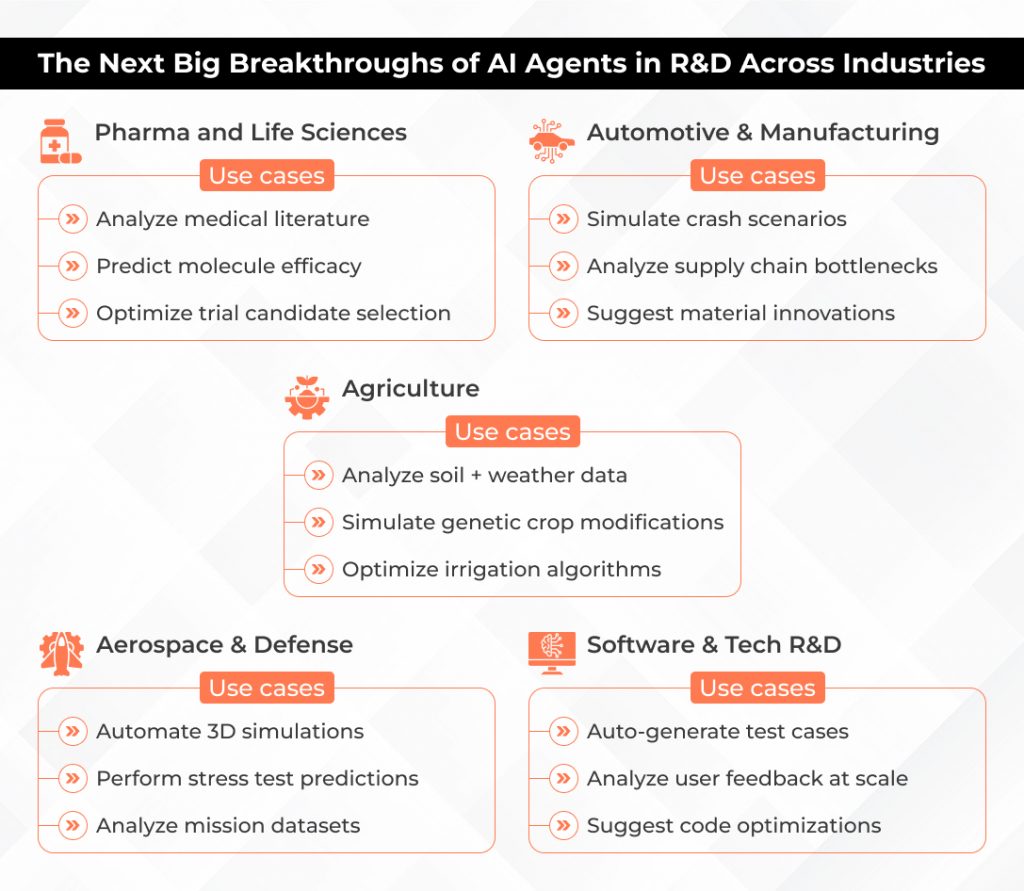
Pharmaceutical companies such as Pfizer and Novartis leverage AI agents to accelerate drug discovery. By analyzing chemical libraries and predicting molecular interactions, AI agents in research and development identify promising drug candidates faster than traditional research methods. This cuts down the time that’s invested in preclinical trials, increases the rate of success, and at the end, contributes to faster delivery of new treatments to the market, benefiting both patients and the companies involved.
What are the types of AI agents?
AI agents can spread across categories as per their complexity of operations, amount of flexibility, and problem-solving techniques, each of which is suited to different R&D scenarios.
1. Simple Reflex Agents
Autonomous AI agents for research of the simple category operate on predefined condition-action rules. They respond to certain inputs that are preprogrammed responses, which makes them the best way out for routine tasks such as data entry, formatting, or sending out alerts in research workflows. Their simplicity basically means dependability in monotonous actions but it happens to stay restricted when it comes to handling unfamiliar or complex research challenges that calls for high-level analysis.
2. Model-based Reflex Agents
In contrast to simple AI agents in research and development, model-based reflex agents are known for internal representation of their ambience. This model allows them to generate inputs on a contextual level – which means more insightful responses. They are well-suited for research scenarios where environmental conditions may vary slightly, requiring agents to adjust their behavior based on previously encountered situations or known patterns, improving task accuracy and relevance.
3. Goal-based Agents
Goal-based agents operate by evaluating possible actions in relation to predefined objectives. They make use of algorithms such as search trees or heuristic strategies to deal with research challenges. For instance, in an experimental design, a goal-oriented agent would explore several ways to figure out the one that pulls the most desirable outcome, making them particularly useful in dynamic research environments where end goals require flexible problem-solving approaches.
4. Utility-based Agents
Utility-based AI agents in R&D go way beyond the achievement of goals. They seem to assess the likability of a variety of outcomes, which they achieve through the help of utility functions. These agents help researchers make decisions that maximize overall benefit, considering factors like cost, efficiency, or innovation potential. When several outcomes are compared, utility-based agents prove to be valuable (the most) in multi-objective projects, where striking the right balance for resource use against discovery impact is crucial for success.
5. Learning Agents
Learning agents keep improving their performance with the help of feedback and data accumulation. They start with a basic model of operation but refine their decision-making processes based on new information. LLM agents in research excel in research environments characterized by evolving challenges or incomplete data, allowing researchers to benefit from progressively more accurate predictions, refined experiment suggestions, and adaptive analytical capabilities that respond to changing project requirements.
6. Multi-Agent Systems (MAS)
Multi-Agent Systems are those that have multiple AI agents interacting and working with each other to solve high-level problems. Each agent may have specialized capabilities, and together, they divide tasks and share information to complete large-scale research objectives. MAS are useful (in particular) in projects that involve multidisciplinary teams, extreme data processing, or distributed research efforts. They ensure collaboration on a real-time basis and increase the chances of achievements in challenging technological goals.
7. Hierarchical Agents
Hierarchical AI agents in research and development are organized in layered structures, with each layer responsible for specific types of tasks, ranging from low-level data collection to high-level strategic planning. This step-by-step process is what makes steadfast delegation occur in what seems like a complicated environment at first. These hierarchical agents also guarantee that routine processes are carried out efficiently while strategic oversight stays in the right balance. In case you’re still wondering, this is exactly what makes them a top choice for comprehensive R&D programs that are spread across a wide range of disciplines and objectives.

Benefits of AI Agents in R&D
AI agents are known among business across the globe for the productivity and quality of research and development initiatives that they bring to the table.
1. Enhanced Efficiency
AI agents accelerate repetitive or time-consuming research tasks such as literature reviews, database searches, and routine data analysis. By taking care of these foundational processes, they open up a window for researchers to dive into higher-level critical thinking, hypothesis development, and creative processes. This helps ensure that human intellect is used for activities that drive innovative projects instead of no-brainer operations.
2. Advanced Data Processing
Advanced data analysis capabilities happen to be a benchmark of AI agents in research. These agents can check out complex information sets, make out relationships between variables, and come up with actionable insights from diverse information sources. Their ability to integrate structured and unstructured data enables researchers to tackle multidisciplinary problems more effectively, transforming research initiatives into streamlined, evidence-backed processes that result in faster and more confident decision-making.
3. Continuous Learning & Adaptation
AI agents improve over time by continuously learning from new data, research outcomes, and user feedback. This type of constant development makes them increasingly precise and skilled in taking care of uncertainties that tag along. As autonomous AI agents for research improve themselves, they offer researchers with more and more relevant insights and suggestions. This, in turn, allows businesses (of almost all kinds to adapt to new challenges swiftly and stay competitive in fast-changing scientific and technological landscapes.
4. 24/7 Availability
As opposed to humans, AI agents can work all the time (literally), providing non-stop support for research, without having to worry about time zones or scheduled working hours. This constant availability speeds up project timelines, cuts down waiting periods for results, and even help global teams to work together effortlessly. Non-stop operation (in particular) is super-beneficial in time-sensitive domains like medical research or cutting-edge technology development, where early breakthroughs can promise solid competitive advantages.
5. Pattern Recognition
AI agents in R&D are amazing at spotting complex patterns that human analysis might overlook. They can identify hidden correlations between variables in big data, find out early signs of scientific breakthroughs, and even forecast long-term trends. By spotting these patterns, AI agents help researchers form hypotheses with greater precision, leading to more robust experimental designs, optimized methodologies, and discoveries that push the boundaries of current scientific understanding.
6. Personalized Insights
By customizing suggestions and data evaluations to individual researchers or teams, AI agents in R&D offer the type of solution that sits perfectly with targeted project goals or researchers’ areas of interest. That being said, these agents ensure that research processes stay eagle-eyed, domain-relevant, and practically sound – all at the same time. The insights that they come up with, boost collaborative efforts, as researchers can build on AI-powered suggestions that match their domain focus. So, one can expect streamlined interdisciplinary research and run targeted breakthroughs for both established and fields that are emerging.
7. Collaborative Potential
AI agents in R&D also welcome researchers from different walks of life by behaving as a channel for dealing with tricky information in easy to understand formats. They promote knowledge sharing by translating specialized information into usable insights for broader audiences. That being said, it breaks the communication barriers between diverse departments or research groups. The result? Pooled research efforts that carry several years of expertise and unique perspectives, leading to comprehensive research outcomes.
8. Risk Reduction
Autonomous AI agents for research contribute to risk management by identifying flaws in experimental designs, predicting potential points of failure, and offering corrective suggestions early in the research process. These proactive measures take charge of reducing resource waste and lower the possibility of errors that may cost a fortune. That’s not all, AI agents can also put into simulation multiple research cases to calculate potential outcomes. This means, organizations can guarantee safer and more filtered strategies that increase the overall success rate of the initiatives.

Challenges of Implementing AI Agents in R&D
AI agents in R&D undoubtedly offer significant benefits, but they also bring technical, operational, and organizational challenges that organizations must address during implementation.
1. Technical Complexity
Developing and launching AI agents in R&D involves detailed frameworks that call for integration across various tools, datasets, and platforms. Striking just the right level of interoperability between legacy systems and newly adopted AI development solutions often asks for a robust technical expertise. It’s not meant to be taken lightly, as these complexities may cause issues in implementation or even make the budget shake. This is what makes it incredibly important for research businesses to invest in well-trained and knowledgeable teams and robust planning before hopping on the AI-train.
2. Data Quality and Availability
Structured, detailed, and accessible information is critical for the overall performance of AI agents in R&D. Inconsistent information, partial datasets, or gaps in technical records may put the analysis accuracy at stake. Furthermore, organizations operating in specialized research domains may struggle with limited available data, slowing AI learning processes. Dealing with data challenges requires careful preparation, standardization, and sometimes a well thought-out collaboration with relevant agencies to build rich datasets that unleash the full capabilities of AI agents.
3. Integration Fragility
Many R&D environments rely on a patchwork of legacy systems, proprietary software, and bespoke workflows. Integrating autonomous AI agents for research into these environments without causing any disruption in the existing processes is a task which can be labelled as delicate (no less). System incompatibilities, lack of standardized APIs, or insufficient IT infrastructure can make integration fragile. Failure to resolve integration-related issues may end in sluggish AI usage or, worse, critical errors that compromise research quality or organizational efficiency.
4. Limits of Autonomy
Despite their advanced capabilities, AI agents still rely on human oversight for nuanced decision-making. While they excel at handling structured tasks or generating recommendations, they may misinterpret ambiguous scenarios or context-specific research objectives. Given that, humans must always cross-check AI-generated insights, using context as a foundation to ensure the conclusions are accurate and reliable.Striking the right balance between automation and human expertise is tricky, but super important for maintaining credibility and integrity in AI-assisted R&D processes.
5. Computational Costs
Running advanced agents in research that are more than capable of deep learning, full-scale information processing, and real-time decision-making demands a lot of computational power (which comes at a seriously huge cost). These costs can be prohibitive for smaller organizations or those lacking dedicated data infrastructure. To add to the problem, cloud computing expenses, data storage fees, and software licensing further top up the existing expenditures. Strategic planning, scalable technology choices, and partnerships with external computing providers can help mitigate the financial burden of deploying AI in research.
6. Memory and Data Management
Dealing with unbelievably big datasets that can be found across various stages of research requires data management strategies of a master-level. AI agents in R&D must efficiently store, retrieve, and process historical and real-time information. Poor data management can lead to redundant analyses, inconsistencies in outcomes, or lost opportunities for generating new insights. Organizations need to ensure that solid data governance practices are in place, including metadata standards, data versioning, and secure storage systems, to ensure reliable and accurate AI-assisted research outputs.
7. Operational Risks
Operational risks include incorrect model predictions, failure of automation processes, or misinterpretation of research objectives. These risks may cause flaws in experiments, waste resources, or even compromise the safety of intellectual property involved, if any. Routine audits, strict model validation practices, and honest feedback loops are crucial for cutting down on operational risks. Additionally, establishing clear accountability for AI-driven processes ensures that any issues are identified early and resolved before they escalate into major setbacks.
8. Change Management
Successfully welcoming AI agents in R&D demands more than money – it asks for cultural adjustments and buy-in from researchers as well as the upper level management. Resistance to change, fear of job displacement, or skepticism about AI capabilities can hinder adoption. Powerful change management strategies need to involve clear communication, detailed and structured training modules, and stakeholder involvement in overall AI implementation planning. If it’s showcased that AI brings tangible benefits to the table instead of how it could possibly replace humans – will only gather more acceptance.
Best Practices and Solutions using Practical Applications
Practical applications of AI go beyond the meetings for planning and investing capital. Implementing AI agents in R&D needs well-thought strategies that bring out what they can do. Practical applications across research processes help organizations avoid pitfalls and fully leverage the benefits of intelligent systems.
Data Analysis and Interpretation
Using datasets that are well laid out and carry clear labels adds to the default accuracy of AI agents. Regular updates of datasets ensure agents remain effective in identifying trends, interpreting complex relationships, and improving research outcomes. By keeping AI analysis models and research goals on the same page, teams can produce insights that are not only statistically accurate but also contextually valuable, strengthening the foundation for future innovation efforts.
Literature Review on Automation
Combining autonomous AI agents for research and academic databases such as PubMed, Scopus, or IEEE Xplore allows comprehensive (and fast!) literature scans. Using AI-driven summarization tools reduces reading workloads and highlights knowledge gaps. Researchers should regularly refine keyword lists and search parameters to improve relevance. This combination ensures that reviews remain thorough, current, and connected to project goals, while drastically reducing manual research burdens in the early stages of R&D workflows.
Experimentation Efficiency
Using AI agents in research to recommend experimental layouts based on past trends and outcomes boosts overall resource allocation and relevancy. For the best results, researchers need to make use of feedback loops, allowing AI agents to filter out the outputs continuously. Leveraging simulation environments can also help AI forecast the success of the experiment even before the physical trials, marling down the errors. This well-designed experimentation approach allows the clock to tick faster, improves precision, and ensures that human researchers remain focused on the strategic and creative dimensions of scientific exploration.
Collaboration and Communication
Introducing AI agents into collaboration platforms like Slack, Microsoft Teams, or in-house lab management systems improves cross-departmental communication. AI can summarize the recent findings of the research, track performance, and keep the project well aligned. Best practices include clearly defining AI responsibilities and human oversight mechanisms. Structured collaboration protocols ensure that AI agents in research and development remain a productive team member, improving interdisciplinary workflows and facilitating innovation across research teams regardless of geographic distribution.
Prototype Development
AI agents assist with early-stage prototype development by modeling and simulating design concepts. Making use of AI-fueled design tools helps make research simpler, as researchers need to test several variations and want the results to be precise. Research teams have to provide AI systems with elements like a feedback channel that helps in refining and highlighting alignment between AI-powered designs and functional needs. Are you’re wondering about the end result? Shorter trial-and-error cycles, improved working models of the prototype, and minimum development time, ensuring rapid validation and launch of creative research outputs.
Intellectual Property Management
AI-driven patent analysis tools simplify intellectual property management by flagging potential infringement risks and assisting in drafting patent applications. A great idea would be to combine these frameworks with legal and R&D databases for real-time updates. If you’re thinking about protecting the IP’s accuracy, routine legal reviews carried out with AI analysis are a non-negotiable. One needs to proactively spot opportunities for filing patent and tightening defensive strategies to maximize the commercial value and safety of their R&D initiatives.
Resource Optimization
Resource optimization using AI agents calls for project planning forecasts that keep budgets, personnel, and timelines in line with research priorities. AI agents are super-useful in highlighting resource bottlenecks even before they impact delivery. Best practices include connecting AI systems with financial and HR data to generate actionable forecasts. Now, what about deployment? It ensures an efficient launch for both human and AI elements across research projects, reduces overhead costs, and helps research organizations stay dynamic in competitive environments.
Innovation and Idea Generation
Effective idea generation involves combining AI-driven data analysis with structured brainstorming frameworks. Now, what’s amazing about this part is that researchers can make use of AI agents in research and development to bring out connections from various fields that may not look obvious. Best practices include setting specific problem statements for AI agents to explore and reviewing AI-generated ideas collaboratively. By putting together the powers of computational intelligence with human context, organizations multifold their chances of coming up with breakthrough concepts that break through the boundaries of old-school thinking.
Conclusion
AI agents in R&D have become indispensable allies in research and development, transforming how innovation is conceived, planned, and executed. Their ability to automate tricky chores, process huge chunks of information, and come up with unique insights or creative solutions lands them on the list of the best tools you could ever come across for modern R&D ecosystems.
By bringing AI agents to the core channel of workflows, researchers get to experience faster access to unique insights, streamline resource usage, and stay ahead of the competition. The way these AI-driven systems can be integrated with legacy frameworks, which helps in closing the gaps between theory and practical implementation, making sure that innovation cycles stay dynamic to market needs.
AI Agent Development CompanyHowever, successful AI adoption in R&D requires more than just technical implementation. It asks for a well-balanced combination of information quality, human context, collaborative models, and active feedback channels. When its applied the right way by an custom AI agent development company , AI agents in R&D not only speed up research but also allow teams to achieve insane results, introducing the world to a new era of efficiency, creativity, and technological advancement across industries.