In today’s fast-paced digital world, organizations can’t afford to make mistakes; there is no room for guesswork. They must predict outcomes, anticipate risks, and make informed, calculated decisions. AI and digital twins are two technologies that offer tremendous value propositions in this regard.
Here’s a glimpse of how AI and digital twin integration can work wonders. On one side, generative AI helps organize the data flowing in and out of digital twins—virtual models that replicate real-world entities such as systems and machines. Digital twins render a safe space for Gen AI to test ideas and learn. Digital twins and generative AI work in unison, helping each other improve.
What Is A Digital Twin?
This section covers the basics of how businesses test ideas using digital twins and Artificial intelligence. In this section, we’ll discuss what digital twin technology is, the types of digital twins, and how they work in real-world scenarios.
> Concept
A digital twin works as a digital replica of a physical asset in a virtual environment. It is designed to reflect a physical object, system, or process. To accurately reflect its real-world counterpart, it utilizes real-time data and simulations to replicate the object’s characteristics and performance.
The digital twin technology spans the object’s lifecycle and uses real-time data sent from sensors on the object to simulate the object’s behavior and monitor its operations. Some common examples of digital twins include wind turbines, entire cities to even single pieces of factory equipment.
> Types of digital twins (Product, Process, System, Human, etc)
There are several types of digital twins. The main difference lies in the scale of coverage – some solutions represent the smallest unit of the production line, others imitate the whole factory. Let’s have a look at four main types of digital twins –
1. Component Twin
This is the lowest part of the digital twin technology. It consists of the individual part of the equipment – switch, sensor, value, etc. Component Twin is important as it allows for monitoring the performance of each of these parts and simulating their behavior in real-life conditions.
2. Product Digital Twin
A product digital twin consists of several component twins. Several component twins are combined to model a complex asset like a pump, engine or building. An asset digital twin or product digital twin analyzes how efficiently separate parts interact with each other.
3. System Digital Twin
They are also known as unit twins. System digital twins are a virtual representation of how a system will function; the twin models real-world products, which comprise many parts. It shows these parts as components of a bigger picture or system. It demonstrates how the various assets will interact with each other, helping identify any loopholes at the ground level.
4. Process Digital Twin
It simulates production processes from beginning to end. The goal of the process digital twin is to develop a more efficient methodology. It first helps establish how the process will work and identify any failures; this way, failures can be mitigated or avoided altogether. Another upside of the digital twin process is that, in the long run, it can help companies save significant costs once the physical process is finally launched.
5. Human Digital Twin
A human digital twin is a virtual representation of a person. It is often based on real-time data from medical devices and sensors used to predict, simulate, and optimize various aspects of a person’s real life, including health.
How Digital Twins Work?
In this section, we’ll broadly deal with how digital twins work. Additionally, we’ll also explore how AI enhances the intelligence of digital twins, providing real-time data and enabling accurate predictions.
Digital twin technology replicates a real-world object or system. The sensors on the real object send real-time data to the digital twin, which is used to run simulations and help predict how the object is performing in real-time. The predictions help spot issues or test any changes. The system also utilizes feedback loops – results from the simulation are sent back to improve the real-world object.
The entire process enables businesses to make smarter and faster decisions that are more accurate and involve less risk.
How Does AI and Digital Twin Work?
AI brings intelligence to the digital twins technology. While a digital twin is a virtual replica of a real-world object, AI helps it think, learn, and make informed decisions. Here’s how AI and digital twins technology work together –
- AI processes the data collected by digital twins via sensors and other embedded systems.
- It finds patterns and insights that humans might miss.
- AI enables digital twins to make predictions about future outcomes. For example, how a machine might break because of the extra load.
- Allow digital twins to tweak operations automatically.
- Digital twins and generative AI technology can work together to learn from real-world changes, enabling the former to make more accurate and informed predictions and decisions.
Power Your Digital Twins With Leading AI Development Expertise
Looking to build smarter, data-driven digital twins for your business? An AI development company can help you in your mission to build AI-powered digital twins.
A3Logics, for instance, is a leading AI development company that can.
- Design intelligent AI models
- Integrate real-time data and apply machine learning
- Transform operations into self-improving, predictive systems that boost efficiency, reduce risks, and support smarter and faster decision-making.
So, if you are seeking a trusted partner for intelligent, future-ready digital twins, partner with A3Logics today and start transforming your business with AI-powered innovation!
The Synergy Between AI and Digital Twin
The fusion of AI with digital twin technology enables the creation of applications that not only replicate physical entities but also predict future outcomes, thanks to advanced learning algorithms.
The synergy between AI and digital twins yields more adaptive, intelligent, and efficient systems that can make more accurate predictions and help forecast problems before they occur. Together, they can automate processes, reducing human efforts and errors. These systems learn from historical data and become more accurate over time.
In an industrial landscape, the synergy between AI and digital twins enables the prediction of equipment failures before they occur, and they can help businesses simulate and test new processes, as well as optimize operations in real-time. This same powerful combination is also revolutionizing AI in ecommerce now. For instance, digital twins of supply chains, powered by AI, can predict inventory shortages, optimize logistics, and even personalize customer experiences by simulating individual shopper behavior.
Role of AI in Enhancing Digital Twins
The integration of AI and digital twins is a key advantage of modern digital twin technology.
AI-driven digital twins utilize advanced machine learning algorithms and real-time data to create more adaptive and accurate models. Here’s how – these digital twins can continuously learn from new data and update the model based on the current state of the system. It is for this reason that digital twins enable proactive decision making, provide more accurate insights, and make better predictions. They can handle complex and dynamic systems by analyzing vast amounts of data and identifying patterns that humans might otherwise overlook.
Core Components of AI-Powered Digital Twins
To truly unlock the power of AI-driven digital twins, it’s essential to discuss their building blocks or “components”. These components work together to make smart predictions, deliver real-time insights, and perform seamless operations –
1. Digital Model
A virtual replica that mirrors the physical asset using system logic, data, and simulations.
2. Physical Object
This is the real-world asset that is being digitally replicated. It can include a system, machine, process, or entire facility.
3. Sensors
These are attached to real-world objects, such as machines, vehicles, buildings, processes, or systems. They help in collecting real-time data from the object.
4. Data Integration Layer
The data integration layer gathers, cleans, and organizes data from various sources to utilize it more effectively.
5. AI and ML Algorithms
The AI and ML algorithm is used to detect patterns, make predictions, and recommend or automate actions.
6. Simulation Engine
It enables the virtual testing of scenarios to observe the changes that may occur in the real-world object and impact its outcomes or performance.
7. Feedback Loop System
The feedback loop system enables the digital twin to learn from real-world outcomes, i.e., the feedback received from the actual performance of a physical object or system. It provides this data back to the AI model, helping to improve accuracy and decision-making.
8. User Interface & Dashboards
In all applications of digital twin technology, the user interface and dashboard are components that help users track performance, visualize data, and interact with the digital twin in real-time.
Key Benefits of AI and Digital Twin Integration
AI enhances the power of applications that run on a digital twin and AI technology. AI-based digital twins offer real-time insights and powerful analytical capabilities. Let’s have a look at some of the advantages of digital twin technology powered by AI –
1. Better Decision Making
Artificial intelligence and digital twins help simulate various scenarios and test outcomes well in advance. As such, they can make calculated decisions and ensure that resources are utilized and planned appropriately.
2. Real-Time Monitoring
Being able to track physical assets through real-time monitoring and respond easily to changes is a significant advantage of digital twin technology.
3. Predictive Analytics
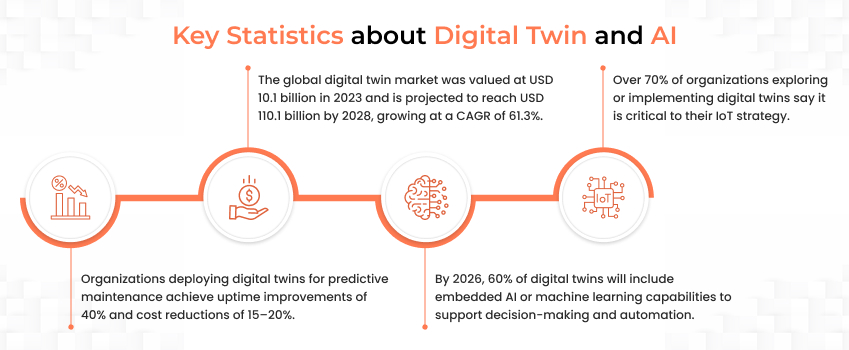
One of the advantages of digital twin technology powered by AI is its ability to forecast maintenance needs or possible issues. This way, digital twin technology companies can rectify problems before they happen and reduce downtime.
4. Process Automation
One of the key benefits of AI-powered digital twin technology is the ability to automate routine tasks, such as data collection and analysis.
5. Customization
Learning from past data and user behavior is yet another advantage of digital twin technology combined with AI. It doesn’t just learn from historical data but also adapts to the specific needs of business, thereby enhancing the accuracy of simulations.
Use Cases of Digital Twin Technology Across Industries
Now that we have seen some of the advantages of digital twin technology, let’s have a look at some of the real-life applications of digital twin technology –
Health
Prominent digital twin technology examples can be seen in the health sector. Digital twins of patients help doctors predict health issues, test treatments, and personalize care with minimal risk involved. Digital twins of equipment are also created to reduce downtime and improve maintenance, resulting in better patient outcomes and lower costs.
Energy
Energy companies use digital twins of power plants, wind turbines, and grids to predict failures, monitor performance, and optimize energy flow. This helps improve safety, reduce downtime, and make production more sustainable and efficient.
Automotive
Monitoring methodologies are yet another great example of digital twin technology. Many companies in the automotive industry sector model digital twins of their vehicles to test vehicle performance, features, etc, much before applying them to the actual model. Digital twins shorten development time, detect issues early, and create smarter cars.
Logistics
Digital twins of warehouses simulate workflows and storage layouts, enabling more efficient management of inventory and operations. This helps companies speed up order picking, improve space usage, and reduce delays in packing and shipping.
Manufacturing
In the manufacturing domain, digital twins of processes, machines, and entire production lines are utilized to identify issues early, thereby reducing downtime and enhancing quality.
Challenges in Integrating AI with Digital Twins
Integrating AI with a digital twin presents numerous challenges, including scalability, data management, talent gaps, and cybersecurity concerns. These challenges make it difficult to fully leverage the benefits of AI-powered digital twins, some of which we have already discussed above. Let’s have a more detailed look at the challenges –
1. Data Management and Scalability
Digital twins often rely on large volumes of heterogeneous data from sources such as sensors, legacy systems, and IoT devices. In this case, managing and processing the data can be a challenge. Secondly, it is crucial that the obtained data is accurate in order for AI-based systems to make informed decisions. In this case, data standardization can be an issue. Lastly, digital twins must be scalable to accommodate changing business needs and increasing data volumes.
2. Shortage of Skilled Professionals
A company wanting to develop AI-powered digital twins may encounter a dearth of skilled professionals with expertise in data science, AI, and IoT. This can further deter the development, deployment, and management of digital twins technology. And, even if there is an adequate workforce, digital twin technology companies may have to invest a significant amount in training and education to equip their employees with the necessary skills to work with AI and digital Twins.
3. Complexity of AI Algorithms
The complexity of AI algorithms is a significant challenge when integrating AI with digital twins. When creating applications of digital twin technology with AI, a large, high-quality dataset is needed. Furthermore, to build, train, process, and maintain this data, powerful computing resources and skilled experts are required. This can lead to increased costs, delays, and difficulty in fully using AI’s potential with digital twins.
4. Cybersecurity and Privacy
Digital twins often handle sensitive data, making them vulnerable to data breaches and cyberattacks. It is crucial to ensure data privacy, trust, and security for building confidence in digital twins powered by AI.
5. Regulatory Compliance
In every domain, there are specific compliance requirements that must be met. When implementing digital twins, industry-specific legislative obstacles may arise regarding confidentiality and data usage.
What Is The Tech Stack Powering This Integration?
The digital twin and AI integration tech stack relies on three core components: first, it processes vast datasets; next, it collects real-time operational data; and finally, it applies intelligent analysis to generate actionable insights. Here’s a deeper dive into how these elements work together –
| Item | Sub-item | Explanation |
| Data Collection | IoT Sensors | Collect data from physical assets in real time—for example, pressure, temperature, vibration, etc. |
| Edge Computing | Process data close to the sensors. | |
| Data Processing and Storage | Big Data Processing | Example – Hadoop and Spark |
| Cloud Computing | For scalable data storage, analytical capabilities, and processing. | |
| AI/ML Integration | Deep Learning | For complex tasks like NLP, and image recognition. |
| Machine Learning | Algorithms like clustering, regression, and classification. | |
| AI-powered Analytics | Analyze historical data, suggest automated actions, and forecast disruptions | |
| Visualization | AR and VR | Technologies help users to interact with 3D simulations of the digital twin. |
| UI | Intuitive interfaces are used to facilitate user interaction and present data effectively. |
Future Trends and Outlook
The integration of AI and digital twins is revolutionizing businesses and providing a fresh approach to solving complex and challenging issues. Looking ahead in 2025, here are some themes that will shape the future AI-powered digital twins –
1. More Industries Are Going To Adopt/ Already Adopting AI-Enabled Digital Twins
More and more industries are starting to enjoy the benefits of AI-enabled digital twins, unlike in the past, when the technology was primarily used in manufacturing and urban planning sectors. Digital twin technology is widely used across various industries, including healthcare, energy, logistics, and others.
2. Enhanced Prescriptive and Predictive Analytics
In this post, we have already established that the digital twin technology, powered by AI, is capable of forecasting what is likely to happen. It also recommends the rightful actions that can help achieve desired outcomes. For instance, AI-based digital twins can forecast when a machine part might break down because of excessive load, they can simultaneously suggest maintenance plans.
3. Integration with IoT for Real-Time Data
Various companies have begun integrating the Internet of Things with AI and Digital Twins. The sensors in the IoT devices can gather data from physical assets in real-time, which can further be used by digital twins for constant analysis and monitoring.
4. Integration of AR/ VR for Improved Decision Making
Digital twins powered by AI are emerging as key hubs where stakeholders can simulate scenarios, interact with data, and collaborate in real-time. As far as future developments are concerned, there is a growing integration of augmented reality (AR) and virtual reality (VR) into digital twins.
5. More Focus on Data Security and Privacy
Ensuring data privacy and security is of utmost importance when integrating AI with digital twins technology.
We expect developments in safe data handling procedures in 2025, such as the ability to train AI models on synthetic data. This effort aims to secure privacy by creating simulated datasets that mimic the characteristics of real data.
The best part here is that this process doesn’t involve personally identifiable information (PII) or sensitive data, thereby maintaining privacy.
Conclusion
Businesses have to make crucial decisions where they can’t afford to guess or delay. The combination of AI and digital twins is revolutionary because it creates smart virtual models that predict outcomes, identify risks early, and optimize operations in real time, helping businesses stay ahead and make confident, data-driven choices every time.