
AI is rapidly becoming a part of the supply chain, it is automation tasks, streamlining workflows and driving revenue. AI is changing how softwares and applications are created, tested and deployed. And with these advancements we can see a new set of challenges arising. An AIBOM (AI Bill of Materials) is a comprehensive inventory of all the AI components involved in developing and deploying systems.
AI in manufacturing have some cool practical use cases today, like voice assistants, coding assistants, customer support chatbots, writing tools, etc., all aimed at making life easier. But, this wide-spread implementation is mostly happening without control measures. The demand for better safety, openness, and the ability to trace in AI is the main reason why it is important to create AI BOM Management Software Development.
In this blog we aim to explore what is AI BOM management and blueprint classification, how BOM extraction automation is making a difference across industries and how an AI development company like A3Logics is transforming the manufacturing industry.
The Growing Complexity of BOM Management
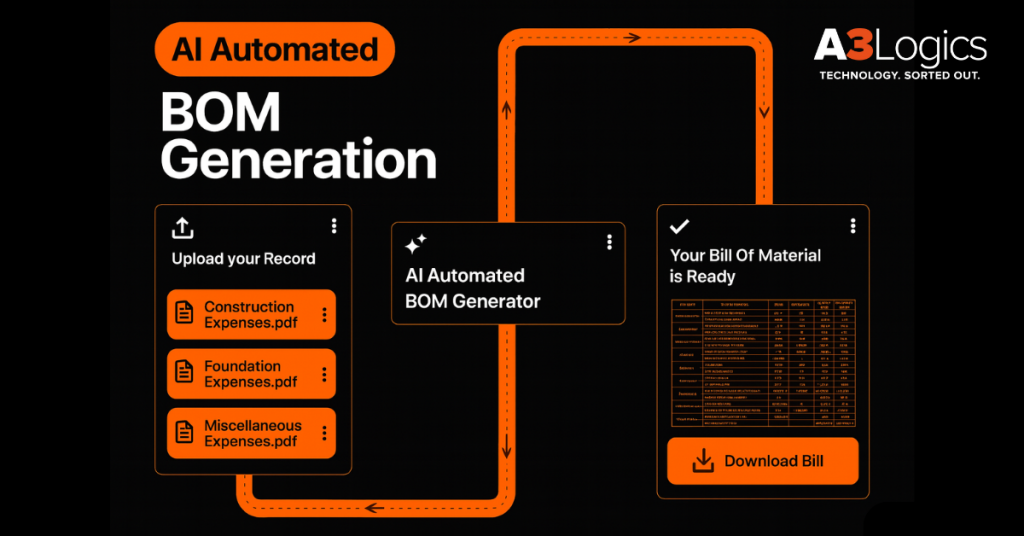
Handling a Bill of Materials (BOM) in the present time is a lot more complicated than just putting together a basic parts list. Products of today are a mix of mechanical, electrical, and software components, thus they need coordination of global teams, suppliers, and systems. Design changes happening frequently, custom configurations, and multi-level BOMs are aspects that are getting more and more difficult too. Therefore, producers are on the rise to the extent of implementing integrated digital BOM management solutions which facilitate not only the collaboration but also the accuracy and the traceability throughout the whole product lifecycle.
1. Why BOM Management Is So Challenging Today
An up-to-date Bill of Materials (BOM) is not only about knowing what parts to use. Manufacturers face products with extremely complex structures that include layers upon layers and additionally, they have the problem of different suppliers and are with rapid product versions. On top of this are the data silos i.e. the information is in PDFs, CAD files, spreadsheets and images, and it is very difficult for them to keep the data consistent.
The lack of a unified digital structure connecting global teams and supply chains results in miscommunication and inefficiency of production workflows quite often.
2. Common Pain Points
The problems with BOM management that lead to pain points are usually the manual processes that are at their root. Most of the data entry errors, inconsistent naming conventions, and lack of proper version control departments are all present in organizations that mostly do things manually. Blueprint interpretation and its conversion into parts or assemblies are very time-consuming and, in some cases, may lead to mistakes. The lack of communication between teams prevents them from spotting issues early. This communication gap slows decision-making. It also causes costly production delays.
3. The Cost of Errors
Even though BOM errors may be small, they can later become huge ones that lead to financial and operational setbacks. Errors in manual BOM and inconsistencies in versioning may cause the inflating of project budgets by as much as 30%. Moreover, such mistakes will result in delays of production thus the schedules will be disrupted and so will procurement.
For example, inaccurate documentation can be the reason for uncontrolled expenses, the wastage of materials, and compliance failures, mainly happening in heavily regulated industries such as aerospace, automotive, and medical devices. Besides losing profit, there is a risk of supplier relationships getting damaged, as well as the brand reputation. With AI coming into play there is an up to an 80% reduction in errors reported in BOM generation processes, compared to manual methods which are often error-prone.
4. Why Traditional Automation Fails
Automated tools that work on a traditional rule basis only have a limited capability to adjust to the ever-changing nature of BOMs of recent years. Companies that are still using spreadsheets or Excel for BOM management have increased error rates and slower workflows compared to those who have adopted digital BOM platforms. The reason is that these systems depend on the logic that is set in advance and they cannot deal with non-standard blueprint layouts or different data formats.
They do not have enough context to understand the information and this is why they find it hard to take visual inputs together with the text. Also, usually, the old systems do not have the features of being expandable and can hardly support the integration with current ERP, PLM, or AI-powered platforms, which limits their ability to provide agile manufacturing operations.
Blueprint Classification: The Core of AI BOM Management
Blueprint classification means using Artificial Intelligence (AI), Computer Vision (CV), and Natural Language Processing (NLP) to automatically understand and categorize technical blueprints. The system uses AI to eliminate the need for manual review of engineering drawings. It reads and classifies drawings automatically. It also converts unstructured visual and text data into structured BOM information. This transformation ensures blueprint data integrates easily into ERP, PLM, and MRP systems. It further helps teams maintain accuracy and efficiency throughout the product lifecycle.
1. Core AI Technologies Involved
AI BOM management is a technologically advanced concept that involves the use of a range of technologies to perform the extraction and interpretation of the data found on blueprints.
i. Computer Vision (CV)
Computer vision in BOM identifies: parts, shapes, and geometric patterns in 2D/3D engineering drawings, thus enabling the visual understanding of components and layouts.
ii. Optical Character Recognition (OCR)
Takes in the technical data, either printed or handwritten, and turns them into machine-readable texts. Some examples of such data can be part numbers, material specifications, and dimensions.
iii. Natural Language Processing (NLP)
Decides the contextual nature of the relationships derived from the given data e.g., the one directing a component to the assembly. This is done by going through the labels, annotations, and legends.
iv. Deep Learning Models
They keep on learning from the blueprints they have already seen, and with time, they become more accurate and adaptable to various sectors and formats through the continuous learning process.
2. Output and Value
The AI-powered blueprint classification system furnishes structured, machine-readable BOM data that merges seamlessly with enterprise systems like ERP, MRP, and PLM. The advantages comprise:
i. High Accuracy & Automation
Drastically cut down on the error in the manual labor of BOM creation.
ii. Design & Procurement at Double Speed
Transforms complicated documents into usable data within a few minutes.
iii. Collaboration Enhanced
It allows the different departments like design, production, and supply chain to be on the same page, thus making workflows more efficient.
Such automation turns blueprints from mere static files into digital assets that can be utilized to speed up innovation and the production process.

Why It Matters
AI blueprint classification is the main factor of change in manufacturing which makes the creation of BOM a quicker, more trustworthy, and purely digital process.
- Process time is reduced from several days to just a few minutes.
- It allows design and procurement teams to make decisions in real-time.
Serves as a pathfinder to digital twin ecosystems where each component and assembly is digitally replicated for ongoing monitoring and optimization purposes.
In the end, manufacturing software development is what makes the transition to AI in manufacturing intelligence, where the insights can flow smoothly from the blueprint stage to production.
How AI BOM Management Works?
1. Data Ingestion
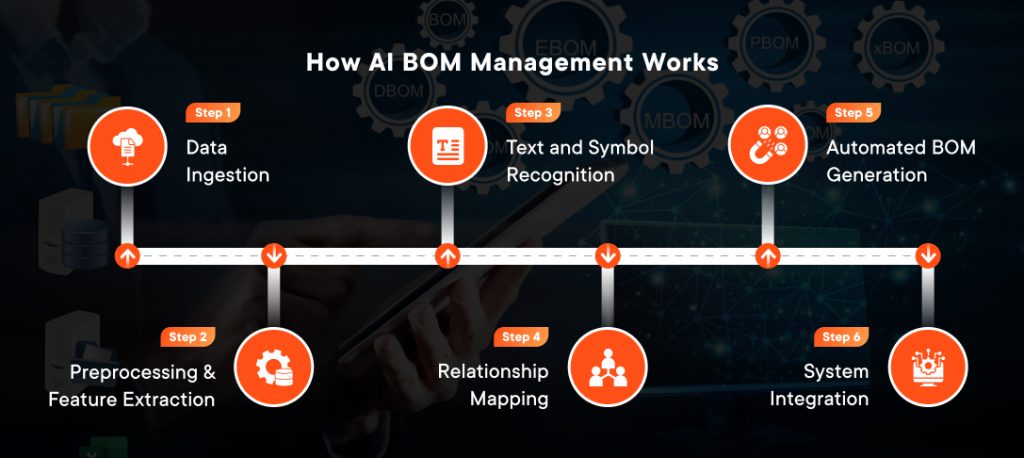
It starts off with gathering blueprints and CAD files from various sources, such as engineering teams, suppliers, or archives. AI-powered systems easily handle various formats, including PDF, DWG, DXF, and image files, thus ensuring that there are no compatibility issues between different departments.
2. Preprocessing & Feature Extraction
After that, the AI model gets rid of noise, standardizes the blueprints, and annotates the areas of interest by removing the noise, aligning the orientation, and annotating the key regions. It detects the legends, symbols, dimension lines, and markers that stand for the most significant manufacturing pieces of information.
3. Text and Symbol Recognition
The method employs OCR and CV to obtain the text as well as the symbolic information of the drawing, thus they are able to come up with the part identifiers, material names, dimensions, and tolerances with a high degree of accuracy.
4. Relationship Mapping
At this point, NLP algorithms and deep learning models find the connections between the: components, subassemblies, and parent assemblies. The system not only comprehends the contextual relationships (e.g., which bolt attaches to which frame) – but it also builds a correct structural hierarchy.
5. Automated BOM Generation
By combining the visual and textual data, AI is able to generate a digital BOM automatically.
6. System Integration
The system integrates the newly created BOM seamlessly with platforms like SAP, Oracle, or Siemens PLM. Moreover, it enables real-time synchronization across engineering, procurement, and production workflows. This integration also ensures smoother operations and faster decision-making. This helps to make the process transparent and gets rid of the data silos. It also ensures that everyone has the most up-to-date information.
Key Benefits of AI-Powered BOM Management
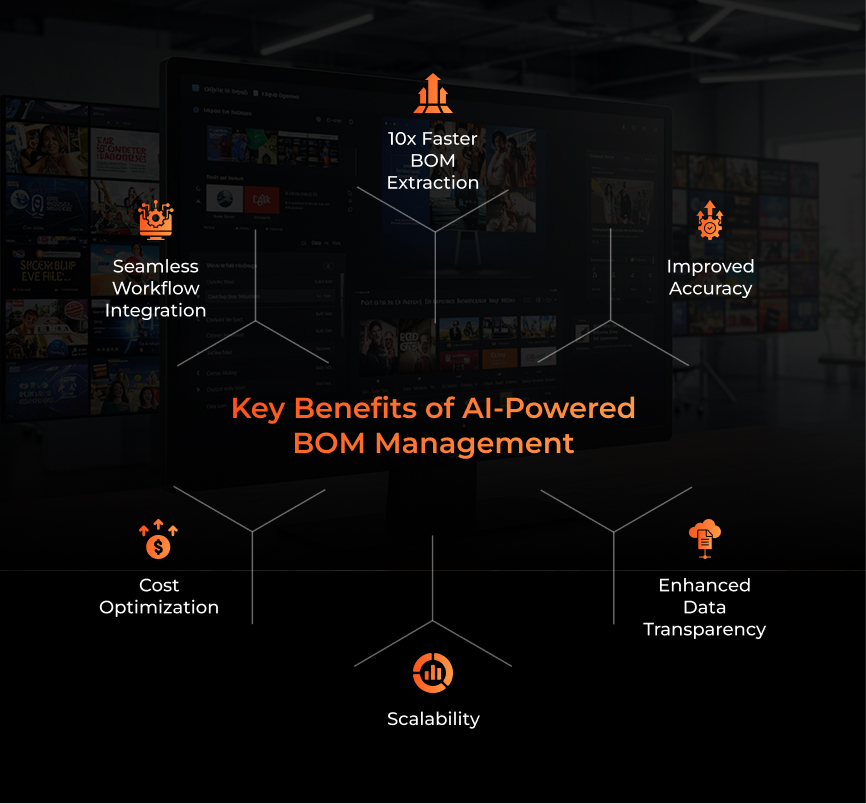
The use of AI technology in managing the Bill of Materials (BOM) radically changes the way manufacturers deal with product data, blueprints, and the supply chain. Because it completely automates data extraction and validation, it can be said that the speed, accuracy, and communication to the whole lifecycle of the product are improved almost to the point of perfection.
1. 10x Faster BOM Extraction
BOM extraction is a tedious work and manual. With BOM extraction automation the time for the creation of a BOM is shortened from several days to several minutes.
2. Improved Accuracy
The use of advanced OCR, NLP, and deep learning models basically exclude human errors, duplication, and missing entries to a minimum.
3. Seamless Workflow Integration
This platform’s most powerful feature enables seamless integration with ERP, PLM, and CAD systems. Moreover, it ensures smooth communication and prevents interruptions. It also maintains continuous data flow and supports consistent collaboration across all departments.
4. Cost Optimization
Lowering of operational costs and reduction of material wastage are mainly caused by a faster procurement and fewer reworks.
5. Scalability
The platform is designed in such a way that it will still work flawlessly with: unlimited product lines, intricate assemblies, and even whenever the designs keep on changing.
6. Enhanced Data Transparency
Through centralized access and real-time visibility, collaboration between engineering, procurement, and production teams becomes more effective.
Implementing AI BOM Management: Step-by-Step
The implementation of AI BOM management should be staged, which is a cautious way of maintaining the system not only accurate and productive but also consistent with the company’s objectives.
Step 1 – Process Assessment
Initially, inspect in detail the BOM processes to visualize the complete situation of inefficiencies, redundancies, and data silos. Establish such KPIs as precision, time saving, and cost reduction to measure the success of AI implementation.
Step 2 – Data Preparation
Rummage through engineering files and gather blueprints, CAD files, and documentation samples. Use the labeled datasets to guide AI modules to learn how to identify the different formats and symbols of the blueprints.
Step 3 – Pilot Project Deployment
Initiate a local test (PoC) on a small dataset or a few product lines. This pilot serves as a tool to assess the AI system’s performance regarding the accuracy of the extraction, seamless integration, and ultimate advantages for the ecosystem that can then be further extended.
Step 4 – Integration & Automation
Link the AI BOM management solution with corporate software such as ERP (SAP, Oracle), PLM (Siemens, PTC Windchill), and MES resources. Automation allows for uninterrupted data transmission from design to manufacture.
Step 5 – Continuous Learning
Put in place feedback loops in which the system gets smarter through the corrections and new blueprint data, thereby increasing model accuracy and flexibility with time.
Step 6 – Human-in-the-Loop Validation
Though automated, expert supervision is still of utmost importance. Engineers confirm the AI-generated work to guarantee safety, correctness, and taking into account the context thus, trust is retained in the decisions made by the system.
Real-World Impact: AI BOM Management in Action
By partnering with A3Logics, a global manufacturing company set out to install an AI BOM management system customized just for them. To make the engineering blueprints easier to understand, the solution used computer vision and natural language processing (NLP) to extract, interpret, and digitize them.
The effects were revolutionary:
- Creating a bill of materials was cut down by half of the time, thus the entire design-to-production cycles were able to be sped up.
- The accuracy of the data was even 90% better, thus the occurrence of reworks and procurement delays was greatly reduced.
- Also, the collaboration between the departments was very smooth as the engineering, procurement, and production teams were able to work in real-time on the synchronized BOM data.
- Return on investment was realized within half a year, largely due to operational efficiency and time-to-market being shortened.
This accomplishment of the rollout serves as evidence of the definite value of AI in manufacturing ecosystems by means of agility, transparency, and data trustworthiness enhancement on a large scale.

Why Choose A3Logics for AI BOM Management Software Development?
A3Logics is a reliable custom software development partner for manufacturers who want to revamp their product data workflows and follow Industry 4.0 trends.
1. Demonstrated AI & Automation Knowledge
A3Logics has been creating AI software, whether it is AI agent development, handling data, or automating workflows A3Logics offers it all. They are therefore capable of delivering smart solutions which are factory-friendly.
2. Artificial Intelligence-powered Models for Drafts Recognition
We have developed cutting-edge computer vision (CV) and natural language processing (NLP) algorithms that comprehend the technical drawings, the revisions, and the CAD inputs, and hence, convert them into structured and executable BOMs.
3. Uninterrupted Assistance
A3Logics is there for you throughout the entire process – from consultation and strategy mapping to tailor-made development, integration, deployment, as well as, support and maintenance.
4. Solutions that are both Scalable & Secure
The platform is robust enough to support various departments and products while it effortlessly integrates with ERP, PLM, and MES systems and keeps the data secure following the best practices.
Working with A3Logics is the key to a manufacturer’s success in meeting the challenges of shorter innovation cycles, achieving cost efficiency, and ensuring supply chain transparency through the use of intelligent automation.
Conclusion
The adoption to AI-powered BOM management is a significant step towards the realization of the future, which consists of intelligent automation and data-driven workflows in manufacturing.
By isolating core information from the labyrinth of blueprints, AI powered by mind-boggling algorithms abolishes waiting times between process steps, unlocks innovation potential, and breaks down the traditional barriers of sharing with an organization-wide cooperative.
A3Logics demonstrates strong AI capabilities and a proven industry record. Therefore, businesses can trust A3Logics for accurate BOM conversion. This partnership increases speed, improves decision-making, and enhances overall accuracy. Moreover, AI-driven BOM technologies create a win-win situation for all industry players. These technologies help companies maintain a competitive advantage. They also prepare organizations for the future. This applies to both global enterprises and small manufacturers.