
Personalization and segmentation are key parts of any effective digital marketing strategy. They let you home in on your most valuable customers, based on everything from where they live to the most recent purchases they’ve made. AI customer segmentation helps businesses achieve this personalization by enabling businesses to tailor their marketing efforts to the unique preferences and behaviors of individual customers.
The application of AI technology lets businesses analyze massive amounts of customer data to find patterns that further help companies to understand their audience and communicate with them more effectively.
AI has the ability to process huge volumes of data faster and more accurately than humans. AI can analyze data at scale discovering hidden insights that may not be evident to human marketers. This way – businesses can uncover every valuable opportunity for personalization and customization, that can drive engagement and increase conversions.
AI-powered customer segmentation and personalization efforts can lead to significant business outcomes. Including revenue increases of 10-25% and improved customer retention rates of 10-20%. In this blog we are going to take a look at what AI customer segmentation and how AI-based marketing segmentation has a major impact on the marketing industry. Let’s dive in!
What is AI Customer Segmentation?

AI customer segmentation refers to the process of making use of artificial intelligence algorithms to analyse data and categorize customers into particular groups based on common behaviours and characteristics.
These different customer segmentation will help the business develop a deeper understanding of their customers. What are the customer preferences, behaviors, and characteristics that will help to provide personalized content.
AI customer segmentation even goes above traditional demographic segmentation to include a variety of factors. These could be purchasing behavior, online interactions, browsing history, and sentiment analysis from social media posts.
With the integration of multiple data points and utilization of advanced predictive modeling techniques – AI customer segments allow a business to draw very detailed and nuanced customer profiles. This will thus enable targeting and marketing messages with unprecedented precision.
AI-powered customer groups will let marketers deliver personalized customer experiences that guarantee increased engagement, loyalty, and higher conversion rates. Segmenting their customer base by applying AI technology helps marketers understand their audience. This will thereby create more significant and effective marketing campaigns.
Why Businesses Need AI-Powered Segmentation Today
1. Increased Demand From Customers For Personalization Experiences
Customers expect the brand to understand their preferences and thereby deliver relevant content, offers, and services. AI makes real-time, hyper-personalization possible from individual behaviors and needs.
2. Explosion Of Multi-Channel Customer Data
Data is flowing today through the websites, apps, CRM, emails, social media, and offline interactions, which the AI stitches together in a seamless manner, presenting a unified view of the customer.
3. Declining ROI From Generic Marketing Campaigns
Mass marketing does not work any longer. AI segmentation enhances campaign precision by targeting the right message to the right audience at the right time, increasing marketing return on investment.
4. Competitive Advantage Of Data-Driven Insights
With AI, companies have strategic advantages in predicting trends, recognizing patterns, and acting upon them in advance of their competitors that would adopt traditional segmentation methods.
How AI-Powered Customer Segmentation Works
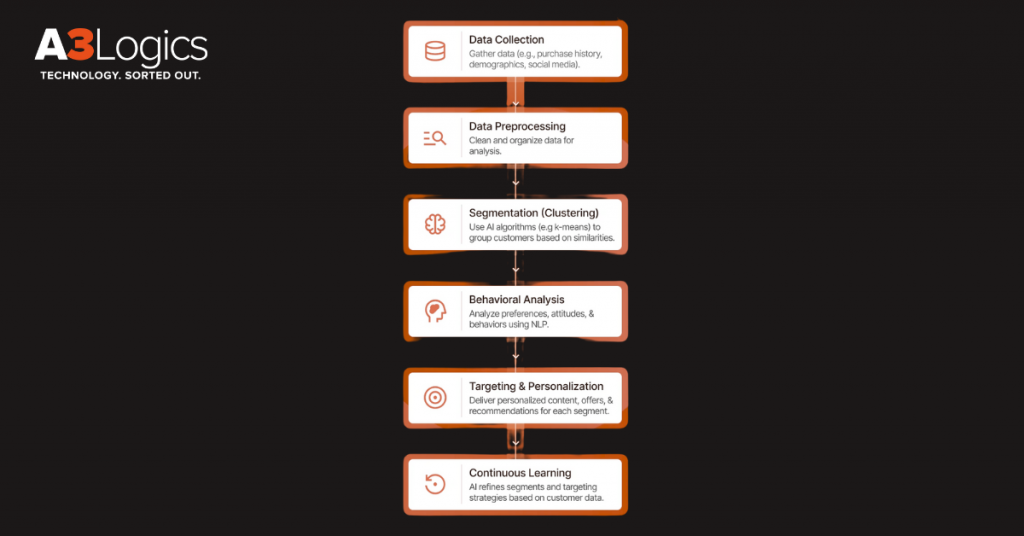
Artificial Intelligence powered segmentation employs to the fullest extent, among other things, advanced analytics and machine learning algorithms so as to divide clients into segments that exist in reality and hence consider real behavior, purchase intent, and future potential of the customer rather than just basic demographics.
1. Data Collection & Integration
Customer data is collected from various channels i.e. CRM, websites, social platforms, mobile apps, point-of-sale systems, etc. The data is then merged into one single cohesive system.
2. Data Preparation & Feature Engineering
Data cleaning, standardization, and enrichment are performed to make data accurate. Then AI builds meaningful customer features for better modeling, such as probability of churn or purchase frequency.
3. Machine Learning Models & Algorithms
Models such as clustering-K-means, neural networks, and predictive models analyze patterns. This helps to create segments automatically based on similar behavior and attribute characteristics.
4. Model Training & Optimization
The system self-trains on both historic and real-time data; the segments are revised over time to ensure accuracy and relevancy.
5. Deployment & Real-Time Activation
Segments are pushed into marketing automation tools, CRM, and ad platforms to trigger personalized campaigns in real-time. These is across platforms like emails, SMS, ads, and customer touchpoints.
Benefits of AI-Based Customer Segmentation
AI segmentation allows to create relevant, low-cost customer segments that can be used to increase loyalty and revenue. These are some of the benefits AI customer segmentation brings to the marketing industry.
1. Hyper-personalization
With AI segmentation – the messages, offers, and experiences are extremely personalized for each customer segment, thus engagement and satisfaction are increased. For example, businesses can create AI videos tailored to each segment to further boost engagement and conversion rates.
2. Better ROI
By focusing only on the most valuable segments and thus making the tailored campaigns have higher conversion rates, spending on marketing is optimized.
3. Improved Retention
More early identification of at-risk customers with a corresponding reduction of churn and increase of customer lifetime value thanks to effective strategies.
4. Predictive Insights
Predicts the future behavior, purchase intentions of customers, and the probability of churning for proactive decision-making.
5. Better Decision-Making
Provides leaders and marketers with data-backed intelligence to pick the right audiences, channels, and strategies with confidence.

Real-World Use Cases of AI Customer Segmentation
1. Retail & E-Commerce
AI-based marketing segmentation helps e-commerce and retail brands understand the buy patterns, preferences, and intent of customers. Analyzing browsing history, purchase frequency, and demographics with real-time behavior allows for hyper-personalized product recommendations and dynamic pricing.
The retailers also use AI in creating segmented loyalty programs, sending behavior-triggered promotions, and doing automated abandoned-cart campaigns, therefore improving their conversion rates and average order value. For instance, AI in retail can help in identifying high-value shoppers, budget-conscious buyers, and impulse purchasers by customizing offers for each kind of group.
2. Banking & Financial Services
The use of AI for segmentation in the BFSI sector allows banks to understand the spending behavior, financial habits, and credit risk of customers. Consequently, these institutions would have the ability to create lending products, suggest personalized wealth management services, and even mark risky accounts.
Additionally, Machine learning customer segmentation has the capability to estimate customer lifetime value, locate segments that are likely to churn, and enhance fraud detection. Segmentation enables banks to present targeted cross-sell and up-sell offers by aligning customer profiles with products such as loans, insurance, investment plans, and credit cards.
3. Healthcare
Medical professionals through AI segment patients by medical records, lifestyle pattern, risk factors, and treatment history for the implementation of a proactive care program such as early intervention of chronic diseases, predictive prevention of hospital readmission, and personalized treatment recommendations.
Artificial intelligence-powered systems can recognize the risk level of individual patients as a means of promoting population health initiatives, reducing the costs of care, and ensuring better long-term patient outcomes. For instance, patients with similar medical history, or a similar response to treatments, could be identified to recommend tailored care pathways.
4. Travel & Hospitality
With AI segmentation in the travel sector, customer requirements, previous travels, budget, frequency of travel, and seasonal behavior can be understood in order to provide highly relevant experiences. Travel businesses also utilize it for generating ideal travel packages, flight deals, and hotel combinations that match user personas. These range from luxury travelers, backpackers, family vacationers, and business flyers. Besides, AI is very instrumental in implementing dynamic pricing, personalizing itinerary suggestions, and optimizing loyalty programs to make more bookings and return visits happen.
5. SaaS & Subscription Services
Segmentation by AI is one of the most common uses within SaaS: to understand user patterns of engagement, feature adoption, and likelihood of renewal. It identifies power users, accounts that are at risk, and inactive subscribers to create customized retention strategies. Predictive models allow them to forecast renewals while informing targeted onboarding workflows and recommending add-ons/upgrades.
AI will also allow for behavioral segmentation to hyper-personalize communication: users will receive relevant product updates, guides for support, or upsell campaigns based on their stage of usage.
Implementation Roadmap for AI Customer Segmentation
1. Establish Business Objectives
Clarify main objectives like saving customers through retention efforts – making customers more valuable, lessening churn, or quickly targeting campaigns with pinpointed personalization. Align the stakeholders involved in crucial decision-making and come up with clearly measurable KPIs.
2. Prepare & Organize Data
Collect data about the customers from the company’s – CRM, analytics tools, POS, and digital platforms; then clean, unify and anonymize it. While creating a single customer view and keeping customer privacy intact.
3. Select AI Techniques & Tools
For Machine learning customer segmentation choose the best Machine Learning algorithms (clustering, deep learning, predictive models) and whether to use a prebuilt platform or a custom solution based on the amount and difficulty of work.
4. Model Development & Validation
Utilize both historical and current data to train the models. To confirm the findings, use A/B testing, statistical verifications, and reports from the marketing & business teams.
5. Deploy & Optimize
Use CRM, CDP, or marketing automation platforms to connect the segments; keep a close eye on the results and refresh the models with new data reflecting customer behavior over time.
Common Challenges of AI Customer Segmentation
1. Data Quality & Availability
Often, incomplete, noisy, or siloed data are at the root of inaccurate segment creation. For this purpose – companies must allocate resources for data engineering, cleaning pipelines, and a unified data infrastructure.
2. Model Transparency & Trust
Non-technical teams might find it difficult to come to grips with the outcomes of AI. Trade scale AI techniques, obvious data visualization on dashboards, and the model supporting the system are essential elements to be able to regain the trust.
3. Privacy, Consent & Compliance
With the enforcement of GDPR and even other various acts – data use should be consent-based, and measures like encryption, anonymization, and storage should be followed to keep data secure.
4. Cross-Department Adoption
Segmentation insights usually lose the potential of scaling because the four departments, i.e., marketing, sales, product, and customer support, don’t adopt them in a uniform manner. Managing change and training are essential ways to overcome this problem.
5. Turning Insights into Action
AI can not only find segments, but also drive action through tailored offers, messaging, or product experiences that need marketing maturity as well as automation systems.
Future of AI in Customer Segmentation
1. Real-Time Adaptive Segmentation
The future of AI customer segmentation will be less about static groups and more about dynamic and real-time models. With AI-powered streaming analytics, customer profiles are continuously updated based on real-time interactions such as browsing activity, app usage, or purchase signals. In this way, brands will be able to instantly respond to customer needs by making campaigns and product suggestions that are flexible and change according to the situation, thus increasing customer engagement as well as the overall experience.
2. Generative AI & Synthetic Personas
Generative AI will refresh the view of customers through the conception of synthetic personas, i.e. accurately, data-driven models of customer types and behaviors. The marketers will get a chance through these simulated personas to test campaign strategies, foresee the reactions, and discover new audience segments even prior to setting the initiatives in motion. The effect of this resource will be extending customer insight and speeding up the process of campaign innovation while lowering the risk.
3. Rise of Agentic & Autonomous AI
Marketing systems based on AI will be able to turn into autonomous agents who will have the capacity to make instant decisions in real life without the aid of a human. The agentic systems will on their own be able to optimize campaigns, suggest personalized actions, initiate offers, coordinate omnichannel touchpoints, and continuously develop strategies relying on the data of their performance. It is here where the role of AI in marketing is handed over to self-learning, self-optimizing marketing ecosystems.
4. Ethical & Privacy-First Personalization
Due to the global focus on data privacy and ethical AI, the main factors that will lead future customer segmentation to be transparent, fair, and consent-driven personalization will be honesty, respect, and privacy. Bias-free modeling, explainable AI, and secure structures like federated learning that safeguard customer data will be the ways in which organizations implement ethical AI. The practice of ethical AI will indeed be the core of trust-building efforts and gaining competition advantage.
5. Hyper-Personalization & Predictive Engagement
The process of customer segmentation will further develop into micro-segmentation along with predictive engagement where AI segmentation tools can not only discover the tiniest customer groups but also forecast their future behavior with a high level of precision using predictive customer behavior analysis. Instead of simply reacting to the actions of customers, brands will predict their intentions, e.g. the intention to churn, buy, or prefer certain content, and thus take the initiative.
Predictive customer behavior analysis will then lead to marketing being able to serve as true predictive personalization, thus allowing for deeply tailored experiences that are the best in terms of customer lifetime value.
How A3Logics Can Help Businesses Implement AI Customer Segmentation?
> AI-Powered Customer Intelligence & Retail Expertise
We design intelligent AI segmentation tools and frameworks that – power hyper-personalization, predict churn, and automate customer lifecycles. From e-commerce to BFSI and SaaS, we enable brands to truly understand their audiences and drive data-driven growth.
> Robust Data Engineering & Single Customer View
The data team of yours will be helped by us to build scalable pipelines, merging unified data sources, and building customer profiles that are clean and enriched. With data warehousing, MDM, and real-time data ingestion of the highest quality, we ensure that your segmentation model is working with datasets that are accurate, complete, and compliant.
> Custom Machine Learning Models designed around your Business DNA
We do not stop at the simple use of AI. A3Logics creates custom machine learning and deep learning models that are consistent with your KPIs – such as RFM clustering and intent scoring, LTV prediction, and generative persona modeling, for unbeatable accuracy and business relevance.
> Seamless CRM, CDP & Marketing Platform Integration
With the help of our engineers, the AI insights that you have can be used without any problem in your tech stack which may consist of CRM, CDP, ERP, marketing automation, cloud platforms, POS, and analytics tools. In this way, teams get instant access to segmentation insights that they can use for campaigns, personalization, and CX automation.
Take a deeper look at our How to build AI Model guide to understand the process better.
Conclusion
Automated customer segmentation through AI is the major change that businesses have to know their customers and then interact with them. Through the use of smart data pipelines – sophisticated ML models, and real-time personalization engines – companies are now able to deliver deeper personalization, increase loyalty, and speed up their growth.
Having the skills and experience in enterprise AI solutions, data engineering, and cross-industry implementations, as an AI development company A3Logics is the partner that a business needs to convert its raw data into customer intelligence and open the door to the next generation of marketing performance.