The insurance sector is rapidly becoming digitalized where customers are demanding faster, more transparent and convenient services. To remove friction in manual operations and deliver a more streamlined experience across all touchpoints, insurers are adopting Artificial Intelligence. This change represents a new era where AI can enable companies to optimize processes, make interactions personal, and optimize customer onboarding in insurance with data-driven precision.
With the growing competition, the capability to offer quick and user-friendly onboarding has turned into a major distinction. This is where AI to improve the customer onboarding experience is important, as it allows automation, real-time verification, and predictive insights. Through these developments, AI in insurance to boost customer experiences is transforming the way insurers attract, verify and onboard customers.
What Is Customer Onboarding in Insurance?
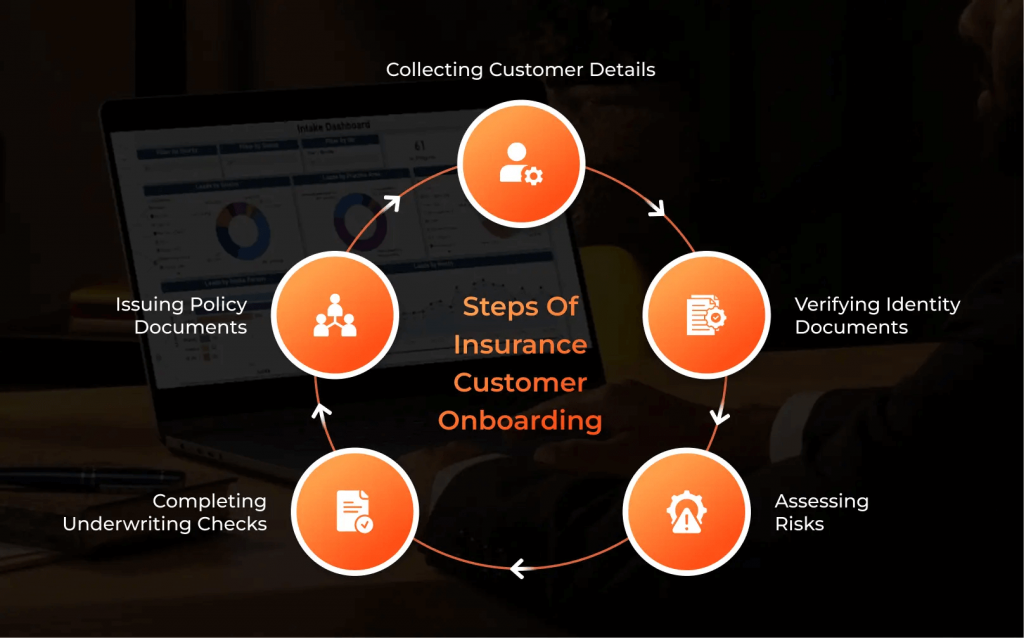
Insurance customer onboarding is the entire process involved from the time a prospective customer shows interest in a policy up to verification, evaluation, approval, and issuance of the final policy. It has several steps:
- Collecting customer details
- Verifying identity documents
- Assessing risks
- Completing underwriting checks
- Issuing policy documents
Previously, it involved various touchpoints and manual operations. As new digital tools and data-driven technologies appear, digital onboarding in insurance is overtaking traditional approaches and allowing customers to complete the majority of onboarding steps online. AI assists in speeding up this change by streamlining the journey and making it more intuitive.
AI Enabled Customer Onboarding in Insurance
AI-based customer onboarding applies advanced technologies to automate, speed up, and streamline the processes of assessing and onboarding new insurance clients. Machine learning, computer vision, and advanced analytics will enable insurers to verify identities, retrieve information from documents and evaluate the risks with increased precision. This simplifies the application-to-policy activation process and is the basis of AI-driven insurance customer onboarding.
With AI modernizing the work of insurers, the process becomes more convenient, providing personal guidance and real-time assistance, as well as immediate verification. Such abilities assist AI in insurance onboarding to reduce manual work, remove bottlenecks, and accomplish a more interconnected experience. Ultimately, AI will emerge as a potent facilitator that will allow insurers to design a more seamless onboarding experience and establish long-lasting relationships with their clients.
Also Read:- How AI Improves Broker Onboarding in Insurance?
Traditional vs. AI Customer Onboarding in the Insurance Sector
| Aspect | Traditional Customer Onboarding | AI Insurance Customer Onboarding |
| Identity Verification | Manual document check | Real-time digital KYC with AI |
| Process Duration | Days or weeks | Minutes |
| Data Accuracy | Prone to human errors | High accuracy with automated validation |
| Customer Experience | Lengthy and confusing | Personalized, guided, and faster |
| Scalability | Limited by workforce | Scalable with automated systems |
| Document Processing | Manual data entry | Automated extraction with OCR and computer vision |
| Communications | Delayed responses | 24×7 chatbot and virtual assistant support |
How AI Enhances Insurance Customer Onboarding?
1. Boosting Customer Verification Procedures
AI enhances customer authentication by automating verification of personal data and cross-checking information with trusted databases as well as authenticating documents in real-time. This considerably saves time that is normally wasted in manually verifying them. AI also enhances accuracy, which assists in facilitating smoother customer onboarding in insurance and prevents the back and forth with customers.
Patterns that can indicate fraud are also detected using AI-enabled verification tools prior to the full onboarding of customers. These tools guarantee compliance and allow insurers to reject risky applications. Faster checks result in a more efficient flow, which supports AI-driven insurance customer onboarding and allows insurers to have a high level of security control over the process.
2. Automated Document Processing and Data Extraction
AI changes the way insurers process documents by removing the necessity of manual data entry and adding automated scanning. AI reads identity proofs, financial statements and medical records with high accuracy using OCR and computer vision. This minimizes errors in paperwork and ensures that valuable information is gathered within a short time. Automation enables insurers to cut the processing timeline considerably and minimize administrative overhead.
When applied to digital onboarding in insurance, document handling automation aids in establishing a more streamlined customer experience, as they no longer have to fill out information repeatedly. Instant extraction and validation allow insurers to work their way through verification and evaluation processes more effectively. This also helps to comply with regulations and ensures robust workflow reliability.
3. AI-powered Digital KYC and Identity Verification
AI-based digital KYC improves identity verification through automated biometric verification, document validation and face matching. These tools detect tampered documents, inconsistencies and possible risks with a high degree of accuracy. This increases the speed and security of KYC, particularly when compared to manual checks that are based on physical checks or the availability of staff. AI keeps track of every step and makes it compliant with the regulatory standards.
Customers benefit by having faster verification, less errors and an easier sign-up process. When insurers incorporate AI to improve the customer onboarding experience, they will be able to perform checks within several minutes and reduce compliance risks. With automation and accurate detection, the KYC process becomes safer and more convenient, and it becomes easy to make decisions confidently.
4. Personalized Policy Recommendations and Seamless Purchase Experience
AI is used to analyze customer data, preferences, lifestyle indicators, and past behaviors and suggest policies that fit the individual preferences. Such a personalization will assist the customers in knowing the products that can fit their risk profiles and financial objectives. It minimizes confusion arising as a result of complicated insurance terminologies and eases decision-making. Smart recommendations also increase customer trust and make the selection process fast.
By introducing a personalized aspect to the onboarding experience, insurers will be able to make the experience much more welcoming. Customers are provided with relevant rather than generic guidance. Such insights can assist AI to improve customer experience and increase conversion rates. Customized recommendations, along with streamlined buying processes, facilitate customer satisfaction and make sure that customers feel confident when transitioning from inquiry to policy purchase.
5. Automating Insurance Underwriting
Underwriting is automated with AI that uses large amounts of data concerning risk, behavior, claims history and demographic trends. Machine learning provides the correct risk scores within a shorter time when compared to manual underwriting teams. This speeds up approvals and eliminates bottlenecks that tend to slow down the process of insurance customer onboarding. Automated underwriting also guarantees uniformity of assessments, avoiding subjectivity.
Customers have the advantage of almost immediate decision-making and better risk explanation, and insurance companies gain less operational overhead. Automation allows underwriters to work on complicated or unusual cases. Insurers are able to provide better results, higher accuracy and efficiency in communication through AI to improve the customer onboarding experience
6. AI-Driven Post-Onboarding Follow-Up
The post-onboarding interaction will dictate the level of satisfaction amongst customers once they receive their policy. Follow-up is automated by AI with personalized messages, renewal reminders, and targeted recommendations. Predictive analytics assists the insurers in knowing the behavioral patterns of the customers and enables meaningful communication at the appropriate time.
This automation helps in retention as the customers are kept updated and in touch with their insurer. Cross and upsell prospects are also identified through AI, which helps insurers to optimize customer lifetime value. With smart follow-up processes integrated into AI in insurance onboarding, companies can ensure constant engagement and minimize churn. Customers enjoy consistent support which builds trust and enhances the overall value of their selected policy.

Operational Benefits of AI-Driven Customer Onboarding for Insurers
1. Faster Policy Issuance
AI speeds up the process of issuing policies through data extraction, verification, and risk analysis, which is automated, enabling insurers to take customers through onboarding without spending much time on manual verification. Real-time processing eliminates bottlenecks and makes sure that applications pass through the system smoothly between submission and approval. This assists insurers in addressing the increasing demands of rapid response and enhances the overall speed of insurance customer onboarding.
Customers are able to enjoy quicker outcomes, reduced wait duration, and a more comfortable onboarding process. They get decisions in minutes, not days, which increases satisfaction and trust. This effectiveness also increases the credibility of insurers and promotes a more efficient implementation of digital onboarding channels.
2. Tackling Repetitive Tasks
AI saves time that employees would have spent on the repetitive administrative tasks such as data entry, document sorting, and manual checking. Automation of these processes enhances accuracy, and reduces the possibility of human error. It also guarantees that key information is handled in a uniform manner, which improves reliability in the workflow during customer onboarding in insurance.
Insurers eliminate repetitive work and enable employees to focus on intricate tasks that need human judgment. This enhances productivity and customer service. More time can be used by teams to solve individual cases or support customers directly, leading to improved operational effectiveness as well as customer experience.
3. Workflow Automation
AI-based workflow automation links the onboarding phases, thus verification, underwriting and approval processes flow smoothly without any redundant delays. Automated triggers enable tasks to be executed in parallel rather than in series, which decreases the total processing time. This provides a more structured and predictable onboarding experience to insurers.
Customers have a hassle-free experience because the number of manual processes, which may cause errors or duplication of information, is reduced. Automated workflow supports real-time updates which increases transparency. By automating workflow, insurers can achieve larger volumes without compromising their effectiveness, which enhances scalability and increases the credibility of AI-driven insurance customer onboarding.
4. Operational Cost Reduction
AI assists insurers in saving money by cutting down on the amount of manual labor, decreasing paperwork expenses, and eradicating redundant procedures. Digital data processing and automated verification limit the use of physical infrastructure and administrative teams. This results in considerable long-term savings, particularly in organizations having high onboarding volumes.
Cost reduction also enables insurers to invest more in advanced technologies that strengthen AI to improve the customer onboarding experience. By having fewer resources allocated to routine work, teams may be repurposed to generate revenue or strategic projects. This balance has sustainable growth and improved financial performance.

5. Minimized Errors and Compliance Risks
AI assists in eradicating errors by certifying information in real-time and making sure the data is registered properly. The inconsistencies, missing fields or suspicious entries are identified by automated checks before an application is taken through. This will reduce the risk of poor onboarding decisions and increase the overall data reliability.
The process of compliance is simplified because AI streamlines onboarding processes and adheres to regulatory standards. Insurers can escape penalties by the use of automated audit trails, proper documentation and standardized verification processes. This offers a safer starting point in terms of insurance customer onboarding and strengthens the customer trust.
6. Improved Decision-Making
AI helps to make better decisions by processing vast amounts of data, finding patterns, and providing information that can assist underwriters in making more accurate judgments. This minimizes the use of guesswork and provides more dependable risk evaluation. Real-time analytics allow faster and more informed responses to customer applications.
Insurers are better informed on the customer behavior, risk patterns and onboarding performance. These insights may be applied to assist in strategic planning and streamline processes in order to attain better outcomes. Better decision-making enhances AI in insurance onboarding because all customers can receive a data-driven analysis, and the overall quality of operations is positively influenced.
7. Higher Conversion and Customer Retention
With the assistance of AI, onboarding is enhanced with individualized suggestions, instant feedback, and automated customer support. This does away with friction and simplifies decision-making among new customers. When the onboarding process is smooth and transparent, a greater number of customers go through the process leading to high conversion rates.
Retention also becomes better as AI-based engagement makes customers feel supported even after issuing policies. Daily notifications, personalized advice, and active communication foster confidence and decrease turnover. AI will enable insurers to provide consistent value, which strengthens the long-term relationships and increases satisfaction during the insurance customer onboarding journey.
8. Fraud Detection and Prevention
AI helps in preventing fraud through behavioral pattern analysis, anomalies, and inconsistency verification of documents provided. Machine learning models are constantly changing to new fraudulent techniques and this makes them more precise in detecting fraud compared to the old rule-based fraud detection. This minimizes financial risks and safeguards onboarding integrity.
Customers have a safer onboarding experience and fraudulent practices are easily detected. Insurers avoid losses and authenticated customers pass through verification without difficulties. This improves the credibility of digital onboarding in insurance and boosts confidence in the capability of the insurer to protect sensitive data.
9. Scalable Operations
AI will allow insurers to process large numbers of onboarding requests without straining internal teams. Customer data is processed by automated systems and verified to generate scale decisions. This will facilitate seamless operation even at peak times, like seasonal rush or marketing campaigns.
Scalability also assists insurers to venture into new markets or expand their products without much staffing. AI-driven insurance customer onboarding with AI-supported workflows helps to sustain the quality of performance and facilitate business growth. Such freedom allows insurers to be competitive and sensitive to the changing needs of customers.
Technologies Used for Customer Onboarding
1. AI and ML
Modern customer onboarding is based on AI and machine learning, which automate the process of verification, risk scoring, and data processing. Structured and unstructured data are analyzed by these technologies to reveal patterns, enhance the accuracy of decisions, and accelerate the working process. ML models leverage on historical behavior that enables insurers to refine forecasting, identify anomalies, and customize onboarding experiences.
2. Natural Language Processing – NLP
NLP enables systems to interpret natural language input by customers, which makes it possible to have an intuitive interaction during customer onboarding in insurance. It drives chatbots, voice assistants, sentiment analysis, and automated form interpretation. NLP assists the insurers in making the communication process easier, answering customers immediately and directing them in the process of the application. This helps in minimizing confusion, enhancing clarity and facilitates a better digital onboarding process.
3. Predictive Data Analytics
Predictive analytics employs AI models to predict customer needs, risks and trends in behavior using historical and real time information. These insights help insurers to tailor policy advice, underwrite, and identify potential fraud. In the process of insurance customer onboarding, predictive analytics improves decision-making and provides quicker and smarter assessment.
4. Computer Vision
Computer vision allows reading, classifying and validating customer documents, photos, and ID proofs automatically. It reads and retrieves pertinent information with great accuracy, assisting insurers to save time and minimize mistakes when performing digital onboarding in insurance. It also serves to validate biometric checks and detect fraud by recognizing altered images or incompatible information.

Conclusion
AI is changing the way insurers attract, verify, and onboard customers, automating essential processes, minimizing the error rate, and providing personalized customer communication. By providing capabilities to simplify verification, improve underwriting, and assist in real-time interaction, AI reinforces operational effectiveness and customer satisfaction. As expectations grow, insurers who partner with an Insurance Software Development Company to embrace AI and enhance the customer onboarding experience will gain a strong competitive advantage.