The global insurance landscape is experiencing a significant change due to the introduction of Artificial Intelligence, which has become a core component of contemporary Insurtech. AI is embedded in almost all business processes, starting with predictive modeling up to intelligent underwriting. Yet one area where its impact is especially transformative is the broker onboarding experience in the insurance industry.
Insurance carriers, agencies, and networks of brokers have found onboarding to be a significant entry point. Efficient onboarding contributes to faster distribution, revenue collection, and better relationships between brokers and carriers. Nevertheless, the traditional onboarding processes can be described as long, paper-based, and prone to errors. Due to the advancement of Insurtech, AI in insurance onboarding is increasingly adopted by businesses to improve their productivity, reduce friction, and build better relationships.
What Is Broker or Agent Onboarding in Insurance?

Broker or agent onboarding is the formalized process wherein an insurance broker is certified, licensed, and ready to market the products of an insurer. It entails gathering of personal and professional information, license verification, assessment of regulatory compliance, background checks, and carrier-specific eligibility. The stage also involves setting up access to the systems, establishing digital profiles, and making sure that all the documentation is in place to facilitate the integration of digital onboarding in insurance.
In addition to verification, onboarding is also concerned with training and early enablement. Carriers present product portfolios, sales guidelines, digital tools and brand expectations to assist brokers in getting fully prepared and confident. Enhanced with AI in insurance onboarding, this process becomes quicker, more precise, and much more helpful to brokers joining the distribution ecosystem.
The Onboarding Dilemma
There is a peculiar paradox with broker onboarding. It has to be detailed enough to meet compliance requirements, fraud prevention, and protect the reputation of the insurer but at the same time, it must be quick and streamlined to allow the business to earn as much revenue as possible.
Industry insights, such as those discussed in India Insurtech’s article “From Paperwork to Proactive”, highlight that insurers often overburden new brokers with heavy documentation, slow manual verification, and fragmented communication. This causes delays and frustration at the very time when brokers are ready to generate business.
AI is finally resolving this paradox by ensuring that the process of onboarding is comprehensive and fast. Using automation, smart decision-making, and predictive capabilities, insurers can cut workload and enhance the process of insurance broker onboarding with AI.
Also Read:- AI in Insurance: Impact, Use Cases & Future Trends
Why Traditional Broker Onboarding Automation Falls Short?
Earlier automation efforts in the insurance sector were primarily about form digitization or a basic workflow solution. Though helpful, they still were heavily dependent on manual review, human intervention, and limited intelligence. Traditional automation falls short because of:
1. Weak Handling of Unstructured Data
The traditional systems are not able to read various documents such as scanned forms, certificates or handwritten notes accurately. This makes human teams do information validation manually, which slows the process of onboarding and causes more errors in the validation process.
2. Excessive Dependence on Manual Validation
Although forms are digitized, human beings have to scan through entries, compare documents and verify accuracy. Such dependence on manual checks increases the time of onboarding and introduces bottlenecks when high volume recruitments are involved.
3. Limited Risk and Anomaly Detection
Rule-based tools are unable to detect small anomalies, suspicious patterns, or indicators of fraud reliably. Consequently, the insurers are forced to engage more human resources to tackle the compliance issues and make sure that the risk related concerns are handled well.
4. Rigid Rules Without Adaptive Learning
Legacy workflow systems adhere to a set of rules and are unable to learn from past instances. They do not fit to new rules, changing business demands, or process enhancement, which diminishes the flexibility and the quality of decision-making.
5. Fragmented and Siloed Process Flows
In general, traditional automation tools may be used to manage isolated systems, reducing information sharing between compliance, licensing, HR, and carrier departments. This fragmentation leads to repetitive work, loss of information and delays in the flow of onboarding tasks.
6. Lack of Predictive and Intelligent Insights
The majority of onboarding tools are tailored to execute simple tasks and do not offer any future looking intelligence. In the absence of predictive analytics or intelligent suggestions, insurers lack an active approach to instruct brokers or streamline the onboarding process to achieve better results.
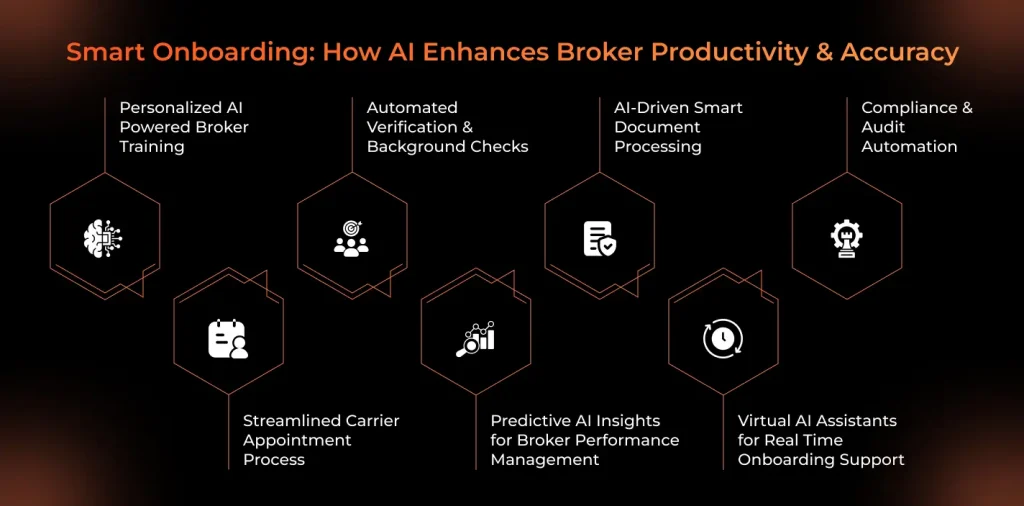
How AI Improves the Broker Onboarding Experience in Insurance?
1. Personalized AI Powered Broker Training
AI-based training systems use learning behavior, knowledge level, and performance data of each broker to design personalized training programs. They divide complex concepts into micro lessons, practical exercises, and scenario-based modules that are individually paced and styled. This kind of customization plays a major role in enhancing the AI-driven insurance broker onboarding as it enables brokers to grasp product knowledge better and develop confidence prior to engaging with clients.
These platforms can also alter learning recommendations depending on evaluations and actual time performance trends. The system modifies content and offers extra advice when brokers are struggling with any subject. This interactive learning model saves time on training, enhances retention and equips the brokers with knowledge and skills to approach customers and carriers in a more knowledgeable and conforming way.
2. Virtual AI Assistants for Real Time Onboarding Support
AI assistants take brokers through the process of onboarding, documentation, compliance requirements, and filling forms with precise and real-time answers. They reduce the reliance on human service teams and offer immediate clarification of onboarding activities. The speed of accessing reliable and consistent information will improve the broker onboarding experience in the insurance industry, providing brokers with more confidence in their progress through complex requirements.
The assistants provide automated notifications, monitor next steps, and outline activities that require a follow-up. Brokers benefit from around-the-clock support that ensures no delay due to unanswered questions or unclear processes. These smart assistants ease frustrations, enhance interactions, and assist brokers in going through onboarding more effectively.
3. Automated Verification & Background Checks
AI ensures verification of identities, licenses, background checks, and compliance matching with verified databases and smart data models. It scans documents, cross-checks information from a variety of sources, and finds discrepancies that require human intervention. Digital customer onboarding in insurance provides insurers with a highly scalable and reliable method to onboard customers, increasing the speed of verification cycles and decreasing the workload on internal teams.
Automated warnings and predictive checks are used to detect possible risks at an earlier stage. Onboarding teams do not interfere with the routine, but only when required, which enables them to focus on exceptions instead of standard validation. This hybrid model will result in a more secure, faster and accurate verification environment for both carriers and brokers.
4. AI-Driven Smart Document Processing
AI-driven systems are highly accurate at reading unstructured files, certificates, emails, and scanned forms. They retrieve necessary information, categorize the content, and contrast the information with the existing records to ensure a certain consistency. An efficient and smooth document flow facilitates smooth digital onboarding in insurance, enabling teams to decrease the time wasted on manual processing and incomplete entries.
The systems identify any missing fields, expired documents, and inconsistencies and notify the brokers to upload the required information or to correct it. Automated tracking makes sure that all the necessary documents are captured and validated without having to manually monitor it. This high-tech processing speeds up the time of the onboarding process and reinforces the accuracy at every level of documentation.
5. Streamlined Carrier Appointment Process
AI compares the credentials, qualifications, and documentation of the individual brokers against the carrier requirements in real-time. It forecasts preparedness, identifies lapses, and gives practical suggestions to accelerate approvals. Carriers can have better insight into the status of applications, which directly helps them improve their AI to enhance broker experience and helps new brokers navigate various carrier processes with less confusion.
The automated analysis also minimizes redundant administrative tasks and shortens the time frame for making appointments. In case there are bottlenecks, the AI systems can detect them in the shortest time possible, and direct the two parties towards a solution. Carriers and brokers can work together more efficiently from the beginning as they have a better understanding of each other.
6. Compliance & Audit Automation
Onboarding data is also constantly checked by AI to ensure its accuracy, regulatory completeness, and documentation validity. It identifies licenses that have expired, certifications as well as possible compliance risks before they become serious. Strong early insight contributes to a more reliable broker onboarding experience enhancement with AI, reducing regulatory exposure and strengthening an insurer’s overall governance framework.
In the case of audits, AI will automatically compile and arrange compliance records, which will be easy to retrieve when reviews are conducted. Teams do not have to run after paperwork or compilations of audit files done manually. This automation reduces workloads on compliance, enhances efficiency, and facilitates faster onboarding processes that keep up with industry regulations.
7. Predictive AI Insights for Broker Performance Management
AI analyzes the market dynamics, broker activity, product adoption rates and past performance to determine whether the venture will succeed or not succeed early. The insights will assist carriers in comprehending where customized assistance or expert training will be required. Improved forecasting empowers AI in insurance onboarding, allowing insurers to make improved choices from the start of the broker journey.
The predictive intelligence also assists in enhancing the long-term engagement plans and productivity planning. Carriers will be able to predict areas of performance decline, find top potential brokers sooner, and develop growth plans based on data-driven insights. These intensive interventions translate into improved business results and enhanced broker relationships.

How AI Transformation Assists Insurance Brokers?
Onboarding is not the only area that AI is improving. It is changing the whole working experience of brokers who are able to serve the customers more efficiently and accurately.
> Faster Quote Generation and Risk Assessment
AI-based quoting tools allow brokers to handle customer data, risk, and carrier regulations in real-time. Rather than comparing rates manually or searching different systems, AI compares all options and provides correct quotes in a few seconds. This will minimize delays and errors, which directly enhance the AI to improve broker experience in the initial customer interaction stage. Brokers are able to provide accurate estimates in a short time, which enhances consumer confidence and boosts the quality of submissions.
Moreover, AI models are capable of evaluating risk factors in a more detailed manner by identifying patterns that cannot always be seen by conventional approaches. Such insights will help brokers offer improved advice and make customers matched to the right products. The combination of speed and precision elevates the overall insurance broker onboarding with AI and ongoing sales experience.
> Personalized Policy Recommendations
AI analyzes customer information based on their profile, financial history, coverage, and lifestyle trends to propose customized policies. Brokers no longer have to rely on manual comparison only since AI can identify the most appropriate ones across lines of products. This leads the AI to enhance broker experience by ensuring that its recommendations are more scientific, consistent and data driven. The relevance of these suggestions is valued by customers, and this increases conversion rates.
AI also follows the customer needs over time and anticipates when coverage modifications could be useful. Brokers get notifications of upsell and cross-sell opportunities supported by real time analytics. This enhances long term client relationships and facilitates smarter selling strategies.
> Workflow Automation for Brokerage Offices
AI automates scheduling, documentation, follow ups, data entry, and application checks. This cuts the operational bottlenecks and enables the brokers to focus more on customer engagement and less on administration. With streamlined workflows, brokers enjoy a seamless process, which strengthens the broker onboarding experience enhancement with AI and daily productivity.
Automation also reduces human errors and provides uniformity in the operations of the brokerage. AI-powered systems are used to follow deadlines, report missing information and keep the data clean across platforms. This helps to maintain a more organized and efficient environment and adds to long-term scalability.
> Enhanced Claims Support for Clients
Claims assistants powered by AI follow claim progress, analyze status changes, and detect missing documents on behalf of brokers. This assists brokers in providing timely information to the clients and minimizes the back and forth that comes with dealing with claims. These features would enhance customer confidence and the level of services that brokers are able to offer as a part of AI in insurance to boost broker experiences.
AI also assists in decision guidance by assessing the claim histories, risk factors, and policy rules. Brokers are able to establish the right expectations, prepare clients in a better way, and raise issues in the right manner. This proactive support builds stronger long term relationships and enhances broker professionalism throughout the customer journey.
> Better Decision Insights for Brokers
AI analytics systems combine customer interaction data, market behavior, underwriting trends, and product performance. Brokers obtain a better idea about what strategies are able to provide the best results. These insights will assist them in prioritizing high value clients, growth opportunities, and refining their sales strategies, which will enhance the process of AI-driven insurance broker onboarding over time.
Predictive insights also reveal the changes in customer behavior or emerging risks. Brokers will have a chance to get ready in advance, modify propositions, and align communication to make a more powerful interaction. Such data informed decision-making helps brokers gain a competitive edge in a fast-moving insurance market.
> Fraud and Compliance Assistance
AI technologies are used to detect fraudulent patterns at an early stage by analyzing vast amounts of structured and unstructured data. These systems alert irregularities, suspicious activities and inconsistencies in information before a submission goes through critical processing levels. This coverage helps to protect brokers from reputational risk and supports ethical practices.
To ensure compliance, AI constantly tracks documentation, validity of the license and changes in regulations. Existing brokers get real-time notifications of missing data or expired credentials. This active governance assists in avoiding fines and facilitates easy interactions with the carriers.
> Streamlined Carrier Broker Collaboration
AI centralizes data sharing, communication, and the exchange of documents between brokers and carriers. This removes miscommunication and minimizes time wastage due to fragmented information. Real-time tracking of appointment status, product updates, and underwriting responses helps improve the insurance broker onboarding with AI and further collaboration.
AI also aligns profiles of brokers with the needs of carriers, making the appointment process simpler. Missing steps or documentation required are shown to brokers. This transparency enhances trust and makes the distribution more unified, whereby both carriers and brokers enjoy effective coordination.

How AI Enablement Impacts the Insurance Industry?
1. Efficiency and Cost-Saving in Operations
AI enhances operational efficiency by automating routine operations, minimizing manual errors, and accelerating the fundamental work processes. Insurers experience faster underwriting, claims handling and recruitment. Such efficiencies also reduce the pressure on the internal teams, allowing them to pursue more strategic activities.
Automation minimizes paperwork, errors and wastage of resources and the result is cost savings. This enables insurers to grow without a significant increase in the number of employees and management costs. This fosters long term profitability and contributes to the implementation of AI in insurance onboarding as part of broader transformation efforts.
2. Personalized Service Recommendations and Dynamic Pricing
AI analyzes the behavior of customers, their demographics, and risk information to provide highly personalized service suggestions. These understandings assist insurers in developing products that are more customer-oriented. This level of personalization enhances customer satisfaction and increases the overall retention rates.
Dynamic pricing is further refined when AI uses real time risk and past claims data. Insurers are able to price the policies more fairly and competitively to enhance the performance of the portfolio. This dynamic pricing approach provides insurers with a competitive advantage in an environment that requires continuous innovation.
3. Enhanced and Automated Underwriting and Claims Processing
AI can assist in the process of underwriting, processing complex data and discovering risk trends while recommending appropriate coverage actions. Underwriters are able to access more insight, reducing the time of evaluation and enhancing the accuracy. Workflows that are automated also minimize the risk of omissions or inconsistencies.
AI-driven data extraction, immediate case triage, and automatic fraud detection enhance claims processing. Customers have quicker service and are more informed on the status of their claims. This efficiency increases confidence and eases the service experience throughout the claims journey.
4. Automated Broker and Agent Enablement
AI simplifies broker and agent enablement by automating licensing checks, document collection, onboarding tasks, and training recommendations. This eliminates the administrative hassle and assists brokers to sell faster. Carriers attain a better insight into onboarding progress and compliance preparedness.
AI also develops customized learning processes that can match the speed and performance of each broker. This guarantees increased interaction and better product familiarity. A stable network of brokers results in better distribution efficiency and enhanced long term relationships within the insurance ecosystem.
5. Improved Compliance and Regulatory Reporting
AI enhances compliance by constantly checking the validity of documents, policy accuracy, and regulatory needs across all interactions of the broker and customers. Teams are alerted automatically to take corrective measures. This minimizes the likelihood of compliance risks and provides uniform supervision.
AI makes regulatory reporting more efficient because it automatically aggregates and verifies data. Report errors are minimized and the transparency is improved to ensure insurers audits are ready. This improves governance, reduces legal liability and establishes a robust platform for sustainable operations.
6. Strengthened Risk Prevention and Loss Mitigation
AI assists insurers in detecting new risk through behavioral patterns, environmental context, and claims patterns. Such insights would enable the insurers to act early and advise clients to make safer decisions. Early detection will lead to reduced loss and better portfolio health.
The mitigation strategies are enhanced as AI models constantly learn from new data. Insurers are able to tailor prevention programs and prescribe specific solutions to policyholders. This helps to reduce long term risks and boost customer confidence.
7. Seamless Integration
AI can facilitate easier integration with reinsurers, data providers, brokers and Insurtech platforms because it supports unified APIs and real-time information sharing. This enhances data exchange for underwriting, claims and compliance information throughout the ecosystem. Cooperation between processes is made more transparent and effective.
Such integrations also minimize system silos, and it becomes simpler to coordinate complex workflows, e.g. reinsurance submissions or cross platform policy servicing. Through connected digital infrastructure, the insurers will have the capacity to expand at a more increased rate and adjust to the changing market requirements.
8. Predictive Analytics for Better Decision Making
Predictive analytics driven by AI are able to assist insurers in predicting market trends, the behavior of customers, and risk exposures more precisely. These insights can guide the leadership teams for product development, pricing models, and distribution arrangements. This enhances business resilience and strategic decision making.
Predictive insights will also be used to determine growth opportunities, new risks, and possible operational challenges. Insurers are able to initiate actions instead of just responding to problems as they arise. This proactive strategy enhances performance and makes sure insurers are competitive in an evolving insurance landscape.

How A3Logics Helps Transform Broker Onboarding with AI?
A3Logics has over 20 years of experience in Insurtech, Artificial Intelligence, and Cloud Infrastructure engineering. As a leading insurance software development company A3Logics has served international insurers, agencies, and the network of brokers by providing advanced solutions of digital transformation in response to contemporary industry issues. This is how A3Logics optimizes the insurance broker onboarding with AI:
1. Personalized Broker Training
The use of AI-directed learning courses can assist brokers to progress at the appropriate speed and work toward specific product knowledge and skill development. Personalized modules enhance trust, retention, and accelerate preparation considerably in the initial stages of broker onboarding.
2. End-to-End Automation with AI Tools
Automation simplifies the process of document capture, verification, and routing of workflows to make the onboarding process faster. With support from A3Logics, insurers minimize manual work and provide brokers with a new process that is in line with the increasing demands of digital onboarding in insurance.
3. AI Driven Insights for Better Decisions
Predictive analytics reveal patterns of performance, customer requirements and risk behavior. These insights enable the insurers to coach the brokers better and provide more accurate decision guidance, ultimately enhancing the long term distribution strategies throughout the organization.
4. Seamless Integration with Existing Systems
AI solutions can be linked to CRMs, policy platforms, compliance tools, and agency systems. The integration enabled by A3Logics removes data silos, enhances accessibility, and enables brokers to operate in a single, effective digital space without affecting the current operations.
5. Regulatory Intelligence for Compliance Management
The automated compliance tracking will check the licensing status, documentation status, regulatory updates and the audit requirements. Real-time intelligence lowers the risk of regulation and ensures that onboarding teams meet the necessary standards with the lowest administrative burden.
6. AI Enablement and Digital Transformation of Existing Systems
The legacy platforms are transformed by AI-driven automation, scalable architecture, and intelligent data processing. A3Logics has transformation initiatives that enable the insurers to simplify the onboarding process, increase the performance of their systems, and move to digital maturity in the Insurtech space confidently.