
AI is redefining how financial professionals approach forecasting, valuation, risk analysis, and strategic planning. In a high-stakes environment where the margin for error is razor-thin, even minor inaccuracies in Financial Modeling with AI can lead to millions in losses or missed opportunities. Traditional methods, typically reliant on static spreadsheets and manual analysis, are no longer agile or scalable enough to meet modern demands. With expanding data volumes and the growing need for real-time decision-making, the limitations of legacy systems have become painfully evident.
AI Financial Modeling presents a direct and powerful solution. By applying machine learning, natural language processing, and automation, organizations are enhancing the accuracy, speed, and strategic depth of their financial models. From AI in Budgeting and Forecasting to AI in Investment Analysis, businesses are not just adopting AI, they are transforming core financial workflows.

Recent surveys show that over 71% of finance teams have adopted AI in some capacity, and 86% report a positive impact on revenue after implementation. Leading companies such as Siemens, Allianz, and Mastercard have achieved measurable gains, from reducing forecasting errors to cutting operational costs by over 30%.
This blog explores AI Financial Modeling, starting with traditional model limitations, examining how AI addresses these issues, delving into the mechanics of automated financial modeling, and covering use cases, benefits, implementation strategies, ethical considerations, and future trends. Let’s just dive in!
Traditional vs. AI-Based Financial Modeling
Traditional financial modeling relies on static historical data, manually built spreadsheets, and analyst-driven logic. While valuable for basic forecasting, this approach suffers from several structural weaknesses:
- Limited scope: Most models use a narrow set of variables and require constant human intervention.
- Slow updates: Monthly or quarterly refresh cycles can’t keep pace with market dynamics.
- Error-prone: Manual data entry and formula dependencies often lead to mistakes, sometimes with high financial consequences.
- Lack of adaptability: Traditional models don’t learn from new data or adjust in response to changing patterns.
In contrast, AI-based financial models ingest structured and unstructured data, apply machine learning algorithms to uncover complex relationships, and adapt continuously. They are capable of analyzing live market feeds, consumer behavior data, and even non-traditional sources like social media sentiment. The result is real-time, predictive, and highly granular insights.
Challenges in Traditional Financial Modeling
1. Manual Data Handling and Analysis
Conventional financial models require significant time and effort to collect, clean, and structure data before any analysis can begin. Analysts often juggle inputs from multiple systems (ERP, CRM, and third-party data feeds) and manually reconcile inconsistencies. As a result, model cycles are delayed, and real-time decision-making becomes impossible.
In addition, traditional tools like Excel limit the volume and variety of data that can be processed. This constraint forces teams to truncate or oversimplify datasets — reducing model robustness. Legacy processes can’t integrate alternative data sources such as web traffic, geolocation, or macroeconomic indices without substantial manual adjustments.
2. Human Errors and Biases
Manual modeling is inherently prone to errors. A single formula mislink or copy-paste mistake can invalidate entire financial statements or forecasts. Furthermore, analysts bring cognitive biases into the model — anchoring on past results, overestimating trends, or omitting tail-risk events.
Studies have shown that traditional forecasters often achieve accuracy rates only marginally better than chance, particularly in volatile markets. This variability in judgment compromises strategic planning and increases financial exposure.
3. Lack of Scalability and Real-Time Insights
As companies expand, so do their data ecosystems. Unfortunately, traditional financial models don’t scale efficiently. Adding new variables, business units, or product lines typically requires significant model rework, version control, and QA.
Moreover, static models lack the capacity for real-time recalibration. In crisis scenarios such as sudden market shocks or supply chain disruptions, firms relying on manual modeling often react too late, missing opportunities to mitigate risk or adjust strategy.
How AI Addresses These Challenges
1. Data-Driven Automation
AI Financial Modeling introduces automation at every level: from data ingestion and cleansing to real-time updating of model variables. Machine learning algorithms can extract structured data from PDFs, ingest live feeds, and even apply natural language processing to parse earnings transcripts or regulatory filings.
This not only eliminates tedious manual tasks but also reduces human error rates significantly. With models auto-updating as new data arrives, finance teams can allocate their time to scenario testing, sensitivity analysis, and executive decision support — not spreadsheet maintenance.
2. Real-Time Forecasting and Insights
With streaming data integration and continuous learning, AI for Financial Forecasting offers a quantum leap in responsiveness. Models can recalculate forecasts on the fly as new data points are added, producing dynamic risk assessments and financial plans.
For example, a retail enterprise can integrate point-of-sale data into its cash flow forecast, allowing the AI system to detect a dip in consumer spending early and adjust projections accordingly. These insights are made available in real-time dashboards, often paired with NLP-generated narratives for easy consumption by decision-makers.
3. Enhanced Accuracy and Adaptability
Machine learning models adapt as they learn from new data. In Financial Modeling with AI, the system continuously improves its predictive capability, accounting for changing business conditions, new KPIs, and external variables.
Whereas traditional models require manual recalibration, AI models self-correct, thereby reducing drift and increasing accuracy over time. Reinforcement learning and ensemble modeling further refine forecasts and valuations, making AI ideal for volatile environments such as commodity markets or global supply chains.
How AI in Financial Modeling Works?
Overview of AI Architecture in Finance
At its core, AI in Finance relies on a modular architecture consisting of:
- Data pipelines to collect and process structured (e.g., financial statements) and unstructured (e.g., call transcripts) data.
- Machine learning engines that apply regression, classification, time-series forecasting, or neural networks.
- Model orchestration tools that allow retraining, performance monitoring, and deployment at scale.
Many organizations deploy these models on cloud infrastructure to ensure scalability and compliance, with APIs enabling easy integration with ERP, CRM, and BI platforms.
Integration of ML Models and Algorithms
AI systems for financial modeling may use a variety of algorithms:
- Time-series forecasting models (e.g., ARIMA, LSTM) for revenue and cash flow projections.
- Tree-based models (e.g., XGBoost, Random Forests) for credit scoring and risk analysis.
- Natural Language Processing (NLP) for analyzing unstructured financial documents.
- Reinforcement learning for real-time, decision-based simulations (e.g., treasury management or trading strategies).

Role of Data Ingestion, Training, and Feedback Loops
The pipeline begins with data ingestion, which involves structured data from systems such as Oracle or SAP, as well as unstructured data, including investor presentations and legal disclosures.
Once cleaned and labeled, the data feeds into training cycles. Models are validated on test sets, and performance metrics like Mean Absolute Error (MAE) or R-squared are tracked. Post-deployment, these models are embedded into financial workflows and monitored for drift.
Feedback loops ensure the model evolves. If actual revenue diverges from the forecast, the system retrains, improving its next prediction. Some enterprises even incorporate human-in-the-loop feedback, allowing finance teams to flag anomalies or override faulty suggestions.
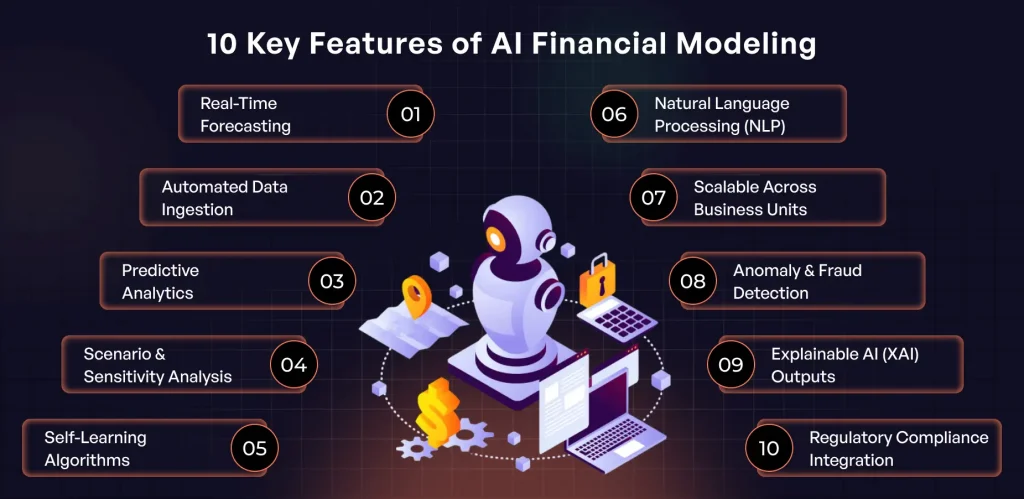
10 Key Features of AI financial Modeling
Applications of AI in Financial Modeling
The real-world use cases for AI Financial Modeling are vast and growing across operational, strategic, and compliance-focused domains. Below, we explore core applications segmented into three categories: core financial operations, strategic and analytical functions, and automation and intelligence.
a. Core Financial Operations
i. AI in Budgeting and Forecasting
One of the most impactful applications of AI Financial Modeling lies in corporate planning. Traditional budgeting processes are slow, static, and often based on outdated assumptions. With AI in Budgeting and Forecasting, companies can shift to rolling forecasts and real-time adjustments.
By integrating machine learning with ERP and CRM data, organizations can improve forecasting accuracy by up to 10%. AI systems evaluate a wide range of inputs, from customer churn to macroeconomic trends, and instantly recalibrate budget assumptions when new data becomes available.
AI also automates laborious consolidation tasks. Departmental budgets can be aggregated and reconciled automatically, while forecast accuracy is monitored and improved through continuous learning cycles.
ii. AI for Financial Reporting
AI for financial reporting eliminates many bottlenecks in the preparation of P&L statements, balance sheets, and cash flow reports. NLP-driven algorithms can extract data from unstructured sources like invoices and contracts, reconcile entries across systems, and even generate first-draft narratives for management discussion sections.
For example, companies now use AI-generated summaries to draft 10-K disclosures or internal memos. AI flags anomalies and ensures that reports are regulatory compliant, significantly reducing time to close. Some enterprises have reduced their monthly reporting cycles from weeks to days by utilizing AI-powered automation tools.
iii. Valuation and Investment Analysis
AI in Investment Analysis empowers organizations to evaluate opportunities using a deeper, more data-rich approach. Rather than relying on basic comparables or DCF models, AI can analyze thousands of data points, market sentiment, alternative datasets, and economic indicators to derive more realistic and dynamic valuation ranges.
AI-powered simulations help finance teams run hundreds of scenarios for pricing assumptions, synergy realizations, and economic shocks. In M&A, AI can even automate parts of the due diligence process, parsing legal documents, flagging risk clauses, and evaluating historical performance metrics with near-zero latency.
iv. Loan and Credit Risk Assessment
In banking and lending, AI-based financial models outperform traditional credit scoring systems. Machine learning models can assess dozens of borrower characteristics from spending patterns to social signals, providing a far more accurate credit profile than traditional FICO-based models.
For instance, Upstart’s AI-driven underwriting process has resulted in 44% more loan approvals while maintaining 36% lower interest rates. These models adapt to changing economic conditions and can spot risk trends earlier than legacy systems.
v. Tax and Pension Modeling
Automated AI systems can also optimize tax planning and pension fund management. In taxation, Financial Modeling with AI simulates different corporate structures and jurisdictions, flagging the most tax-efficient setups based on real-time policy updates. In pensions, AI forecasts liabilities and asset returns under various macroeconomic scenarios, enhancing solvency planning and mitigating actuarial risk.
b. Strategic and Analytical Functions
i. Predictive Analytics and Scenario Modeling
AI for Financial Forecasting leverages time-series models and ensemble learning to generate accurate forecasts for short-, mid-, and long-term horizons. However, more than just a point estimate, these systems support scenario modeling, running hundreds of “what-if” cases with varying inputs, such as commodity prices, interest rates, and consumer trends.
Instead of three-case forecasts (best/expected/worst), automated financial modeling powered by AI can simulate hundreds or thousands of scenarios. These simulations allow leadership teams to identify inflection points and stress-test strategies well in advance.
ii. Risk Management and Sensitivity Analysis
Risk modeling has become one of the most critical use cases for AI Financial Modeling. Algorithms evaluate risk not just through financial ratios, but by tracking real-time signals from across the web, news, and internal transactions.
AI systems can detect early signs of operational risk or liquidity crunches and even assign risk-adjusted returns dynamically to new investments.
iii. Strategic Planning and M&A Modeling
AI enhances strategic modeling by predicting the downstream effects of decisions like entering new markets, acquiring companies, or restructuring operations. With access to historical outcomes across sectors and geographies, AI helps identify patterns associated with success or failure.
c. Automation and Intelligence
i. Automated Financial Modeling
From model generation to testing and deployment, Financial Modeling with AI enables systems to automatically build forecast models for individual business units, refresh them with live data, and even generate dashboards and visualizations without human input.
This is especially useful in decentralized finance teams managing multiple P&Ls. AI reduces the time-to-insight from weeks to hours while eliminating version control issues inherent in manual spreadsheets.
ii. Natural Language Processing (NLP)
In finance, NLP is increasingly used to interpret unstructured data: extracting figures from scanned invoices, summarizing earnings calls, or analyzing sentiment from analyst reports. For instance, hedge funds use NLP to parse call transcripts for tone, revealing early signals of underperformance.
Additionally, NLP drives AI for financial reporting by generating human-readable summaries of economic outcomes. For instance, “Operating income fell 7% QoQ primarily due to a 12% increase in raw material costs and a 4% decline in customer orders” could be entirely machine-generated from raw data.
iii. Personalized Financial Advisory
In wealth management, AI-based financial models drive robo-advisors that offer personalized investment strategies tailored to real-time market behavior, individual risk preferences, and specific goal timelines. These systems adjust automatically when a client’s portfolio deviates from the target or when new economic data is released.
In corporate finance, similar models are used internally for personalized decision support. A sales VP might receive a tailored dashboard showing forecasted commission fluctuations, pricing risks, and capital availability in a way that’s context-specific and forward-looking.
iv. Compliance and Fraud Detection
AI models are now essential in automated financial modeling workflows that require built-in compliance checks. These systems cross-reference entries against accounting standards, regulatory thresholds, and audit trails in real time. Anomalies are flagged instantly.
For fraud detection, AI utilizes behavioral modeling to identify abnormal transactions or data manipulation, which is far more effective than traditional rule-based methods. Mastercard’s AI system reportedly doubled fraud detection rates and reduced false positives by over 200%, demonstrating the significant impact these tools can have.
Key Benefits of AI in Financial Modeling
Adopting AI Financial Modeling delivers measurable, strategic value. Here are the most critical benefits:
1. Improved Accuracy and Speed
Machine learning models consistently outperform manual forecasts by incorporating more data and dynamically adapting to change. AI eliminates errors common in spreadsheet-based models and produces high-frequency forecasts that reflect real-time data.
Companies report reducing forecasting errors by 20–30%, leading to better cash planning and fewer missed earnings targets. Faster output also means finance teams can respond to risks and opportunities in near real-time.
2. Scalability and Real-Time Updates
As businesses grow, traditional models become unmanageable. In contrast, AI-based financial models scale automatically—processing millions of transactions across geographies, product lines, or customer segments without adding complexity.
More importantly, these models can update instantly as new data is ingested. A change in supplier pricing or consumer demand is reflected in the next iteration without waiting for month-end reconciliations.
3. Cost Reduction and Operational Efficiency
Finance teams leveraging AI have significantly reduced manual workloads. J.P. Morgan’s AI legal review system, COIN, saved over 360,000 hours annually, and similar efficiency is achievable in financial modeling through automation of data handling, model updates, and report generation.
AI also drives downstream savings by optimizing capital allocation, identifying fraud early, and accelerating close cycles—cutting compliance costs and reducing FTE load.
4. Enhanced Decision-Making Support
Perhaps the most strategic benefit of AI Financial Modeling is how it augments leadership decision-making. AI highlights key drivers, surfaces blind spots, and supports multi-variable trade-offs that would be impractical in traditional models.
For instance, finance leaders can evaluate not just ROI, but also risk-weighted ROI, adjusted for currency volatility, economic indicators, and supply chain risk. With AI Financial Modeling, decisions are backed by robust, multi-dimensional analysis rather than intuition alone.
How to Implement AI in Financial Modeling?

The successful adoption of AI in Financial Modeling requires a structured, outcome-driven implementation strategy. Below is a five-step framework for integrating AI into finance workflows.
Step 1: Define Objectives and Data Requirements
Before selecting tools or hiring vendors, organizations must define the strategic purpose behind the initiative.
- Are you aiming to improve forecast accuracy by 25%?
- Automate variance analysis?
- Reduce the month-end reporting cycle?
Once objectives are established, map out all relevant internal and external data sources: historical financials, ERP/CRM systems, customer data, macroeconomic indicators, and alternative datasets. The quality and granularity of data will directly impact model accuracy. If your source data is fragmented or inconsistent, you’ll need a data engineering phase to clean and standardize inputs.
For example, a company focused on AI in Budgeting and Forecasting would prioritize transactional data, seasonal patterns, and marketing drivers as key input variables.
Step 2: Choose the Right AI Tools and Platforms
Selecting the right tools involves balancing in-house capabilities, data security, and long-term scalability. For some, this means using out-of-the-box solutions with embedded AI capabilities. For others, building custom models using Python, TensorFlow, or PyTorch may offer deeper control.
Either way, the platform should support:
- Time-series forecasting
- Regression/classification models
- Natural language processing (for AI for financial reporting)
- API-based integrations with ERP or BI tools
- Security and compliance features
Companies can also partner with an AI Development Company to accelerate implementation and reduce risk. These partners bring not only technical expertise but also domain experience in finance, regulation, and operations.
Step 3: Data Preparation and Model Training
This phase involves building the automated financial modeling engine. Begin with data ingestion pipelines—connecting ERP, CRM, and external feeds—and then prepare the dataset by:
- Cleaning anomalies
- Filling missing values
- Engineering new features (e.g., ratios, rolling averages)
Once the dataset is ready, select and train your model. Depending on the use case, this could be a Gradient Boosted Tree for classification, an LSTM for time-series forecasting, or a hybrid ensemble.
Validation is critical. Use historical test sets to compare predictions against actuals. Models should beat existing baselines before being deployed in production.
Step 4: Integrate with Existing Systems
Integration is what transforms AI from a lab experiment into a business enabler. Your AI outputs should feed directly into:
- Financial dashboards
- Excel-based reports
- BI tools like Tableau or Power BI
- ERP systems for automated action triggers
For example, if AI in Investment Analysis flags a significant variance in projected vs. actual returns, the system should alert the investment committee and suggest reallocations. Integration also means establishing access controls, audit trails, and user feedback channels.
Step 5: Monitor, Retrain, and Iterate
Once deployed, AI models must be monitored continuously for drift and performance decay. Track metrics like RMSE (Root Mean Square Error), directional accuracy, and user override rates.
Retraining cycles should be built into the workflow. Whether monthly or quarterly, models should evolve with the business environment. For instance, a pricing elasticity model may need adjustments if market behavior changes due to inflation or competitor moves.
Engage both finance professionals and data scientists in a feedback loop. Analysts can flag anomalies, refine assumptions, or request additional outputs—ensuring that the AI remains aligned with business needs.
Ethical and Regulatory Considerations
Implementing AI Financial Modeling introduces legal and ethical responsibilities. As regulators worldwide increase scrutiny of algorithmic decision-making, companies must proactively manage risk across three areas:
1. Bias and Fairness
AI models inherit biases from their training data. In financial contexts, this can translate into discriminatory lending decisions, inaccurate risk assessments, or skewed forecasts.
For example, a credit risk model trained on biased loan approval history could systematically disadvantage certain demographics. To avoid this:
- Use balanced datasets
- Apply fairness metrics during validation
- Mask sensitive variables where required
Bias doesn’t just create reputational risk—it can violate laws such as the Equal Credit Opportunity Act or GDPR. Ensure your models meet fairness benchmarks before deployment.
2. Transparency and Explainability
Black-box models, especially deep learning networks, may deliver accurate forecasts but lack explainability. This creates problems in regulated environments, where decisions must be auditable and defensible.
Use Explainable AI (XAI) techniques such as:
- SHAP values (to explain feature importance)
- LIME (to interpret local predictions)
- Surrogate models (simplified approximations of complex algorithms)
These methods allow stakeholders—executives, auditors, regulators—to understand why the AI flagged a risk, rejected a transaction, or forecasted a loss. Building explainability into your models increases stakeholder trust and reduces compliance risk.
3. Data Privacy and Compliance
AI in Finance must comply with a web of global regulations: GDPR in Europe, CCPA in California, and sector-specific rules like SOX and Basel III. AI models handling personal or financial data must adhere to strict standards:
- Encrypt sensitive data during training and storage
- Implement role-based access control
- Maintain audit logs and retraining history
If models pull data from third-party APIs or cloud storage, ensure the providers also meet compliance standards. Engaging legal and compliance teams early in the AI journey will prevent downstream regulatory friction.
Future Trends in AI for Financial Modeling
As AI matures, the next wave of innovations will expand beyond automation into strategic and autonomous decision-making. Here are four emerging trends reshaping the field:
1. Generative AI for Financial Simulation
Generative AI models are being applied to financial scenario generation, creating synthetic stress-test data or crafting multiple plausible future states. Instead of relying solely on historical patterns, models can simulate “black swan” conditions—helping organizations prepare for extreme volatility.
In practice, this means forecasting under novel combinations of inflation, geopolitical risks, or customer behavior that the company has never seen before. These simulations support more resilient planning and robust capital management.
2. Explainable AI (XAI) as a Standard
As regulatory pressure increases, explainability will move from “nice-to-have” to “mandatory.” We’ll see AI platforms embedding interpretability tools by default—allowing users to drill down on each prediction and see the reasoning behind it.
For example, a treasury system predicting a liquidity shortfall will not just display the number, but also annotate it: “Driven by 15% lower collections, extended receivables by 7 days, and rising payables.”
XAI ensures accountability and gives finance teams the confidence to act on AI recommendations.
3. Integration with Blockchain and Web3
AI is increasingly intersecting with blockchain, enabling smart contract automation, immutable audit trails, and decentralized data marketplaces. For example, a model could trigger a blockchain-based smart contract when forecasted EBITDA falls below a covenant threshold, automatically notifying counterparties.
Blockchain also enhances model auditability by recording training data hashes, decision logs, and version history in tamper-proof ledgers. This supports regulatory audits and internal compliance reviews.
4. Autonomous Financial Agents
Looking ahead, we may see autonomous finance systems that handle entire workflows—from real-time reforecasting to investment execution—without human input. These systems will ingest live data, adapt models, and execute decisions within predefined boundaries.
Use cases could include automated capital deployment, algorithmic pricing updates, or treasury rebalancing. While human oversight remains critical, the direction is clear: finance functions will evolve from reactive to predictive, and eventually autonomous.
A3Logics AI Development Services for Financial Modeling
When adopting AI Financial Modeling, selecting the right implementation partner is critical. A3Logics offers comprehensive AI development services tailored specifically for finance teams, banks, and fintechs.
Overview of Services Offered
- End-to-end AI strategy and roadmap design
- Custom development of AI-based financial models
- Data engineering and model training
- Seamless integration with ERP, BI, and CRM systems
- Post-deployment support and retraining workflows
Whether you need a forecasting model, an intelligent assistant, or a fraud detection engine, A3Logics builds production-grade solutions with security and compliance at the core.
Industry Expertise and Use Cases
A3Logics has successfully delivered AI implementations across:
- Corporate FP&A: Automated revenue forecasting with continuous learning and live dashboard integration
- Risk Modeling: AI credit scoring tools using 100+ features, outperforming legacy models in default prediction
- AI for Financial Forecasting in retail and manufacturing enterprises, improving forecast accuracy by over 20%
- Financial Reporting Automation for insurance clients, cutting reporting cycles by 60%
- AI in Investment Analysis for fintechs to automate portfolio rebalancing and simulate fund performance under various market regimes

Why A3Logics?
- 500+ projects delivered over 21+ years across finance, insurance, and enterprise SaaS.
- Deep experience at the intersection of AI and finance
- Proven success in highly regulated industries
- Strong capabilities in explainability, scalability, and audit-readiness
- Commitment to ethical AI development and continuous client collaboration
With A3Logics as your partner, you can unlock the full potential of automated financial modeling without compromising security, speed, or compliance.
Conclusion
AI Financial Modeling is the new foundation of modern finance. From forecasting and budgeting to valuation and risk analysis, AI is transforming how organizations model their financial future. AI is empowering finance leaders to make faster, smarter, and more data-driven decisions. The benefits are clear: improved accuracy, reduced costs, scalable insights, and proactive planning.
Yet, achieving this transformation demands more than just tools. It requires structured implementation, high-quality data, cross-functional collaboration, and a strong ethical framework. Leaders must navigate challenges around bias, explainability, and compliance with strategic intent and operational rigor.
Looking forward, the future belongs to those who can blend AI in Finance with deep domain expertise, embedding intelligence at every level of their financial stack.
Partnering with experts like A3Logics, investing in scalable infrastructure, and fostering a culture of data-driven thinking are the next logical steps. The companies that do so will lead the next generation of financial performance — intelligent, resilient, and future-ready!