
Artificial intelligence has been reshaping industries around the world by automating workflows and elevating efficiency. AI for lab automation has recently gained momentum as it not only accelerates the research process but also promises accuracy while eliminating human errors.
Scientific research, healthcare, and drug development rely on laboratories. Nevertheless, they have always faced challenges in terms of repetitive manual labor, data fragmentation, and time-consuming procedures. AI for lab automation is the groundbreaking method that combines artificial intelligence with sophisticated Lab Automation Systems and robotics to establish intelligent, efficient, and exact laboratories.

Speeding up research is not the only aspect of AI-powered Lab Automation in 2025, but also enhancing reproducibility, safety, compliance, and cost-effectiveness. Using Lab Automation Software, the labs can unlock predictive insights and optimize experiment design, and also they can speed up scientific breakthroughs. AI in healthcare is reshaping the lab model, be it in a pharmaceutical laboratory, clinical diagnostic, or biotechnology research.
This blog discusses the revolution of AI for lab automation in laboratories, technologies that are driving this, and their advantages to the researcher, its implementation in the real world, and emerging trends that will define the next generation of intelligent laboratories.
What is AI for lab automation and Why It Matters in 2025?
AI for lab automation is the application of artificial intelligence technologies (e.g., machine learning, natural language processing, robotics, and computer vision) to Lab Automation Software and systems. In contrast to the classical system of automation, where programming is strict, AI-based automation allows labs to be creative, learn, and evolve.
According to statistics, the global lab automation market size has been valued at USD 7.84 billion in 2024, and is expected to reach around USD 14.78 billion by 2034. Experts have also anticipated that it will grow at a CAGR of 6.55% from 2025 to 2034.
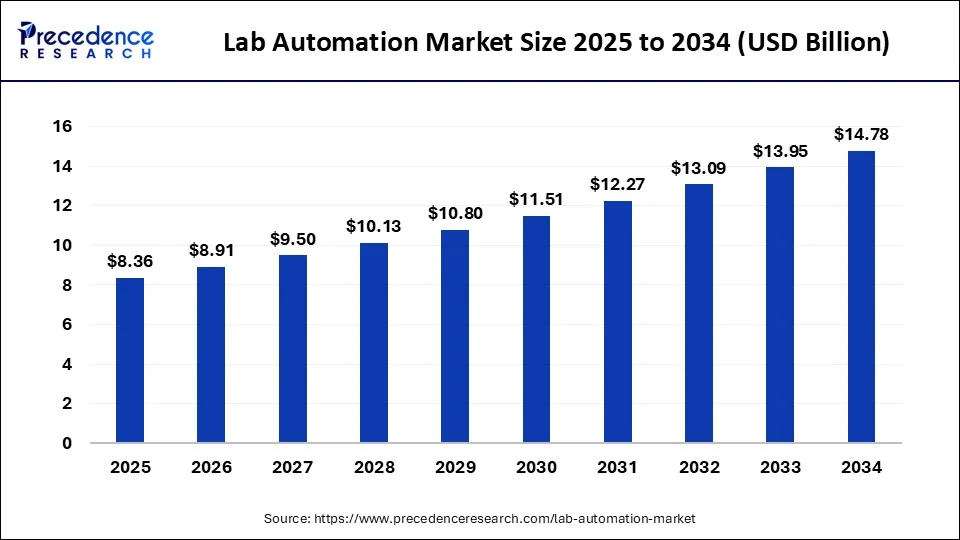
By the end of this year, genomic sequencing, high-throughput screening, and imaging by the laboratories will produce vast data that has never been generated before. It is not practical to handle, analyze, and extract insights about such data on a manual basis. This gap is filled by AI by automating complicated processes, making use of previous experiments, and offering predictive feedback that motivates improved outcomes.
The value of AI extends beyond efficiency in the lab nowadays. It has a direct influence on drug discovery schedules, diagnostic precision, patient results, and the general research quality. Pharmaceutical firms are able to streamline the development process across various healthcare software types, clinicians can detect problems quickly, and scientists are able to devote their attention to innovation rather than menial duties.
Moreover, Lab Automation Systems powered by AI contribute to a higher level of compliance and safety through workflow monitoring and handling hazardous materials, as well as protocol compliance. With the current trend of the world focusing more on speed, safety, and accuracy in research and healthcare. AI turns out to be the backbone of intelligent laboratories.
The Evolution of Lab Automation: From Manual to AI-Powered Systems
Automation in the laboratories passes through various stages. Early on, some of the labs were using manual procedures in pipetting and monitoring of experiments, all of which were subject to human error. This reduced scalability and slackened discoveries.
Introduction of the first wave of automation meant the introduction of mechanical tools such as pipetting robots and sample handlers, which minimized manual labor. Although effective, these systems were not flexible and still required a significant input of human supervision.
The second was the centering of wave to Lab Automation Software Development, and the incorporation of digital platforms to schedule, manage instruments, and optimize workflow. This change allowed the enhancement of consistency, yet it continued to have a weakness in working with complex data and prediction.
In 2025, we live in the era of AI for lab automation. Modern automation uses machine learning, natural language processing, robotics, and cloud AI platforms to provide intelligence and flexibility.
For example, AI-based imaging systems detect subtle cellular changes invisible to the naked eye.
Predictive algorithms help design and optimize experiments, saving both time and resources efficiently.
This process has turned laboratories into intelligent environments, in which machines not only work, but also give suggestions, anticipate failures, and make the most out of the results. The transition to Lab Automation Systems based on AI becomes a significant turning point in the field of scientific and medical innovations.
Top Benefits of AI-Driven Lab Automation for Researchers and Scientists
AI-powered lab automation empowers researchers by eliminating inefficiencies and introducing intelligence across workflows.

1. Liberation from Repetitive Tasks
The AI does not require scientists to perform menial activities, including pipetting, labeling, and data input, and allows them to focus on research and decisions. It eliminates boredom, enhances efficiency, and makes sure the researchers dedicate more time to the generation of hypotheses, innovations and critical problem-solving as opposed to the manual processes.
2. Dramatically Accelerated Research Pace
Using automate lab management software encompasses a shorter time to run the experimentation process using AI, resulting in faster publications, discoveries, and clinical outcomes. The new kinds of studies that used to require weeks before were now accomplished in a few days and helped the institutions to be competitive besides making breakthroughs in the medical field, genetics, biotechnology, and advancements in healthcare all over the world.
3. Unprecedented Data Analysis Power
The AI codes have the capacity to process a lot of information at a particular time, which will reveal hidden patterns and relations that would remain unnoticed by human beings. The collaboration with the Lab Automation Systems enables the researchers to predict, which entails that they explore the intricate biological pathways and make evidence-supported and more accurate decisions.
4. Enhanced Reproducibility and Reliability
AI ensures consistent protocol implementation, eliminates human error, and enhances the validity of research findings.
Such standardization increases the reliability of outcomes, supports peer-reviewed validation, and builds confidence in pharmaceutical, diagnostic, and biotechnological applications.
The new criterion of standardization is reproducibility, which strengthens scientific credibility and ensures reliable advancements across diverse fields.
5. Reduced Operational Costs and Waste
The most effective utilization of resources is automation which minimizes reagents, staff and energy wastages. The software, Lab Automation Software, will forecast the exact resources required, remove over-utilization and minimize errors, which leads to leaner and more sustainable research operations.
6. Intelligent Experiment Design and Optimization
Automate lab management software simulates experimental conditions and generates workflows in the most optimal ways and proposes parameters that would make future research more efficient. Scientists can develop and experiment on ideas in a virtual arena before implementing them in practice and thus it is cheaper, eliminating unnecessary failures and achieving success in more scientific and pharmaceutical projects that are complex and require more resources.
7. Proactive Problem-Solving and Predictive Maintenance
AI predicts the failure of the equipment before it arises and helps save time to conduct effective lab work. It stops costly failures, maximises uptimes and manages real-time so that important experiments are not held on due to unanticipated failures.
Key AI Technologies Transforming Laboratory Automation in 2025
The power of AI-driven lab automation software comes from cutting-edge technologies. Below we have listed the major technologies that are trending in the market.
1. Machine Learning for Data Analysis
The ML algorithms are able to find trends in experimental data and help scientists to make predictions, find anomalies, and make decisions using data. Besides the simple analysis, machine learning is continuously being improved upon by learning novel data, meaning it is better able to predict, so to speak, and work smarter as well as discover relationships in more complex biological issues.
2. Natural Language Processing for Research
NLP can be used by the laboratories to interpret scientific literature, derive the essential results, and even to work out the hypotheses. It is capable of summarizing thousands of papers, reading unstructured lab notes, and converting them into actionable insights to enable the researcher to keep up with the science and plan experiments based on the current science.
3. Computer Vision for Microscopy and Imaging
Vision systems powered by AI improve the clarity of images, identify anomalies, and speed up the process of research in the field of pathology and genomics. They detect minor cellular or molecular alterations that cannot be detected by the human eye, which reduces the misdiagnosis, accelerates clinical workflow,w and enhances the reliability of both experimental research and diagnostics significantly.
4. Robotics and AI in Automated Pipetting and Handling
AI and robotics will guarantee accuracy in pipetting samples, handling them, and transferring liquids with minimal errors, and enhancing throughput. AI for lab automation allows screening at high throughput, repetitive task consistency, and smooth processing of sensitive samples, and will eventually result in a more efficient lab and a reduction of human error in sensitive processes.
5. Cloud AI Platforms for Connected Labs
Cloud systems incorporate lab systems, making it possible to collaborate in real-time, remotely monitor, and do analytics en masse using AI. They centralize the information among the remote workforces, provide a real-life connection of data anywhere, and provide on command processing power, and thereby the labs are able to accelerate the research and are not tied to the local resources.
AI in Pharmaceutical Labs: Accelerating Drug Discovery and Development
AI revolutionizes pharmaceutical research by making processes faster and more efficient.
1. Target Identification
AI is able to quickly process genomic and molecular data with accuracy to predict promising drug targets. This accelerates the preliminary research, decreases trials and errors, and enhances the chances of success of therapeutic findings.
2. Drug Discovery
Machine learning can predict the state of both molecular interactions and candidate drug effectiveness, dramatically speeding up the process of drug candidates. This saves on time and money used in actually discovering new medicines that researchers would have struggled to find otherwise.
3. Preclinical Testing
The AI is used to imitate biological reactions to compounds, which reduces the use of animal models. This will speed up preclinical trials, improve ethical standards, lower expenses, and leave only the most promising ones.
4. Clinical Trials
AI simplifies the procedure of trial design and the purposeful selection of the ideal groups of patients, and constantly monitors information. This can ensure rapid recruitment besides improving accuracy, improving safety, and reliable findings that reduce the risks of trial delays or failure.
5. Manufacturing and Quality Control
Pharmaceutical production is made more straightforward through AI whereby consistency is ensured, anomalies are identified in real-time, and quality checks are automated. This will guarantee increased compliance, reduced errors, and safer medicines will be provided to people earlier.
AI in Clinical Diagnostics: Enhancing Accuracy and Speed
Diagnostics benefit from AI’s unmatched ability to process complex data rapidly.
1. Revolutionizing Medical Imaging Analysis
AI improves the accuracy of imaging and identifies the signs of disease at an early stage before a patient can recognize them. This allows faster and more precise diagnoses, enhances treatment planning, and facilitates earlier interventions to improve patient outcomes.
2. Powering Advanced Pathology
AI-based automated pathology solutions analyze tissue samples faster and more accurately in greater volumes than manual techniques. This ensures uniform diagnostic findings, reduces workload, and greatly enhances the diagnosis of complicated illnesses such as cancer.
3. Unlocking Insights from Genomic Data
Big data of genomic sequencing is analyzed by AIs and provides insights into promising areas to initiate precision medicine. It helps in personalized treatment, correct assessment of risk and enhanced methods of treating patients through connecting the genetic variation to illnesses.
4. Streamlining Laboratory Medicine
Biochemistry, cultures, blood tests; work processes are accelerated and errors during manual work are eliminated. The AI-driven systems will ensure accurate output, less human involvement, and more work per unit of work can be done by laboratories.
5. Accelerating Workflow and Reducing Wait Times
The advantages of AI in diagnostics include process automation, improved efficiency, and reduced time delays in operations. This minimizes patient waiting time, accelerates result delivery, and ensures timely provision of accurate and appropriate medical care.

AI-Powered Data Management: From Raw Data to Actionable Insights
AI-powered lab automation revolutionizes the way laboratories handle massive datasets. Below are some key points for consideration.
1. Intelligent Data Ingestion and Integration
AI for lab automation will be able to integrate various streams of data into central hubs, which will allow seamless integration of more efficient and consistent laboratory analysis that has been faster and more efficient.
2. Automated Data Cleaning and Standardization
AI can automatically eliminate errors and duplicates, standardize data forms, and ensure high-quality and reliable data to perform accurate research and diagnostics.
3. Unleashing Advanced Analytics and Pattern Recognition
AI scans through non-obvious patterns in large datasets and foretells results, finding correlations that can improve precision in research and clinical decision-making.
4. Generating True Actionable Insights
AI transforms unstructured data in the laboratory into evidence-based insights, enabling researchers and clinicians to make more informed decisions.
How AI Improves Lab Safety, Compliance and Risk Management?
AI for lab automation safeguards laboratories by proactively identifying and minimizing risks. Below are the significant points on how AI-empowered lab automation software reduces the risk and ensures safety.
1. Predictive Hazard Detection
AI anticipates a chemical, biological, or mechanical threat prior to its escalation. Such a proactive method protects scientists, minimizes incidents, and makes the laboratories safe and in accordance with international safety regulations.
2. Intelligent Personal Protective Equipment (PPE) Monitoring
Innovative PPE is an AI and machine that tracks the compliance of workers in real time. It promotes a consistent adherence to safety measures, eliminating the risk of exposing people to dangerous substances and enhancing the overall laboratory risk management standards.
3. Proactive Chemical and Inventory Management
AI and LLM in healthcare can be used to track the inventories of chemicals to prevent shortages and reduce hazardous waste. This proactive system is safer, financially more economical, and the labs will have a sustainable and risk-free inventory system.
4. Automated Compliance and Audit Trail Generation
AI for lab automation simplifies the compliance process by automating regulatory reporting and creating entire audit trails. This minimizes human error, addresses standard compliance, and simplifies inspections, saving labs time and preserving credibility.
5. Enhancing Standard Operating Procedure (SOP) Adherence
Lab automation software based on AI causes employees to adhere to SOPs, tracing workflow and reporting the deviation. This will reduce mistakes, provide consistency and make sure that the whole lab business is compliant with the safety and regulatory provisions.
6. Risk Forecasting and Strategic Management
AI predicts the possibility of risks based on trends and abnormalities. It offers viable mitigation strategies to be implemented, and labs can be proactive to tackle challenges and become more resilient to operational disruptions.
The Role of Robotics and AI in High-Throughput Screening Labs
Massive experimentation is known to flourish in high-throughput labs, which are based on robotics and AI development services. The complex sample handling is performed with the help of robotics, and the optimization of the experiment, the detection of errors, and predictive modeling are performed with the help of AI.
Together, they enable thousands of tests to be performed at the same time with unmatched accuracy and dramatically speed up drug discovery, molecular research, and diagnostics. This synergy saves human intervention in tasks in which errors are likely to occur, and guarantees data uniformity in the case of large-scale experiments.
AI-driven robotics will provide the core of the laboratories carrying out the most advanced types of biotechnological research by 2025, allowing the discovery of findings that have never been found before.
Case Studies: Real-World Applications of AI in Lab Automation
Case Study 1: Accelerating Drug Discovery at AstraZeneca

The AstraZeneca uses AI lab automation software to improve the compound screening and predictive analytics. By aggregating machine learning models, they can reduce the discovery time and amount of money spent on development by a significant margin. This revolution increases the speed of drug development, increased efficiency, and quick delivery of innovative treatment to the patients in other parts of the world, and hence more competitive in the pharmaceutical market.
Case Study 2: Revolutionizing Diagnostics with Paige.AI

Paige.AI is an application based on deep learning that changes the workflow of pathology. Its AI-based lab automation solutions analyze digital slides as precisely as possible and enhance the accuracy of cancer diagnosis and reduce human error. This technology offers clinicians an insight that is faster, offers an option to intervene earlier, and eventually has an improved patient outcome because of making the diagnosis process more credible, scalable and data-driven.
Case Study 3: Optimizing Gene Editing with an Automated CRISPR Platform

CRISPR platforms based on AI increase the precision of gene-editing because they automate the design of experiments and detect errors. This breakthrough lowers the side effects, speeds up the research processes, and promotes the revolutionary changes in genetic therapies. Automation and AI enable researchers to gain greater reproducibility, accuracy, and quicker outcomes, and the combination of the two opens up transformative biotechnology and healthcare innovation opportunities.
Challenges and Limitations of AI in Laboratory Settings
Let us consider some of the significant challenges of adopting AI-powered lab automation software.
1. High Implementation Costs
The deployment of advanced AI systems requires huge investments in infrastructures, software, and human resources. Such initial costs are too costly to adopt in most labs, in spite of its greater efficiency, greater precision, and greater novelty in the long term.
2. Data Privacy Concerns
The processing of genomic and patient data must have stringent protection. The implementation of AI introduces the risks of breaches, abuse, or regulatory failure, and it is necessary to have strong security, encryption, and compliance systems to ensure safe implementation.
3. Integration Complexities
Many of the laboratories have been operating outdated systems that are incompatible with AI. It hinders the smooth adoption because of compatibility, disruption of workflow and intensive migration efforts, slows down the transformation and efficiency.
4. Skill Gaps
Laboratory specialists and scientists lack proper training on how to work with AI. Existing is the skill gap which is the gap that exists between the education, collaboration, and upskilling and is imperative in maximizing the potential of AI in the laboratories.
5. Ethical Dilemmas
Prejudice of AI algorithms may corrupt results, particularly in clinical or genomic studies. It is necessary to make sure that the results are fair, transparent, and designed responsibly to avoid the results being skewed and ensure that the results are scientifically sound.
Ethical Considerations in AI-Driven Lab Automation
Ethics plays a crucial role in AI-powered research. Lab automation software empowered with AI should be adopted with ethical considerations.
1. Bias in Algorithms
AI systems must minimize bias to protect scientific integrity and ensure fair, accurate, and inclusive research outcomes. Furthermore, they should rely on diverse datasets, populations, and experimental conditions to strengthen accuracy and enhance reliability.
2. Data Privacy
Strong security controls are necessary to protect sensitive patient and research information to comply with, and be trusted, ethically, and responsibly used in a laboratory.
3. Transparency in Decision-Making
AI models should deliver explainable and interpretable results to build researchers’ confidence and enhance accountability. Moreover, they support informed decisions in complex scientific tasks by providing clarity and fostering trust among researchers. As a result, they drive reliable advancements in research while ensuring transparency and accountability in every scientific process.
4. Responsible Innovation
In research and healthcare use, AI should be responsible in scientific advancement, striking a balance among innovation, safety, ethics, sustainability, and long-term societal effects.
Future Trends: What’s Next for AI and Smart Laboratories Beyond 2025?
The future of AI-powered lab automation promises even greater breakthroughs. The table below shows the significant trends in lab automation systems.
| Trend | Description |
| AI + IoT Integration (The Internet of Labs) | AI and IoT can bind laboratory equipment together, which will be able to communicate autonomously in real-time, manage and control fully connected labs, and simulate experiments to predict and make decisions more easily before physical experiments. |
| Digital Twins of Laboratories | Virtual replicas of labs simulate experiments, optimize workflows, and allow risk-free testing, enabling predictive analysis and better decision-making before physical execution. |
| Generative AI in Research & Experiment Design | The process of AI formulates new hypotheses, protocols, and experiments, which drives innovation, advances discovery, and proposes an optimized method of approaching complex scientific studies, which has never been as fast and accurate as possible with classical computing. |
| Quantum Computing + AI in Labs | Combining quantum computing with AI enables analysis of massive datasets far beyond classical computing capabilities, allowing unprecedented speed and accuracy in research. |
| Sustainability and Green AI-Powered Labs | Artificial Intelligence removes waste, maximizes energy consumption, and encourages friendly environmental activities, and it facilitates efficient and effective laboratory work. |
Why Build Your AI-powered Lab Automation Software With A3Logics?
It is essential to collaborate with the appropriate team to create AI-powered Lab Automation Software that supports the specific needs of your laboratory. A3Logics is an AI development company that believes in optimization of workflow, improving data management, and compliance by combining profound healthcare domain knowledge with advanced AI powers.
Custom software development services meet the specifications of the labs, and the end-to-end AI development services take projects through the entire cycle of creation and deployment to success.
A3Logics offers future-ready laboratory automation solutions that adapt to evolving technology, backed by proven industry experience. They deliver reliable, innovative, and efficient solutions for research, diagnostics, and pharmaceutical applications.

Conclusion
Lab Automation is the application of AI and a global trend that is redefining the world of research and healthcare in 2025. Initially, creating ever-smarter, safer, and more productive laboratories, AI-based Lab Automation Systems are also seen to accelerate drug discovery and improve diagnostics, compliance, and predictive maintenance.
By implementing AI, labs enhance efficiency and scientific understanding, leading to improved patient outcomes and innovative solutions. The future of laboratories will be more intelligent and connected, driven by digital twins, quantum computing, and sustainable AI technologies.
Investing in Lab Automation Software Development is now a requirement, rather than a choice, as it is inevitable to remain competitive in the case of startups, enterprises, and healthcare providers. The collaboration with a more seasoned Healthcare Software Development Company, such as A3Logics, would make sure your trip into intelligent laboratory automation is a successful, not only compliant, but also future-ready one.