
The construction industry has struggled with delayed timelines, rising costs, and safety concerns. These drain away both time and resources. For industry leaders, the question is, how can we get things in order and build smarter construction systems?
Use of AI in construction could just be the answer. Using advanced technologies such as machine learning, deep learning, and computer vision, AI provides real-time insights that keep budgets and timelines under control while ensuring safe construction practices. It also helps take proactive decisions that can increase productivity and profitability.
In this blog, we’ll cover how to use AI in construction by going through its benefits, practical use cases, and more.
Understanding AI in Construction
AI in the construction industry is the use of advanced technologies like machine learning, deep learning, and robotics to analyze massive amounts of data in real-time; The analysis helps in providing insights; uncovering patterns, and accurately predicting outcomes so that necessary steps can be taken promptly and efficiency can be increased. Leveraging advanced algorithms, cost overrun can also be prevented using AI in construction estimating. In addition, modern project financial systems such as construction invoice management software integrate AI and data workflows to automate billing, improve accuracy, and accelerate invoice approval cycles across complex construction projects.
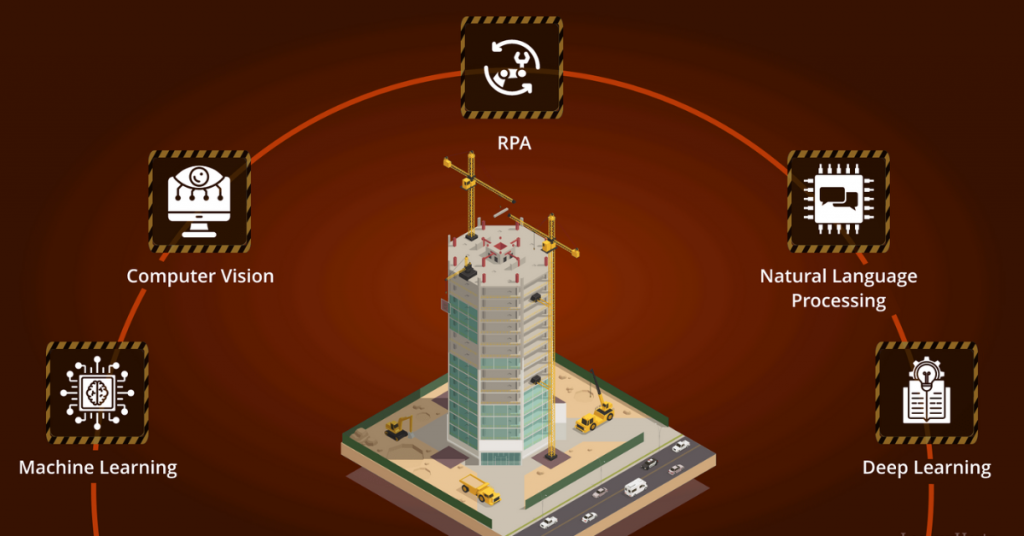
Core technologies applied to construction
> Artificial Intelligence
AI can be applied to various spheres of construction. One of the ways it is used is how it predicts maintenance needs for critical systems such as HVAC (Heating, ventilation, and air conditioning) and electrical systems. This helps ensure equipment remains operational and unsafe conditions are avoided.
> Machine Learning
Machine learning in construction analyzes vast amounts of project data to make predictions that can expedite construction operations as well as enhance safety. One of the key roles involves analyzing sensor data to predict construction machinery failure.
> Deep Learning
The role of deep learning in the construction industry can be seen in areas like risk monitoring; it can help contractors prioritize on-site risks. This way, they can direct their resources and time towards the bigger risk factors.
> Computer Vision
Cameras placed at construction sites can scan areas for defects, deviations and inconsistencies. AI can further suggest if any immediate corrective actions need to be taken. Also, computer vision can identify unauthorized personnel in restricted areas; enforcing access control measures.
AI Construction Market Overview
- Global market growth & statistics
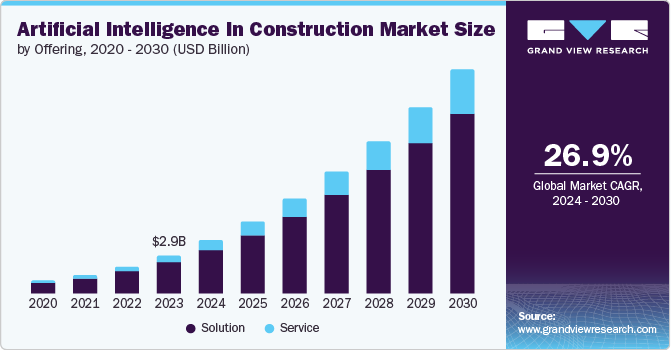
- The AI construction market is projected to reach $24.3 billion by 2030.
- AI in the construction market sales will account for more than 55% of total sales by 2030.
- Contractors have reported 37% labour-productivity gains and 41% fewer change orders using predictive analytics.
- North America holds the largest market share in AI in construction, followed by Europe and the Asia Pacific.
- Key trends driving adoption
Let’s have a look at some of the key trends driving the adoption of AI in construction –
> Improved productivity and efficiency
AI assistants are being integrated into planning, design, and management to streamline operations and automate repetitive tasks. This is done to complete projects faster.
> Enhanced safety
AI systems are capable of monitoring job sites in real-time and identifying potential safety hazards. AI tools can analyze historical data to predict and prevent future accidents.
> Sustainability and green construction
Using data from various sources; AI can analyze material usage, energy efficiency, and other aspects and help in more sustainable construction practices. Sustainability is also inclusive of recommending eco-friendly designs that can contribute to climate change.
> Stand ahead of the competition
With the growing awareness of AI’s benefits, more and more construction firms are adopting AI in their workflow. This implies that if a construction firm wishes to stay ahead of the competition, adopting AI can help them do just that.
> Cloud-based deployment
Cloud-based AI construction solutions are being adopted since they ensure better collaboration, scalability, and easier data integration across projects.
Industry segments adopting AI (residential, commercial, infrastructure)
> Residential
AI can assist in making home designs more accurate and managing the supply chain of residential projects; It can analyze data on space usage, airflow, sunlight and materials to suggest layouts that are comfortable, efficient and cost-effective.
> Commercial
When it comes to commercial construction; AI focuses on large-scale planning and management. Here it optimizes floor space for offices, retail shops and other commercial establishments where it is essential to meet even stringent safety and regulatory standards. Here, AI can help in real-time monitoring of huge sites and ensure that sustainability is at scale.
Machine Learning and Deep Learning in Construction
With the use of AI in the construction industry, several areas can be improved. These include areas; such as safety management, site monitoring, alerting workers, etc.
> How ML improves predictions and optimizations
To begin with, ML algorithms can use historical data and real-time information to predict construction costs. This way, they can prevent any budget overruns. With the use of artificial intelligence in construction, project owners can allocate resources wisely, ensuring that equipment, labor, and materials are used efficiently.
> Role of Deep Learning in vision-based tasks (safety monitoring, defect detection)
AI in construction management can use deep learning in vision-based tasks to identify risky behaviors on construction sites, which can further cause mishaps. Computer vision can analyze 2D images or videos of unsafe behavior on construction sites. It can be used to detect any defects, and safety monitoring measures can be taken.
Benefits of AI in the Construction Industry
1. Efficient Planning & Scheduling
By using AI for the construction industry, project owners can streamline project schedules by taking into account materials, weather, and workforce availability. By using construction AI solutions, they can predict any potential delays and make adjustments to keep the projects on track.
2. Enhanced Risk Management
Construction owners can use AI applications in the construction industry together with security cameras, sensors and other devices. Together, these AI-based devices can help identify safety hazards and alert site managers. Necessary actions can be taken to resolve issues before situations escalate. Project owners can also use AI in construction to monitor any flaws in designs and building materials and take action in a timely manner.
3. Improved Resource Allocation
The role of AI in construction management is important. Artificial intelligence helps construction managers to analyze data and optimize their resource distribution – from labor to materials and energy. By optimizing resource allocation; the right materials and personnel can be deployed. This can help ensure timely project completion.
4. Quality Assurance & Control
AI-based digital applications can help Quality Assurance teams assess the quality of structures and even the vicinity, both on-site and off-site. They can conduct automated inspections of sites using computer vision and drones and get real-time analysis. Using this data, they can identify potential flaws much before they cause any damage.
5. Cost Reduction
With AI in construction, project owners can create on-target estimates that become the foundation for mid-flight adjustments and real-time monitoring. Such predictive analytics can help teams stay on budget; when it comes to materials, rising labor and compliance costs.
6. Increased Productivity & Efficiency
AI applications in the construction industry can help in project planning and scheduling, safety, materials procurement and other areas, thereby boosting productivity and efficiency. By reducing the time spent on these tasks, workers can stay on schedule. Apart from that, construction managers can identify which teams need what machinery and stay on schedule.
7. Sustainability and Waste Reduction
Construction companies use Artificial Intelligence to build in ways that protect the environment as well as save money by reducing wastage. 3D printers can be used to make floors, walls, and other parts of buildings and other establishments with greater accuracy, leading to minimal waste of material. By reading data information from sensors in existing concrete structures, designers can use AI applications to adjust concrete mixes and create structures with lower carbon emissions.

Use Cases of AI in Construction
Let’s have a look at some of the common use cases of Artificial Intelligence in construction that are transforming the way projects are carried out in terms of planning, management, and execution –
1. Smart Building Design & Simulation
AI and ML analyze data from various building systems to optimize energy consumption. They predict maintenance needs, and improve occupant comfort. Furthermore, AI studies data from systems such as lighting, heating, cooling, etc, and learns patterns. Using this knowledge, AI can adjust the air conditioning in real-time, thereby saving power. The data can also help designers simulate how a building will use energy or react to weather changes. This way, they can design more efficient structures.
2. Autonomous Machinery & Robotics
AI robotics is being used increasingly in construction. AI-robots deployed on construction sites include 3D printers, painting robots, welding robots, bricklaying robots, and layout drawing robots, just to name a few. These are further equipped with cameras and sensors and can perform repetitive or hazardous tasks such as excavation, bricklaying, etc, with precision, complementing the work of human workers.
3. Predictive Maintenance for Equipment
Construction AI solutions analyze data from sensors integrated into machinery to predict when certain equipment will need maintenance or when it is likely to fail. This approach can be useful as it helps reduce downtime, which can further cost a lot. Once the system is able to understand repeated patterns of when equipment requires maintenance, it can automatically schedule maintenance tasks.
4. Real-Time Project & Site Monitoring
AI in construction estimating can help in both project and site monitoring by giving real-time updates. For project monitoring, AI tracks the overall status of the project, i.e., its progress against the scheduled plan. It tracks, whether tasks are completed on time and aligns with the assigned budget. When it comes to site monitoring – AI uses cameras, drones, and sensors to watch daily activities, material use, and worker safety.
5. Automated Documentation & Reporting
AI automates document management; by categorizing, tagging, and storing files without constant human involvement. It uses NLP to scan, interpret, and classify documents; permits, contracts, design specifications, and others to extract key clauses, dates, and requirements. It analyzes progress data from various sources to generate automated reports and conduct tasks such as tracking costs and identifying delays; It then collates this data and sends it to project managers.
6. Building Information Modeling (BIM) Enhancement
This involves creating digital representations of a building’s functional and physical characteristics. BIM uses AI to create detailed 3D visualizations of construction designs that users at different levels can share with each other; This helps in better design, planning, and management throughout its lifecycle.
7. Data-Driven Decision Making
With the use of AI in construction, project owners as well as construction managers can take calculated decisions based on data obtained from various sources; They can collect inputs from sensors, drones, 3D models, and other systems and use this real-time data to predict outcomes such as costs, risks, safety hazards, etc.
8. Predictive Analytics for Project Outcomes
In a construction project, if you can control the outcome, you can speed up project delivery, cut costs, and save time, all while delivering supreme quality. And, predictive analytics does just that. It analyzes historical data and current project metrics to forecast potential outcomes in the form of project completion time and budget adherence.
9. Safety Management & Hazard Detection
AI systems help automate safety inspections and ensure that safety standards are met. They monitor site conditions using devices such as sensors and cameras 24/7. In addition to that, AI helps detect potential safety hazards such as loose wires, unstable structures, and blocked exits.

Future of AI in Construction
> Generative AI
GenAI will help architects and planners generate 3D designs so that they can turn concepts into models. Construction firms can employ GenAI techniques to leverage historical data to improve processes and procedures. It will also be able to identify and correct building code violations.
> Digital Twins
By using this advanced technology, digital twins or accurate virtual production of real-world spaces, buildings, objects, and other infrastructure facilities can be created. Using these models, construction teams can virtually explore and engage with the physical property, leading to a more interactive and efficient project development process.
> IoT+AI Integration
In construction; IoT sensors can capture real-time data from environments. Furthermore, AI and ML algorithms can analyze the data to derive meaningful insights; facilitating informed decision-making.
> Long-term impact on project delivery and workforce
The use of AI applications in the construction industry is going to have a revolutionary impact. For one, AI will redefine construction by making project deliveries faster while also keeping control of the budget. With AI Takeoff Software Development, construction owners will be able to conduct real-time risk predictions, reducing delays and shrinking errors.
Challenges in AI Adoption
1. High implementation costs
AI deployment in construction requires a big investment in hardware and software. Where hardware comprises devices – such as IoT sensors, drones, etc, the software includes AI applications in the construction industry.
2. Skill & training gaps
Many workers may not be familiar with new technologies; such as AI, ML, and computer vision. In the absence of adequate training, they may resist change and may find it challenging to use AI in their existing workflow. This may lead to slow AI adoption.
3. Data security & integration issues
Just like in any other case, AI tools in construction collect sensitive data. This makes them vulnerable to data breaches, cyberattacks, and privacy intrusions. To overcome such issues; it is important to have strict security and regulatory measures.
4. Resistance to digital transformation
Some individuals in the construction industry may prefer traditional construction methods over AI for a variety of reasons; Apprehensions about adopting AI in construction may further arise from concerns about job loss, high costs, or complex technology.
Why Choose A3Logics for AI in Construction Software Development?
> Industry expertise in construction software development
A3Logics is a seasoned construction software development company that knows the construction industry inside-out. We use cutting-edge technology to deliver solutions that can improve construction site efficiency and increase safety through real-time monitoring.
> Proven AI/ML development capabilities
At A3Logics we harness the full capabilities of artificial intelligence with AI development services. We can help you with complete lifecycle of AI development services; including data preparation, model training and integration into existing applications.
> Custom solutions
We create custom software solutions like ERP systems, and project management tools. These can help you manage resources and track timelines. We offer BIM integration; help connect your 3D building models with project management and other software.

Conclusion
Construction is becoming smarter with AI. Here’s how – It helps teams plan, monitor and execute construction projects more efficiently; They can now cut costs and meet deadlines, all while reducing errors. Now that you have a fair idea of how to use AI in construction, as a construction project owner, you can start leveraging advanced technologies to plan better.