The stock market is where artificial intelligence is becoming more common, and the financial business is always changing. It is transforming how people invest by making it easier and more accurate to do so in markets that are otherwise hard to understand. If you want to use AI in stock trading app, you need to know how it works and what it can do.
In this era, stock trading isn’t just about gut feelings and experience; it’s mostly about using new technologies to make smart choices. Artificial intelligence in the stock trading market is transforming the financial world by making it possible to quickly analyze large volumes of data. This opens up new ways for everyone to make money on the stock market. And while humans remain a significant part of trading, AI-Powered Stock Trading App are becoming more and more important. In 2023, the worldwide AI trading market was worth $18.2 billion. By 2033, it may be worth almost thrice as much.
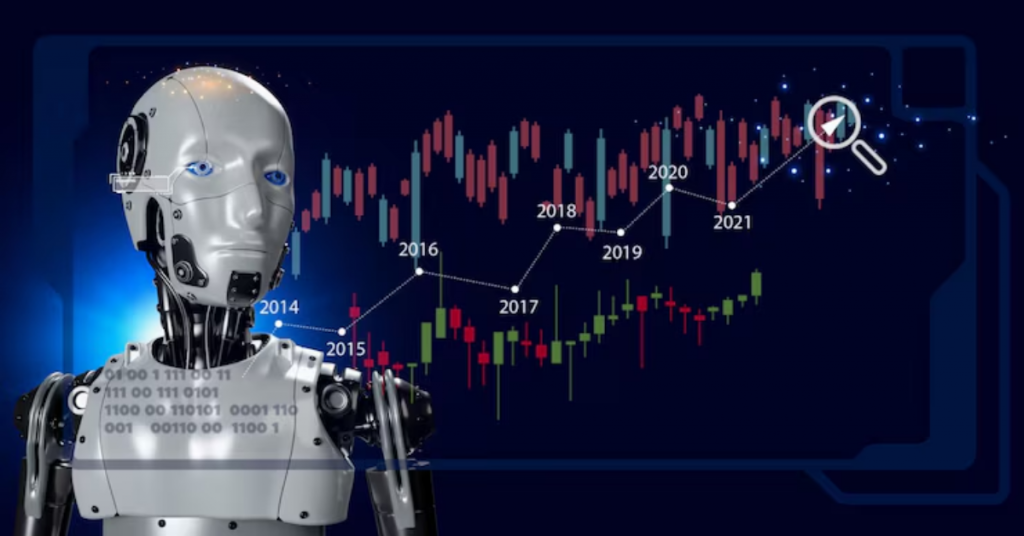
AI trading is a broad term that includes using AI, predictive analytics, and machine learning to look at past market and stock data, come up with investment ideas, develop portfolios, and automatically buy and sell stocks. In this blog we have taken an in-depth look at the role AI in stock trading and what the future holds for stock trading.
Key Statistics and Insights on the AI in Stock Trading app Market
Before we understand AI in stock trading app, let’s delve into the numbers that are making all the difference in the world of stock trading and how the role of AI-based trading systems has revolutionized and reformed the sector. In the last ten years, algorithmic trading has grown a lot:
- About 70% of the total trading volume on the U.S. stock market comes from algorithmic trading.
- The worldwide algorithmic trading market was worth $21.59 billion in 2024 and will rise at a compound annual growth rate (CAGR) of 13.3% from 2024 to 2029.
- In 2029 AI in trading marketing will be worth $40.47 billion
What is the Role of Artificial Intelligence in Stock Trading?
AI in stock trading is like a trading assistant that is always there for you. It analyzes a huge quantity of data in seconds and makes decisions in the financial market that are based on facts and not feelings.
AI trading, on the other hand, employs machine learning, deep learning, and predictive analytics to find patterns, improve techniques, and make trades without any human help. This is very different from traditional trading, which depends primarily on gut feeling and manual analysis.
It looks at a lot of historical and real-time data, like price changes, financial news, economic indicators, and social media sentiment, to figure out what the market is doing.
Artificial intelligence in stock market helps hedge funds, fintech firms, and retail traders feel safe and secure by lowering risks, raising earnings, and taking away emotional feelings. Fintech businesses may improve risk management, customize user experiences, optimize trading techniques, and make themselves the best in the business.
How Does AI Stock Trading Work?
AI trading companies use various AI-based trading systems to interpret the financial market, use data to calculate price changes, identify reasons behind price fluctuations, carry out sales and trades, and monitor the ever-changing market. Let’s take a look at how the AI in stock trading work-
1. Data Gathering
AI in stock trading starts with large-scale data gathering. This involves historical and live stock prices, trading volumes, order book information, and other market statistics. AI systems also gather financial reports, economic indicators, news reports, earnings announcements, and even social sentiment from Twitter or Reddit. Some sophisticated trading systems also incorporate alternative data like satellite pictures of retail parking lots or shipment volumes. The more diverse and richer the dataset, the better the AI model can be informed.
2. Preprocessing of Data
The raw data is never directly usable after being gathered. Preprocessing is vital for eliminating noise, missing value imputation, removing duplicate records, and making datasets consistent. For instance, values for prices can be normalized to a standard scale, and irrelevant or incomplete records can be filtered out. This step also involves time aligning datasets so that all variables fall into place across various sources and time periods. Well-prepared, structured data are necessary to construct solid AI models.
3. Feature Extraction
Feature extraction is the act of finding and constructing pertinent input variables (features) that the AI model will utilize to make a prediction. Such features could be technical indicators (such as moving averages, RSI, or MACD), sentiment scores from news or social media feeds, earnings growth rate, or volatility measures. In certain situations, AI models can even learn advanced features directly from raw data automatically through deep learning methods. Good-quality features greatly improve model accuracy and predictive capability.
4. Model Training
Once the features are extracted, the AI system goes into training. Machine learning algorithms—decision trees, support vector machines, or deep neural networks—are taught on past data to learn patterns that lead to profitable trades. The AI-powered stock trading app learns from the past behavior of the market and optimizes its internal parameters in order to reduce prediction errors. This stage usually involves backtesting, in which the performance of the model is tested on previously unseen historical data to test its effectiveness prior to deploying it in actual markets.
5. Decision Making
After training, the AI-powered stock trading app is able to make trades in real time. From received data and patterns it has been trained on, it can produce a prediction like whether or not a stock will go up or down, and subsequently trigger a buy, sell, or hold command. Probability scores or confidence levels are sometimes output by models to measure a prediction’s strength. These choices are usually made in the millisecond range, enabling AI systems to react far quicker than human traders.
6. Trade Execution
Trade execution is the process of translating forecasts into actual actions. AI can be integrated with trading platforms or brokerage APIs to execute trades automatically. Execution algorithms seek to reduce slippage and transaction fees through the choice of optimal order types, timing, and routing strategies. In high-frequency trading (HFT), this phase is closely optimized for speed so that thousands of trades are executed in seconds based on micro-movements in price.
7. Monitoring & Adaptation
Markets are not static, and therefore ongoing watching and adjustment are essential. AI models get retrained from time to time with new data to stay current with shifting market patterns, new policies, or changing investor sentiment. Secondly, real-time performance monitoring is applied to catch anomalies, risk exposure, or model accuracy drift. Some systems leverage reinforcement learning or online learning methods to fine-tune on the fly, getting better with each cycle of the market.
AI Trading Tools That Are Revolutionizing the Market

AI stock trading apps are revolutionizing the financial world by providing sophisticated features. The following is a discussion of the tools and their effects:
Portfolio Managers
Portfolio managers driven by AI, commonly known as robo-advisors, use algorithms to manage asset allocation, portfolio rebalancing, and investment strategy reallocation with respect to market trends and individual risk profiles.
These AI technologies choose assets on their own to make a portfolio and then keep an eye on it, adding and removing assets as appropriate. AI managers can also give investors financial advice. Investors can tell the algorithm about their financial goals and how much risk they are willing to take, and the algorithm will use this information to make financial decisions and give advice in the future.
Trading Robots
Trading bots, as they are also referred to, are computerized systems programmed to execute trades based on strategies driven by artificial intelligence. They sort through real-time market data, identify opportunities, and can execute buy or sell orders in a fraction of a second.
Robot trading has become increasingly popular in high-frequency trading, where one can take advantage of even the smallest changes in price without allowing emotions to interfere.
AI Trading Signals
AI software sends out real-time buy and sell signals based on technical indicators and predictive analytics. They’re designed to assist human traders by identifying the best trading opportunities.
Additionally, there are even platforms that offer customizable AI signal generators that can be designed to suit a trader’s specific strategies and risk tolerance.
Strategy Builders
AI strategy developers enable users to create, test, and refine trading strategies using historical information and machine learning. The platforms often have easy-to-use drag-and-drop interfaces and backtesting functionality, allowing traders of any level of coding expertise to design intelligent strategies and run them through simulations before they reach the market.
Key Benefits of Using AI in Stock Trading
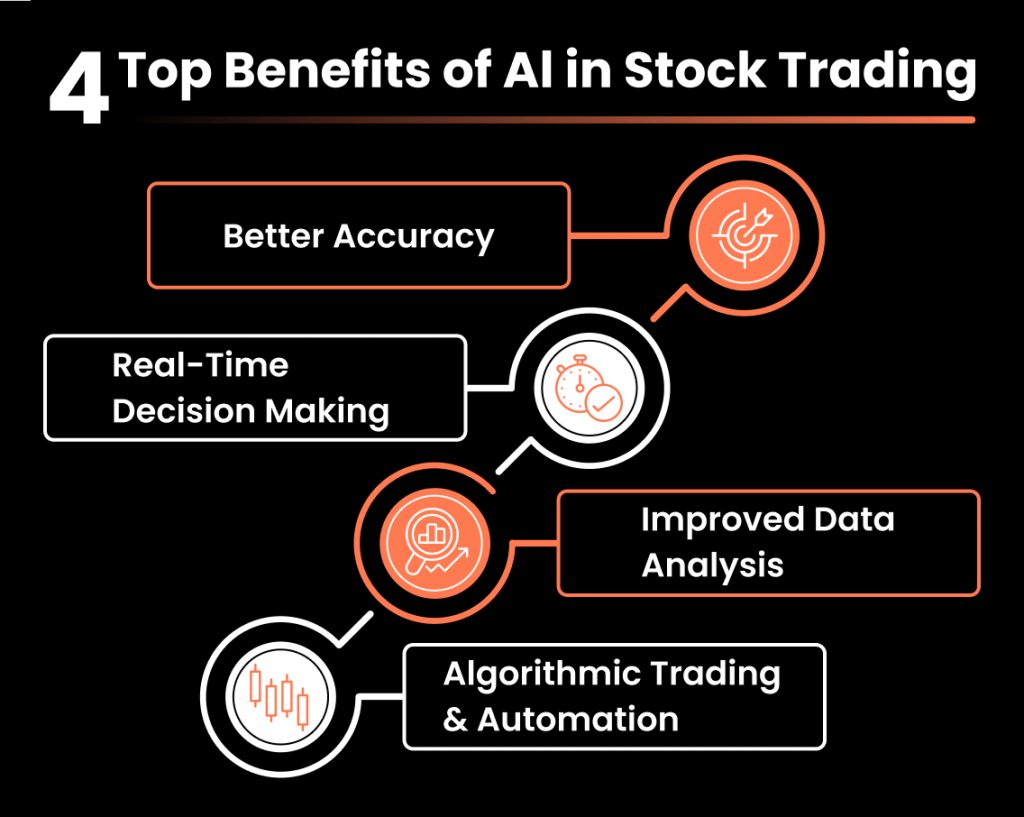
AI has a huge potential to change how people make investing decisions. Historically, investors have depended on financial reports, earnings statements, and macroeconomic trends to make choices. AI simplifies this process by going through huge amounts of both structured and unstructured data to provide you useful information right away.
Let’s take a look at the key benefits of AI in stock trading
> Real-Time Decision Making
AI-based trading systems can instantly assess news, technical indications, and price changes in only milliseconds. This is different from traditional approaches that rely on human analysis, which can take hours or even days. This quick processing lets traders take advantage of short-lived chances and cut down on possible losses.
> Improved Accuracy & Efficiency
AI trading automates research and decision-making based on data. This means that investors may spend less time researching and more time watching transactions and giving their customers advice. A report indicated that merchants who employed algorithmic trading were 10% more productive. AI in stock trading uses past financial data to help make decisions, which means there is less chance of making a mistake and more possibility for precision.
> Sentiment Analysis & Market Predictions
AI can do more than just statistics. It can also read news, social media, and public opinion in real time. Artificial intelligence in stock market can read millions of news items to get a sense of how people feel about certain stocks or sectors. This is done via natural language processing. This provides traders a big advantage when it comes to anticipating whether the market will go up or down and making smart selections based on public opinion before it changes the market.
> Algorithmic Trading & Full Automation
AI is changing algorithmic trading by following pre-set trading rules that take into account things like time, price, volume, and other complicated market situations. Once these AI algorithms are working, they can trade on their own, which means that traders don’t have to watch everything all the time. You may grow your trading approach, lower your operating costs, and trade in more than one market at a time thanks to automation.
> Enhanced Data Processing & Analysis
Every second, financial markets generate an enormous amount of data. AI is great at sorting through and interpreting this information in ways that people just can’t do. AI-powered stock trading app can find those hidden linkages and trading opportunities that a manual analysis might overlook, whether it’s looking at past price movements or keeping an eye on macroeconomic data.
Types of AI Trading Techniques That Empower Traders
The greatest technologies are used by AI in stock trading to look at past data, guess what will happen in the future, and make decisions automatically. The technology even makes things faster, more accurate, and safer, which lets traders improve their methods over time and get an edge in the market. Let’s take a closer look at these technologies.
> Data Mining
Data mining is the practice of compiling and analyzing massive volumes of data to identify trends and patterns. Within the context of stock trading, AI can gather historical data and extract insights on past stock market behavior. Investors can then use these insights to make smarter trading decisions.
> Real-Time Analysis
Real-time analysis is when data is analyzed by algorithms as soon as it has been created to figure out market trends and patterns. AI-based trading systems can analyze large volumes of data in real time and produce usable information. Investors can utilize these real-time analyses to make quicker trades and gain an edge.
> Predictive Modeling
Predictive modeling is the process of gathering previous data to forecast future trends. In trading stocks, AI algorithms can analyze millions of transactions and use this past data to forecast stock market activity based on past circumstances. Investors can use this information to prepare accordingly with market volatility in mind.
> Risk Modeling
Apart from predictive models, investors can employ AI technologies to generate risk models. These models compare the chances of various events based on historical information and analysis. Investors can scan these scenarios and determine the level of risk an investment has. They can also evaluate their existing portfolio and make changes if they are prone to typical investment mistakes.
> Stress Testing
Stress testing entails trying an investment strategy on past data or using a simulation to determine how it would perform under different conditions. Investors can then identify weaknesses in their strategies and ascertain measures to build their financial positions. Accordingly, investors can be more proactive in managing risk.
> Backtesting
Backtesting is the process of testing an investment strategy with historical data prior to permitting an AI tool to employ this strategy to make actual world trades. This implies having an AI tool execute an investment strategy on imaginary capital and then examining the outcomes. Investors can then make adjustments to their strategies accordingly before permitting AI tools access to real assets.
> Benchmarking
Benchmarking is the process of measuring an investment strategy against a stock market index or benchmark. AI applications may compare investment strategies to the strategies adopted by other investors or industry and sector-specific benchmarks. Investors can then place their financial position into context and determine if they must enhance their strategy.
Key Features of an AI-Powered Stock Trading App
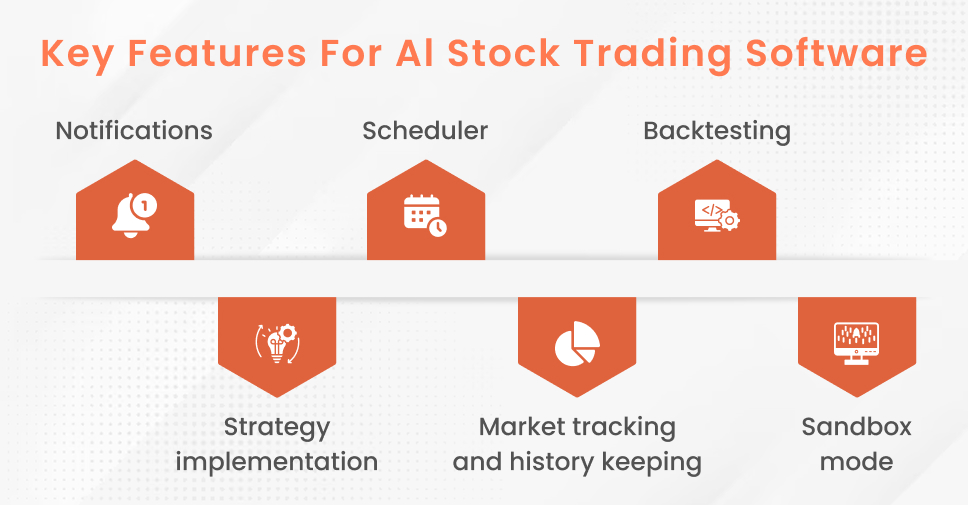
Here are some of the key features of AI-powered stock trading app:
1. Strategy Implementation Tools
A trading app powered by AI has tools which enable users to create, backtest, and roll out their own trading strategies. These tools usually include support for technical indicators, algorithmic rules, as well as AI models that scan for market patterns. As a beginner or experienced trader, the tools facilitate real-time decision-making as well as enabling you to execute AI-based strategies according to your risk appetite and financial objectives.
2. Custom Notifications
Intelligent notifications remind users of important market events, price activity, and trade opportunities. Using AI, alerts are more than routine updates—they are user-centric, informed by user habits, watch lists, and strategy performance. Users are able to get reminders for entry/exit points, news affecting their portfolio, or even pre-market volatility warnings.
3. Market Tracking & Historical Data
The app provides real-time market monitoring and deep historical datasets, such as price patterns, volume fluctuations, and company fundamentals. AI algorithms interpret this information to detect patterns and forecast future behavior. Traders can utilize these insights to tweak their strategy or test their hypotheses prior to entering a trade.
4. Sandbox/Simulation Mode
A sandbox or simulation mode enables one to trial their strategies in a risk-free manner with virtual money. This is vital for fine-tuning algorithms, learning about model behavior, and gaining confidence without risking actual money. It also offers a risk-free learning environment for beginners to learn about trading mechanics and AI capabilities.
5. Data Logging & Archiving
Each trade—successful or not—is logged and stored automatically. Historical data enables users to look back at completed trades, examine strategy performance, and meet regulatory obligations. Comprehensive logs also help detect patterns or defects in trading decisions, facilitating ongoing refinement of AI models and human inputs.
6. Trade Scheduler and Automation
This functionality enables users to automate trading on predetermined rules, timing, or signals generated by AI. You can set trades to be executed at precise market conditions, lowering the hands-on intervention. Automation guarantees speed, eliminates emotions, and enhances strategy uniformity in execution—especially critical in turbulent markets.
Challenges of Integrating AI Into Stock Trading Apps
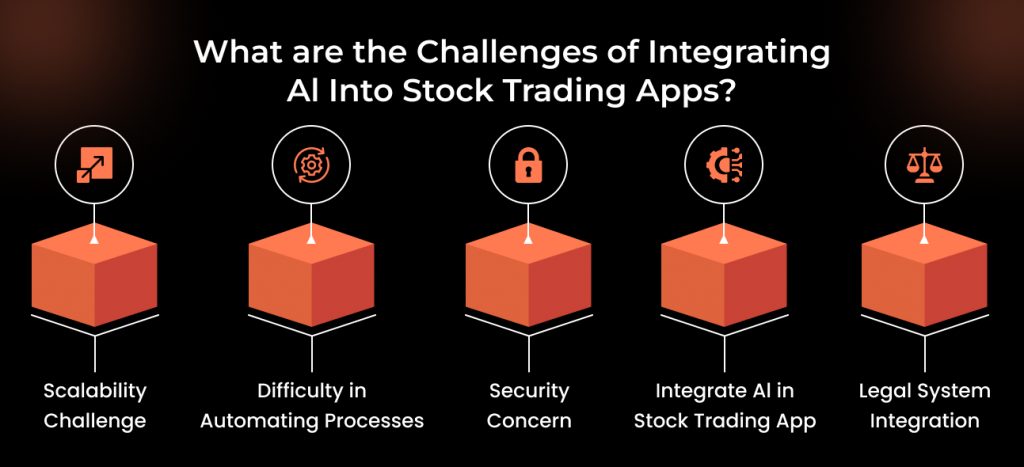
1. Data Privacy and Security Issues
AI stock trading app are dependent greatly on live and historical market and user data. This makes them most vulnerable to cyber attacks. Protecting sensitive financial information, personal user details, and AI decision logs demands end-to-end encryption, secure authentication processes, and adherence to data privacy regulations such as GDPR and CCPA. Any compromise not only harms the reputation but can also attract serious financial and legal penalties.
2. Legal and Regulatory Obstacles
Finance AI functions in a highly regulated space. It is a challenge to work with legal frameworks like SEC (U.S.), SEBI (India), and MiFID II (Europe). Regulatory entities continue to develop guidelines for algorithmic and AI in stock trading, leading to uncertainty or unexpected compliance changes. Firms need to make their AI models explainable, auditable, and refrain from practices such as market manipulation and front-running.
3. Interoperability with Legacy Financial Systems
Most brokerage and clearing systems retain legacy infrastructure that does not provide a straightforward path for AI integration. Interoperating new AI models with legacy APIs, databases, or order management systems causes compatibility challenges, latency, and data inconsistencies. Smooth integration demands diligent architectural design, middleware technologies, and continued support to avoid disrupting operations.
4. Scalability & Infrastructure Challenges
AI algorithms need huge computational capacity, particularly for real-time data processing, model training, and high-frequency trade execution. With increasing user volume, maintaining consistent performance is difficult. Cloud-based infrastructure aids in scaling dynamically, yet it involves substantial DevOps investments, load balancing, and infrastructure optimization to assure reliability under heavy usage.
5. Full Automation Complexity
Full automation of the trading lifecycle, from analysis to execution, adds layers of complexity. AI models have to make accurate decisions in real-time, handle abrupt changes in markets, and manage exceptions (such as flash crashes or black swan events). Full automation can also decrease human monitoring, which may lead to cascading errors if the models start acting erratically. Providing transparency, interpretability, and human intervention is still critical in such configurations.
AI Stock Trading vs. Human Stock Trading
Comparing AI-based trading systems with traditional human-led approaches based on:
| Factor | AI Stock Trading | Human Stock Trading |
| Speed | Executes trades in milliseconds with real-time market analysis. | Slower due to manual analysis and order execution. |
| Accuracy | High precision through data-driven decisions and pattern recognition. | Prone to errors due to limited data processing and cognitive bias. |
| Emotion | Emotionless; decisions are purely algorithmic. | Influenced by fear, greed, and psychological pressure. |
| Decision-Making | Based on machine learning models, statistics, and historical patterns. | Relies on experience, instinct, and manual analysis. |
| Scalability | Easily scalable to handle thousands of trades and assets simultaneously. | Limited by individual capacity and market coverage. |
Real-World Use Cases of AI in Stock Trading
AI in stock trading has simplified the trading process and revolutionized how today’s stockbrokers trade. In this section let’s take a look at some of the real-world use cases of AI in stock trading
1. Algorithmic Trading Systems
Use Cases of AI in stock trading: Hedge funds and financial institutions employ AI-based algorithmic trading systems to make high-frequency trades relying on predictive models.
Example: One of the world’s most profitable hedge funds, Renaissance Technologies, uses machine learning algorithms to detect subtle patterns in the market and make trades on global markets. It takes massive amounts of data and makes thousands of trades in a matter of microseconds, taking advantage of tiny price movements with perfect efficiency.
2. Automated Trading Bots
Use Cases of AI in stock trading: Retail investors utilize AI-powered trading bots to oversee their portfolios with minimal or no human intervention. Such bots may implement pre-programmed strategies or learn and evolve based on real-time data.
Example: QuantConnect and MetaTrader platforms enable traders to utilize AI-based bots that open buy/sell orders automatically based on signals generated from technical indicators, news sentiment, or even social media trends—24/7 market participation without emotional interference.
3. AI-Based Customer Support in Broker Platforms
Use Cases of AI in stock trading: AI chatbots and virtual assistants are used in stock trading platforms to offer instant, intelligent support to customers.
Example: Robinhood and Zerodha employ AI-powered customer support systems to manage requests such as order status, account verification, portfolio monitoring, and market news. Real-time responses, load reduction on support, and user experience enhancement are achieved without the need for a human agent in each interaction.
7 Easy Steps to Build an AI Stock Trading App
Using Artificial intelligence in stock market lets you make judgments quickly, run your business more efficiently, and get rid of emotional biases. Let’s go over the step by step process of building AI driven stock trading apps.
1. Market Research & Strategy Planning
Begin by knowing your target market—are they professional investors, beginner traders, or institutions? Learn from competitors, regulatory directions, user pain points, and wished-for functionalities. Clearly establish your app’s unique value proposition, be it predictive analytics, low-latency trades, or deep learning-driven insights. Having a clear product vision that fits market demand is the key to developing a successful app.
2. Define Core Features & Compliance Requirements
Determine the AI app’s essential features like strategy development, automated trading, live alerts, historical data analysis, and user dashboards. In parallel, study financial regulatory standards (such as SEBI in India, SEC in the United States, or GDPR for data security). Establish user authentication (KYC), data security, and audit requirements right from the start to prevent future legal problems.
3. Select the Right Technology Stack
Choose strong and scalable tech suited for artificial intelligence in stock market, real-time data processing, and high security. For instance:
- Front-End: React, Flutter
- Back-End: Node.js, Python, Django
- AI/ML Frameworks: TensorFlow, PyTorch, Scikit-learn
- Databases: PostgreSQL, MongoDB
- Cloud & DevOps: AWS, Azure, Kubernetes
The selection of the correct stack guarantees performance, flexibility, and future scalability.
4. UI/UX Design for Traders
Create intuitive interfaces that cater to the needs of traders. A clean dashboard, readable charts, customizable watchlists, and easy-to-press order buttons are a must. Visual cues and data visualization tools such as candlestick charts or trend lines should be employed. Ensure that the design caters to both mobile and desktop variants, with dark/light themes for improved usability.
5. Back-End Development & API Integration
Design the central architecture that manages user handling, order processing, AI decision-making, and compliance logic. Include APIs for brokerage services, payment gateways, and secure authentication. Provide strong error handling, low-latency execution of trades, and high user capacity without crashing under load.
6. Integrate Real-Time Market Data Feeds
Integrate your app with trusted market data feeds for current stock prices, financial news, and economic indicators. Leverage APIs from data providers such as Alpha Vantage, IEX Cloud, Polygon.io, or Yahoo Finance. Real-time information is necessary for the AI algorithm to produce correct signals and timely executions of trades.
7. Test, Deploy, and Monitor Ongoing
Completely test the app on devices and conditions using functional, performance, and security testing. Perform backtesting for AI models using historical data. After deployment, implement real-time monitoring dashboards to monitor app performance, identify bugs, and monitor trades. Leverage analytics and user feedback to iteratively enhance the app.
Future Trends in AI-Powered Stock Trading
> Increased Participation of Retail Traders through AI Platforms
With Artificial intelligence in stock market becoming more widely available, retail traders are increasingly deploying AI-based platforms to level the playing field. From robo-advisors to AI-based trading bots, retail investors now have access to technologies previously exclusive to hedge funds—making intelligent, data-driven trading choices more democratic.
> Machine Learning & Deep Learning Advancements
Future trading platforms will make use of next-generation machine learning methods including reinforcement learning, deep neural networks, and combined models. These will provide enhanced prediction precision, self-learning approaches, and adaptability to volatility in the market, increasing risk management and ROI.
> Regulatory Changes Around AI in Finance
As trading behavior is increasingly influenced by AI, regulatory agencies are crafting new frameworks to track and regulate its usage. Coming policies can emphasize AI transparency, ethical model training, explainability, and ensuring systemic risk avoidance due to algorithmic decision-making in financial markets.
> AI-Powered Financial Advisors
Artificial intelligence-powered digital advisors will grow intelligent, providing hyper-personalized investment advice in real-time portfolio performance, financial goals, and risk tolerance. These solutions will fill the gap between conventional wealth management and on-demand financial planning.
> Integration of Quantum Computing in Trading Systems
Although in nascent phases, quantum computing can change the face of AI trading. It is capable of processing a much larger volume of data at faster speeds, supporting quicker simulations, real-time risk analysis, and optimized portfolios. Quantum algorithms coupled with AI can radically redefine predictive models of trading.
How A3Logics assists you in integrating AI in stock trading?
At A3Logics, we are experts in creating – intelligent, secure, and scalable AI-based stock trading applications that suit your business objectives. If you are a fintech company, broker-dealer, or institutional investor – our experts can assist you.
- Create predictive models with cutting-edge AI/ML algorithm
- Incorporate real-time market data and trading APIs
- Implement automation-enabled secure trade execution systems
- Create intuitive dashboards and mobile-first UI/UX designs
- Comply with regulatory requirements (SEBI, SEC, GDPR, MiFID II, etc.)
- Monitor and retrain AI models with continuous support
- Implement scalable infrastructure with cloud-native solutions
Our end-to-end Stock Trading App Development Company ensures your platform is not only cutting-edge but also future-ready.
Conclusion
AI is transforming how stock trading operates—providing unprecedented speed, precision, and intelligence. As markets continue to evolve – AI in stock trading is enabling institutional and retail investors to make more intelligent, data-driven choices. With the right approach – technology, and partners such as A3Logics – you can leverage this revolution to create smart, compliant, and lucrative trading solutions. Whether you want to automate your portfolio or create the next-generation AI trading platform, the algorithmic finance of the future is already here.