
Interior design, is not just about beauty, it’s also about making spaces useful. It lets you make a space your own with its unique style. Thanks to AI interior design apps, this process is now more personalized. These apps analyze your space, style, and budget.
By building interior design apps with AI, you would eventually create a platform that’ll help anyone design their space – home or office without seeking professional help. In fact, people can use the power of AI to get suggestions on not just decor but furniture, color theme, layouts, and more. The rise of AI interior design apps can be ascertained by the fact that the market is projected to reach $1.39 billion in 2025.
So, if you have decided to explore this opportunity, this blog gives an overview of AI home design apps. Here, we’ll discuss their features, types, cost factors, and more.
Why AI in Interior Design?
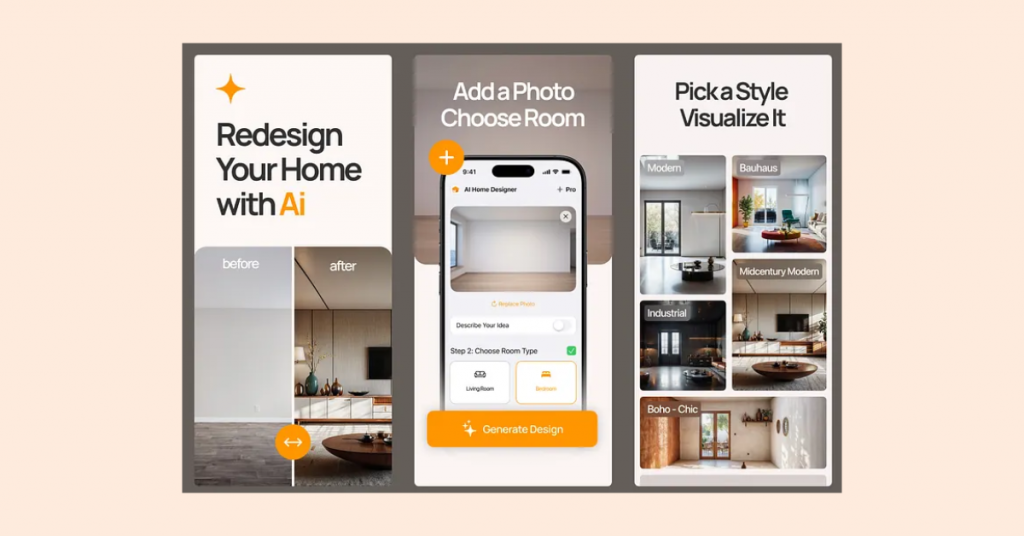
There are a lot of people who want well-designed spaces. However, they are held back by lack of expertise and budget. Moreover, growing awareness about aesthetics and changing lifestyles have given rise to AI interior design apps that help create spaces that align with aesthetic preferences.
AI as a technology is gaining ground due to the amount of personalization and accuracy it provides. Combine this with design – you can quickly generate layout plans, get decor ideas, and even visualize spaces and elements in 3D, much before you go ahead with a decision, or, more importantly, invest your hard-earned money.
As for businesses that wish to tap into the limitless potential of AI interior design software development, AI-driven interior design apps present profitable opportunities in technology, interior design, and retail. Platforms can earn revenue through subscription models, in-app purchases, and brand partnerships.
What is an AI Interior Designer App?
> Definition and Core Purpose.
An AI interior design app uses artificial intelligence to analyze user input. For example, a user can upload photos of a room, or mention a desired style. Based on analysis, the app can generate suggestions. Not just suggestions, it can also render 3D previews, and recommend decor choices accordingly.
- How it works: AI generates room designs based on user inputs (dimensions, photos, preferences).
An AI interior design app combines various technologies. To begin with, it takes the input from a user in the form of images or videos. The technology that processes these inputs is called computer vision. Next, the Artificial Intelligence algorithms come into play and suggest design ideas based on user preferences. The AR/ VR or 3D rendering lets users see their design live.
They can see how the design’s layout, color, furnitur,e and other elements will look in real life in a certain environment. The natural language processing, or NLP, helps users interact with the app using chat or, more specifically, prompts.
Common Functionalities Users Expect
Here is what users can expect from an AI interior design app:
Design Recommendation
An AI-based interior design solution helps you decorate your space your way. It studies your taste, favorite styles, and new trends using AI, and then offers home design ideas that match your needs.
Budget planning
The app shows the estimated costs for each product used in the design or the design itself. This can help them stay within their decided budget and also help them make practical choices.
Chat-based design help
You can ask questions using NLP (natural language processing), such as “Show modern kitchen design ideas,” and the app will generate suggestions using the AI chat.
Style Customization
You can change the color palette, layouts, walls, furniture, and all the other elements of your interior design and even choosea specific theme or style such as modern, boho, minimal, etc.
Use of Predictive Analytics
If you are unsure of how certain elements would look like in the environment or have similar questions, the app can use predictive analytics to study room details, your past preferences, trends, etc, and tell you what you might like next.
3D Model Creation
You can view a 3D version of your space and watch the complete design from all angles. You can see how everything looks in a lifelike, realistic setup.
Core Features to Include
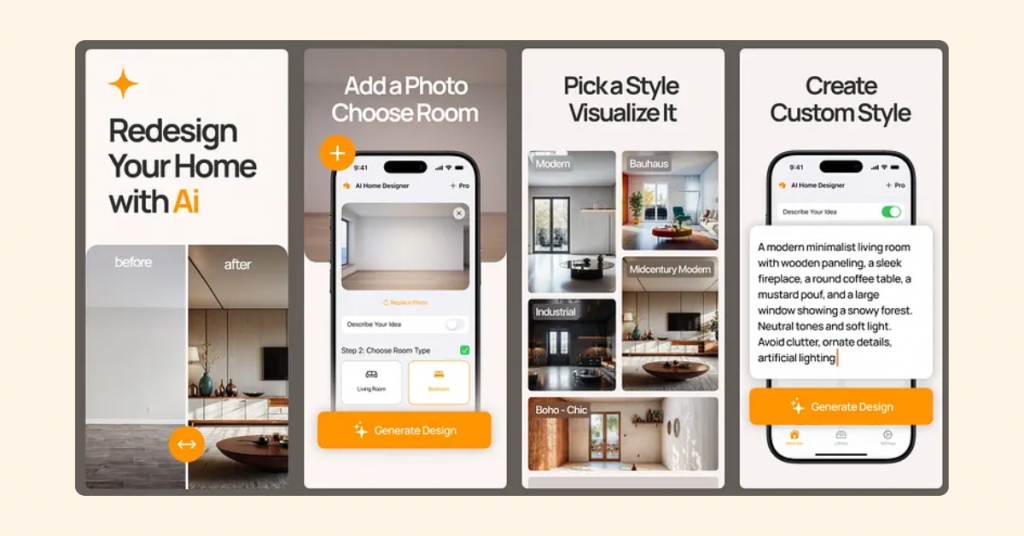
1. AI-generated interior designs from uploaded photos or inputs.
With interior design apps powered with AI, you can provide inputs about a space. The AI algorithm, then, suggests ideas based on these. The app takes into account various aspects, such as existing decor, room dimensions, and user preferences.
2. 3D room modeling and visualization.
An interior design app lets you create a 3D representation of a room, allowing you to visualize how your desired space will look. This is useful when various elements are placed, such as furniture, or when colors and materials are applied.
3. Smart measurement and floor plan creation.
Interior design apps with smart measurement capabilities allow you to input accurate room dimensions. Some apps even let you capture dimensions, such as door sizes and wall lengths. You can also create 2D or 3D drawings or visualizations of their floor plans from different perspectives.
4. Mood board generator based on user preferences.
In an AI home design app, an AI-powered mood board generator uses user preferences to create personalized visual inspiration boards. It allows users to input their desired colors, style, textures, and furniture preferences. Users can use AI algorithms to reflect those choices.
5. Furniture and decor recommendations.
This feature helps generate various recommendations for furniture and decor, such as lighting, color, style, layout, and room size. For instance, if you like Scandinavian design, the app might recommend neutral tones and light wood furniture.
6. Save, compare, and manage design versions.
The AI-based interior design app lets you create multiple versions of a design. You can compare these versions, and save the one you are satisfied with. When you create a single room, you can save multiple versions of it, allowing you to compare the versions as needed.
7. Virtual walkthroughs for immersive experience.
To get a closer look at how the design is turning out, you can take a virtual 3D tour of the room they have created. You can verify that all the elements are placed correctly and the output is as expected, before making the actual purchase.
8. Augmented Reality (AR) previews.
The AR technology in AI-based interior design software lets you point your phone’s camera at the actual room. The app’s algorithm allows you to see what your room will look like when objects, such as lamps and paintings, are placed together, and that too in real-time. This way, you can purchase only desirable items.
9. In-app shopping and vendor integration.
Once you have finalized the design, the AI app can suggest places from which you can purchase the items you have used. You can visit online stores, compare prices and place orders directly from within the app.
10. Budget planning and cost estimation tools.
This feature of lets you set a budget at the beginning, before you choose the items of your design. Using this, you can track the cost of every item you are using and, at the same time, see the running total. This way, you can stay in the stipulated range while making choices.

Types of AI Interior Design Apps
1. Style-based design generators.
As the name suggests, style-based design generators use AI to create customized interior design concepts based on user-selected styles. These apps analyze user preferences, chosen style, room characteristics, and other aspects to generate multiple design options.
2. Real-time AR visualization tools.
With the integration of AR visualization tools in interior design app, users can see the placement of an interior design element in their actual space. These tools use the device’s smartphone camera i.e., the user can choose an element and the app will leverage AI algorithms to create a realistic 3D visualization that demonstrates how the design will look in the real world.
3. Professional tools for interior designers and architects.
These apps utilize AI to analyze spaces – using tools that consider various dimensions and suggesting optimal layouts. The apps also learn from preferences, allowing professionals to collaborate better, work faster and deliver high-quality and personalized designs for clients.
4. Sustainability-focused apps with eco-friendly design suggestions.
The apps can use AI algorithms to help people design homes in eco-friendly ways. They suggest things like choosing recycled materials, using natural light, and saving energy. By building such interior design apps with AI, users can make greener and more sustainable choices while decorating. For example, they can opt for less amount of plastic and choose plants to decorate their spaces.
Technology Stack for Development
> AI/ML for design recommendations and learning user preferences.
It helps analyze user behavior, room types, style choices, and layouts. Gradually, the system starts to understand individual preferences. It also generates data-driven designs that align with aesthetics, budget, and space requirements.
> Computer vision for image recognition and space mapping.
This technology helps systems to understand spaces quite like a human designer would. It facilitates tasks such as layout analysis, object recognition, virtual staging, etc. They can detect furniture, walls, room dimensions, and lighting. It uses these elements, the AI home design app suggests suitable decor, and design layouts.
> AR/VR for immersive experience and real-time visualization.
The use of AR (Augmented Reality) and VR (Virtual Reality), in interior design app development, enables users to use their smartphone’s or any device’s camera to overlay decor, furniture, or any design element directly onto a live view of a room. The user can then take a full virtual tour or walkthrough of the environment with the redesigned space.
> NLP for prompt-based and conversational UI.
Using NLP, you can talk to the app naturally using voice or text. Once you type the prompt, for example, “show me minimal design for small bedrooms, the app understands the request and responds with suggestions. To take this a step further, there are AI chat assistants that can answer your questions and give design advice and help nurses refine their preferences.
> Backend: Cloud infrastructure, APIs, and databases.
The backend is the brain of the app. The cloud infrastructure handles a large database and conducts heavy resource-consuming tasks such as AI model execution and image processing. The APIs help connect different parts of the app. They can help connect third-party data sources or AI services. The databases securely store room images, user data, and much more.
> Frontend: Mobile/web frameworks with 3D rendering support.
The frontend consists of buttons, design previews, and layout tools. It’s built using web and mobile frameworks such as Flutter and React Native. These make the app fast and smooth. The 3D rendering tools are added when building interior design app with AI so that users can view lifelike furniture, room designs, and layouts directly on the screen.
Step-by-Step App Development Process
Designing an AI home design app requires planning. Here’s the step-by-step app development process to build interior design app with AI –
1. Conduct market and competitor research
Before tactually building an interior design app, first study your competitors. This way, you’ll get an idea of what to include. You should research what similar apps are offering. Study their features, their design, their target users, etc. it is also important to consider the features that are trending such as 3D walkthroughs, budget evaluation, AR previews, etc.
2. Define app objectives and target audience
An AI home design app shouldn’t be generic. Your focus should be clear about what your expectations are, or rather, what your target audience would expect from your AI-based interior design solution. For example, if your app is more focused on furniture sellers, your app should make it easy to align designs with catalogs.
3. Finalize features and user journey
Once you have conducted the research, finalize all the features that you’ll include in your app. Next, map out the steps users take to interact with the app. This will further allow developers and marketers to ensure that the app functions as per user expectations and is successful.
4. Choose tech stack and tools
This is a stage where you select the right framework and right technologies for developing an interior design app with AI capabilities, like we have discussed above.
5. Assemble development team (AI, frontend, backend, UI/UX)
Assemble the team that will help build interior design app with AI. Your team should have AI/ML engineers who are capable of creating smart recommendation engines, UI/UX designers, who will ensure that the app is easy to use, and attractive. The frontend and backend developers will work on the actual construction of the app. And, since you are planning to create an AI-based interior design app that can help users visualize things in 3D, you’d even need to onboard 3D/AR specialists on your team.
6. Prepare datasets and train AI models
Since, AI is a major component of AI home design app, you’ll need relevant datasets to train the AI. You’ll need to collect elements like decor styles, furniture, room layouts, pricing of various objects, and others. Once you have gathered this data, you can use it to train models that will suggest personalized designs, recommend items, and estimate costs.
7. Build frontend/backend infrastructure.
When you build an interior design app using AI, create an architecture that consists of a frontend and the backend. The frontend has UI, menus and designs. It should be complemented with a backend that handles databases, user accounts, AI processing, etc. The layers must work smoothly to support 3D previews, AR, design saving, etc.
8. Integrate AR, 3D design, and shopping modules
As essential aspects of your Interior design app, integrate AR, 3D design, and shopping modules. A quick recap – the AR functionality will help users visualize items in their real space, the 3D design will bring room designs to life; you will be able to see the 3D models of objects or the room itself, and the shopping modules will help users ascertain the price of the items they are purchasing.
9. QA testing and performance optimization
This stage helps test whether the app can deliver a stable and smooth experience. QA testers test the app for functionality, user flow, features, in short, every minute aspect of the app. They make sure that the app is intuitive enough. They even verify the AI’s capability to deliver accurate results, as well as the AR and 3D elements’ ability to render quickly and clearly across various devices.
10. Launch MVP and collect feedback for improvements
Once you are ready with the main features, launch a minimal viable product (MVP), a simplified version of your AI interior design app that includes only the most essential features. Share this version of your app with users so that you can gather feedback on the apps usage. At this stage you can also spot bugs, improve user experience and understand what features are missing.
Real-World Use Cases
1. AI-based room layout and furniture placement
Here, the AI-based interior design solution helps scan the space using AI. It then suggests the most effective layout in terms of furniture placement, keeping in mind comfort, design balance, and flow.
You can even get suggestions based on the purpose of the room. For instance, whether it’s a living area, a functional workspace, a kid’s room, etc., and accordingly, the app will suggest how the furniture and other elements should be placed.
2. Real-time design visualization using AR
You can point your phone’s camera at an empty room, and the app will utilize AR (Augmented Reality) technology to display decor and furniture in the actual space in real-time, as if those objects were physically present. Here, the app takes into account the actual size and position. Not only that, but you can also adjust the lighting, space, and style.
3. Personalized suggestions based on mood/style
In an AI-based interior design app/ software, it isn’t just about the decor or furniture that can be used to provide suggestions. You can also build interior design app with AI that can perceive a user’s mood. For example, users can specify their mood; i.e., whether they are feeling energetic, calm, etc, and accordingly suggestions will pop up.
4. Smart space optimization and budgeting
An AI interior design app can help in solving two of the biggest challenges people face – limited space and budget. The app uses AI to understand your room’s size, shape, and budget. Then it gives ideas for the best furniture and how to place it.
- Also Read: Interior Design App Development Cost
Why Invest in AI Interior Design App Development
1. Saves users time, money, and effort
Instead of hiring expensive interior designers, especially for small projects, you can use an AI interior design app to get suggestions tailored to your space and budget. It helps remove guesswork and can save you from making costly mistakes that may arise from mismatched furniture, poor space planning, and items that don’t suit your room.
2. Democratizes access to high-quality interior design
With an AI interior design app, you can get high-quality interior design without having to spend a lot on a professional or without needing a big budget. You can easily revamp your space – your home, room, office, dorm, small flat, etc.- based on your preferences, regardless of who you are: a student, a professional, a business owner, or someone else.
3. Bridges tech, design, and e-commerce into one app
Since an AI interior design app fuses tech, design, and e-commerce into one app, you can design your space with ease, and you don’t have to be a professional interior designer. You can utilize technologies like AI, AR, and 3D modeling to visualize realistic layouts featuring items that match your style. Additionally, an AI home design app integrates e-commerce directly into the app, allowing you to make purchases within the app.
4. High potential in real estate, interior decor, and retail sectors
AI interior design apps bring together real estate, interior decor, and retail. The apps understand room dimensions, layout, floor plan, and style preferences. Based on these aspects, they suggest designs that match your space and budget. With e-commerce built in, users can make purchases directly from within the app. For businesses, it gives opportunities, to collaborate with furniture, home decor, and paint brands.
How A3Logics Can Help Build Your AI Interior Design Platform
Have an idea for an AI home design app? But, you are unsure of who to choose for your AI interior design app development or software development project. You can put your trust in A3Logics.
1. Expertise in AI Development, AR/VR, and mobile/web development
A3Logics is a trusted AI development company with expertise in AR/VR, AI development, and mobile/ web development. With these combined, we can help you build intuitive, smart, and user-friendly AI interior design apps that can help your users generate immersive designs.
2. End-to-end support: Idea to deployment.
We offer end-to-end support. We help you refine your idea, design UI/UX, develop AI features, and once the product is ready, we even help you with testing for quality and post-release maintenance.
3. Proven experience in smart design and visualization tools.
We have experience building smart design and data visualization tools that integrate 3D modeling and AR/VR functionality. We can help you create AI based interior design solutions that help users see interactive interior designs.
Conclusion
1. AI is transforming how we visualize and plan spaces
Gone are the days when it would take people long to visualize interior designs. AI can help you intelligently visualize spaces and design them as per your budget and style needs. You don’t need to be a professional to design home or office. Even as someone who probably knows a little about interior design, you can personalize spaces from homes to offices.
2. With the right tech and strategy, you can launch a profitable and user-friendly app
All it needs is the right tools, proper framework, and a development team to turn your idea into a scalable product. With the right team, you can develop an app that would offer your users a great experience. It will also open doors for various revenue streams, such as, ads, subscriptions, partnerships, and much more.
3. Now is the perfect time to invest in AI-based design innovation
With growing demand for smart, personalized experiences, AI is reshaping how people design and experience spaces. This is the ideal time to lead the change. At A3Logics, we’re here to help turn your vision into reality.