AI Lead Scoring: Artificial intelligence is changing the way organizations of all sizes and types operate across the globe. If you run a call centre or a customer service-focused organization, you’ve most likely used traditional lead scoring systems.
However, it’s time to question yourself: Is there a better way? AI is about more than just increasing efficiency and production or speeding up company procedures. It’s a game changer that enables whole new capabilities and business model extensions, including the vital safeguard of PII redaction to ensure consumer data security.
You may use AI to give personalized services and experiences to your clients, helping your firm stand out in a crowded marketplace. But did you know that artificial intelligence can also revolutionize lead generation?
Recent studies show that more and more firms are using AI to score leads. In fact, 75% of businesses expect to employ AI-driven lead scoring methods in the next two years. Companies that employ predictive lead scoring have seen a 25% boost in conversion rates and a 30% decrease in the cost of getting new customers, which is what is driving this trend.
In this blog, we have looked at how AI-based lead scoring may help generate more leads. Following these suggestions can help you increase your lead conversion rates and gain more consumers for your business.
What is AI Lead Scoring?
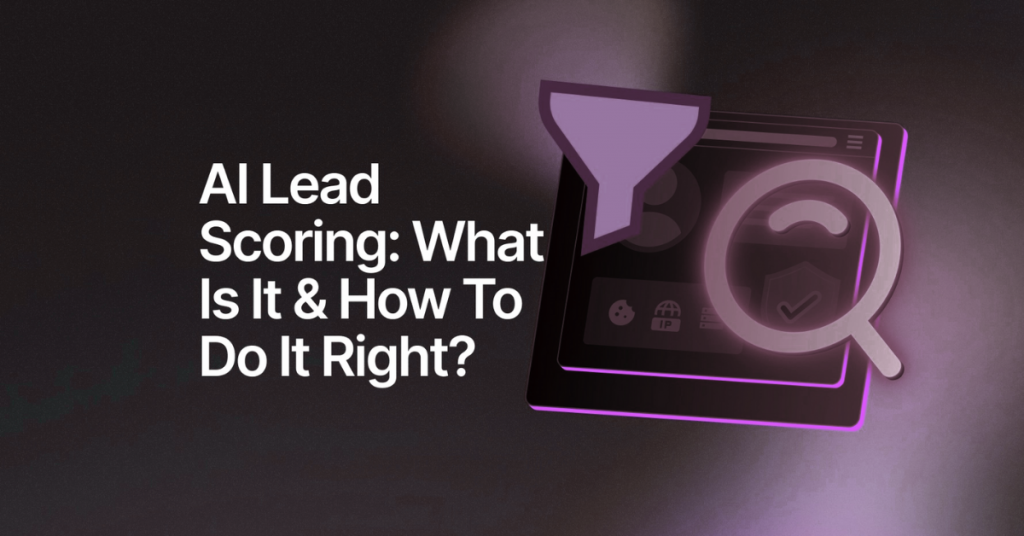
So, what is AI lead scoring? Well, AI lead scoring is a technique that uses a machine-learning algorithm to analyse consumer engagement data such as previous interactions with the firm, website behaviour, demographics, involvement with marketing materials, and so on. It then analyses this information to estimate which leads are most likely to become paying customers by assigning a numeric score to each one.
An AI lead scoring system computes the lead score utilising two types of criteria. First, it applies the baseline score standards established by sales experts in the form of “the ideal lead profile”. Then it does its own continuing analysis of fresh lead data, history of customer interactions, conversion rate dynamics, market trends, and so on.
For example, if viewing a pricing page on the company’s website begins to show a particularly strong link with a greater conversion rate, the AI algorithm will consider it more heavily when generating a total lead score.
To ensure a full and unbiased analysis, the AI based lead scoring system tracks each lead throughout their journey, recording as much of their behaviour as possible and accumulating demographic and firmographic data from sources such as completed forms, social media platforms, and so on.
As new information about the lead becomes available, the system modifies the lead score to achieve the highest precision. When the lead score hits a particular threshold; the lead is identified as a qualified prospect and can be prioritised for follow-up.
How Does AI Lead Scoring Work?

AI lead scoring has benefited various businesses across all industries. Here is how lead scoring using AI implementation works.
Phase 1 – Data Collection and Integration.
AI lead scoring starts with gathering data from a various of sources. CRMs, marketing automation technologies, internet interactions, email campaigns, social media – and other client touchpoints will all fall under this category.
This data contains –
- Demographic information – includes age, job title, company size, and location.
- Behavioural data includes – website visits, content downloads, email conversations, and social media participation.
- Firmographic data includes the company’s industry, revenue, and number of employees.
- Engagement data refers to how frequently a lead engages with the brand (for example, attending webinars or downloading eBooks).
Phase 2: Data Cleanup
Once acquired; the data is cleaned to remove inconsistencies, duplication, and errors.
AI systems also do ‘feature engineering’ – which is the process of creating new features by merging or altering current data in order to increase prediction accuracy.
Phase 3: Data Modelling
AI models are trained with historical data from previous leads. The machine learning algorithm learns the traits of leads who become customers and those that don’t.
- Identifying patterns – The algorithm looks for patterns in the data that are linked to successful conversions. Like – certain actions, business information, or engagement indicators.
- Weighting factors: AI gives different lead traits different weights based on how much they affect the probability of conversion.
- For example – frequent website visits may be given more weight than demographic data.
Phase 4 – Lead Scoring.
After training, the model gives new leads ratings depending on how similar they are to leads that have already worked.
The higher the score – the more likely the lead will convert. This number is normally between 0 – 100; with higher scores indicating a more qualified lead.
Phase 5: Continuous learning and optimisation.
AI lead scoring models are dynamic, constantly learning from new data.
As more leads enter the system and their outcomes (conversion or no conversion) are tracked. The model gets better at making predictions over time.
Manual vs. AI Lead Scoring – A Comparison
Lead scoring is important to prioritize prospects and maximize sales efficiency. Yet, not all methods of scoring are equal. The typical lead scoring using AI depends on static rules and human intuition – whereas AI-driven lead scoring employs predictive analytics and real-time behavioral signals to learn and iterate.
Knowing the difference can assist companies in deciding which approach to use to – scale revenue and maximize lead conversion.
> Traditional Lead Scoring
Rule-based or manual lead scoring is often done by giving scores to leads according to predetermined characteristics. This include – job function, industry, company size, or activity (such as email opens or attendance at webinars). These rules are established based on historical patterns or experience – which may render the system inflexible and less dynamic in response to changes in buying behavior.
Chief Shortcomings.
- Does not provide real-time insights.
- Is hard to scale.
- Needs to be updated manually frequently.
- Are subject to human error and bias.
> AI Lead Scoring
AI-based lead scoring employs machine learning models that scan high volumes of data — such as demographics, firmographics, web history, email activities, and CRM information — to automatically detect patterns that foretell lead quality. These models learn and refine themselves over time, accommodating evolving behaviors and market dynamics.
Key Strengths-
- Learns and improves in real-time with increased data.
- Determines high-quality leads with greater accuracy.
- Supports real-time scoring and prioritization.
- Easily scales with expanding data sets.
Comparing Traditional vs. AI Lead Scoring
| Criteria | Traditional Lead Scoring | AI Lead Scoring |
| Accuracy | Moderate – based on assumptions and rules | High – data-driven and adaptive |
| Scalability | Low – manual effort increases with leads | High – handles large datasets effortlessly |
| Real-Time Insights | Limited – periodic updates | Real-time – automatic updates and feedback loops |
| Adaptability | Low – static rules require manual revision | High – model evolves with new data |
| Data Usage | Basic – uses predefined attributes | Advanced – uses behavioral, historical, and intent data |
| Bias & Subjectivity | High – human decisions involved | Low – objective, pattern-based |
| Maintenance Effort | High – frequent manual reviews | Low – self-learning and auto-optimization |
| Lead Prioritization | Often inaccurate or inconsistent | Highly targeted and consistent |
Key Benefits of AI Lead Scoring
There are various benefits that are achievable with the help of AI lead scoring. Here are some of the key benefits of AI lead scoring.
1. Error Elimination Through Automation
One of the most significant benefits of AI lead scoring is its potential to reduce human mistake. Traditional techniques sometimes rely on subjective assessments, which leads to discrepancies and errors, particularly when sales and marketing teams are under pressure.
AI, on the other hand, relies on data-driven analysis to provide objective and accurate lead rating.
In some cases – automated lead scoring uses speech analytics to eliminate errors caused by fatigue or emotional bias, which can arise while manually evaluating leads (for example, on sales calls).
Automating these processes ensures consistent lead rating.
This means teams can concentrate on high-value opportunities without concern for score accuracy.
2. More Insights Through Data-Driven Intelligent Modelling.
AI explores big data through intelligent modelling to discover – patterns and relationships that would otherwise overwhelm human approaches.
This facilitates greater insight into client behaviour. This includes – buying history, habits of engagement, and demographics. Enabling companies to make a more detailed profile of their best lead.
In addition, machine learning algorithms enhance this process by continuously refining lead scoring parameters based on real-time indicators, ensuring that the automated lead scoring model evolves as emerging trends come to light.
3. Seamless integration with CRM and Marketing platforms
This integration enables AI based lead scores to be displayed directly within the CRM platform, saving users from having to constantly switch between multiple tools to obtain critical lead information.
Sales teams, for instance – can view real-time scoring refreshes, a lead’s behavioral history, and optimized recommendations on the next best action from within the same platform.
This synchronized flow of data among AI tools and CRM systems assures that no leads get lost in transit. This leads to a streamlined process of managing leads and better coordination among teams.
3. Sales and Marketing Team Alignment
Lead scoring using AI tackles a common problem – sales and marketing departments not working together.
A single; AI-powered scoring system helps both teams agree on which leads to follow up on. This makes it easier for them to work together and coordinate. This clears up any doubts or arguments about the quality of leads – which makes handoffs go more smoothly and marketing campaigns work better.
Since both teams operate from one source of truth, the overall lead nurturing efficiency and follow-ups become better, leading to more successful results and more effective sales-marketing partnerships.
4. Exponential Revenue Growth
The primary function of AI lead scoring is to grow revenue by maximising – lead identification precision.
It focuses on the most valuable leads – enabling teams to accelerate conversion ratios, leading to increased and quicker financial returns.
The synergy of AI’s precision and effectiveness results in increased sales, better resource allocation, and, ultimately, increased revenue growth. Therefore this helps in making AI lead scoring an imperative tool for any organisation seeking to grow.
How to Get Started with AI Lead Scoring?
Using automated lead scoring can make your marketing and sales much better – but you need to plan and carry out your strategy correctly for it to work. Here’s a plan that can help you get started.
1 – Audit Your Current Lead Scoring Process
Begin by analyzing your existing lead scoring model. Evaluate the following –
- How are leads currently scored?
- Which attributes and behaviors are being tracked?
- How accurate and actionable is your scoring today?
- Are high-scoring leads consistently converting?
- This audit helps you identify – bottlenecks, gaps, and areas for AI-powered improvements.
2 – Define Your Lead Qualification Criteria
AI needs data, but that data needs to be set up in a way that helps the organisation attain its goals. Set the rules for what makes a lead “sales-ready” for your business. Think about these things-
- Demographics (job title, company size, and location).
- Information regarding actions, such as visits to a website, downloads of files, and email openings.
- Firmographics – such as the industry, revenue, and tech stack.
- Historical data shows what customers looked like in the past.
- These criteria are what the model needs to learn and get better.
3: Pick the Best AI Lead Scoring Tool
Choose an AI-powered product that works with both your CRM and your marketing platforms. Think of top lead scoring tools that offer.
- The ability to use predictive analytics and machine learning.
- Processing data in real time.
- Integrations with CRM and MA tools like Salesforce, HubSpot, and Marketo that work without problems.
- You can change the models to fit your industry and business model.
4: Use AI with CRM and marketing automation together.
Make sure your new tool works nicely with the systems you already have after you’ve picked it out. The AI platform needs to get information from.
- CRM is a tool for talking to leads and keeping track of where they are in their life cycle.
- Tools for automating marketing, like email engagement and campaign behaviour
- Websites and analytics tools (to keep track of how people act and engage with material)
- With the right integration, the AI engine can look at leads as a whole, from all points of contact.
5: Teach, watch, and get better
AI becomes better with time, but only if it gets feedback and is improved. Here are the outcomes of automated lead scoring and conversion rates.
- Change the weights and properties of the input as appropriate.
- Show your employees how to understand and use scores made by AI.
- Use feedback loops to improve models.
- This constant learning makes it easier to prioritise things correctly and with confidence.
Top 3 AI Lead Scoring Tools (With Key Features)
Here’s a closer examination of three high-performing AI lead scoring solutions that integrate predictive analytics. They also offer real-time behavior analysis, and CRM integrations. This help to enhance your sales pipeline quality.
1. Demandbase One
Overview – Demandbase One is a market-leading ABM or Account-Based Marketing and AI-based analytics tool for B2B businesses. It is oriented towards discovering top-value accounts with intent data and predictive analytics, and it aligns well with approaches like a HubSpot ABM strategy for driving targeted growth
Key Features.
- Intent-Based Targeting – Monitors buyer intent through web and content interactions. This helps to rank accounts with purchasing indications.
- Account Intelligence Hub – Single source for firmographic, technographic, and engagement information.
- Engagement Insights – Historical engagement data analyzed by AI to forecast which accounts are poised to convert.
- Firmographic & Technographic Data – Intensive account-level intelligence to correctly segment.
- Advanced Segmentation – Develop dynamic lead lists with AI-enriched filters.
- AI-Driven Predictive Models – Automatically identifies the leads with your ideal customer profile (ICP) and forecasts close likelihood.
- Ideal For: Enterprise-sized B2B firms with account-based approaches.
2. HubSpot (Marketing Hub + Sales Hub)
Overview – HubSpot provides a simple-to-use AI-driven CRM and marketing suite with intelligent lead scoring integrated. It’s best for SMBs and mid-size firms seeking a single tool.
Key Features.
- Custom Lead Scoring Models – Create rules based on – behavior, demographics, or history of engagement.
- Behavioral and Demographic Tracking – Monitors: page views, clicks, email opens, and form submissions to detect intent.
- Engagement Signals Integration – Real-time information from email marketing, live chat, and web interactions is included in scoring.
- Workflow Automation – Follow-ups, lead assignment, and nurturing – are automated based on score thresholds.
- Ideal For: Small to medium-sized businesses with expanding marketing and sales organizations.
3. Salesforce Einstein
Overview – This helps in putting; predictive intelligence, lead scoring, and actionable analytics straight into your Salesforce instance.
Important Features.
- AI-Driven Next Best Action – Based on historical results – it tells sales professionals what they should do next.
- Activity Capture & Email Tracking – This looks at emails to see how people feel about them and what leads are doing.
- Sales Forecasts and Opportunity Insights Rates – This means leads and opportunities based on how likely they are to close or convert.
- Lead Scoring in Sales Cloud – This gives every lead a score based on hundreds of signals.
- Best for – Companies who already use Salesforce and want to add AI capabilities to their business.
How A3Logics AI Services Can Help?
At A3Logics, our main goal is to offer tailored AI development services that will help you make your lead scoring process better. We employ – machine learning and predictive analytics in our AI development services to accurately rate the quality of leads. This makes sure that your sales and marketing teams only work with leads; that are most likely to turn into customers.
We find out how you qualify leads and what your business model is before building AI models that work for you.
We make it easy to connect to popular CRMs like – Salesforce, HubSpot, and Zoho. This enables you sync data in real time and put leads in order of how smart they are. We also continuously training and upgrading your model based on what you say and how the market develops. This makes sure that your AI gets – better and more precise as time goes on.
A3Logics has been developing software for over – 21 years and has a dedicated AI team. They help organisations get – smarter leads, shorten sales cycles, and increase ROI. We do this with intelligent AI lead scoring. Our end-to-end support makes sure that your AI implementation is – scalable, secure, and has a big impact. We have a solutions for you whether you’re starting from scratch or replacing an old system.
Conclusion
In this blog we have taken a in-depth look at the role of AI lead scoring. We have taken a look at various things including its – definition, several benefits, and implementation strategies. AI lead scoring is your key to success in this AI-powered era. Especially if you’re managing a contemporary contact centre or a company that focuses entirely on customer service. Consumers now have higher expectations – and competition is intense. In order to overcome these obstacles – you must lead the way rather than merely follow the future.
Your path to success is AI lead scoring – which improves efficiency and ensures client satisfaction. Therefore – allow your contact centre to lead the way in developing new concepts. Adopt AI lead scoring to make your company stand out as a model of excellence in the field of customer service. With AI lead scoring, the future is already here, and now is your chance to take the lead.