AI Medical Transcription Software: Numerous technological developments have led to a notable increase in the healthcare sector’s market share. From maintaining room after room of patient records and genuine, paper-based medical paperwork, the healthcare industry has progressed to digital data storage.
Thanks to next-generation AI software development company, hospitals may now leverage cutting-edge technology to enhance patient care and streamline their business processes. According to Grand View Research, the healthcare IT industry was valued at 663 billion in 2023 and is projected to expand at a compound annual growth rate of 15.8% between 2024 and 2030.
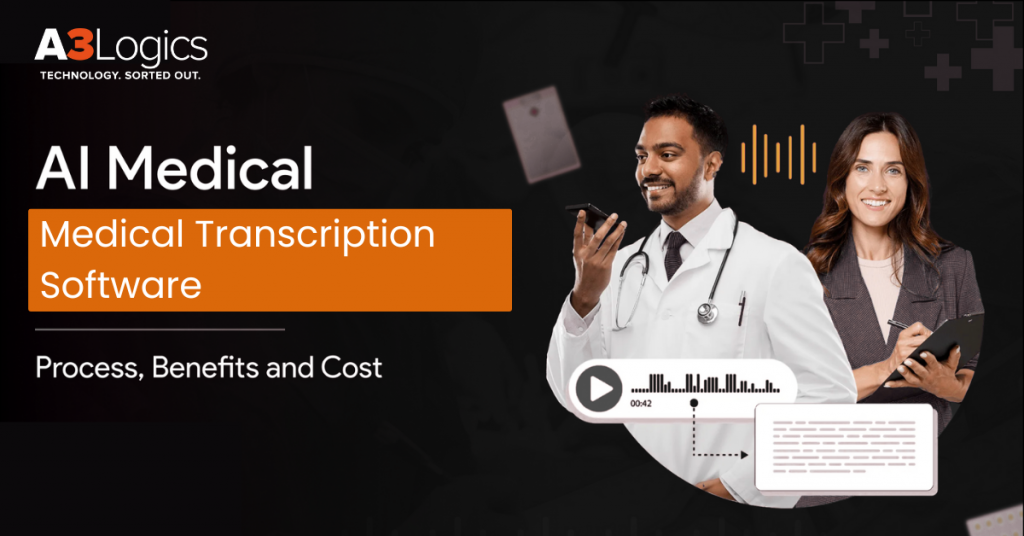
AI is currently a well recognised and talked-about technology in the healthcare sector – and numerous problems have been solved thanks to AI solutions. By automating repetitive tasks, AI medical transcription software can help clinics and hospitals identify and treat illnesses more efficiently while also lowering management workload.
Do you want to learn more about developing AI medical transcription software? It’s appropriate to read this blog. We’ll talk about this incredible advancement in artificial intelligence for medical transcription and show off how powerful AI is to revolutionise medical transcription and the future of medical record-keeping. Let’s start by looking at the expenses related to creating AI software for medical transcription.
What is AI Medical Transcription Software?
AI medical transcription software is a ground-breaking technology that, without the need for human typing, automatically records and transforms patient and healthcare provider discussions into written documentation. Moreover, the technology uses natural language processing and sophisticated speech recognition to listen to clinical conversations in real time, accurately transcribe the exchange, and even determine who said what.
With the capacity to create organized summaries that emphasize important clinical information from each conversation, the resulting documentation may be saved, searched, and consulted at a later time. This technology falls under the more general heading of ambient AI, which refers to AI systems that operate covertly in the background of clinical environments, continuously gathering and processing data without needing direct input or engagement from medical professionals.
Ambient AI functions as a silent, it is ever present as a constant helper, capturing and processing the organic flow of clinical discussions so that physicians can fully concentrate on their patients. Are you aware that doctors in the US devote up to 30% of their working hours—or 15.5 hours a week on average—on just administrative duties? Similar circumstances exist in the UK and Canada, where doctors jointly devote an incredible 18.5 million hours a year to paperwork. Almost 50% of doctors and physicians-in-training suffer from physician burnout, which has become a concerning epidemic as a result of these administrative responsibilities.
Key Features of AI Medical Transcription Software
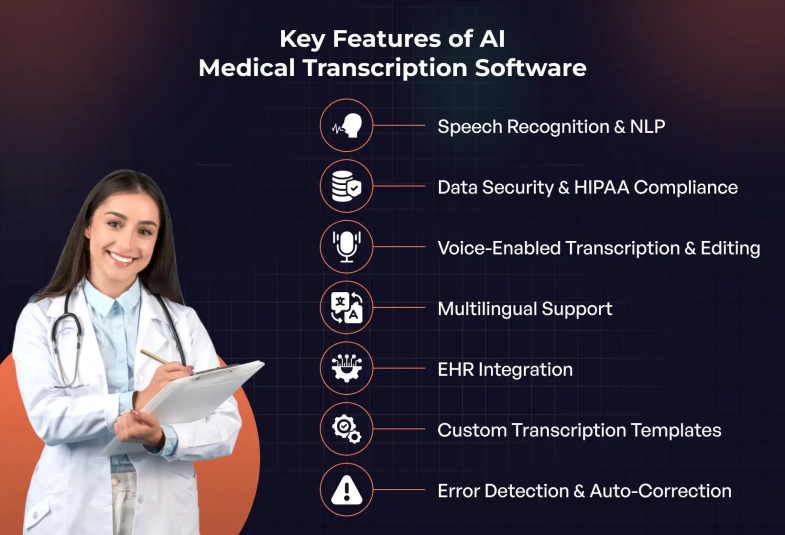
There are various significant features that drive the growth of AI medical transcription software. They simplify various manual tasks reducing the chance of human error. Here are some of the key features that can make an AI-driven medical transcription software standout.
1. Speech Recognition & Natural Language Processing (NLP)
The cornerstone of AI medical transcription software is the use of sophisticated speech recognition technology paired with NLP. These technologies transfer verbal medical dictations into precise, structured text. NLP makes the software grasp medical jargon, abbreviations, and contextual meaning, which results in greater precision even in complicated medical cases.
2. Data Security & HIPAA Compliance
Medical information is strictly regulated and sensitive. The software has to conform to HIPAA (Health Insurance Portability and Accountability Act) in the US or an equivalent where it is operating. Data encryption (in transit and at rest), secure authentication of users, and role-based access control guarantee patient confidentiality and legality.
3. Voice-Enabled Transcription & Editing
Clinicians may dictate straight into the system by giving voice commands, and also make corrections to transcripts hands-free. It enhances workflow productivity so that they can edit out mistakes or make comments without losing continuity in attending to patients.
4. Multilingual Support
Multilingual transcription is a necessity in global healthcare operations. AI transcription tools can be trained to recognize speech in multiple languages, making it possible for hospitals, research centers, and telemedicine providers to cater to patients with diverse backgrounds.
5. EHR Integration
Integration with Electronic Health Record (EHR) systems puts transcribed information automatically into the patient’s medical records. AI Transcription Software for Healthcare prevents manual entry, minimizes errors, and speeds up documentation processes.
6. Custom Transcription Templates
Automatic formatting of transcripts based on the healthcare provider’s requirements, such as SOAP notes, operative reports, or discharge summaries, is provided through custom templates to ensure consistency and adherence to documentation requirements. For clinicians focused on SOAP documentation, Noterro is the best SOAP notes software, offering structured templates that align seamlessly with clinical workflows.
7. Error Detection & Auto-Correction
AI algorithms learn from past transcriptions, picking up likely errors and making recommendations for correction. This feature saves human proofreading time without sacrificing accuracy, particularly critical in medico-legal transcription.
Cost of Creating AI Medical Transcription Software
There are various Factors Influencing the Cost of AI Medical Transcription Software:
1. Scope and Complexity of Features
Low-end solutions with bare speech-to-text capabilities are much cheaper than enterprise-level platforms with multilingual NLP, EHR integration, real-time editing, and analytics.
2. Platform Compatibility (Web, iOS, Android)
Cross-platform development raises costs through individual UI optimization, device-specific integrations, and performance tuning.
3. Developer’s Location (India vs. US vs. EU)
Cost of AI Medical Transcription Software Development rates differ significantly:
- India & Southeast Asia: $25–$50/hour
- Eastern Europe: $40–$80/hour
- US & Western Europe: $80–$150+/hour
4. Integration with APIs (EHRs, Voice Tools)
Speech recognition APIs, medical term libraries, and EHR integration (such as Epic, Cerner) may involve additional licensing costs and development effort.
5. Security and Compliance Needs
Developing AI HIPAA-compliant transcription software with encryption, safe hosting, and auditing mechanisms incurs additional investment.
6. Ongoing Maintenance & Updates
Yearly expenditure on bug fixes, feature enhancements, compliance patching, and AI model retraining typically costs 15–25% of the original development expense.
Estimated Development Cost Range
- Basic Version (Speech-to-Text + Basic Editing): $25,000 – $50,000
- Mid-Level (EHR Integration + Error Detection + HIPAA Compliance): $50,000 – $100,000
- Advanced (Multilingual NLP, Voice Commands, Advanced Security, Custom Templates): $100,000 – $150,000+
Enterprise implementations can go beyond this range, particularly if constructed using on-premise hosting, dedicated AI model training, or high-scale integrations.
Step-by-Step Development Process
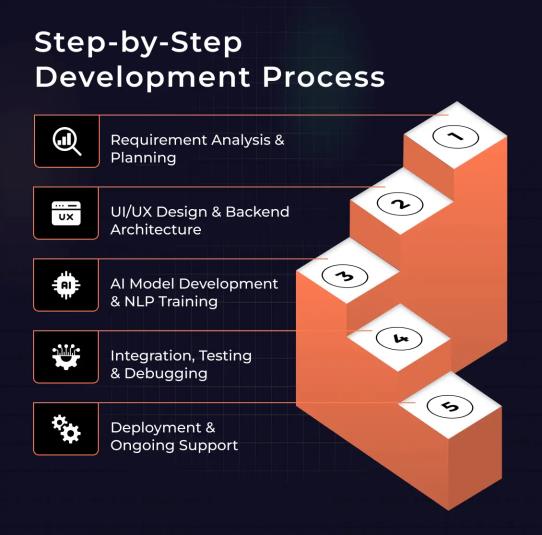
AI medical transcription software system creation may appear to be a daunting task, but with the right plan and professional guidance, it can be made significantly easier. Here’s a step-by-step guide to help you learn how to write an accurate, efficient, and practical response.
Step 1: Requirement Analysis & Planning
Careful planning is the first step in developing AI-based transcription tools. Establishing priorities and answering basic questions is crucial at this phase.
What specific challenges are you seeking to resolve?
What distinguishes your AI-powered transcription tool from other options?
An AI development company can assist you with market research, trend analysis, and developing your idea into a viable plan. This makes it easy to draw out a well-organized plan and go forward with confidence to the next stage of development.
Step 2: Backend Architecture & UI/UX Design
Create a simple, elegant interface that is medical-professional-friendly, with minimal navigation and accessibility features. Create wireframes, prototypes, and user flows to make tasks such as dictation and editing efficient. Behind the scenes, organize secure, scalable backend architecture with encrypted databases, API gateways for integrations, and compliance-ready infrastructure.
Step 3: AI Model Development & NLP Training
Choose or develop a speech recognition engine tuned for medical terminology. Create de-identified datasets, train the AI to be accent and specialty term aware, and include NLP for context-sensitive accuracy. Add continuous learning so the system gets better with user input.
Step 4: Integration, Testing & Debugging
After developing your AI medical transcription software, extensively test it to ensure that it works and conforms with laws such as HL7, GDPR in the UK, and AI HIPAA-compliant transcription software in the United States. It is now important for QA specialists to confirm these requirements, which should have been considered during the planning stage.
Once QA has verified the functioning and compliance of the artificial intelligence transcribing software solution, it can be deployed. Allow doctors to start using the application for internal use right away. If it is a commercial product, launch it in your target market.
Step 5: Deployment & Ongoing Support
The truth is that using AI in medical transcription software is not the ultimate goal. It signifies the start of a continual effort to keep your product relevant in an ever-changing healthcare environment.
Benefits of Using AI in Medical Transcription
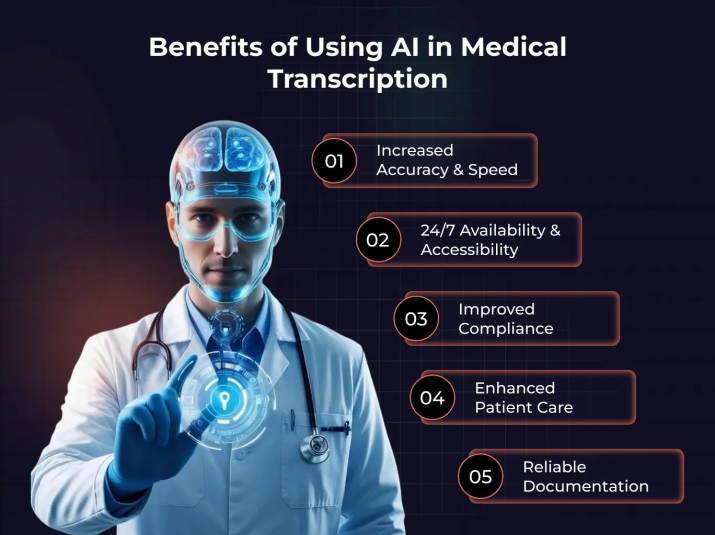
AI application in medical transcription is transforming healthcare providers’ documentation of patient encounters. It combines the experience and quality of human medical scribes with affordability and scalability of dictation services. Medical transcription AI is transforming healthcare documentation through real-time transcribing, accuracy enhancement, and enhanced patient outcomes. Some of the significant advantages provided by AI-based transcription tools are as follows:
1. Increased Accuracy & Speed
Medical record precision is required for treatment and patient safety. Incorrect healthcare documentation can result in misdiagnosis and inappropriate treatment. AI-based automated medical transcribing applications address this issue.
Less human error: Sophisticated speech recognition algorithms significantly reduce transcriptionist fatigue, time pressures, and misinterpretation. Such systems process complicated medical vocabulary like drug names, procedures, and diagnostic terms (e.g., “gastrocnemius,” “sternocleidomastoid”) more accurately than human transcriptionists.
The use of techniques such as the SOAP (Subjective, Objective, Assessment, Plan) note format improves accuracy and standardizes nomenclature in medical records. Standardization enhances healthcare worker communication and removes patient record discrepancies.
Quality assurance: Sophisticated documentation systems such as Nuance Dragon Medical One match medical terms and phrases against medical databases in real time to enhance precision. They provide complete and accurate documentation with quality checks. provides updates.
2. 24/7 Availability & Accessibility
Excellent patient care demands timely access to accurate medical records in the fast-paced healthcare landscape of today. Cloud-hosted, AI-powered online medical transcription services enable instant retrieval of medical records.
So how:
Real-time documentation: Medical transcription service providers provide transcribed notes in real-time, allowing real-time decision-making and enhancing care coordination between medical teams. Hospitals using these technologies achieve 50% sooner documentation turnaround.
Healthcare staff can view and update patient records on any approved device or location, such as hospitals, clinics, and residences. AI transcription services enable providers to access patient information quickly and securely. This enhances patient care responsiveness and flexibility.
More collaboration: Real-time sharing of patient records enhances team communication and enables physicians to make more informed, coordinated patient care decisions. This teamwork enhances patient outcomes and minimizes medical errors.
3. Major Cost Savings
Documentation consumes up to a third of healthcare professionals’ workdays, robbing time from patient care. Medical transcription powered by artificial intelligence accelerates and reduces documentation costs, alleviating this huge burden. So how:
Instant advantages: Speech-to-text translation in real-time eliminates dictation-to-transcription lag. Therefore, physicians can fill and send clinical notes instantaneously without hours or days of waiting for processing. Healthcare professionals can concentrate on patient care with this quick turnaround.
Less human transcription saves operation costs and makes medical transcription cost-effective. It does away with paperwork overtime and saves transcription workflow costs.
Optimization of Resources: Medical professionals can attend to patients while administrative personnel can take care of other relevant duties. This enhances operational efficiency through effective human resource allocation across the organization.
4. Enhanced Compliance & Record-Keeping
Contemporary hospitals need to operate both efficiently and compliantly. AI-based transcription software from leading medical transcription companies helps businesses accomplish this by providing structured, secure document processes that adhere to healthcare regulations and legislation.
So how:
Compliance management automation: Secure treatment of data, automated audit trails, and privacy protection safeguard sensitive patient information throughout documentation in such AI systems. Utilization of well-established medical transcription facilities eliminates noncompliance risk for healthcare companies.
Automating quality assurance: Automated quality verification and templated reporting forms help healthcare organizations maintain documentation standards, perform internal audits, and accelerate regulatory reporting. Hospitals using digital medical transcription technology report preparing for audits 25% quicker.
Standardized workflow integration: By seamlessly integrating with existing Electronic Health Record (EHR) systems, the solution supports an integrated documentation workflow, thereby reducing manual data entry and ensuring standardized medical record formatting. As a result, staff productivity improves, and overall operational efficiency is significantly enhanced.
5. Enhanced Patient Care through Reliable Documentation
The ultimate goal of medical documentation improvement is better patient care. The top medical transcription services help healthcare providers focus more on patient interaction and less on administrative responsibilities. So how:
Instead of manual note-taking, doctors can make greater eye contact and connect with patients during consultations. This strengthens patient-provider relationships and patient trust.
Swift decision-making: Fast, accurate clinical documentation accelerates medical decision-making and treatment planning, saving patients time and boosting outcomes.
Decreased documentation time equates to lower wait times, longer provider visits, and more focused attention, boosting patient satisfaction.
- Also Read: AI Medical Coding in 2025 – Complete guide
Why Choose A3Logics for AI Medical Transcription Software Development?
Revolutionize your medical documentation process with a proven technology partner that combines healthcare acumen, AI innovation, and delivery excellence. At A3Logics, we don’t code software — we create solutions that save time, minimize errors, and enable clinicians to spend more time on patient care.
Unparalleled Healthcare AI Expertise – We have successfully implemented advanced AI solutions in top-ranked hospitals, telemedicine platforms, and research centers globally.
Top-Tier Speech AI & NLP Talent – Our engineers are medical speech recognition and NLP experts, so your software will accurately comprehend sophisticated jargon and specialty-specific vocabulary.
Security You Can Trust – Fully HIPAA-compliant with enterprise-grade encryption and tight access controls to protect every item of patient data.
End-to-End Excellence – From design and concept to deployment and continuous optimization, we take you through each step for smooth launch and long-term success.
Select A3Logics — where AI blends with healthcare expertise to provide quicker, more precise, and fully secure transcription.

Conclusion
Artificial intelligence being included into medical transcribing is a major development in the field of healthcare technology. The way in which healthcare providers collect and communicate patient information is being revolutionized by artificial intelligence, which is automating the documentation process and boosting its accuracy and efficiency. As the technology behind artificial intelligence continues to grow, we may anticipate seeing additional advancements in medical transcription as well as in the healthcare business as a whole. Artificial intelligence is the future of medical transcription, and it has the ability to completely revolutionize the healthcare industry.
Get in touch with the leading Software Development Company today!