The buying behavior of insurance is changing more rapidly than ever before, transforming the way policies are found and bought. Customers are no longer limited to face-to-face consultations. They anticipate smooth, digital-native experiences where the exploration of policies, comparison and selection happen instantly through online mediums. This change has compelled insurers to use smart tools such as an AI policy recommendation engine to fulfill the increased expectations.
In line with this transformation, insurance products have become more complex. Customers are overwhelmed with flexible coverage options, riders, add-ons, and usage-based pricing. Existing agent-based models and fixed-point rule-based recommendation systems cannot comprehend this complexity.
The cost of poor policy matching is high. Poor recommendations translate to low conversion rates, increased churn, and unhappy customers. They also pose compliance and regulatory risks, whereby policies do not meet the suitability standards. This renders accurate, data-led policy recommendations a defining growth requisite among insurers that aim to attain sustainable sales performance.
Understanding an AI-Powered Policy Recommendation Engine
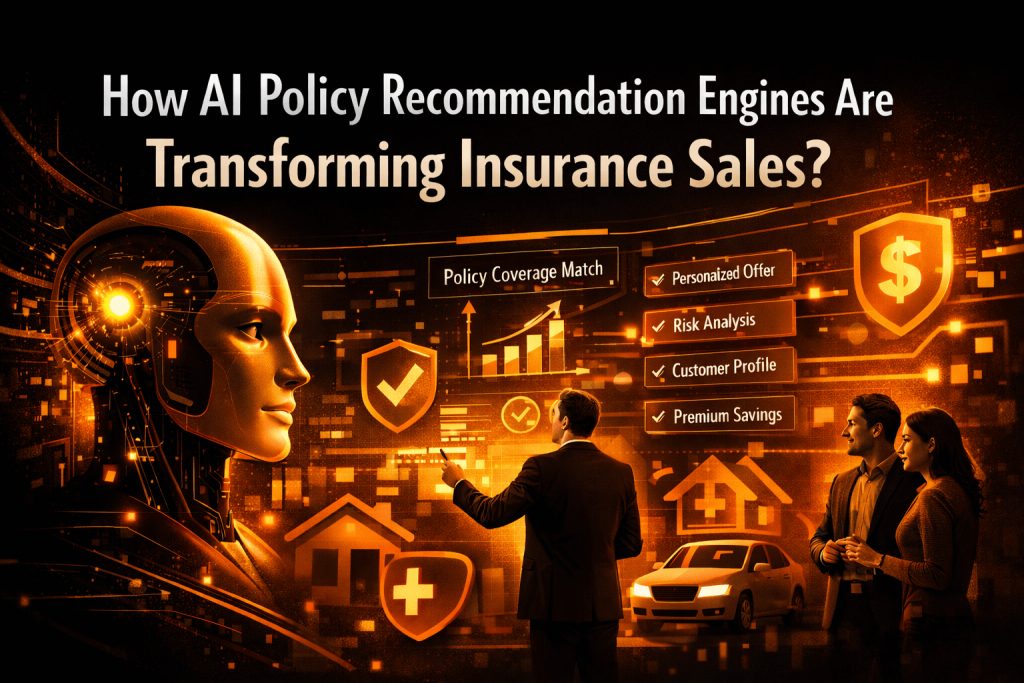
An Insurance policy recommendation engine is a technology layer that processes customer data, information on products and risk factors to recommend the most appropriate insurance policies. Contrary to the traditional tools, the AI policy recommendation engine for insurance helps to discover and advise policy on the basis of real-time evaluation. It takes into account demographics, behavior, life events, and risk exposures to direct customers and advisors towards making the best decisions.
The difference between the AI-driven engine and the static rule-based system is that the former is capable of learning and adapting. An AI insurance recommendation system is driven by machine learning and real-time intelligence to continually update recommendations, informed by new data and results. Scalable, data-driven advisory will help insurers, brokers and agents, whereas policyholders get more precise, transparent and personalized recommendations.
Market Drivers Accelerating Adoption Among Insurers & Brokers
1. Personalization Expectations
Consumers are now demanding insurance products that would represent their lifestyle, risk profile and financial hope. AI recommendation engines facilitate profound policy personalization in insurance by interpreting various pieces of information individually.
2. Insurtech Competition
The digital-native insurtechs are pushing boundaries by delivering new norms of fast, convenient and personalized purchasing experience. Conventional insurance agents and brokers embrace AI-driven recommendation systems to keep up with the pace of speed, intelligence, and customer interactions.
3. Agent Productivity Pressure
Agents have to deal with increasing product complexity and a larger customer volume within a constrained time. AI-based recommendation engines facilitate advisory procedures, making them quicker, more reliable, and efficient.
4. Regulatory Transparency Needs
Regulators are demanding more explicit insurance recommendation justification. Explainable AI will help insurers to show their relevance and impartiality, strengthening the preparedness of compliance and customer trust.
5. Revenue Optimization Goals
The long-term growth will be dependent on the maximization of customer lifetime value through cross-sell, upsell, and renewals. AI recommendation engines find pertinent opportunities when necessary without losing suitability or credibility.
How an AI-Powered Policy Recommendation Engine Works
1. Data Sources Powering Intelligent Recommendations
The success of an AI recommendation engine is predetermined by the quality and the range of its data inputs. New systems combine streams of data to create a comprehensive view of the customer and risk.
Customer demographic, lifestyle indicators, and behavioral data are the foundation. It includes age, income, family status, digital interactions and buying behavior. Historical policies, claims and renewal data give insights into coverage adequacy and long-term value.
Internal systems provide risk and underwriting information, which enhances the exposure and pricing sensitivity. Moreover, external data sources further improve accuracy, as telematics data reveals driving habits and IoT sensors provide insights into property risk. Additionally, insurers use health and financial data to deliver more precise life and health insurance recommendations.
The integration of these sources of data helps the insurance recommendation system produce personalized and risk-sensitive suggestions.
2. AI Technologies Behind the Engine
The recommendation engine revolves around machine learning models. These models detect patterns, forecast customer requirements, and predict the results, e.g. conversion probability or risk of claims.
Recommendation algorithms are a combination of content-based and collaborative filtering. Content-based strategies pair policy attributes with customer attributes. Collaborative filtering uses the knowledge of related customer profiles and results.
The role of natural language processing becomes more significant. With NLP, the system is able to interpret customer intent based on chat, voice, or advisor questions and make better recommendations that are more conversational and accessible.
Explainable AI methods make sure that the recommendations are justifiable and auditable. This plays a pivotal role in regulatory compliance and internal control, whereby the insurers are able to justify the rationale behind a specific policy or add-on. A combination of these technologies results in a powerful AI-based insurance decision support solution.
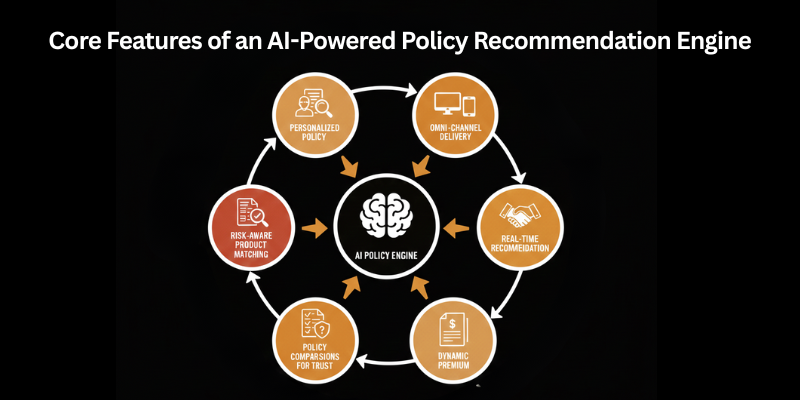
Core Features of an AI-Powered Policy Recommendation Engine
1. Personalized Policy and Coverage Recommendations
An AI policy recommendation engine examines customer demographics, behavior and risk profile to suggest the most pertinent policies. It covers individual needs instead of generic bundles. Consequently, insurers achieve higher suitability, increased customer trust, and enhanced conversion results.
2. Dynamic Premium and Add-on Suggestions
The system is dynamic in proposing premiums and riders depending on real-time data and customer feedback. Recommendations would automatically vary based on the change in preferences or risk factors. This flexibility portrays the increased use of AI in insurance to price smarter and design products with customer-centricity.
3. Risk-Aware Product Matching
Risk-sensitive matching will make sure that the suggested policies correspond to the underwriting guidelines and general risk appetite. The engine evaluates historical claims trends and external risk signals. Such abilities assist in minimizing the policy mismatch, enhancement of portfolio quality, and limit post-sale corrections.
4. Explainable Policy Comparisons for Trust and Compliance
The engine gives clear reasons as to why a specific policy is suggested as opposed to another. It brings out differences in coverage, cost drivers and risk considerations in an easy way. Clear comparisons build customer confidence and uphold regulatory and audit standards.
5. Omni-channel Delivery Across Touchpoints
Recommendations are provided regularly via agent portals, websites, mobile applications, and chatbots. The same guidance is given to customers despite the channel of interaction. An integrated experience will enhance interaction as well as brand consistency during the purchasing experience.
6. Real-time Recommendation Updates
The engine keeps track of customer activities throughout the sales process. Recommendations update automatically according to the browsing, quote or advisor entries. Constant responsiveness ensures that suggestions are relevant and augments the interactions at all levels.

Business Value for Insurers
1. Increased Policy Conversion and Quote-to-Bind Rates
AI-based recommendations match the policies with the customer needs and budgets. Better relevance reduces the time of purchase and improves confidence during the making of decisions.
2. Improved Underwriting Precision and Risk Selection
An insurance policy recommendation engine examines customer and risk data on a granular level and then recommends products. This leads to cleaner portfolios and better compliance with defined risk tolerance.
3. Higher Customer Lifetime Value
The correct matching of policy increases customer satisfaction and trust. Regular, timely suggestions enhance renewals and increase cross-sell opportunities in the long run.
4. Faster Launch of New Insurance Products
Recommendation logic can be easily embedded with new products. With insurance software development services, quick configuration and scalable rollout through digital channels will be possible.
5. Reduced Operational and Advisory Costs
AI-based recommendations minimize the reliance on manual reviews and repetitive advisory tasks. It ensures increased efficiency and a consistent quality of decisions across channels.
Competitive Advantages for Brokers & Agents
1. Human-Centric AI Advisory Support
AI recommendation engines act as smart assistants that enhance, instead of eliminating, the expertise of brokers and agents. They facilitate informed advisory, combining human judgment and data-driven insights. It is particularly a useful balance when it comes to navigating AI vs traditional underwriting, where contextual knowledge is essential.
2. Accelerated Sales Conversations and Closures
By having access to real-time and updated policy suggestions, brokers and agents can approach their customers quickly. Automated assessment eliminates the time-intensive manual comparisons. This consequently leads to a reduction of the sales cycles and increases the deal close rates tremendously.
3. Smart Cross-Sell and Upsell Enablement
AI analyzes customer data, current policies, and behavioral trends in order to reveal some of the most promising cross-sell and upsell opportunities. Such recommendations are contextual and personalized. This will promote conversion without compromising trust and regulatory appropriateness.
4. Data-Driven and Explainable Policy Comparisons
AI policy recommendation engine for insurance provides a clear explanation of why certain policies are suggested based on data-supported arguments. This transparency boosts the credibility of the advisors in the discussions. It also makes recommendations compliant, auditable and customer-friendly.

Industry Use Cases Across Insurance Segments
1. Life & Health Insurance
Recommendation engines in the domain of life and health insurance employ AI to process variables such as life stage, income, dependents, and health indicators. These insights are used to make appropriate decisions on coverage levels, terms and riders of policies. The outcome is advice that would balance protection with long-term financial security and wellness objectives.
This kind of intelligence also assists in the prevention of under-insurance and over-insurance. Coverage recommendations evolve depending on changes in life events, income, and health conditions. To ensure the accuracy of such models over time, insurers rely on sophisticated machine learning development services.
2. Motor & Telematics Insurance
For motor insurance, AI engines use telematics information and trends of behavior on the road to customize their suggestions. The coverage and pricing recommendations are directly dependent on speed patterns, braking, mileage, and driving conditions. Policies are more reflective of the actual risk as opposed to generalized assumptions.
Optimization of add-ons and coverage in real-time is possible throughout the policy tenure. Modifications are proposed as a behavior change over time. This creates fairer pricing for safer drivers and improved loss ratios for insurers.
3. Commercial & Specialty Insurance
In commercial and specialty insurance, the insurance policy recommendation engine allows in-depth SME risk profiling. Customized policy bundles are informed by business size, industry type, operational activities, and exposure data. Business owners find it simpler to navigate complex coverage decisions.
Recommendation logic follows industry-specific compliance requirements from the start. As a result, systems identify required coverages and coverage gaps early in the advisory process. Consequently, brokers gain the ability to deliver precise, compliant, and value-based recommendations at scale.
Challenges in Implementing AI Policy Recommendation Engines
1. Data Silos and Legacy Core Insurance Systems
Most insurers have fragmented data that is distributed across legacy core systems. Such silos reduce the quality of data, accessibility, and real-time to make accurate recommendations. The process of modernizing architecture and making it capable of data integration is usually cumbersome, expensive, and time-consuming.
2. Bias, Fairness, and Model Governance
AI models have the potential to amplify historical bias in training data. This poses a threat of unfairness in price, eligibility and coverage suggestions. The ethical and compliant results are only achievable with the help of strong model governance, bias testing and continuous monitoring.
3. Regulatory Compliance and Explainability
Insurance regulations require clear and reasonable policy suggestions. However, black-box AI models often obscure the reasons behind proposed policies. Therefore, insurers must implement explainable AI to meet audit requirements, regulatory standards, and customer trust expectations.
4. Integration with Core Insurance Systems
AI engines should be compatible with underwriting, CRM, and insurance policy administration software. Lack of integration may disrupt the working process and make the system less effective. Smooth operations and synchronization of data highly depend on reliable APIs.
5. Agent Adoption and Change Management
Agents might be resistant to AI tools because of trust issues or fear of being replaced. Adoption will not be high without appropriate training and value demonstration. An effective change management strategy will make sure that AI is used as decision support, not a replacement.
Best Practices for Successful Implementation
1. Focus on Major Use Cases
The first step towards successful implementation involves picking use cases that can deliver fast and quantifiable business value. New policy sales, renewals and cross-sell are ideal starting points. Clear KPIs are used to monitor performance, direct improvements, and develop internal confidence.
2. Blend AI with Human and Business Control
AI should not substitute the existing insurance policies and experience, but it should complement them. Business logic integration will help to be in line with the underwriting and regulatory needs. Human control permits advisors to authenticate the recommendation and exercise discretion during complicated situations.
3. Build Explainability from the Start
Regulatory compliance and trust among stakeholders rely on transparent recommendations. An Insurance recommendation system should explain the reasons behind the recommendation of certain policies or coverages. Good audit trails facilitate governance, reviews and long-term accountability.
4. Keep Models Continuously Updated
The behavior and risk profile of customers in insurance markets vary over time. Regular retraining with real-world data makes the recommendations current and relevant. This will reduce model drift and ensure the same performance.
5. Select an Insurance-Savvy AI Partner
The use of AI in insurance requires domain knowledge. An informed partner is aware of products, compliance requirements and advisory processes. This minimizes the risk of implementation and makes the solution deliver viable business value.
How A3Logics Helps Insurers & Brokers Build Intelligent Policy Recommendation Engines
1. Insurance-Focused AI Strategy & Consulting
A3Logics assists insurers and brokers in finding high-impact policy recommendation and advisory use cases that meet growth, revenue, and customer experience objectives. The team establishes a clear AI roadmap with data preparedness, architecture, and deployment priorities. This will guarantee quicker adoption and foreseeable business outcomes.
2. Custom AI Policy Recommendation Engine Development
The AI policy recommendation engine for insurance is designed to be in line with the insurance product, coverage logic, and underwriting needs. Machine learning models deliver precise, personalized outcomes while performing reliably at enterprise scale. Moreover, teams integrate explainable AI capabilities to support regulatory compliance and simplify audit requirements.
3. Seamless Integration with Insurance Ecosystems
A3Logics facilitates policy recommendation engines to be co-integrated with the core insurance platforms. API-based architectures provide real-time recommendations via agent portals, customer apps, and conversational channels. The outcome is a seamless omni-channel advisory experience across touchpoints.
Why Choose A3Logics as Your AI Insurance Technology Partner
a. Strong AI and Data Engineering Expertise
A3Logics has extensive experience in AI, machine learning, and data engineering for complex insurance initiatives. Enterprise-level solutions are configured and installed in controlled settings. Large-scale insurance operations and digital platforms are supported with high performance, security, and regulatory preparedness.
b. Insurance Workflow and Regulatory Knowledge
Good knowledge of end-to-end insurance processes and regulatory needs informs the solution design. A3Logics captures underwriting logic, compliance rules and audit requirements at its core. Faster adoption is enabled across sales, underwriting, and policy servicing teams with reduced implementation risk.
c. Purpose-Built, Custom AI Solutions
A3Logics is an AI development company that does not focus on generic platforms but purpose-built AI solutions. Recommendation engines are associated with particular products, risk policies, and distribution patterns. An increase in accuracy, explainability and quantifiable business impact is realized across insurance value chains.
d. Scalable for Insurers, Brokers, and Insurtechs
Cloud-native architecture is designed to support insurers, brokers, and insurtechs by making them scalable. A3Logics makes sure the solutions expand in terms of customer volumes, products and regions. Steady performance is ensured as digital and omni-channel insurance activities continue to grow efficiently.
e. Ongoing Optimization and Innovation Support
A3Logics continues to work with clients after the initial deployment. Constant monitoring, optimization and innovation maintain accuracy and compliance of systems. Sustained value is delivered as data, regulations, and customer expectations evolve over time.
Conclusion
The insurance sector is fast-moving towards customer-oriented and data-driven sales models. An AI policy recommendation engine helps insurers and brokers navigate an increasing complexity of products and provides the right, personalized and compliant guidance. Through the power of real-time insights and explainable intelligence, the sales and advisory processes will become more engaging and credible.
With the expectation of customers and the intensity of competition growing, it is currently a strategic imperative to embrace AI-based recommendation functions. Early investment by organizations helps them to increase their conversions, enhance retention and customer confidence. Such benefits enable insurers to remain agile, stable, and well-placed to grow long-term within a digital-first insurance environment.