
What if every policy update, claim approval, or, customer query could be managed without delays? That’s what insurance policy administration software does. It streamlines workflows and optimizes insurance operations, and reduces errors; thereby, helping integrate data across departments.
As an insurer, when you invest in custom insurance software development and partner with a software development company like A3Logics, you can expect a tool that streamlines the processing of the entire policy lifecycle – from issuance, billing, and termination.
Every time a change occurs in a policy, the policy administration system systematically logs the transaction and creates a way to track it. It further lines up appropriate follow-up actions to maintain accuracy and continuity in policy management without hampering operations.
What is the Policy Administration System (PAS) in Insurance?
Policy Administration System is a software used by insurance companies to manage the various aspects of insurance policies; like policy issuance, quoting, billing, underwriting, endorsements, and claims processing.
The insurance policy administration system acts as a central hub for insurers. Here, they can store, retrieve, and update policy-related information. This results in efficient administration and management of insurance policies.
Insurance Policy Administration Software – Key Statistics
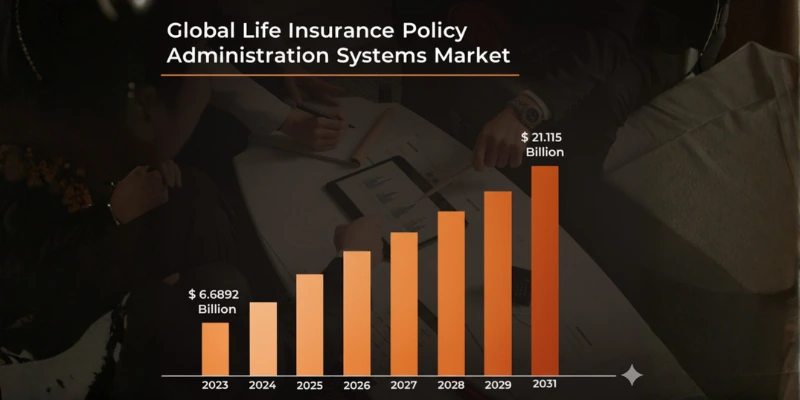
Source:- verifiedmarketresearch.com
- The value of AI in the insurance industry is estimated to reach about $79.86 billion by 2032 from approximately $4.59 billion in 2022.
- Asia Pacific is expected to be the fastest-growing region in the global insurance platform market in the forecast period 2025-2030.
- Software accounts for the largest share of global life insurance policy administration systems; nearly 66%
- Term life insurance policies make up an important sub-segment within policy administration market, with a share of 32%.
- The U.S. Life Insurance Policy Administration Systems Market was valued at $6.3 billion in 2024 and is anticipated to reach approximately $15.8 billion by 2034
- 92% of insurers are focusing on digital transformation; 75% are investing heavily in platforms like policy administration systems.
Why Do Insurers Need Custom Policy Administration Software?
Here are some reasons why insurers need custom policy administration software –
1. Streamlined Workflows
Insurance policy administration software development offers systems that automate repetitive tasks in the policy lifecycle. These include – quoting, underwriting, renewal, etc. They help reduce errors and speed up policy management-related processes.
2. Flexible and Scalable
These systems can be designed to adapt to an insurer’s specific business model. They can support customized workflows and complex product lines. Their flexible architecture allows the system to accommodate new products, markets, and customer growth without disrupting existing operations or requiring extensive reconfiguration.
3. Cost Efficiency
Paperwork and manual effort can add to administrative costs. Apart from that, traditional workflows are slow. On the contrary, digital workflow streamlines paperwork and automates repetitive operations.
4. Centralize Scattered Data
When data sits in silos, mistakes are bound to happen and in fact multiply. An insurance policy administrative software, consolidates customer, policy and claims data into one secure platform, giving teams real-time access and improving coordination.
5. Simplified Compliance with Built-in Rules
The systems come with an integrated compliance check that automatically validates policies and reports. This helps avoid penalties since the necessary regulations are met. And, it’s not just one one-time process; the system stays updated with changing insurance laws.
6. Self-service Portals for Customers
Customers needn’t contact the insurers for minute queries; they can access policies, renew plans, and track claims instantly online or through apps. The systems also send automated notifications with which customers are informed of their claim status.
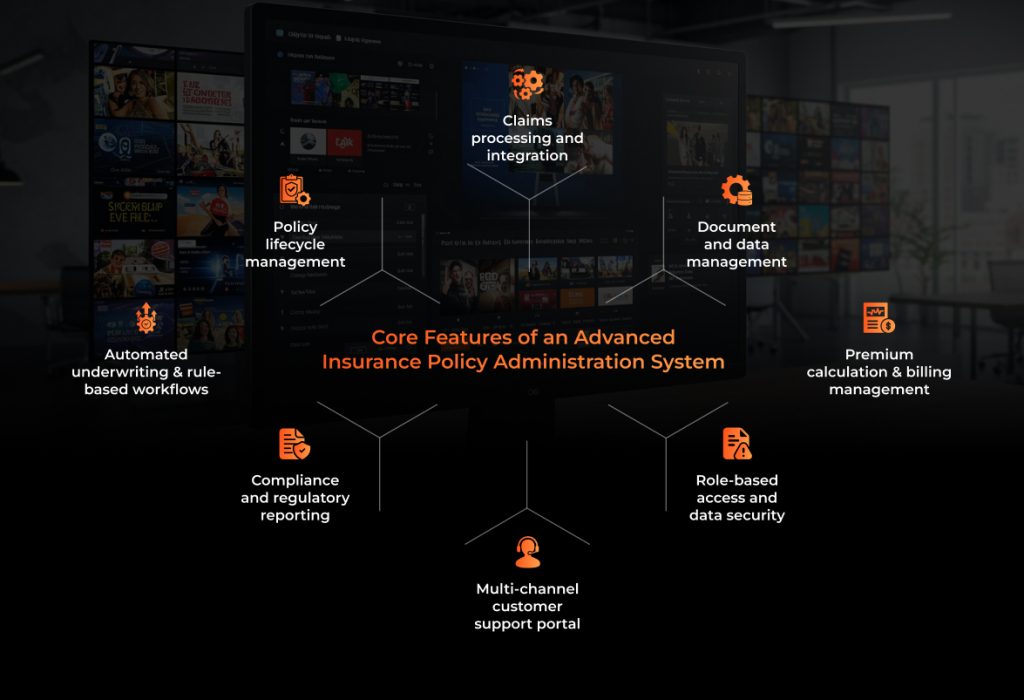
Core Features of an Advanced Insurance Policy Administration System
1. Policy Lifecycle Management
In insurance policy administration software, policy lifecycle management refers to the structured handling of a policy from beginning to conclusion. It encompasses a range of processes, including quoting, issuance, endorsements, renewals, and cancellations. As a key feature of insurance policy administration systems, it governs the complete journey of an insurance policy.
2. Automated Underwriting and Rule-based Workflows
Automated underwriting uses advanced technologies such as AI in underwriting. When a customer applies for a loan, their borrower’s information is fed into an automated underwriting system. It checks their data against predefined underwriting criteria like employment history, credit score thresholds, or claim records.
3. Premium Calculation and Billing Management
In a custom insurance policy administration software, there is an option for premium calculation and billing management. It automates the calculation of policy premiums based on factors such as coverage, risk profile, and regulatory requirements. It ensures timely billing, accurate pricing, and flexible payment options.
4. Claims Processing and Integration
In an advanced insurance policy administration system; claims processing ensures efficient handling of claims, right from submission to settlement through an automated workflow and real-time data exchange. By using AI in claim management, the system accelerates assessments while timely detecting frauds. It also understands each case, checks it for credibility, and helps insurers make faster and fairer decisions.
5. Document and Data Management
Insurance policy administration systems software have document and data management features. Using this functionality, they capture, store, organize, retrieve, and manage digital and digitized documents. The system automatically extracts key data from both structured and unstructured documents, while storing and indexing them. Apart from that, it also assigns role-based access and facilitates audit trails.
6. Compliance and Regulatory Reporting
In the insurance industry, organizations must comply with the legal and regulatory requirements established by governing bodies. The compliance and regulatory feature of an insurance policy administration software help organizations collect, compile, and submit data to authorities. Before submitting, the system helps analyze the collected data to identify patterns of compliance and non-compliance. Once analyzed, the report is compiled by various departments.
7. Multi-channel Customer Support Portal
In an advanced insurance policy system, a multi-channel customer support portal provides customers with seamless access to various channels, including mobile apps, web portals, email, chat, and call centers. It unifies all interactions into one system for policy updates, real-time query resolution, and claim tracking.
8. Role-based Access and Data Security
An insurance software development company designs features that restrict user access by assigning permissions based on their job-specific roles and responsibilities. This measure helps prevent unauthorized access and defines roles (for e.g., underwriter, claims adjuster, etc). It also helps prevent internal data breaches or unauthorised access.
Role of AI and Automation in Policy Administration Systems
1. Intelligent Underwriting and Risk Assessment
AI helps analyze vast and complex datasets from various sources such as public records, IoT devices, and social media. Because of this ability, AI and automation detect those patterns that human underwriters may miss. Similar to how data science techniques are used to extract insights from large-scale insurance and business datasets. Based on these patterns, they accurately predict risks and flag inconsistencies. The outcomes are fairer decisions and precise pricing for policies.
2. Claims Processing Automation
AI and automation use advanced technologies such as NLP and computer vision to capture and extract data from claim forms, images, and other unstructured documents. Based on their complexity, claims are categorized as either low-risk or high-risk cases. The latter are routed to human underwriters.
3. Personalized Policy Recommendations
Insurance policy administration software analyzes customer data to offer highly customized, dynamic pricing and coverage options. It takes into account individual risk profiles, behaviors, and needs to recommend specific policies, adjust premiums, and identify potential coverage gaps.
4. Predictive Maintenance and Renewal Automation
AI in policy administration systems uses predictive models to forecast potential incidents like maintenance needs of insured vehicles or property. This allows insurers to offer preventive advice and even reduce future claims. AI and automation also play a key role in renewal automation as well; automation handles routine tasks such as processing standard updates or sending timely reminders.
5. Fraud Detection and Compliance Monitoring
By leveraging AI and ML, intelligent policy administration systems, analyze large datasets for suspicious patterns and anomalies. Such high-risk claims, or applications can be acted upon promptly, and insurance companies can reduce financial losses. Simultaneously, automation ensures strict adherence to regulatory standards as it automates tasks like generating audit trails, compliance checks, and adapting to data protection laws.
6. Process Optimization through Robotic Process Automation (RPA)
While not as powerful as AI, RPA bots are used to automate repetitive, rule-based back-office administrative tasks that are common in policy administration systems. They copy data between systems, update policy records, trigger emails, generate reports, and move information from one workflow to another. Since most of these tasks don’t require judgment, RPA follows fixed rules to carry out these tasks.
7. Data-Driven Decision Making
An AI-based policy administration software enables data-driven decision-making by transforming raw policy, customer, and claims data into real-time insights. With the help of this data, insurers can understand risk patterns and streamline operations with precision. These insights also help insurers set smarter prices; designing products that match customer needs.

Advantages of Implementing Policy Administration Systems Software
1. Enhanced Operational Efficiency and Reduced Manual Errors
By automating repetitive tasks like billing, policy issuance, and renewals, insurance policy administration systems software reduces manual intervention. This results in fewer errors and improved efficiency across the policy lifecycle. It also lets the staff focus on higher-value tasks such as risk assessment and customer engagement instead of administrative work.
2. Improved Customer Experience and Faster Service Delivery
An insurance policy administration system software transforms customer service by offering policyholders real-time access to their insurance-related information. Take, for instance, health insurance policy administration systems. They allow customers to instantly check their policy coverage, track claim status, and download e-cards from one unified platform. For the same reason, they don’t have to contact an agent. Furthermore, automated approvals and digital document uploads further reduce waiting times.
3. Streamlined Compliance and Reporting Processes
When a policy administration system is implemented, it streamlines compliance and reporting by automating data validation, It further conducts rule checks, and audit trails. Not only does it monitor policy and claim transactions against regulatory standards; but it also flags discrepancies. The system also generates real-time, audit-ready reports. These reports give insurers instant clear visibility into compliance status; through these they can respond quickly to audits.
4. Cost Savings through Automation and Scalability
Custom insurance policy administration software reduces operational costs by automating repetitive tasks; such as policy issuance, renewals, underwriting, and billings. Its scalable design enables insurers to manage larger customer volumes and business growth without added infrastructure and staff by optimizing processes and efficiently distributing system workloads.
5. Real-time Insights for Data-driven Decision-making
The insurance industry generates a massive amount of data. Insurance policy administration software for instance, health insurance policy administration systems, harnesses this data effectively. They process clinical trial outcomes, patient records, research insights, and administrative information in real-time. Furthermore, they use predictive analytics to forecast risk pools and optimize premium pricing, helping insurers make informed decisions.
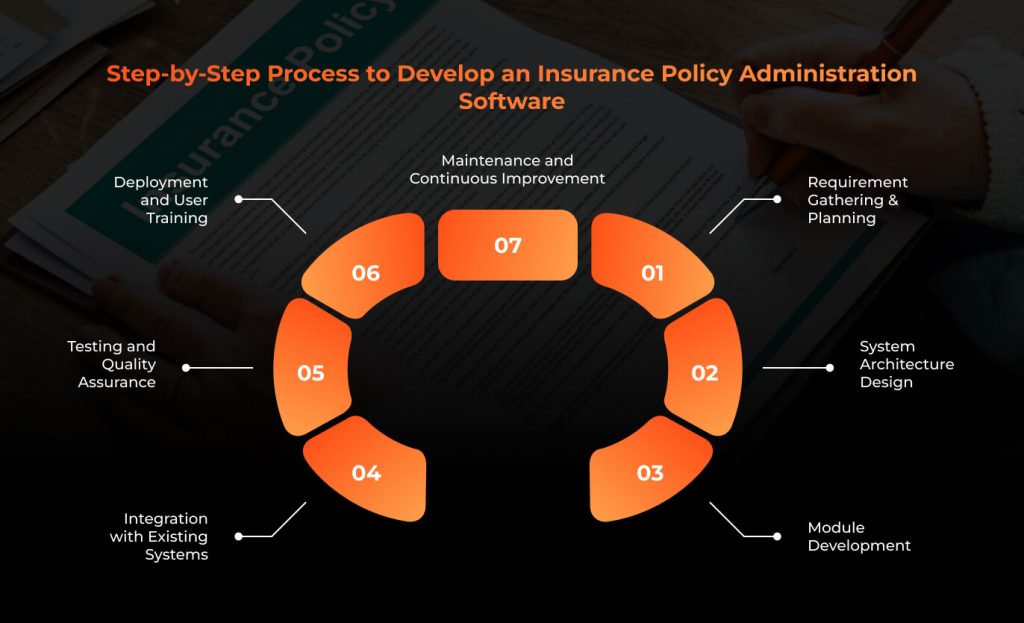
Step-by-Step Process to Develop an Insurance Policy Administration Software
1. Requirement Gathering & Planning
The development of insurance policy administration software starts with identifying insurer’s business needs. The needs are then documented so that they can act as a reference and later be incorporated into development. Stakeholders from various sub-domains; such as claims, underwriting, billing, compliance, and IT, collaborate to capture functional requirements such as policy workflows and reporting, and non-functional needs like performance and security. Next, business rules, regulatory obligations, and product-specific nuances are mapped.
2. System Architecture Design
This step involves the process of planning the overall structure of the software. It defines how different modules; such as claims, policy management and customer portals communicate with each other. At this stage; you also design the database, outline the technology stack and security measures with existing systems. The aim here is to develop a system that’s scalable and secure.
3. Module Development
As part of software development services; a software development company builds the core functional components of the software. For example; when building health insurance policy administration systems, it develops modules for policy management, underwriting, customer self-service portals, reporting, etc.
4. Integration with Existing Systems
In insurance policy administration system development; integration with existing systems involves connecting the new software with the insurer’s current platforms like claims, billing, underwriting, etc. This allows the existing data; such as policy details, claim updates, and payments to flow automatically between systems. It also avoids duplicate work and keeps historical records intact.
5. Testing and Quality Assurance
In this phase; testers check each part of the system; like policy creation, claims, billing, renewals, for errors, workflow issues, and data accuracy. Quality Assurance, on the other hand is a part of software development that ensures that the whole development process follows standards, prevents defects, and maintains reliability. Both departments guarantee that the final system is secure, compliant, and provides a smooth, error-free experience for both staff and policyholders.
6. Deployment and User Training
At this stage, the insurance policy administration software is moved from the development environment to the insurer’s live environment. Here, not only is the system configured, but the data is successfully migrated, and all modules are activated for real use. After deployment, the development team trains all the departments, such as underwriters, agents, claim adjusters, etc, on how to use the system. For the same they provide user guides, hands-on sessions, and offer support so that employees can carry out their operations seamlessly.
7. Maintenance and Continuous Improvement
Even after the system is successfully deployed and the insurance organization’s teams are well-trained on system use; the developers ensure that the system remains stable, secure, and up to date, even after deployment. They continuously monitor the system’s performance and promptly fix bugs. Apart from that; they also enhance features based on regulatory changes, feedback, and new business needs.
Technical Architecture, Tech Stack & Integration Considerations
Here’s where you shift from business to tech: selecting architecture and stack that supports your goals.
Architecture
- Microservices or modular architecture is preferable for flexibility and scalability.
- API-first design so modules (billing, underwriting, portal) can evolve independently.
- Cloud or hybrid deployment to support high volume, geographic distribution, disaster recovery.
- Event-driven or workflow engine for endorsements/renewals and asynchronous tasks.
- Data warehouse or lake for analytics, reporting, machine learning.
Tech Stack
- Backend: Java, .NET, Node.js
- Workflow/Rule engine: Drools, Camunda, or proprietary rule engines
- Database: Relational (PostgreSQL, Oracle) + NoSQL if needed for big data
- Frontend: React, Angular for portals; mobile if needed
- Cloud platforms: AWS, Azure, GCP
- Integration: RESTful APIs, GraphQL, message queues (Kafka, RabbitMQ)
- DevOps: CI/CD pipelines, containerisation (Docker/Kubernetes)
Integration Considerations
- Connect with existing legacy insurance systems (if any) via adapters or ETL.
- Link with claims system, agent management system, payment gateways, CRM, third-party data (e.g., telematics, weather risk).
- Ensure data sync and consistency (real-time or near real-time).
- Plan for migration of legacy policies/data into new system with minimal disruption.

Common Challenges in Building Insurance Policy Administration Systems Software
1. Data Migration from Legacy Systems
Migrating data from legacy systems is challenging because older platforms often store information in outdated formats. Furthermore, there are inconsistent structures, or incomplete records. Ensuring accuracy, cleaning duplicated data, and avoiding downtime requires careful planning; a strong migration strategy.
2. Ensuring Interoperability with Multiple third-party Tools
Insurance PAS must connect smoothly with tools for payments, underwriting, analytics, CRM, and claims. Each system may use different formats or APIs, making integration complex. Ensuring stable data exchange, real-time updates, and error-free communication demands well-designed interfaces and continuous monitoring to keep all systems working together. There also need to be standardized protocols that prevent conflicts between systems.
3. Maintaining Security and Privacy of Sensitive Data
Protecting policy data is difficult because insurers handle high-risk information that can be misused. Hence, strong authentication, encryption, access controls, and monitoring are required. With insurance fraud detection automation development, systems must analyze patterns without exposing data. Maintaining strict security standards reduces breaches, unauthorized access, and regulatory penalties.
4. Keeping up with Changing Insurance Regulations
Insurance rules change frequently across underwriting, claims, data storage, and customer communication. Updating systems quickly while remaining compliant is a challenging task. Therefore, Insurance policy administration software must support configurable rules, and clear audit trails with which every policy action becomes fully traceable.
Future Trends in Insurance Policy Administration Systems
1. AI-driven Underwriting and Predictive Analytics
AI-driven underwriting and predictive analytics will shape the future of insurance policy administration systems by enabling faster, and more accurate risk assessments and automated decision making. These technologies analyze vast datasets; i.e. data from claim trends, medical history and lifestyle patterns to generate personalized premiums and precise risk scores.
2. Integration of IoT for Usage-based Insurance
While usage-based insurance and wearable-driven policies already exist as in the case of auto and health insurance, future personalization will dynamically lower premiums when, for instance, IoT sensors confirm safer conditions, such as active security systems, reduced risk levels, or healthy behavioral patterns, allowing coverage and pricing to adjust in real time to a customer’s current situation.
3. Blockchain for Secure, Transparent Transactions
Blockchain will enhance future Insurance Policy Administration Systems by enabling secure, tamper-proof, and transparent transactions. Smart contracts automate policy issuance, updates, and claims payouts with built-in verification; reducing fraud and manual intervention. With shared, immutable ledgers accessible to all stakeholders, insurers can speed up settlements, minimize disputes, and strengthen trust across the entire insurance value chain.
4. Cloud-native and Low-code Development Platforms
Cloud-native insurance policy administration solutions run on scalable cloud infrastructure, allowing insurers to handle high policy volumes without performance issues as computing capacity expands instantly when traffic increases. Low-code platforms speed up development by enabling drag-and-drop configuration instead of heavy coding. Together; they reduce deployment time, simplify integrations through APIs, lower infrastructure costs, and allow rapid updates to insurance products.
5. RegTech & Compliance Automation
RegTech or Regulatory Technology will automate regulatory checks. It will monitor compliance changes, and flag risks instantly before they escalate. As global insurance regulations evolve faster; automated compliance engines will ensure accuracy, reduce penalties, and maintain transparency.
6. Enhanced Personalization and Customer Self-service
Future insurance policy administration software will use AI, IoT, and behavioral analytics to create hyper-personalized policies tailored to real-time customer needs. Paired with self-service portals; insurers will offer instant policy updates, automated claims, and dynamic pricing.
Why Partner with A3Logics for Insurance Policy Administration Software Development?
If you have a product vision for insurance policy administration system but don’t have the resources; here are some reasons why you should partner with A3Logics –
1. Deep Insurance Technology Expertise
A3Logics builds tailored policy, claims, billing, and underwriting solutions designed for accuracy and compliance. Our industry knowledge ensures smooth workflows, reliable automation, and system architectures; built for custom health insurance software development that match your specific business needs.
2. Strong Security and Fraud-Detection Capabilities
We develop secure insurance policy administration software with encryption, access controls, and real-time monitoring. With our expertise in insurance fraud detection automation development, insurers gain intelligent tools to detect abnormal patterns, reduce risk, and protect high-value policy and customer data.
3. Seamless Integration and Scalable Architecture
A3Logics ensures your new insurance policy administration software integrates smoothly with – CRM, claims, billing, underwriting, and third-party systems. Our scalable design supports business growth; enabling quick product expansion, and maintaining reliable performance as customers and regulatory demands increase.
Final Thought
The future of insurance policy administration holds greater automation, accuracy, and real-time decision-making. With the help of automated systems in place; insurers can eliminate mundane tasks such as manual data entry, policy updates, and basic claims checks. They can easily navigate the challenges that slow down the workflow. As is established from the post, advanced technologies such as AI-driven analytics can streamline processes, reduce errors, and support faster, more informed operations.