AI-based SaaS products are transforming the way businesses function. They help analyze data, automate various tasks, and even predict future results. The increased use of AI in SaaS can be seen in numbers as well. According to a report, 52% of bootstrapped SaaS companies reported using AI. With so many options available for AI SaaS products, it can be difficult to choose the right tools. That’s where AI SaaS classification criteria come in; With the proper knowledge, you can categorize various AI SaaS products based on – how they use AI and what they have to offer. Proper AI SaaS product categorization makes it easier for businesses to match the right solutions to their needs.
In this guide, we’ll start with the basics and then dive deeper into the various criteria, trends, and the exact steps to apply AI SaaS product classification criteria.
What Is an AI SaaS Product?
An AI SaaS (Software-as-a-Service) product is a cloud-based software that leverages AI and is delivered as a subscription. It lets businesses scale easily without significant upfront investment. It can be used to automate tasks, make intelligent decisions, analyze data, and all without requiring users to have deep technical knowledge of AI.
Why Does AI SaaS Product Classification Criteria Matter in 2025?
AI SaaS product classification criteria matter since it is important to clearly distinguish between AI-powered solutions that are genuine and those that are just using AI as a buzzword.
With the right AI SaaS product classification, you will be able to choose the right product that fits your business needs. You will be able to align the cost of the product to the value it is delivering. You will eventually have a product that adheres to security and compliance standards.
Core AI SaaS Product Classification Criteria Every Business Should Know
1. Functionality-Based Classification of AI SaaS Products
Functionality-based AI SaaS product classification criteria is key. Here, we look at the main functions the AI SaaS product offers. It further boils down to the primary and secondary functions of the product. The primary functions are the main abilities of the product. The secondary functions describe the additional features that enhance the product’s quality.
2. Deployment Models and Their Role in AI SaaS Categorization
When choosing AI in SaaS products, the deployment model holds a very important position. The model describes where and how the software is hosted, managed, and delivered to users. It includes options such as public, private, hybrid, and Bring Your Own Cloud (BYOC) options. Their role is significant in AI SaaS product classification criteria because the chosen model would impact factors such as control, scalability, cost, and security.
3. Industry-Specific Classification of AI SaaS Applications
When considering SaaS AI product categorization, it is essential to see for which domain the SaaS product is being developed. This classification method categorizes AI SaaS applications based on the particular market they serve, such as finance, retail, AI dropshipping and healthcare.
4. Classification by Intelligence Level: Rule-Based AI vs. Generative AI SaaS
When selecting AI for SaaS products; classification can also be based on the type of AI chosen – Rule-based and Generative AI. The Rule-based AI is more suited for tasks requiring consistency, control, and transparency. It’s ideal when the input-output relationships are well understood. Generative AI SaaS is more suitable when the task involves understanding context, such as content generation, summarization, code completion, etc.
5. Scalability and Performance-Based Product Classification
Scalability is the ability of the AI Saas product to handle increased user demand and a growing number of products without a decline in performance. Talking of performance, when classifying AI SaaS products, they should be categorized on speed, accuracy, and responsiveness.
6. Security and Compliance Standards for AI SaaS Categorization
The AI-based SaaS products must have security features such as role-based access controls, end-to-end encryption, and secure data storage. Furthermore, AI in SaaS products must adhere to industry-specific regulations such as HIPAA, GDPR, or CCPA. Meeting regulatory requirements helps build trust with both partners and customers.
7. Pricing Models and Value-Based SaaS Product Classification
Consumption-based pricing SaaS models charge for the actual usage. This can help reduce waste; however, it introduces cost variability. Which means you can prevent paying for unused features, but the cost can vary each month, making it harder for you to predict expenses. Value-based pricing AI SaaS models charge based on the business impact the software delivers.
You can align your spending with ROI. However, here the downside is that it might be difficult to calculate the pricing, since value can be subjective and may vary with the customer.
Detailed Breakdown of Functionality-Based AI SaaS Categories
1. AI SaaS for Customer Experience Management
AI-powered SaaS customer experience management leverages tools like virtual assistants, customer service chatbots, and intelligent automation mechanisms based on AI. These help automate customer service activities in SaaS businesses; these systems can handle customer queries, combine natural language processing with ML algorithms to understand what the customer wants, automate repetitive queries, and transfer critical queries to human agents.
2. AI SaaS for Predictive Analytics and Forecasting
Predictive analytics uses statistical modeling and historical data to forecast future outcomes. It helps optimize product roadmaps based on usage patterns, predict customer churn, and forecast demand for any new features based on market expectations. AI SaaS for predictive analytics also takes into account the historical data based on which it formulates smarter strategic decisions.
3. AI SaaS for Workflow Automation and Productivity
AI SaaS for workflow automation and productivity refers to a cloud-based software that uses artificial intelligence to streamline repetitive tasks such as approvals, data entry, task assignments, and email responses. These tools can help improve accuracy and focus on high-value work by intelligently managing workflow across departments like finance, HR, and customer support.
4. AI SaaS for Healthcare, Finance and Retail
AI in SaaS products has a prominent presence in three key domains: healthcare, finance, and retail. Healthcare uses AI to simplify tasks such as administrative automation, clinical documentation, and patient engagement. In finance; AI SaaS automates business related processes such as budget optimization, cash flow forecasting, billing, and fraud detection. In retail, AI-based SaaS products helps predict demand, and automate customer service.
Step-By-Step Process to Apply AI SaaS Product Classification Criteria
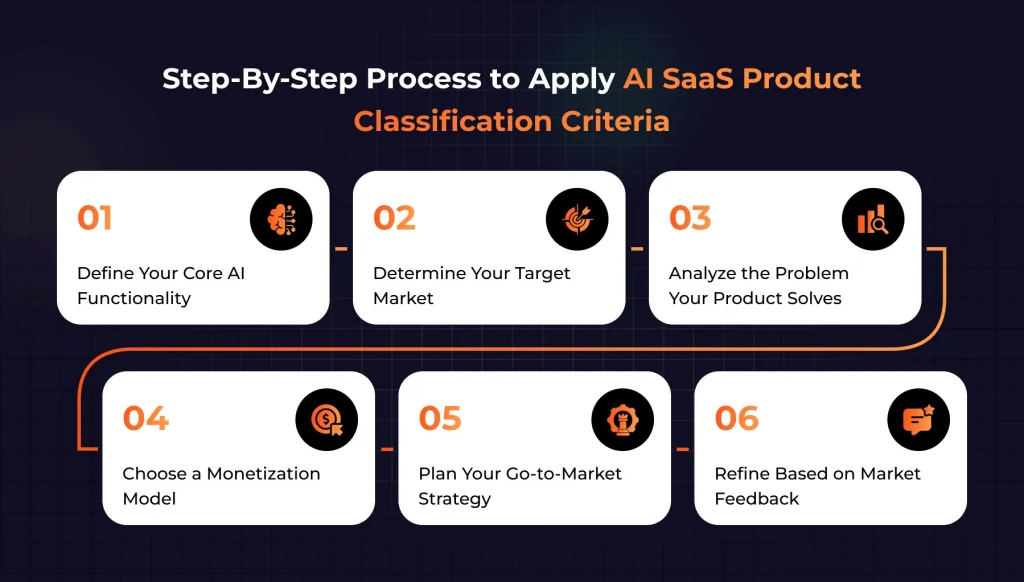
Step 1: Define Your Core AI Functionality
These are the AI capabilities that are core to the product’s value proposition and primary purpose. For example – image recognition, OCR, text summarization, document classification, etc. Once you have determined the core capabilities, identify which specific capability powers this solution – machine learning, generative AI, natural language processing, or predictive analytics. Align naming with AI SaaS product naming conventions. This will help reflect value, function, and audience expectations.
Step 2: Determine Your Target Market
Define exactly who you are building for. It could be mid-market, SMBs, or enterprise. By classifying by customer persona, it will be easier for you to ensure onboarding, align features, and match pricing according to actual price behaviors. With this step for AI saas product categorization, you can craft GTM (Go-to-market) strategies that resonate with the right audience.
Step 3: Analyze the Problem Your Product Solves
Identify the core problem solved by the tool during AI product categorization. For this purpose utilize structured customer interviews and pain-point mapping to validate the problem you aim to solve with your product. Once you have identified the problem, map it to your IA features. Here, your focus should be on how AI addresses the pain points, especially as compared to existing solutions. Next, bring in the other AI SaaS product classification criteria, such as AI autonomy, data handling, industry usage, and the solution’s fit to classify your product accurately.
Step 4: Choose a Monetization Model
Choosing a pricing model for your SaaS product is an important aspect you should consider during AI product categorization. It could be anything – subscription, enterprise licensing, or usage-based, the pricing model must reflect value delivery to the market. When pricing classification is clear, it shows that your product is scalable and it sharpens your GTM narrative.
Step 5: Plan Your Go-to-Market Strategy
To plan a go-to-market (GTM) strategy for an AI SaaS product, start by defining your ideal customer profile and the specific problem that the AI in SaaS products will address. Create a strategic narrative that clearly communicates the unique value of your AI solution. Once you have done that; select an apt distribution channel – online, direct, through partners, or others. Choose a pricing model and set clear, measurable launch goals based on the sales forecast. Ensure that all your teams are well aligned to execute the strategy. Apply AI SaaS product naming conventions across domains. Finally launch the product and continuously measure its performance against your set KPIs.
Step 6: Refine Based on Market Feedback
Take your AI SaaS product classification to a small group of users and investors and gather their feedback. Based on this feedback, refine positioning and identify gaps. This iterative loop will make sure that your classification resonates in the real world and not just on documents. By attaining early validation, you will be able to lock in the criteria easily and also see long-term growth.
Trends Shaping AI SaaS Product Classification in 2025
1. Verticalization and Niche Specialization
These are the solutions that specialize in solving particular business functions. Vertical AI agents have the capability to replace both the software and the human teams that operate within a single product.
2. The Rise of Agentic AI
Agentic AI has surpassed the presence of traditional AI in SaaS. It introduces true autonomy and strategic thinking. Instead of just relying on simple rules, this system actively helps in business strategy execution. For instance, Agentic AI identifies potential problems at an early stage before they escalate and implements preventive measures. In another example, sales enablement platforms using agentic AI can adjust lead scoring models and outreach strategies based on changing buyer behavior patterns.
3. API-First and Embedded AI
API-first is an approach where the developers design the API first; instead of treating it as an afterthought. This way they make sure that users can use all features of the AI SaaS product through an easy-to-use API. With AI embedded into SaaS applications, the product can perform tasks, make decisions, and provide personalized experiences autonomously without human intervention.
4. Focus on Security, Compliance, and Explainability
With ever-evolving cyber threats, there is an increased focus on security. Enhanced security measures such as end-to-end encryption, role-based access, and secure data storage are being increasingly used when deploying AI in SaaS. Another increasing trend in AI SaaS product classification is adherence to AI ethics, security frameworks such as SOC 2, and data privacy such as GDPR. AI SaaS products are also classified based on their ability to provide understandable, transparent processes.

A3Logics’ Role in Defining AI SaaS Product Classification Criteria
As a leading generative AI development company, we specialise in helping companies validate AI SaaS ideas that can ace the competition. If you have a vision regarding AI SaaS product, here are some reasons why you should choose us for AI SaaS product classification criteria –
1. Technology Stack Evaluation
Since the technology stack places the foundation for a product, our experts assess your concept for the product, and recommend and optimize technology stacks to maximize performance, scalability, and security.
2. Market Research and Niche Identification
We conduct in-depth market research to identify profitable niches and industry-specific opportunities. A3Logics helps you position your AI SaaS product strategically for maximum adoption and growth.
3. Monetization Strategy Consultation
Whether subscription, value-driven, or usage-based, our AI development services help you select a monetization strategy that drives sustainable revenue and maximizes ROI.
4. Go-to-Market (GTM) Strategy Development
Our aim is to position your AI SaaS product in a manner that it gains maximum adoption quickly. So, in that direction, we help you position your product correctly and ensure that your product enters the market with impact.
5. Product Development and Refinement
Once we have helped you build an AI SaaS product, we go that extra mile to refine and enhance it to exceed user expectations. For instance, we roll out continuous upgrades to keep your AI SaaS product relevant.
Conclusion
If you have a vision in mind for an AI-based SaaS product, back it with AI SaaS production classification criteria. With the right classification, you will be able to define how your product is marketed. You’ll be able to make your product reach the right target users and will be able to ensure that it goes on the right growth path. The best-classified AI SaaS products are able to soon gain a competitive advantage while also avoiding wastage of resources.