
Banking and financial services digital transformation is moving at a very fast speed. The rapid advances in digital technologies, changing customer expectations, and increasing competitive pressures are the primary factors that are changing the way banks and financial institutions operate fundamentally. Customers of today demand digital, first, always, financial services from instant account opening and real time payments to personalized advisory services available across mobile and web channels. Traditional branch, centric models and legacy systems are no longer able to support these expectations.
At the same time, fintechs, neobanks, and digital, native platforms are changing the competitive landscape by using cloud, native architectures, AI, driven insights, and API based ecosystems. Digital transformation in financial services is no longer a choice but a strategic necessity for institutions that want to remain relevant, compliant, and profitable in this environment. According to statistics almost 78% of financial institutions have accelerated digital transformation initiatives since 2020. This is a clear reflection of urgency in modernization efforts. In this blog we are going to be taking a look at banking and financial services digital transformation and how it is changing the fintech sector.
What Is Digital Transformation in Banking & Financial Services?
Digital transformation in the financial services industry refers to the end-state transformation of financial services based on digital technology, which strives to transform and modernize banking and financial institutions, their operation, and their customer services. This requires transitioning away from manual, inefficient, and isolated processes, which are often based on legacy, to smart, optimized, and customer-focused processes that have the ability to innovate and scale.
Conventional financial services were dependent on outdated core systems and manual workflows. Almost 85% of banking executives view digital transformation as essential for competitive advantage. Modern banking and financial services digital transformation solutions emphasize automation, real time analytics, and integration across platforms without any interruption to establish financially connected and responsive ecosystems.
1. Key Pillars of Banking Digital Transformation
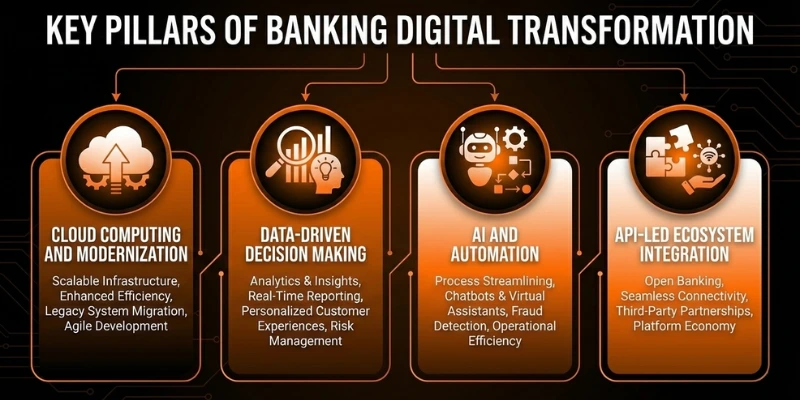
i. Cloud Computing and Modernization
Modern banking digital transformation services rely heavily on cloud based infrastructure as it brings about scalability, resilience, quicker deployments, and lower IT costs. Hence, it forms the basis of most of these services.
ii. Data, Driven Decision, Making
Advanced data analytics solutions and real time dashboards provide financial institutions with the means to detect and implement changes from the insights they gain regarding risk, customer behavior, and operational performance.
iii. AI and Automation
Artificial intelligence, robotic process automation and machine learning development services are the main tools that are used to increase productivity, reduce errors, and improve the overall of the following areas: underwriting, fraud detection, customer service, and operations.
iv. API, Led Ecosystem Integration
Application programming interfaces (APIs) facilitate open banking, embedded finance, and integration with fintech partners, thus enabling the creation of interconnected digital ecosystems.
2. Digitization vs Digitalization vs Digital Transformation
These three concepts are often confused and used as synonyms. Digitization, digitalization of financial services, and digital transformation are three different things that represent different levels of digital maturity. Digitization is about data, digitalization is about processes, and digital transformation changes the whole business model and customer experience.
| Aspect | Digitization | Financial Services Digitalization | Digital Transformation |
| Core Focus | Data conversion | Process improvement | Business reinvention |
| Definition | Converting analog information into digital formats | Enhancing existing processes using digital tools and platforms | Reimagining business models, culture, and customer engagement using digital technologies |
| Primary Objective | Improve data accessibility | Increase efficiency and speed | Drive innovation, agility, and competitive advantage |
| Scope of Change | Limited and tactical | Functional and operational | Organization-wide and strategic |
| Technology Used | Scanning, OCR, document management systems | Workflow automation, RPA, digital channels, core system enhancements | Cloud, AI/ML, advanced analytics, APIs, platform ecosystems |
| Impact on Customer Experience | Minimal | Moderate (faster services) | High (personalized, omnichannel experiences) |
| Business Model Impact | None | Low | High—new products, services, and revenue streams |
| Example in Banking | Digitizing paper-based KYC documents | Automating loan processing and online account opening | Launching digital-only banks or embedded finance platforms |
| Level of Strategic Value | Low | Medium | High |
Key Benefits of Banking & Financial Services Digital Transformation
Banking and financial services digital transformation is a powerful tool that brings tangible benefits across the organization, including cost savings and customer experience improvement.
1. Reduced Operational Costs
By using automation and optimizing workflows, digital transformation in financial services make it possible for financial institutions to:
- Remove manual processing
- Reduce errors and redo work
- Decrease infrastructure and maintenance costs
Cloud migration and AI powered automation are the main sources of operational efficiency and effective cost management.
2. Improved Customer Experience
Next generation banking digital transformation solutions are the enablers of seamless omnichannel user experiences through:
- Speedy digital onboarding and approvals
- Transactions and notifications in real time
- Products and services tailored to customer data
It results in customer satisfaction, loyalty, and lifetime value, which keep increasing.
3. Improved Innovation and Agility
With contemporary banking and financial services digital transformation, financial institutions can:
- Speed up the launch of new products.
- Test innovative financial models
- Seamlessly interact with Fintechs and Ecosystem partners
Wide agility becomes widely available as a competitive weapon in an increasingly digital financial landscape.

Key Challenges in Digital Transformation of Financial Services
While the digital transformation in financial services conveys several advantages, it is similarly burdened with unique challenges due to the regulatory complexity, legacy environment, and handling of high-risk data.
1. Digital Upskilling and Workforce Enablement
The technology transformation is to be accompanied by a people transformation. Training employees on the usage of modern platforms, data tools, and AI-driven systems will have to deal with resistance to change in organizations. A successful transformation requires the following:
- Structured upskilling and reskilling programs
- Alignment of leadership and change management
- Redesigning roles to make automation a complement, rather than a competitor.
2. Data Privacy and Cybersecurity Risks
Financial institutions deal with highly sensitive personal and transactional data, which makes cybersecurity a critical concern. Digital initiatives increase the attack surface, thus, the exposure to threats is higher. Banks must put in place:
- Robust identity and access management
- Encryption, monitoring, and threat detection
- Compliance with regional and global regulations such as GDPR, PCI DSS, and local banking laws
Security by design and zero trust architectures are fundamental in retaining customer trust and regulatory confidence.
3. Legacy System Integration
The core systems that most banks have relied on for over 30 years were not built with real time or API driven interaction in mind. These legacy systems, when integrated with modern digital solutions, pose technical challenges due to the nature of the existing environment. Some of the main issues are:
- Handling accumulated technical debt
- Guaranteeing smooth data exchange between systems
- Reducing the impact of operations that are vital for the bank
To lower the risks, it is necessary to rely on legacy modernization approaches like gradual migration, microservices, and middleware integration.
4. End User Support at the Moment of Need
The always- on nature of digital banking raises the demand for real time support both for customers and employees. Losing service or interruptions can very quickly lead to the loss of trust in the institution. Therefore, the following investments are necessary:
- Smart support systems
- Proactive monitoring, incident detection, and resolution
- Conversational AI, based chatbots and self service tools
5. Understanding End User Pain Points
Technology cannot be the only factor to bring success. Banking and financial services digital transformation should be based on understanding customer and employee journeys first. Creating the right solutions entails:
- User experience, customer experience, customer experience mapping, customer experience
- It has feedback loops that are continuous
- Iterative product changes
- A user-centric strategy will ensure that digital services become a factor of simplicity, not complexity.
6. The Steep Price of New Technology
Investments in cloud, AI, analytics, and cybersecurity could be very expensive for the institution. It is crucial for the institution to go beyond innovation and include returns on investment and sustainability.
This, in fact, demands:
- Roadmaps for Transformation
- Prioritization on the Basis of Business Impact
- Scalable, modular investments rather than monolithic programs
7. Regulatory and Compliance Requirements
Compliance with regulations is a process that is still not negotiable. On the other hand, it is also true that banks should make sure that their preparations for audit, transparency, and governance take place across the entire lifecycle of transformation.
Digital platforms have to facilitate:
- Data lineage and traceability
- Explainable AI and decision transparency
- Continuous compliance monitoring
Real World Examples of Digital Transformation in Financial Services
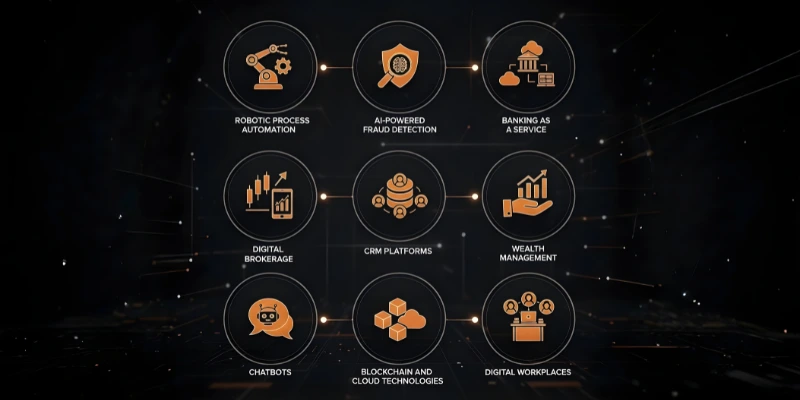
1. Robotic Process Automation (RPA)
Robotic Process Automation is one of the key elements of financial services digitalization, especially in the case of high volume, rule- based workflows. Banks are using RPA for tasks such as KYC verification, account opening, reconciliations, and regulatory reporting. What is more, reducing manual intervention by RPA substantially shortens processing cycles, operational errors are minimized, and the consistency of compliance is improved.
As a result, institutions get the ability to scale their operations efficiently, at the same time they remain audit ready and maintain governance standards.
2. AI-Powered Fraud Detection
AI-powered fraud detection is a great example of how digital transformation impacts risk prevention in financial services. Machine learning models monitor transactions in real time and thus they recognize customer behavior patterns and, at the same time, they detect any anomalies that can indicate fraud.
AI differs from traditional rule, based systems in the continuous adaptation to new threats, which leads to a reduction of false positives and prevention of financial losses at their very early stage. By doing so, the security level is elevated and at the same time, the customers are not inconvenienced.
3. Banking as a Service (BaaS)
Banking as a service signifies a profound change in the way banks digitally transform their operations, as it allows financial institutions to open up their core banking capabilities in a modular manner via secure APIs. BaaS platforms have no direct customer, facing applications and are thus ideal for embedded finance use cases, fintech partnerships, and product innovation at the speed of light.
This approach not only liberates banks to tap into the new revenue streams but also positions them as the next generation of scalable infrastructure providers in digital ecosystems.
4. Digital Brokerage and Trading Platforms
Digital brokerage and trading platforms exemplify the impact of banking and financial services digital transformation on the capital markets operations. These platforms offer the fusion of real time market data, sophisticated analytics, and user- friendly interfaces to achieve trading efficiency and investor engagement at a higher level. As a result of digital platforms, retail and institutional investors, whether local or global, get what they want, faster execution, deeper insights, and seamless portfolio monitoring.
5. CRM Platforms for Financial Advisors
Financial advisors utilizing banking CRM development services that are tailor made for them can greatly benefit from these tools as a key enabler in the relationship driven financial services arena. CRM systems, by consolidating client data across products and channels, allow for the delivery of personalized advisory services, customer outreach, and the collaboration among advisory, sales, and service teams. Employing such a data, driven model not only strengthens client relationships but also facilitates the generation of long, term value.
6. Wealth Management and RIA Platforms
Wealth management and RIA solutions are examples that highlight the importance of digital transformation in the banking and finance sector as far as the ability to implement pervasive personalization on a scalable level is considered. Digital onboarding, portfolio optimization, and AI-driven portfolio views empower the institution to handle an increased number of customers effectively and efficiently.
7. Chatbots and Virtual Financial Advisors
Chatbots and Virtual Financial Advisors remain among the central approaches used in consumer engagement. AI and natural language processing, powered by these approaches, operate round the clock on online channels, responding to common queries on accounts, payments, and loans. Apart from offering support, Virtual Advisors indeed offer financial advice and recommendations, hence raising the level of consumer satisfaction and decreasing the cost of service.
8. Blockchain and Cloud Technologies
Blockchain and cloud technologies are the core of the next generation banking and financial services digital transformation. It facilitates secure, transparent, and tamper, resistant transactions, thus trust is enhanced in payments, settlements, and trade finance. Cloud platforms offer scalability, resilience, and quicker deployment cycles, thus banks can modernize their legacy infrastructure while cutting down on operational costs.
9. Digital workplaces
Financial institutions are looking to retain talent, increase agility, and improve their service to customers. Transitioning to modern digital workplace settings is part of the solution. However, change can still be challenging if you don’t have the right tools, systems, and guidance. According to Deloitte, the skills needed by finance professionals will change significantly by 2025 due to the introduction of new technology and human workforce combinations. This means that financial services organizations have to concentrate on the basics of the skills to be able to keep up with the competitors.
A digital transformation becomes a source of empowerment for the staff when platforms and support are in harmony, rather than a cause of frustration. Easier workflows and collaboration help the units to become connected with a shared objective. That is when struggles become opportunities. Putting people first in the use of technology can, therefore, be a great help in the retention of talent.
Key Trends Shaping Banking & Financial Services Transformation
1. Mobile First Banking Experiences
In banking and financial services digital transformation app centric engagement, biometric authentication, and seamless mobile payments have become baseline expectations.
2. Payment Innovations
Real time payments, cross border transfers, and digital wallets are the major factors that speed up transactions and make them convenient in digital transformation in financial services. At the same time, consumers can also use money comparison sites like Moneyfacts Compare to evaluate payment-linked savings products and financial offerings before adoption.
3. Advanced Analytics and Big Data
Predictive insights driven digital transformation in financial services are the main drivers of smarter risk management, underwriting, and personalized engagement.
4. Embedded Financial Services
Financial products integrated into non-financial platforms are the main factors that facilitate the rapid development of ecosystem based banking models.
How A3Logics Is Instrumental in Banking and Finance
1. Financial Services Digital Transformation Services and Consulting
A3Logics offers strategic consulting services that enable banks and financial institutions to effectively plan and implement large, scale banking and financial services digital transformation initiatives. We take into consideration legacy systems, create detailed transformation roadmaps, and coordinate technology investments with business objectives, regulatory standards, and long, term scalability, thereby ensuring measurable outcomes.
2. Legacy Modernization and Cloud Migration
We change old banking systems to new ones through application re-architecture and by moving workloads to a secure cloud environment. The method that we use lightens the financial institution from technical debt, enhances system performance, and makes it possible for the institution to innovate at a much faster rate, while at the same time taking care of data security, regulatory compliance, and ensuring that business operations are not interrupted.
3. AI, ML, and Advanced Data Analytics Solutions
As a leading AI development services provider A3Logics provides AI driven analytics solutions that are instrumental in fraud detection, risk assessment, underwriting, and customer personalization. Through the use of machine learning and predictive analytics, we enable financial institutions to identify actionable insights, increase decision accuracy, and fuel data, led innovation across operations.
4. Secure Fintech and Banking Platform Development
We create secure, scalable banking and fintech app development services that allow for easy and quick digital banking experiences in payments, lending, wealth management, and embedded finance. Our fintech software development services come with security, first architectures, smooth API integration, and high-performance capabilities to support the latest digital banking experiences.
5. Regulatory, Compliant, Security, First Implementations
Security and compliance are the foundation of every solution we deliver. A3Logics facilitates strict adherence to international and regional banking regulations through excellent governance, data protection, audit readiness, and risk management practices thus, giving institutions the ability to retain the trust of their customers and the confidence of regulators.
6. End-to-End Development, Integration, and Support
A3Logics is a full cycle partner in your digital transformation journey. We are with you every step of the way from ideation and design through deployment and ongoing support. Our team ensures smooth integration with your current systems, perpetual performance enhancement, and stability of operations over the long term, thus, enabling financial institutions to scale with confidence.
Why Partner with A3Logics
- Deep expertise in banking digital transformation solutions.
- Proven success delivering enterprise-scale banking transformation services.
- Scalable, future-ready architectures.
- Business-focused, ROI-driven delivery approach.
Conclusion
Banking and financial services digital transformation is not a strategic option anymore. It has become a business imperative. Banks, which are using cloud, AI, automation, and data, driven innovation, have the ability to provide better customer experiences, improve their internal operations and also retain the trust of regulators. Through a well, thought, out strategy, a state, of, the, art technology stack and a seasoned transformation partner such as A3Logics, financial institutions will still be able to manage the intricacies and risks of the industry and establish strong, digitally, enabled banking platforms that are able to sustain and prosper in the highly digitalized financial ecosystem.