
LLMs are powerful tools that can change how businesses automate tasks and make decisions. They come with benefits like customization, data control, and long-term cost savings. However, there are significant challenges of deploying LLMs, such as high infrastructure requirements, data privacy concerns, and performance issues, which necessitate intelligent strategies and future-ready solutions, including edge AI and human-in-the-loop systems.

The growing need of LLMs is visible across various kinds of industries – healthcare, retail, finance, and more. Their strength lies in understanding and generating human-like language to automate decision-making.
However, deploying them is challenging because they need a complex infrastructure. Additionally, they pose challenges as there are data privacy concerns, and the need for constant updates to keep models accurate and business-relevant.
Market Trend of LLMs
- LLMs are projected to grow from $6.4 billion in 2024 to $36.1 billion in 2030.
- As per Gartner’s statistical report, 85% of organizations attempting to develop and deploy custom LLM solutions face challenges.
- 67% organizations use generative AI powered by LLMs for content creation.
- 88% users have reported having improved their work with LLMs.
- In 2025, it’s estimated that there will be 750 million apps using LLMs.
What Does Deploying an LLM Involve?
Deploying LLM means making it ready for real-world use. The process includes integrating the model into a system so that it can handle inputs. Once the inputs are processed, it produces outputs. Next, a deployment method is chosen – such as cloud-based deployment or self-hosted deployment. Other key aspects include handling data and addressing security and privacy concerns.
Common Deployment Environments: Cloud, Edge and Hybrid Solutions.
Cloud Deployment
Refers to hosting and running LLMs on remote servers provided by cloud computing platforms. These enable users to access and utilize language models over the internet without the need to manage infrastructure. Cloud providers handle computing resources, manage the LLM, and provide storage.
Edge
It refers to the deployment of LLMs on edge devices such as smartphones, IoT sensors, robots, and specialized hardware located close to the data source instead of a centralized cloud server. Edge AI enables lower latency, faster decision making, enhanced privacy, and reduced dependency on internet connectivity.
Hybrid solutions
These involve a combination of on-premise infrastructure and cloud-based resources to optimize cost, performance, and security. This approach allows organizations to leverage the scalability and flexibility of the cloud while maintaining control over sensitive data and critical models on-premise.
Why Build Your Own LLMs

Deploying LLMs undoubtedly comes with its own set of challenges. But before we dive into those, let’s first understand why building your own LLM might be worth considering in the first place.
Customization to Business Needs
You can train the LLMs on your own data, ensuring that it aligns perfectly with your industry-specific terminology, business requirements, and use cases. Custom LLMs offer complete control over the model’s architecture, training process, and updates, allowing for adaptation to changing needs and continuous improvement.
Data Control and Ownership
By building your LLMs, the data stays with you. None of it is sent to outside companies. You have complete control over what the model learns, how it’s trained, and where it is stored. All this makes it easy for you to follow data rules easily, keeps your information safer, and gives you complete ownership of the data and the subsequent model built from it.
Cost Efficiency
As opposed to an external API, which can become costly at scale, building your LLM in the long run can be a cost-effective solution. Although the initial setup may require an investment, a custom LLM can gradually reduce ongoing API expenses, enhance data privacy, and provide complete control over performance and updates.
Competitive Edge
By building your LLM, you can develop unique features and capabilities that differentiate you from those using off-the-shelf, generic models. Your LLM evolves in tandem with your data, decisions, and insights. A custom-based LLM removes the dependency on a vendor; you don’t have to wait for a vendor update, as you can tweak your model yourself to adapt to market shifts, making it non-replicable.
Adaptability
For an LLM to truly understand your business, it must be trained on data from your specific field. Without that, it may sound correct, but it misses the real meaning. But training once isn’t enough. Things change—your customers, products, and industry. If the model isn’t updated, it falls behind. Regular updates help it stay useful, accurate, and ready to meet your changing business needs.
Key Challenges of Deploying LLMs in Production
Let’s have a look at some of the key challenges of deploying LLMs in production –
Infrastructure and Cost Constraints
Configuring the infrastructure is one of the key challenges of deploying LLMs, particularly when managing multiple models simultaneously. LLMs are computationally intensive and require a substantial amount of processing power and memory. Failure to comply with these requirements can lead to issues such as high latency, slow performance, and even system crashes. This brings us to yet another challenge in deploying LLMs: the high operational cost associated with the computational demands of LLMs.
Inference Latency and Performance Optimization
Advanced agentic frameworks involving multiple agents require several back-and-forth iterations. While each iteration helps improve the output, it also introduces additional latency. This is where there is a need for a platform that is optimized for rapid data processing and low-latency responses, ensuring LLMs deliver the required performance in various environments.
Model Size and Complexity
The key challenge with LLM model size is the trade-off between model complexity and computational resources. Although larger models with more parameters can capture more language patterns and achieve better performance, they also require significant computational power, making it challenging to deploy these models, especially in resource-constrained environments.
Data Privacy and Regulatory Compliance
Massive language models are developed to handle vast data volumes from diverse sources, which may further contain sensitive customer information. Leakage of sensitive information can jeopardize privacy. This can risk consumer trust and violate data privacy laws. Regulatory compliance is yet another challenge associated with deploying LLMS. To ensure compliance with laws like HIPAA, CCPA, GDPR, and others, LLMOps processes must be aligned with these frameworks. This includes keeping detailed audit logs of data access and model outputs.
Bias, Toxicity and Hallucinations
LLMs are trained using different types of datasets sourced from the internet. This data can be raw and unfiltered, which means that LLMs trained on this dataset can adopt toxic behavior similar to what is prevalent online. Hallucination, on the other hand, may arise when models begin to focus on unimportant patterns. This can again lead to the generation of toxic content.
Integration with Legacy Ecosystems
Integration with legacy ecosystems can be one of the key challenges when deploying LLMs because of differences in data formats, architecture, and computational requirements. Considering that legacy systems are often rule-based and rigid, while LLMs are flexible and data-driven, bridging this gap may require significant effort.
Model Monitoring, Governance and Maintenance
Each of the aspects poses a distinct challenge during LLM implementation. Monitoring can be challenging since LLMs can hallucinate, drift, or exhibit unexpected behavior in new contexts. Whereas governance requires strict adherence to data privacy, accountability, and the ethical use of data. Last but not least, maintenance is demanding as models require regular tuning, updates, and alignment with changing results and user needs.
User Trust and Explainability Issues
When users can’t clearly see how and why an LLM gives a response, especially in sensitive domains like law, healthcare, and finance, they hesitate to trust the output. Additionally, there are instances when LLMs arrive at a conclusion without providing a logical explanation for their decision. Therefore, developing explainable systems that show reasoning, while essential, is technically difficult.
Strategies to Overcome Deployment Challenges
Adopt Smaller, Domain-Specific LLMs
To overcome challenges in implementing LLM, it is recommended to use smaller models trained on domain-specific data. This reduces infrastructure demands and increases accuracy. In contrast to general-purpose LLMs, domain-specific LLMs produce more relevant outputs tailored to specific industries, such as law, healthcare, and finance, while avoiding the complexity and cost associated with them.
Model Distillation and Quantization Techniques
Both quantization and model distillation techniques are valuable in optimizing and deploying machine learning models in scenarios where there are resource constraints, such as limited computational power. Both these techniques enable efficient model deployment on embedded systems, edge devices, or in situations where low-latency inference is essential.
Hybrid Human-in-the-Loop Systems
These systems involve integrating human feedback and expertise into the LLM’s lifecycle to enhance performance, reliability, and accuracy. Here, humans actively participate in the training, evaluation, or operation of models, providing feedback, valuable guidance, and annotations. In simple terms, LLMs handle routine tasks while humans review or correct critical outputs. The balance helps improve trust and reduce errors.
Efficient Monitoring and Continuous Model Updates
Once deployed, LLMS must be monitored to mitigate deployment challenges, such as bias, performance issues, and drift. This can be achieved through regular updates (with fresh data) to ensure that the model remains accurate and relevant. To help in this process, there are monitoring tools that can help flag issues early and track usage in real-time. Additionally, regular updates also allow the model to adapt to industry needs and changing user behavior.
Optimized Infrastructure for Scalable Deployment
To overcome the various challenges of deploying LLMs, it is essential to have a robust and optimized infrastructure. This involves leveraging powerful hardware accelerators, such as TPUs or GPUs, along with optimized model serving techniques and efficient storage. Additionally, techniques such as model distillation, compression, and efficient inference strategies can handle increased user demands and loads without compromising performance.
Advanced Prompt Engineering and Fine-Tuning
These are the two key techniques for optimizing and overcoming LLM implementation challenges. Where prompt engineering focuses on crafting effective input prompts to guide the LLM’s response, fine-tuning involves further training the LLMs on a specific dataset to improve their performance on a particular task.
Data Augmentation and Synthetic Data Generation
Data augmentation refers to the process of adding extra examples to your training data by modifying or rephrasing existing data. This helps the LLM learn more effectively and perform better in various situations. Synthetic data refers to the creation of fake but realistic examples, which is useful when real data is limited or confidential. Both make LLM deployment easier and more reliable.
Utilization of LLMs (Use Cases of LLM)
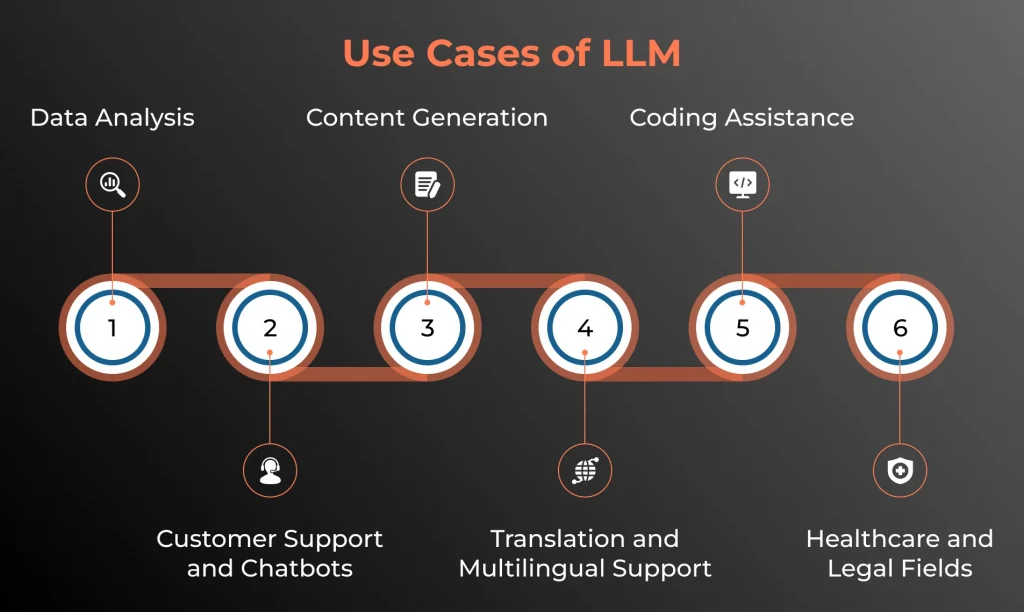
Customer Support and Chatbots
LLMs help provide automated yet deeply personalized responses to customer inquiries. Chatbots powered by LLM, for instance, provide instant, human-like responses to customer inquiries, reducing support costs and improving customer satisfaction. Additionally, LLMs can also analyze customer feedback and social media sentiments to understand customer needs and improve services.
Content Generation
LLMs can generate various forms of content, including emails, blog posts, social media descriptions, marketing copy, and more, thereby accelerating and automating the content creation process. With the implementation of large language models, LLMs can tailor marketing messages to specific customer segments.
Coding Assistance
LLMs can assist developers in generating code snippets, suggesting code improvements, and identifying any bugs, thereby expediting the software development lifecycle. Not just that, LLMs can also translate code between different programming languages.
Data Analysis
By combining LLMs with data analytics, you can easily analyze large volumes of data, uncover hidden patterns, and gain valuable insights that boost business intelligence. LLMs help make sense of complex information by extracting key details and improving the overall understanding of data. This integration makes the analytics process smoother, faster, and more effective, leading to smarter decisions.
Translation and Multilingual Support
LLMs facilitate smooth language translation between different languages by contextually understanding the meaning behind words. They are trained on massive multilingual datasets that help them learn patterns, grammar, and context across various languages.
Healthcare and Legal Fields
There are several ways in which LLMs can be used in the healthcare and legal fields. LLMs can assist in diagnosing diseases by analyzing medical records and research. The models can help tailor treatment plans as per individual patient data. Furthermore, LLMs can automate tasks like document processing and appointment scheduling, thereby freeing up healthcare professionals for patient care.
Future Outlook for LLM Deployment
Edge AI and Lightweight LLMs
Edge AI and lightweight LLMs can address significant challenges in large language model development. Let’s first talk about lightweight LLMs. These are smaller versions of large language models designed to use less computing power and memory. These models enable the deployment of LLMs on edge devices, providing faster responses, improved privacy, and offline capabilities. This brings us to the concept of Edge devices; edge AI refers to running AI on local devices, such as sensors, phones, or machines, rather than relying on cloud servers.
Energy-Efficient AI Hardware and Accelerators
As LLMs grow in usage and size, traditional hardware becomes costly and power-hungry. That’s the reason for scaling AI in everyday businesses and devices; energy-efficient accelerators and AI hardware are used. These are specialized chips designed to run LLMs faster while consuming less power. New technologies like NPUs, TPUs, and custom AI chips help reduce energy, make LLM deployment more sustainable, and improve speed.
Decentralized and Federated Learning
Decentralized and federated learning offer a future where LLMs can be trained across many devices without moving data to a central server. In federated learning, each device trains the model locally on its own data, and only the updates (not the data itself) are shared. This approach improves privacy, reduces bandwidth costs, and allows LLMs to learn from diverse sources—making deployment more secure, scalable, and user-friendly.
Regulatory Evolution for AI and LLMs
AI and LLM regulations are expected to evolve towards a more risk-based approach. There will be a greater emphasis on accountability, transparency, and ethical considerations. We can expect to see increased scrutiny of high-risk AI applications, particularly in areas like finance, healthcare, and critical infrastructure. In the future, we can expect to have regulatory sandboxes where policymakers and companies can test and refine AI regulations in a controlled environment.
Integration of LLMs with Other AI Technologies
The future of LLMs lies in integration with other AI technologies. For instance, when combined with computer vision, they can understand images and text. With federated learning, they learn from many places without sharing private data. They make chatbots smarter, aid learning, provide better suggestions, and even create content quickly — all leading to faster decisions, improved privacy, and easier user experiences across various industries.

Why Choose A3Logics as Your LLM Deployment Partner?
Want to develop LLMs from scratch? Want to successfully tackle the challenges of deploying LLMs? You can count on A3Logics as your large language model development company. We customize models to match your business needs and ensure they work efficiently. Here’s why choosing us for LLM implementation is a smart move –
AI and NLP Expertise
We have deep expertise in NLP consulting and application development. Craft applications to solve specific business challenges. We unveil the power of text and sentiment analysis to gain insights into market trends, customer opinions, and more.
Custom LLM Solutions
As a leading generative AI development company, we have considerable expertise across diverse LLM models. With our LLM development services, you can uncover hidden patterns in your business data and make insight-driven decisions.
Data Security and Compliance
For us, your data security is supreme. Therefore adhere to stringent data security and privacy protocols, including HIPAA, GDPR, and other applicable standards. We anonymize data where necessary and practice security measures.
Scalable and Cost-Effective Solutions
We implement scalable private LLMs to improve AI capabilities. Our models learn from your data, adapt to new inputs, and automate tasks. As a seasoned LLM model development company, we reduce costs by optimizing model efficiency and performance.
Conclusion
As LLMs continue to grow in importance for businesses of all types, understanding how to use them effectively becomes crucial. In this blog, we explored the core challenges of deploying LLMs, the clear benefits of building custom models, real-world use cases, and future trends shaping their evolution. We also shared practical strategies to help businesses overcome common hurdles and unlock the full potential of LLMs.