Human-driven vehicles are becoming a thing of the past. We now have autonomous vehicles that can navigate on roads and deal with traffic with minimal human intervention using advanced technologies like cameras, sensors and AI. They intelligently sense their environment and make real-time decisions, thereby ensuring safe navigation. At the heart of this capability lies computer vision in autonomous vehicles that helps these vehicles respond just like a proficient human driver.
In this post – we’ll explore why computer vision for autonomous vehicles is a necessity. We’ll look into how it works, the various use cases, and other aspects. Let’s begin by understanding the basics.
What is Computer Vision in Autonomous Vehicles and How Does It Work?
Computer vision enables autonomous vehicles to see their surroundings, allowing drivers to navigate easily and safely.
Autonomous vehicles are equipped with multiple cameras that are placed in the front, rear, and sides. These provide a 360-degree visual of the complete surroundings. The embedded deep learning algorithms determine the various kinds of objects and their location.
The technology combines visual data with other sensor inputs to create a 3D map, enabling drivers to determine the position of objects on the map accurately.
Now that we have a basic understanding of how computer vision in self-driving cars work, let’s go through the step-by-step flow of computer vision in the automotive industry.
Step-by-Step Flow of Computer Vision in Autonomous Vehicles
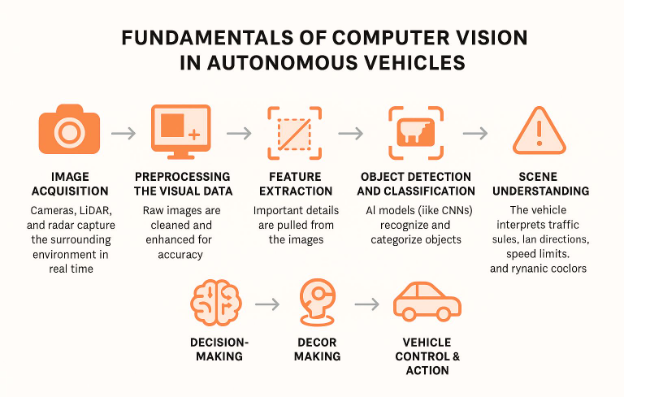
Step- 1: Image Acquisition
This step in computer vision in autonomous vehicles involves capturing images from the vehicle’s cameras; We’ll discuss in a later section how images of the car and the surrounding environment can be captured using various mediums.
Step- 2: Preprocessing the Visual Data
Not all captured images or videos are of a quality that can be analyzed. Hence, they are sometimes manipulated; their quality is improved so that information can be easily extracted. The visual data is cleaned so that it can be ready for subsequent analysis.
Step- 3: Feature Extraction
This step involves describing the key elements within an image; involving features such as corners, edges, and even abstract patterns. The features further highlight important details such as pedestrians, lane markings, and other vehicles. The detected features are transformed into a format that can later be analyzed.
Step- 4: Object Detection and Classification
This allows autonomous vehicles to identify and categorise items in their surroundings, such as vehicles, animals, pedestrians, and others. Computer vision in autonomous vehicles utilizes advanced algorithms to process visual data based on aspects such as size, position, and movement.
Step- 5: Sensor Fusion
Computer vision in the automotive industry leverages sensor fusion algorithms. These combine data from multiple sensors; helping in a more accurate understanding of the environment where vehicles can gain a sense of what objects are around them.
Step- 6: Scene Understanding
Scene understanding enables computer vision in autonomous vehicles to identify not just objects, but also their context, establishing a deep understanding of their relationships.
Step- 7: Decision-Making
The AI integrated into the vehicle uses the data from cameras and sensors to analyze the environment. It detects obstacles and makes real-time decisions to ensure safe navigation. For example; if it perceives the the road ahead has minimal traffic, it’ll prompt the driver or accelerate. On the similar lines – it can suggest actions such as braking or steering to navigate the route safely.
Step- 8: Vehicle Control & Action
In this stage, all processed data obtained from sensors, along with decisions, are converted into actual driving maneuvers; The system generates exact commands for acceleration, steering, and braking. The same commands are sent to vehicle actuators to ensure obstacle avoidance and safe navigation.
Role of AI and Deep Learning in Computer Vision for Self-Driving Cars
The ability to process images and videos in real-time is one of the most defining computer vision trends, especially, when it comes to driving advancements in autonomous vehicles.
Let’s take a closer look at how two major technologies – AI and deep learning are transforming computer vision in self-driving cars or other vehicles –
1. AI – The Enabling Brain for Autonomous Cars
The automotive AI powers critical functions of self-driving cars, such as path planning, environmental perception, decision making, risk assessment, etc. Let’s have a look at how AI is leveraged in self-driving cars –
- Computer vision – helps vehicles identify objects.
- Sensor fusion – various sensors provide data and help vehicles in making perception when navigating. Based on the perception, vehicles can make decisions.
- Predictive analytics – analyzes vast driving datasets and help vehicles predict object/ people behavior and make decisions.
- Path planning – AI gives destination inputs and provides real-time road understanding.
- Situation analysis – monitors situations, identifies anomaly probability, and helps vehicles maneuver.
2. Deep Learning – Powers Core Perception Tasks in Autonomous Vehicles
It goes without saying that deep learning is a branch of AI. That said, it is important to know how it powers computer vision in the automotive industry. That’s because, unlike broader AI techniques, it directly enables pattern recognition and visual perception, two factors that autonomous vehicles depend on –
- Convolutional Neural Networks (CNNs) – are used for identifying objects, road signs and lane markings with accuracy.
- Semantic segmentation – classifies each pixel in an image to better understand a scene.
- Recurrent Neural Networks (RNNs) – maintain a memory of previous inputs and can forecast future values based on historical data.
- Generative Adversarial Networks (GANs) – generate new data samples resembling the given dataset.
- Deep learning models can process large volumes of sensor data coming from LiDAR, RADAR, and cameras in real-time, helping in accurate decision-making.
Testing results on real-world driving data show that vision-based lane-changing behavior detection using deep learning results in 87% lane-changing detection accuracy.
Use Cases of Computer Vision in Autonomous Vehicles
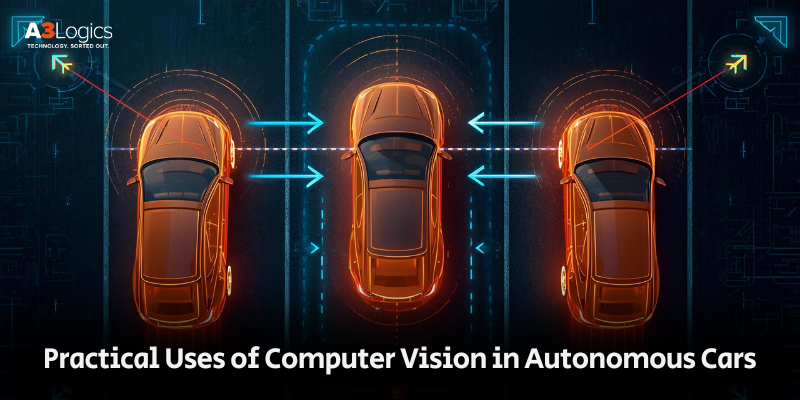
1. Lane Detection and Traffic Sign Recognition
Computer vision in self-driving cars uses techniques such as convolutional neural networks (CNNs) and Hough Transform to identify lane marking regardless of how tricky it is, i.e., even in the case of poor lighting or rain. The system classifies markings as dashed, solid, or nonexistent, adjusting the path accordingly. To know more, you can refer to our post that highlights the role of computer vision in traffic management.
2. Pedestrian and Object Detection in Real Time
Autonomous vehicles combine sensor data and deep learning algorithms to analyze their surrounding environment. Computer vision in autonomous vehicles doesn’t just pick up static objects; it also estimates how pedestrians are moving, more specifically, it captures their motion.
3. Collision Avoidance and Safety Systems
These intelligent systems are designed to alert and assist drivers to avoid collisions, thereby reducing the chances of accidents. Apart from computer vision, these systems use a variety of technologies such as lasers, GPS, lasers, and radars. While some systems warn or alert drivers, others override them to mitigate risks of collision or avoid it altogether.
4. Driver Monitoring Systems and Fatigue Detection
As the name suggests, the systems use cameras and algorithms to analyze a driver’s behavior in real-time. It can detect signs of distraction, drowsiness, or impairment, and it accordingly issues warning signs or triggers safety interventions.
5. Navigation and Localization in Smart Cities
Computer vision in self-driving vehicles lets autonomous vehicles see and interpret their surroundings through cameras and sensors. Using this capability, vehicles can navigate smart cities safely by identifying traffic signals, lane markings, and other vehicles. In fact, a 3D map of the environment is created so that the driver can position the vehicle accurately.
6. Road Condition Analysis for Predictive Maintenance
The need for computer vision for autonomous vehicles arises from the possibility of road defects that could harm the vehicle. Such defects include cracks, potholes, uneven surfaces, etc; Using deep learning models that excel at image recognition, computer vision detects such defects early; prevents any costly repairs or accidents.
7. Intelligent Traffic Flow and Parking Assistance
We have already discussed the role of computer vision in traffic management. Using advanced algorithms, authorities can monitor and analyze traffic patterns, dynamically adjust signal timings, and detect bottlenecks; This way it can help in managing road traffic. Apart from helping with the traffic flow; computer vision in autonomous vehicles helps in parking assistance by detecting parking spaces, obstacles, and other vehicles.
Common Computer Vision Sensors in Autonomous Vehicles
1. Cameras
These capture detailed visual information, including traffic signs, lane markings, and classify objects such as pedestrians and other vehicles. Cameras are further of various kinds. For instance, RGB cameras capture color information from the visible spectrum. The Thermal cameras detect objects based on their heat signatures. For example, thermal cameras are used to capture animals and pedestrians. Then, there are near-infrared and short-wave infrared cameras that provide vision in challenging conditions.
2. LiDAR (Light Detection and Ranging)
LiDAR in computer vision in the automotive industry creates a detailed 3D map of the vehicle’s surroundings. These sensors continuously rotate and generate thousands of laser pulses per second; The high-speed laser beams are continuously emitted in 360 degrees and reflected by the objects that come in their way. With the use of complex and advanced machine learning algorithms, the data received is converted into 3D graphics. These are further displayed as 3D maps of the surrounding objects.
3. Radar
Radar is a system in computer vision in self-driving cars and other vehicles that uses radio waves to determine and map the location, direction, and speed of both fixed and moving objects, such as aircraft, cars, and many other objects. It measures how far the objects are, and how fast they are moving, even in complex conditions such as darkness, rain, fog, etc.
4. Ultrasonic Sensors
Ultrasonic sensors help in parking assistance, low-speed maneuvering, and detecting obstacles such as pillars and pedestrians; Instead of using visual data, they use high-frequency sound waves to detect objects.
5. Infrared Sensors
In computer vision for autonomous vehicles, infrared sensors detect objects by sensing their heat radiation. It captures images that may be invisible to the human eye. These sensors work in conditions such as fog, darkness, and mist, where sensors such as radar may be less effective. These sensors are also fused with visible light cameras and radar, and hence offer a more complete and robust perception of a vehicle’s surroundings.
Benefits of Computer Vision in Autonomous Vehicles
1. Enhancing Road Safety with AI-Powered Decision Making
Computer vision for autonomous vehicles offers AI-powered decision-making that detects and recognize potential dangers; act upon them before they occur. AI-driven features such as lane departure warning systems and automatic emergency braking reduce the chances of accidents caused by human error.
2. Reducing Traffic Congestion through Smart Navigation
Computer vision enables the vehicles to see traffic patterns. It accordingly helps make smart route choices so that drivers can drive their vehicles smoothly. Furthermore, in a traffic situation, computer vision helps keep safe but optimal distances. This, in turn, avoids sudden braking that’s often the cause of creating traffic jams.
3. Lowering Human Error in Driving with Automation
Computer vision provides constant, high-accuracy perception of the environment. Because of this ability; it identifies potential hazards such as pedestrians and other vehicles. It even recognizes traffic signs and maintains safe lane positions. It integrates data from multiple sensors, enabling autonomous vehicles to have superior situational awareness.
4. Cost Savings for Logistics and Ride-Hailing Industries
In either the logistics or ride-hailing industries, computer vision can help in cost savings. It can save a significant amount in key areas where losses are high. With the help of smart navigation; computer vision can help autonomous vehicles save fuel and even prevent accidents. By detecting obstacles proactively and preventing hazards, it can help industries save a lot of money on vehicle repair costs.
5. Improved Accessibility for Elderly and Disabled Drivers
For elderly or disabled drivers who may require assistance when driving, computer vision in self-driving cars offers a pathway to independent transportation. It helps prevent accidents by ensuring the vehicle can accurately perceive and react to its surroundings, reducing the risk of mishaps for elderly or disabled drivers.
Real-world Examples of Computer Vision Solutions in Self-Driving Cars
1. Tesla Autopilot & Full Self-Driving (FSD)

It is known for its vision-based system; Its Autopilot and Full Self-Driving capabilities rely on AI-powered computer vision. With the help of these technologies, its vehicles detect lane markings, perceive surroundings, and identify other vehicles.
2. Mercedes-Benz Drive Pilot

It is an automated driving system that allows drivers to take their eyes and hands off the road in specific situations. The system controls tasks such as steering, braking, and acceleration while providing infotainment options such as watching videos or playing games.
3. Volvo Pilot Assist & City Safety

Volvo’s Pilot Assist is a proactive system that assists the driver with steering and speed control to keep the car within the lane and set a distance from the vehicle in front. Its City Safety feature is an autonomous braking and steering system that prevents collisions with objects such as cyclists, pedestrians, large animals, etc.
4. Waymo’s Self-Driving Cars

Google’s self-driving subsidiary, Waymo, uses computer vision with other sensors in its autonomous vehicles to power fully autonomous ride-hailing services in cities like San Francisco and Phoenix. According to studies, its services have significantly lower crash rates.
Challenges of Computer Vision in Autonomous Vehicles
1. Sensor and Camera Limitations in Adverse Weather
Adverse weather conditions can create challenges for both the cameras and LiDAR. Weather conditions such as haze, snow, smoke, dense rain, fog, and snow can make it hard for the cameras to distinguish objects from their surroundings. The same weather conditions scatter or absorb the laser pulses of LiDAR, leading to reduced detection range and inaccurate range measurements.
2. Data Privacy and Cybersecurity Concerns
Computer vision in the automotive industry requires stringent data privacy and
Cybersecurity measures are necessary since computer vision in automotive vehicles captures a lot of sensitive data. For instance, it records faces, license plates, location details, etc. It doesn’t just put the data of the drivers or passengers of the vehicles at stake, but also the bystanders who are knowingly or unknowingly captured, and who may not have consented to be captured.
3. Regulatory and Ethical Challenges in Autonomous Driving
There are still many regions that lack specific laws to govern the widespread deployment and testing of autonomous vehicles. Since AVs collect a vast amount of data, this raises concerns about user data privacy and collection. Another unresolved issue is establishing who is responsible for an autonomous vehicle’s action can be a challenge.
4. High Costs of Implementation and Scalability Issues
Computer vision in the automotive industry can be a costly affair since it requires massive labeled data, advanced hardware, and specialized expertise. Apart from high implementation cost, another challenge that may surface is the scalability. That’s because computer vision demands real-time processing for which high computational power is required. Apart from that, the systems must adapt to varied weather, surroundings, and rare edge cases.
5. Complex Urban Environments and Edge Case Scenarios
Complex urban environments and edge case scenarios remain major challenges in computer vision in the autonomous industry. In complex urban environments, computer vision may be overloaded or unable to perceive unpredictable vehicle movements or dynamic traffic patterns. Despite advances in edge AI for autonomous vehicles – balancing computational power, energy efficiency, and low latency with real-time safety decisions and limited hardware remains a challenge.
Future of Computer Vision in Autonomous Vehicles
The advanced driver assistance systems; ADAS market; is expected to reach $48.37 billion in 2028. Here’s what you can expect from computer vision in the automotive industry in the future –
1. Integration with 5G and Edge Computing
The future of autonomous driving will rely on low-latency and ultra-fast communication enabled by edge computing and 5G technology; The computer vision systems embedded in vehicles will be able to process large amount of data in real-time with edge servers, reducing the need for cloud-only reliance. This will ensure quicker decision-making and better obstacle detection.
2. Role of Digital Twins and Simulation in AV Testing
Before going on the road, autonomous vehicle systems will be tested using digital twins. This will allow companies to train and validate computer vision models across millions of simulated scenarios; including complex traffic patterns, rare weather conditions, and other complex scenarios, without physical risks or costs.
3. Collaboration Between Automakers and AI Startups
In the near future, we can expect collaboration between automakers and AI startups. Where automakers will bring infrastructure and regulatory expertise, AI startups will infuse cutting-edge AI and deep learning algorithms. Together building robust, intelligent, and safe autonomous vehicle systems that accelerate the path toward fully self-driving cars.
4. The Path Toward Fully Autonomous Driving (Level 5)
Most autonomous vehicles today operate at level 2-4. This is a level where some amount of human intervention is needed. However, the future of computer vision in automotive vehicles lies in level 5. At this level; vehicles will be able to drive autonomously without any human intervention. They will be able to handle all situations on the roads, regardless of how complex they are. We can also expect advances in multi-model perception – combining cameras, radar, and LiDAR.
Why is A3Logics Your Ideal Partner for Autonomous Vehicle Vision Systems?
Do you want to build autonomous vehicle vision systems and are looking for a reliable AI development company? You can partner with A3Logics – Our computer vision development services include developing AI-driven computer vision systems that mimic human perception in detecting objects and identifying anomalies. We also provide ML development services, where we utilize advanced algorithms, AI-driven models, and data analytics.
Conclusion
Strides in computer vision in self-driving cars and other vehicles are setting the stage for smarter navigation, safer roads, and the eventual realization of fully autonomous transportation. Needless to say, as a rapidly evolving technology, this gives a great opportunity to businesses and innovators to create solutions that are going to change the way vehicles interact with their environment and communicate with each other.