Cost to Make a Food Delivery App: Even in the most devastating circumstances where many of the businesses were taking a hit, there was one business that was thriving – food delivery. The culture of ordering food to be delivered on demand has become a necessary aspect of everyday living. The internet meal delivery business is still doing well because more people want it and the market is always changing.
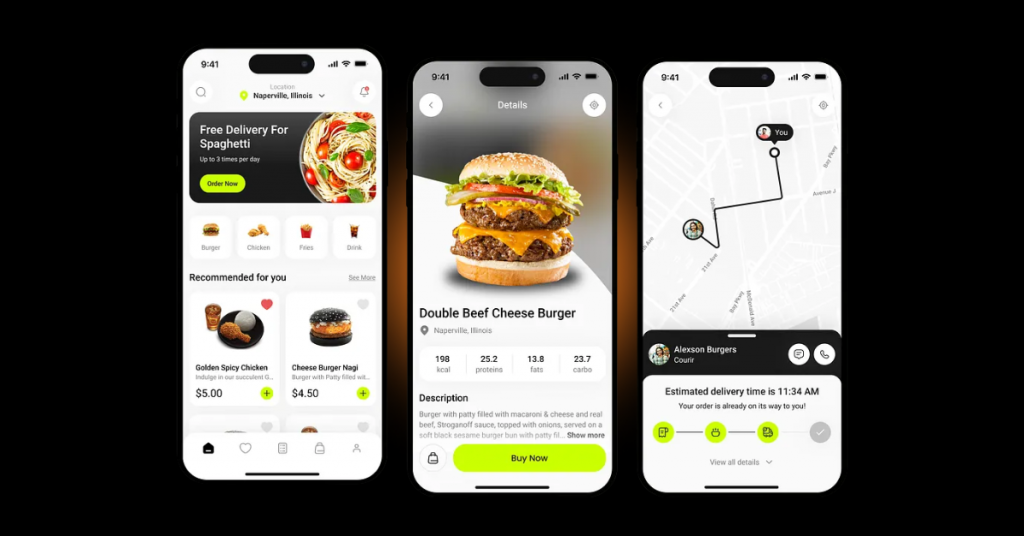
The food delivery industry has experienced exponential growth in recent years, driven by changing consumer behaviors and technological advancements. Platforms like Uber Eats, DoorDash, and Grubhub have revolutionized the way people access meals, offering convenience and a vast array of dining options at their fingertips .A research by Gloria Food found that almost everyone in the US gets food delivery. The study found that a large 86% of Americans had ordered food delivery at least once a month. In the same study it was found that almost 26% of Americans order takeout or delivery at least once a week.
It’s hardly unexpected that more businesses are now interested in offering comparable on-demand meal delivery services, given how popular platforms like Uber Eats and DoorDash have become.
For entrepreneurs and businesses looking to tap into this lucrative market, understanding the cost to make a food delivery app is crucial. In this comprehensive guide we have taken a deep dive into the factors influencing cost to make a food delivery app, provided cost estimates for building apps similar to major platforms, and offered strategies to optimize expenses.
What is a Food Delivery App?
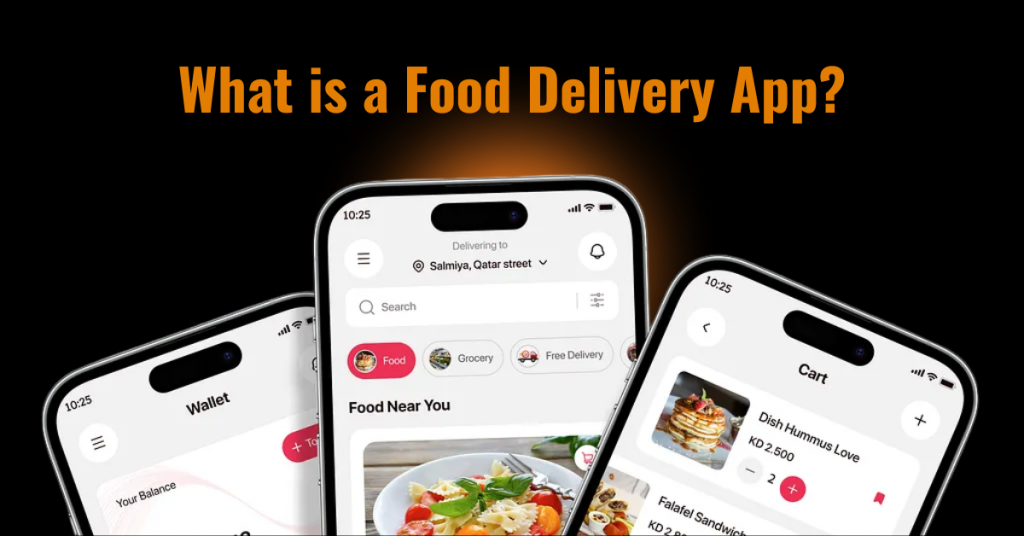
One of the most secure of the businesses ventures is food delivery. And a way that simplified this food delivery is an app. Why do you ask? Because with the help of a food delivery app it is easy to bring all the data and tasks under one simple dashboard. Let’s understand what a food delivery app exactly is – A meal delivery app links users to restaurants or food providers, making it easy to browse menus, place orders, and make payments all from a mobile device. These apps make things easier for both businesses and customers by letting them track and fulfill orders in real time.
There are three main types of food delivery apps: aggregator apps, which connect clients with many restaurants; dedicated restaurant apps, which focus on user ratings and services for a particular brand; and logistic support applications, which help companies with delivery.
Some important aspects of the meal delivery app are user registration, fast menu browsing, quick order placement, and safe payment integration. Real-time purchase tracking, push alerts, and customer feedback are just a few of the features that make the experience smooth for users and keep them interested. These applications typically consist of multiple interfaces:
- Customer App: Allows users to browse menus, place orders, make payments, and track deliveries.
- Restaurant App: Enables restaurant staff to receive and manage orders, update menu items, and monitor delivery status.
- Delivery Partner App: Provides delivery personnel with order details, navigation assistance, and payment tracking.
- Admin Panel: Offers administrators tools to manage users, restaurants, payments, and analytics.
Types of Food Delivery Apps
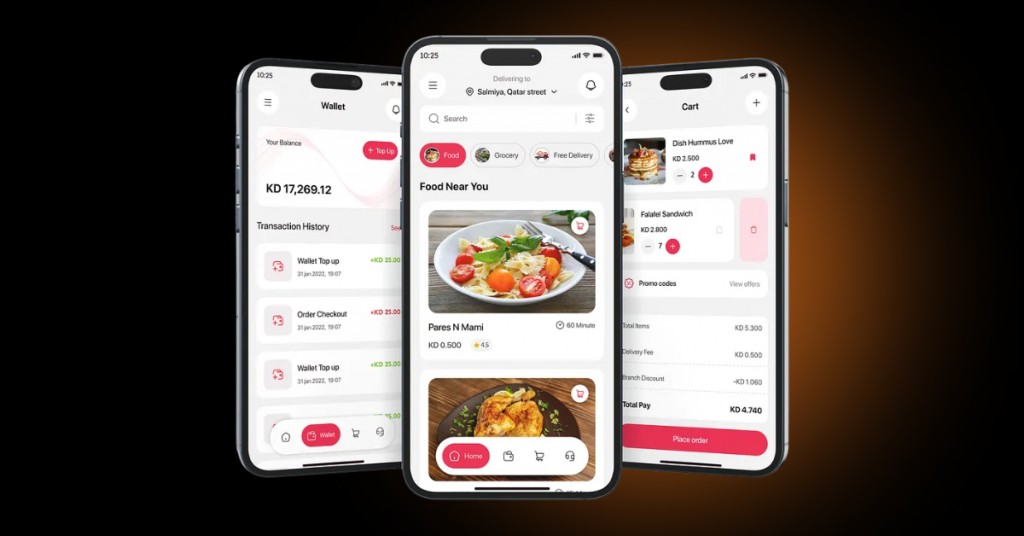
There are three main types of food delivery apps: aggregator applications, dedicated restaurant apps, and logistic support apps. Each one is made to meet the demands of a certain group of users or businesses.
These groups have different uses, such as connecting several restaurants or providing solutions that are exclusive to a brand or delivery. This makes the mobile app market more flexible and the cost to build a food delivery app can vary based on this.
1. Aggregator Apps
Aggregator apps are places where people can find and order food from many different restaurants. They are like a central hub for browsing menus and placing orders. These apps let people look at different places to eat and let restaurants handle the practicalities of delivery.
Some examples of meal delivery apps that collect orders are:
Uber Eats: This is a popular app that lets users see menus from hundreds of restaurants. It has an easy-to-use interface and lets customers track their orders in real time.
Grubhub: Grubhub is popular with U.S. customers since it makes ordering and paying easy.
2. Dedicated Restaurant Apps
Dedicated restaurant applications are built just for one brand, giving businesses complete control over how their app looks and works, how it interacts with customers, and how it looks and works. These apps make things like placing orders, integrating payments, and sending push notifications easier.
Some examples of apps made just for restaurants are:
McDonald’s: The McDonald’s App lets you track your order in real time, get exclusive promotions, and get quick food delivered, specifically for McDonald’s customers.
Dominos App: The Domino’s app makes ordering pizza easier by letting you browse the menu, track your delivery, and earn rewards for being a loyal customer.
Starbucks App: Lets coffee enthusiasts have a personal experience with features like mobile payments and rewards.
3. Logistic Support Apps
Logistic assistance applications help restaurants and food providers with delivery by taking care of the logistical process. These apps make it easy for drivers and restaurants to talk to each other and keep track of orders in real time.
Some apps that help with logistics are:
Postmates: Postmates is known for its flexible delivery services, which help eateries that don’t have their own delivery staff.
DoorDash: DoorDash Drive is a logistics platform that works with restaurant systems to take care of delivery needs.
Deliverect: Deliverect connects restaurants’ systems with several delivery apps to help them make the most of their delivery procedures.
Market Overview: Food Delivery Industry
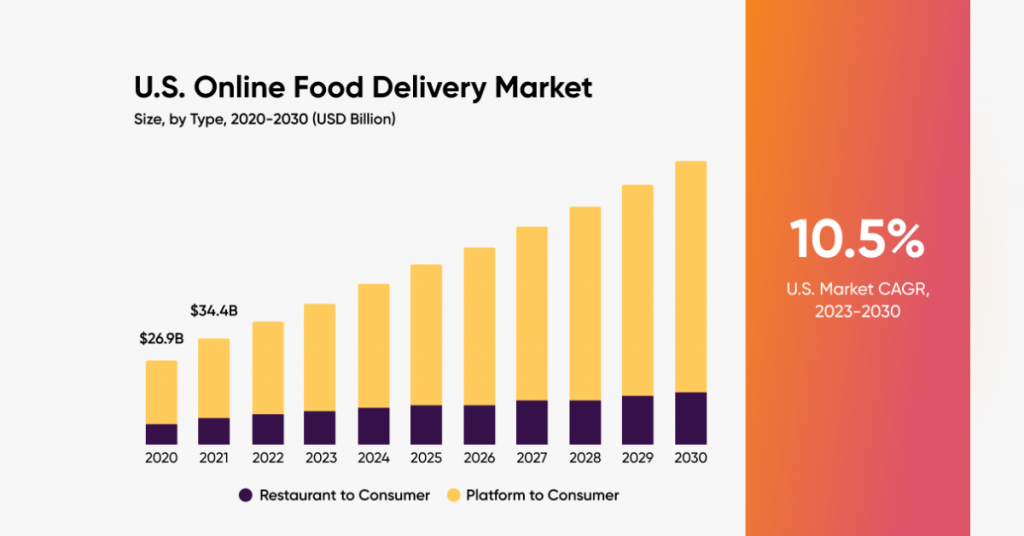
The food delivery industry has witnessed significant transformations:
- Global Growth: The online food delivery market is projected to reach $483.9 billion by 2032, growing at a CAGR of 12%.
Regional Insights:
- North America: Dominated by platforms like DoorDash and Uber Eats.
- Europe: Features a mix of local players like Deliveroo and global platforms.
- Asia: Rapid adoption with platforms like Zomato and Swiggy leading the market.
- Latin America: Emerging markets with increasing smartphone penetration and internet access.
Why is the Demand for Food Delivery Apps Increasing?
The market for food delivery apps has grown at an incredible rate in the past few years. This isn’t just a trend; it’s a major change in how people get food. There are a number of strong and linked causes that are causing this rise in demand:
1. Shifts in how people shop
People today are more willing to pay for convenience than ever before. Many people can’t cook at home every day anymore because they have busy job schedules, lengthier commutes, and more homes with two incomes. Food delivery apps are a great way for busy people to get meals without having to leave their homes. With only a few taps on their smartphone, they can order food. Users also want variety and customisation, which these platforms easily give them through curated menus, personalized recommendations, and deals that fit their needs.
2. The rise of delivery without contact
The COVID-19 epidemic changed what people demand from safety and hygiene in a big way. Contactless delivery, which used to be a luxury, became a need, which made millions of people try food delivery apps for the first time. People still prefer transactions with as little touch as possible, even after the world has returned to normal. Delivery applications are still meeting this need by giving users safer, clearer choices that let them track their orders in real time and give delivery instructions for doorstep drop-offs.
3. Restaurants have a competitive edge
For restaurants, especially small and medium-sized ones, working with delivery platforms makes it easy to grow their business right away. They don’t have to buy their own fleet or equipment; they can just link into an existing system that connects them to thousands of clients. This not only helps them reach more people and make more money, but it also gives them information on what customers like and how they act through analytics. Many restaurants have even switched to delivery-only models (cloud kitchens), using smartphone platforms as their only way to sell food.
4. The growth of digital payment systems
Digital wallets, UPI, and one-click payment alternatives are all quite popular now. This has made shopping online safer and easier than before. As mobile payments grow easier, people are more likely to utilize delivery applications often without having to deal with the hassle of cash purchases. Loyalty schemes, rebate discounts, and reward points all make people want to order again.
5. Urbanization and the spread of technology
As smartphones and the internet become more common in Tier 2 and Tier 3 cities, more people are going online, and meal delivery is generally one of the first things they do. People are moving to cities and getting better access to technology, which is bringing in more customers from outside of metro areas.
6. More services are being offered
Food delivery applications today can do more than just bring you food. A lot of platforms are branching out into grocery delivery, pet food, sweets, drinks, and even meal kits that are ready to cook. This extra usefulness is making these apps necessary for everyday living instead of just being useful sometimes.
Key Factors Influencing Food Delivery App Cost
Understanding the factors that affect the cost to make a food delivery app is essential for accurate budgeting:
1. App Complexity
- Basic Features: User registration, menu browsing, order placement, payment gateway integration.
- Advanced Features: Real-time GPS tracking, push notifications, AI-based recommendations, multi-language support.
2. UI/UX Design Complexity
- Basic Design: Standard templates with minimal customization.
- Custom Design: Tailored interfaces with unique branding elements and user-centric design.
3. Platform Choice
- Single Platform: Developing for either iOS or Android.
- Cross-Platform: Building for both platforms simultaneously using frameworks like Flutter or React Native.
4. Third-Party Integrations
- Payment Gateways: Integrating services like Stripe, PayPal, or local payment systems.
- Mapping Services: Utilizing APIs like Google Maps for location tracking.
- Other Integrations: Incorporating features like SMS gateways, email services, and analytics tools.
5. Security and Compliance Measures
- Data Protection: Implementing SSL encryption and secure data storage practices.
- Regulatory Compliance: Ensuring adherence to local laws and regulations, such as GDPR or PCI-DSS.
6. Development Team Location and Rates
- Onshore Development: Higher costs associated with developers in regions like North America or Western Europe.
- Offshore Development: Cost-effective solutions from regions like Asia or Eastern Europe.
7. Technology Stack Used
- Frontend Technologies: React Native, Flutter, Swift, Kotlin.
- Backend Technologies: Node.js, Python, Ruby on Rails, Java.
- Database Solutions: PostgreSQL, MongoDB, Firebase.
How to Estimate the Cost of a Food Delivery App?
When you want to know how much it will cost to make a food delivery app like DoorDash, you need more than just a rough number. You need to know a lot about your business goals, technological needs, and how you fit into the market.
Here’s how to break the cost to build a food delivery app in a smart way:
1. Making a full project scope
Begin by explicitly stating the app’s purpose, goals, and main features. A well-documented scope makes sure that everyone involved in the project, including the development team and stakeholders, knows what has to be done. Think about adding:
- Roles of users (consumer, restaurant, delivery worker, and admin)
- Ordering, paying, tracking, and leaving reviews are some of the most important features.
- Platforms for apps (iOS, Android, web)
- Preferences for UI/UX design
- Coverage area (local, national, or global)
A defined scope will help you avoid making guesses and keep the scope from growing during development, which will save you time and food delivery app cost in the end.
2. Looking into apps that are like yours
To learn about industry norms, look at prominent meal delivery apps like DoorDash, Uber Eats, Grubhub, or Zomato. Find:
- Feature sets that are necessary vs. pleasant to have
- Trends in user interfaces
- Benchmarks for performance
- Customer evaluations that point out problems or gaps
You may set realistic expectations for how well things will work and how easy they will be to use with this comparison. It also helps you find things that make your software stand out and could make it more useful.
3. Separating features into the MVP and the full version
Launch a Minimum Viable Product (MVP) first instead of building the whole software from scratch. An MVP merely has the basic functionalities that the program needs to work and get feedback from users. Some of the most important MVP features could be:
- Lists of restaurants
- Looking through the menu
- Ordering
- Basic payment and tracking
Once the MVP starts to get popular, you may add more advanced features like AI suggestions, group ordering, loyalty programs, and dynamic pricing. This step-by-step plan lowers your initial investment and the chance of losing money in the market.
4. Getting advice from experts in development
Hire meal delivery app developers or organizations that focus on mobile and online development. Tell them what your project is about and when you want it done so they can:
- Give precise cost estimates
- Give advice on the best technology stack
- Find more options that can save you money.
- To avoid starting from scratch, suggest third-party integrations.
An expert-led session can also help you find hidden expenditures like API subscriptions, cloud hosting, or security certifications.
5. Using Online App Cost Estimators
You can get a preliminary food delivery app cost estimation from a number of online tools by choosing features, platforms, and geographies. These calculators aren’t always right, but they are a good place to start when making a budget. Some of the most important variables you can enter are:
- How hard the app is to use
- Platforms that the target works on (Android, iOS, Web)
- How many displays there are and what roles users can play
- Integration needs, like payment gateways and map APIs
Estimate My App, BuildFire, and Cleveroad’s App Cost Calculator are some good tools to use.
Food Delivery App Cost Comparison: Based on Popular Brands
Developing an app similar to established platforms involves varying costs:
- Cost to build an app like DoorDash: $100,000 – $180,000
- Cost to build an app like Uber Eats: $90,000 – $130,000
- Cost to build an app like Grubhub: $80,000 – $150,000
- DCost to build an app like eliveroo: $70,000 – $140,000
These food delivery app cost estimation depends on various factors such as the complexity of the features, the technology stack used, and the geographical location of the development team. To build an app like DoorDash, with advanced features like real-time tracking, payment processing, and multi-language support, will obviously cost more than a basic app that only includes core functionalities.
If you’re planning to build an app like Uber Eats or DoorDash, consider breaking down the cost to make a food delivery app into different stages of development, such as:
- Planning and Research: This includes market analysis, creating project scope, and determining the features.
- Design and Development: Design custom interfaces, develop the backend, and integrate APIs.
- Testing and Launch: Testing the app for bugs, user acceptance testing, and deploying the app on app stores.
- Post-Launch Support and Maintenance: Regular updates, bug fixes, and adding new features after the app goes live.
Smart Tips to Reduce Food Delivery App Cost
Cost to build a food delivery app can be expensive, but there are several strategies you can adopt to reduce costs without sacrificing quality:
1. Prioritize Must-Have Features
Instead of launching a fully-loaded app with every feature, focus on the core functionalities first. This includes user registration, menu browsing, order placement, and payment processing. You can add advanced features like live tracking, AI-based recommendations, or voice search in later updates.
2. Leverage Open-Source Libraries and Tools
Using open-source libraries can significantly reduce the development cost, as it minimizes the need to code from scratch. Libraries for common features like chat functionality, user authentication, and payment gateway integration can be easily found.
3. Start with a Single Platform
Instead of building for both iOS and Android right away, start by developing for just one platform. This allows you to test the market and get feedback before investing in additional development. You can use cross-platform tools like Flutter or React Native to build for both platforms later without duplicating effort.
4. Hire Developers from Cost-Effective Regions
The location of your development team can have a significant impact on costs. Developers in North America or Western Europe tend to charge higher rates compared to those in regions like Eastern Europe, Asia, or South America. By hiring developers from cost-effective regions, you can save a substantial amount without compromising quality.
5. Use Scalable Cloud Infrastructure
Cloud platforms like AWS, Google Cloud, or Microsoft Azure provide scalable solutions that grow with your app. Instead of investing in expensive physical servers, you can scale up or down based on demand, which can help keep operational costs lower, especially in the early stages.
6. Design with Future Updates in Mind
Develop your app with future scalability in mind. Implementing features and building a robust architecture that can easily accommodate updates or additional features will save time and money down the road. This can include using modular design practices or implementing a flexible backend system.
Why Choose A3Logics to Develop Your Food Delivery App?
When it comes to developing a food delivery app, partnering with an experienced and reliable development company is crucial. A3Logics is a renowned food delivery app development company that specializes in creating custom solutions tailored to your business needs. Here’s why you should consider A3Logics:
- Expertise in Food Delivery App: A3Logics has extensive experience in developing food delivery apps with core functionalities and advanced features.
- End-to-End Development: From planning to post-launch support, A3Logics offers complete app development services.
- Scalable and Cost-Effective Solutions: By leveraging industry best practices and advanced technologies, A3Logics ensures that your app is scalable and future-ready while keeping development costs within budget.
- Global Reach: Whether you’re in North America, Europe, or Asia, A3Logics has the expertise to handle projects worldwide.
If you’re ready to develop a high-quality food delivery app, A3Logics is the right partner for you. You can also learn more about building an app like UberEats or DoorDash by checking out this blog post.
Conclusion
Developing a food delivery app is an investment that can yield significant returns in the rapidly growing food delivery industry. However, understanding the factors that contribute to the development cost is crucial to ensuring that the process is efficient and within budget. From basic features to advanced functionalities, the complexity of your app, the technology used, and the geographical location of your development team can all influence the overall cost.
By focusing on core features, leveraging open-source tools, and carefully choosing your development partner, you can reduce the cost of building your food delivery app without compromising on quality.
If you are considering launching your own food delivery platform, consulting professionals like A3Logics can help you make informed decisions and get a more tailored cost estimate for your specific requirements.